
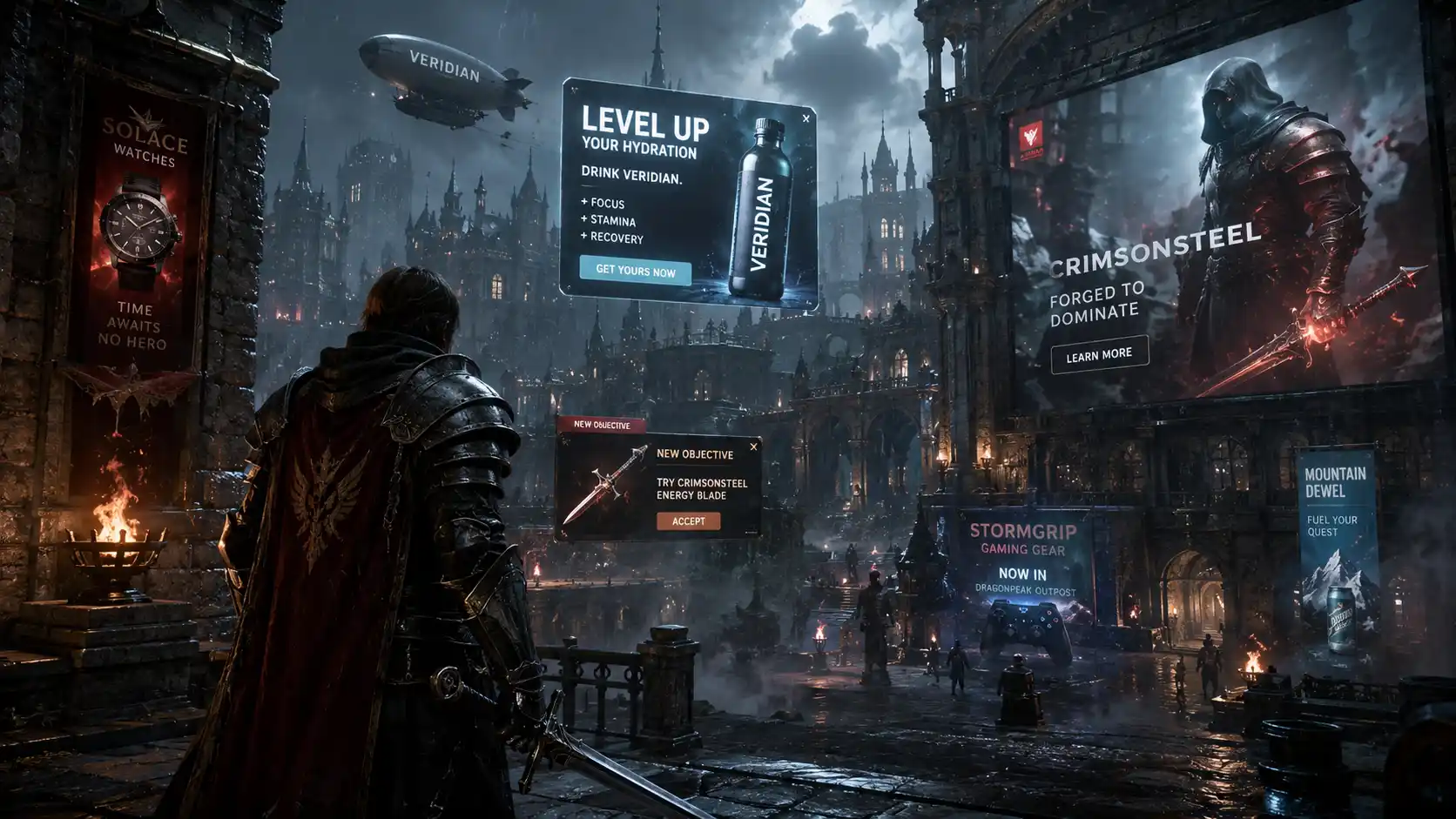
When people hear “ads in games,” they tend to imagine the worst version immediately: a boss fight paused by a soda commercial, a battle pass sponsored by car insurance, or some poor medieval fantasy RPG forced to explain why there is suddenly a glowing Coca-Cola bottle next to a cursed catacomb.
That nightmare is useful, but it is also a little misleading.
In-game advertising is not some distant future threat waiting for one reckless executive to flip the switch. It already exists, and in some genres it has existed for years. The real debate is not whether ads can enter games. They already have. The real debate is which kinds of ads feel natural, which kinds feel invasive, and whether publishers can resist turning every digital surface into ad inventory once the economics start looking tempting.
The First Problem Is Defining What an “Ad” Even Is
This gets slippery fast.
A real car brand in a racing game can feel like worldbuilding. Stadium signage in a sports game can feel authentic. A fashion collaboration in The Sims can feel like branded content, yes, but also like the sort of thing that naturally belongs there. EA is explicitly leaning into that logic with its new EA Advertising platform, which promises dynamic placements, branded content, stadium boards, overlays, and custom integrations that are supposed to feel native to the game world rather than stapled awkwardly on top of it.
Even older uses of real brands in games can absolutely be read as advertising, even when they are subtle. The line between “licensed realism,” “product placement,” and “advertising” is often less a hard boundary than a matter of context, payment, and player perception. A racing billboard feels normal because racing has billboards. A courtside logo in NBA 2K feels normal because real arenas are commercialized to death already. A Coke bottle in Elden Ring would feel deranged because it clashes with the internal logic of the world.
Check out my other article: AI and Humans: The Third Relationship
The Industry’s Best Argument for Ads Is Also Its Most Convenient One
The strongest pro-ad argument is affordability.
In The Game Business interview, Xbox chief strategy officer Matthew Ball said gaming has a “two-sided problem”: development costs are rising, while players also hate seeing higher prices on hardware, software, and microtransactions. He pointed to streaming, where ad-supported tiers have driven subscriber growth without eliminating premium ad-free options, and argued that ads could create cheaper on-ramps for people who “can’t afford, or wouldn’t try” certain gaming experiences.
That is the cleanest version of the pitch: ads are not there to ruin your game, they are there to subsidize access. A cheaper Game Pass tier, a lower-cost cloud tier, or some ad-supported version of a service could, at least in theory, expand the audience without forcing every player to swallow higher upfront prices. Ball later clarified that ads should be used to offer “more affordable alternatives” alongside ad-free options, and that interrupting gameplay would be a bad idea.
From a business perspective, this is not nonsense. If costs keep rising and players resist higher prices, publishers will keep searching for another bucket of money. Ads are one of the few obvious buckets left. That does not make the idea lovable. It just makes it legible.
The Best Case for Ads Is Realism, Not Revenue
The more convincing case for in-game ads is not actually “we need more money.” It is “this world already contains ads.”
Take-Two CEO Strauss Zelnick made that distinction pretty clearly. In his March interview, he said advertising can make sense in free-to-play games, and that some limited advertising in NBA 2K fits the “vernacular” because stadium ads are part of real sports. But he also said interstitial advertising in a game someone paid $70 or $80 for would seem “unfair.”
That is probably the most durable dividing line in the whole debate. If the ad strengthens the illusion of the world, players may tolerate it, or not even register it as advertising. If it exists purely because a monetization team noticed an empty surface, players will smell it immediately.
That is why racing and sports are the easiest genres for this stuff. Ubisoft’s Trackmania partnership with Anzu placed ads where you would expect them in a real race: alongside the track, above the course, in cinematic scenes, and in high-traffic areas. Ubisoft’s own communication director described the ads as adding realism, while Anzu emphasized that placement optimization and measurement improved over time.
The Anti-Ad Argument Is Not Just “Ads Bad”
Players do not hate ads only because ads are ugly. They hate them because ads usually signal a change in who the product is for.
A premium game is supposed to feel like something you bought. Once it starts behaving like an ad-supported surface, the relationship changes. Suddenly the game is not just serving your experience; it is serving an advertiser, a targeting system, or a monetization layer sitting one floor above the design team.
That is why “non-intrusive” is doing so much work in every corporate statement. EA says its ads are designed to “enhance, not disrupt” the experience. Ball says the question is not whether to “cram ads in everything.” Zelnick says premium interstitial ads would be unfair. Everybody understands that players can tell the difference between atmospheric signage and the feeling that a game has started renting out its soul.
And once players suspect that design decisions are being made for ad inventory rather than for play, trust goes downhill very quickly. A loading screen becomes suspicious. A menu panel becomes suspicious. A town square with lots of large flat walls suddenly looks less like art direction and more like future billboard zoning.
That may sound cynical, but the modern games business has earned that cynicism the hard way.
Technically, Yes, This Can Absolutely Happen
The short answer is that the infrastructure already exists.
EA did not merely say brands are welcome. It launched EA Advertising, complete with a proprietary ad server and SDK built into Frostbite, plus targeting and measurement capabilities that it says are privacy-safe and aligned with industry standards. It also described dynamic real-time placements in 3D sports simulations, including digital ad boards, scoreboards, and broadcast overlays.
That is not a vague future concept. That is ad tech.
The industry also has measurement standards for in-game advertising already. IAB and MRC guidance covers things like in-game viewability, polling intervals, SDK considerations, measurement differences across platforms, and how to count branded areas of interest inside 3D environments. In other words, this is not being treated as a novelty anymore. It is being treated like a formal media channel that needs standardized metrics.
So yes, technically this could happen at much greater scale. Games can already serve dynamic ad assets, measure whether they were seen, report impressions, and optimize placement. The harder question is not technical feasibility. It is where developers can put ads without destroying tone, immersion, or player goodwill.
The Technical Challenges Are Less About Rendering and More About Context
Putting an image on a virtual billboard is easy. Making it belong there is the real work.
Advertisers want visibility, measurement, and scale. Designers want consistency, mood, and control. Players want the world to feel coherent. Those goals only neatly overlap in a few genres. Sports games, racing games, and some urban live-service games are friendly terrain because ads already exist there in real life. A branded sideline board in a football game is almost invisible as a design intrusion. A branded shopfront in a near-future city can work if the art direction supports it.
But once you move into stronger authored fiction, things get awkward. Fantasy, horror, historical drama, and prestige single-player games are much harder to commercialize without creating tonal damage. That is why the Coke-in-Elden Ring example is funny: it instantly exposes the problem. The issue is not only immersion. It is authorship. Ads do not just decorate a world; they declare that some part of the world now answers to someone outside it.
And that gets even trickier with dynamic systems. If you are serving different ads by region, time, campaign, or audience segment, you are no longer designing one fixed world. You are designing a world with rotating commercial logic. Technically clever, perhaps. Artistically cursed, very possibly.
There Is Also a Data Problem Hiding Under the Floorboards
Ads are not just pictures. They are usually part of a measurement machine.
EA’s official pitch stresses targeting, campaign insights, accredited measurement, and privacy-safe collaboration. Those are normal words in advertising. They are also the sort of words that make players immediately wonder what exactly is being tracked, inferred, or optimized around them.
To be fair, “privacy-safe” does not automatically mean sinister surveillance. But ad-supported systems almost always create pressure to collect more performance data, understand attention better, and prove value to buyers. Even the IAB’s guidelines spend significant time on viewability, activity, device compatibility, and measurement mechanics because advertisers need confidence that their ads were actually seen.
That means in-game ads are not only an aesthetic question. They are a product, infrastructure, and analytics question. Once a company builds the pipes, it becomes much easier to use them more often.
And that is usually the moment players begin to feel the future breathing on their neck.
So Could This Actually Become Normal?
Yes, but unevenly.
The most likely future is not “every game becomes ad-supported.” It is a more selective split.
The first bucket is natural-fit advertising: sports, racing, some social platforms, some free-to-play ecosystems, and perhaps certain city-based or simulation-heavy games. This is the least controversial lane because brands can plausibly belong there. Trackmania already shows how that can work, and EA is clearly betting that sports games are prime ground for scaled ad inventory.
The second bucket is service-layer advertising: cheaper subscription tiers, cloud gaming offers, dashboard placements, pause-screen surfaces, loading-screen promotions, or ecosystem-level upsells. This is closer to Ball’s “affordable alternative” framing and much more plausible than hard gameplay interruption.
The third bucket is the one players fear most: ads in premium, fiction-heavy, full-priced games where the placement has no natural relationship to the world. That is the space where resistance will remain strongest, and even industry executives seem to know it. Zelnick’s “it would seem unfair” comment is revealing precisely because it acknowledges the social contract players think they are buying when they pay full price.
So yes, this can happen. Parts of it are already happening. But it probably will not arrive as one dramatic moment where games suddenly “get ads.” It will arrive the way most monetization changes arrive: gradually, by genre, by platform, by business model, and always with someone insisting it is being done very respectfully this time.
The Weirdest Part Is That Everyone Is Kind of Right
The pro-ad side is right that game economics are getting uglier, and that ad-supported options could lower prices for some players.
The anti-ad side is right that once advertising enters a medium more deeply, it rarely stops politely where it started. The incentive is always to scale.
The creatives are right that some genres can absorb ads naturally while others would be aesthetically poisoned by them.
And players are right to distrust language like “enhance, not disrupt,” because the games industry has an almost supernatural ability to take a limited monetization concept and see just how far it can be stretched before the subreddit catches fire. That last part is my inference, but I would not call it a reckless one. It follows pretty directly from the incentives the industry itself is now openly describing.
Final Thoughts
In-game advertising is no longer a hypothetical. It is already present in genres where branding feels structurally normal, and the technical stack to expand it is becoming more sophisticated and more standardized. EA is building the pipes. Xbox’s chief strategy officer is openly describing ad-supported affordability as a legitimate idea. Take-Two is signaling that premium interstitials would cross a line, while still accepting that some contextual advertising belongs in sports worlds.
So the real question is not whether ads will appear in games.
It is whether the industry can keep them in places where they make sense, or whether it eventually decides that every screen, menu, plaza, and pause state is just unrealized ad inventory wearing a fantasy costume.
A billboard at a racetrack is one thing.
A Coke bottle in Elden Ring is a declaration of war.


