
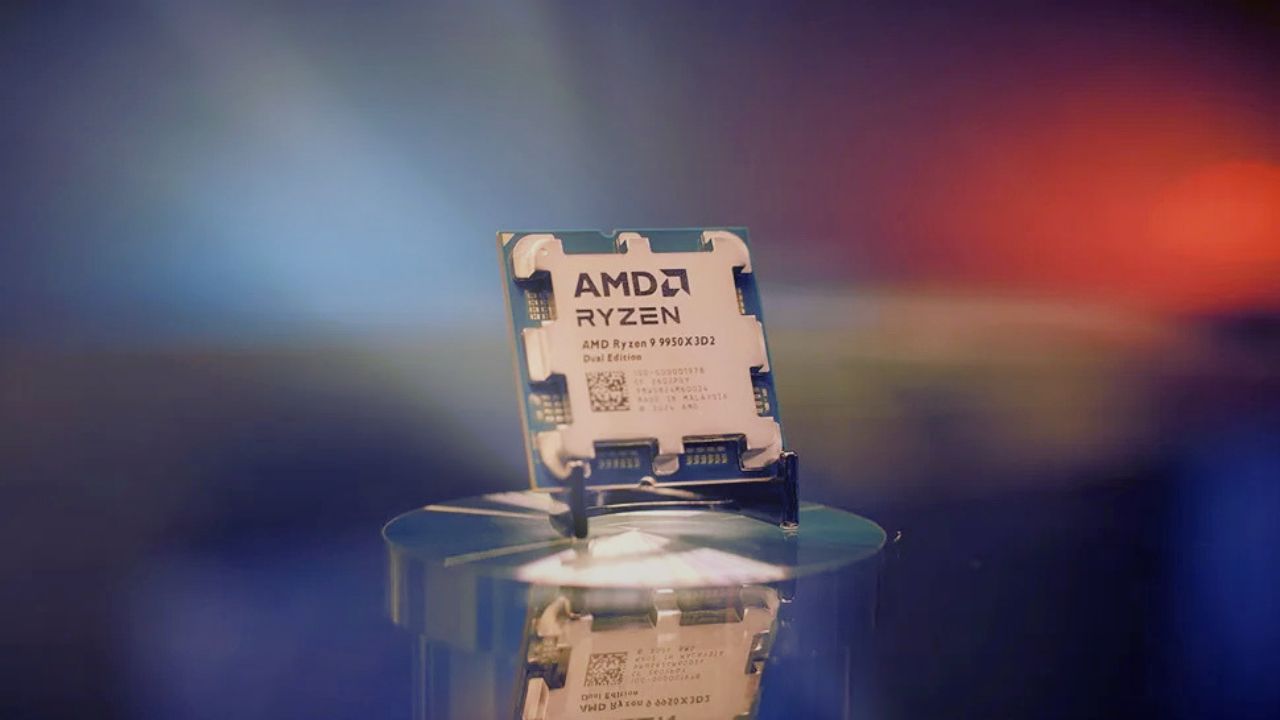
AMD has finally put a price tag on its upcoming Ryzen 9 9950X3D2 Dual Edition, and it is not exactly subtle. At $899, the chip lands around $200 above the original Ryzen 9 9950X3D launch price, which immediately tells you this is not a “great news for everybody” kind of product.
That pricing, paired with AMD’s own positioning, makes one thing pretty clear: the 9950X3D2 is less about chasing every last gaming frame and more about serving users who can actually put a huge pool of cache to work. In other words, this is a processor for people whose workloads are expensive enough to justify a processor that is, well, also expensive enough to justify a small sigh before checkout.
Launch Date and Upgrade Path Stay Friendly
The Ryzen 9 9950X3D2 is set to arrive on April 22, and there is at least one bit of good news for current AMD users: it will remain fully compatible with the AM5 platform.
That means existing AM5 owners will not need to swap out their motherboard or memory just to move up to this chip. In an era where platform transitions can feel like being charged admission three separate times, that continuity matters. AMD is still giving enthusiasts a reasonably painless upgrade path, even if the CPU itself is anything but budget-friendly.
The Big Change: 3D V-Cache on Both Chiplets
The headline feature here is not clock speed. It is not core count either. It is cache.
For the first time in AMD’s X3D lineup, the company is applying 3D V-Cache to both compute chiplets rather than confining it to a single CCD. That pushes total cache to 208MB, up from 144MB on the standard Ryzen 9 9950X3D.
That is a meaningful architectural shift.
In practical terms, more cache means the processor can keep larger chunks of frequently used data closer to the cores. For workloads that repeatedly hit the same datasets, that can reduce trips out to main memory, cut latency, and improve throughput. It is one of those upgrades that sounds abstract until your productivity app or simulation job suddenly stops acting like it is constantly waiting in traffic.
Same Zen 5 Core Layout, Higher Power Demands
Under the hood, the Ryzen 9 9950X3D2 keeps the familiar high-end formula:
- 16 cores
- 32 threads
- Zen 5 architecture
- 4.3 GHz base clock
- Up to 5.6 GHz boost
So no, AMD did not reinvent the CPU here. The main differentiator is the cache design, not a dramatic shift in raw compute layout.
What has changed is power. The chip carries a 200W TDP, which is higher than its predecessor and signals the obvious consequence of stacking more silicon and pushing a more ambitious cache configuration.
This is not the sort of processor you casually drop into a system with a “good enough” cooler and vague optimism. Anyone eyeing the 9950X3D2 will need to think seriously about thermal headroom, motherboard power delivery, and overall system balance.
Checkout my other article: The Death of the Gaming Keyboard
AMD Is Framing This as a Workstation Chip
Perhaps the most interesting part of the announcement is how AMD appears to be positioning the processor.
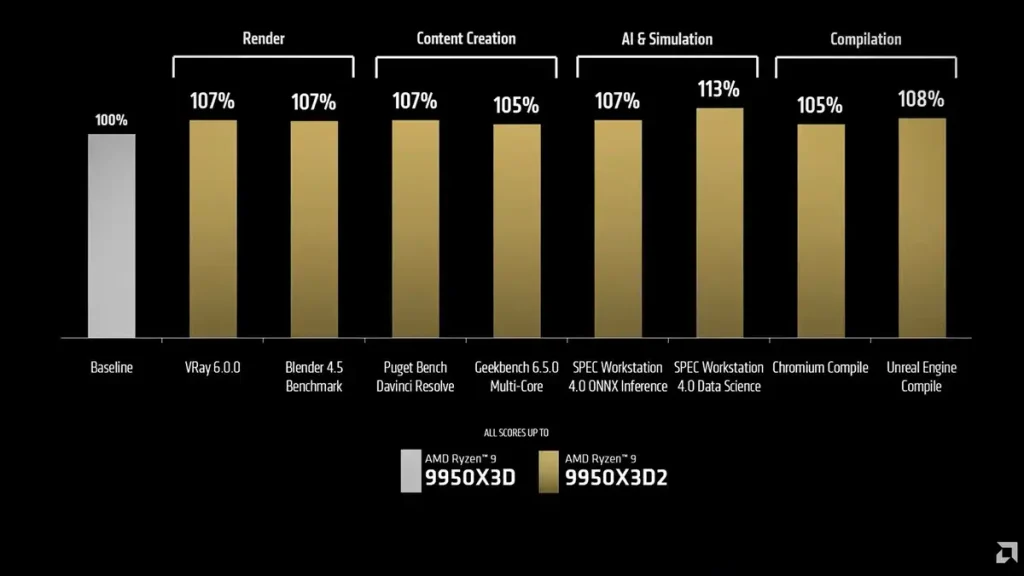
Rather than selling the 9950X3D2 as the next must-have gaming monster, AMD is leaning toward workstation and professional use cases. Internal performance claims point to moderate gains in content creation, data science, and related professional workloads, generally in the mid single-digit to low double-digit percentage range.
That makes sense. Extra cache is often most valuable in applications where large datasets are accessed repeatedly and predictably. Developers, researchers, creators, and certain technical users are far more likely to see the benefit than someone whose main benchmark is whether a game launches before they finish their coffee.
Gaming Performance May Be Less Exciting Than the Specs Suggest
Here is where things get less glamorous.
More cache sounds like an automatic gaming win, but past dual-CCD X3D chips have shown that reality is messier. Inter-chiplet communication can add latency, and that overhead can eat into the benefits of having more cache available in the first place.
So while the 9950X3D2 looks monstrous on paper, it may not translate into a dramatic gaming uplift over current X3D processors, especially models whose designs are already tuned around a single CCD for gaming efficiency.
That does not mean it will be bad for games. It just means the chip is unlikely to become the universally obvious choice for enthusiasts who care primarily about gaming. AMD seems to know that, which is probably why the company is not pretending this is the second coming of the gaming desktop.
What the $899 Price Really Says
The pricing tells the story as much as the specs do.
At $899, AMD is signaling that this chip is meant for buyers who see CPU cost as part of a broader productivity investment, not just a luxury gaming purchase. The extra cache, higher TDP, and workstation-oriented messaging all point in the same direction: this is a premium niche part for users with specific workloads that can exploit it.
For everyone else, especially gamers, the standard X3D lineup may still offer the better balance of performance and value. Spending extra for a giant cache pool only makes sense if your software can actually turn that into saved time or improved output.
Industry Insight: AMD Is Stretching X3D Beyond Gaming
What makes the 9950X3D2 interesting is not just the part itself, but what it says about AMD’s strategy.
X3D started out as a gaming-focused differentiator, a clever way to squeeze more performance out of cache-sensitive titles. Now AMD is testing how far that technology can stretch into workstation territory. That is a smart move. The high-end desktop market is crowded with buyers who are willing to pay for meaningful specialization, and cache-heavy designs offer AMD a way to stand out without changing the core architecture every five minutes.
The risk, of course, is pricing the chip into a very narrow corner. If real-world gains end up looking merely decent rather than transformative, the 9950X3D2 could become one of those technically fascinating products that everyone discusses and relatively few people actually buy.
Also read: USB Explained: The Universal Standard That Isn’t
Final Thoughts
The Ryzen 9 9950X3D2 looks like a bold experiment in pushing AMD’s 3D V-Cache design further than before. With 208MB of total cache, dual-chiplet cache stacking, and full AM5 compatibility, it has the makings of a serious tool for specialized workloads.
But at $899 and 200W, this is not a mainstream slam dunk. It is a targeted high-end part that will live or die by how well professional applications can use that extra cache.
For workstation users, it could be a very compelling upgrade. For gamers, it may end up being more of a fascinating engineering exercise than a must-buy. Sometimes bigger specs really do change everything. Sometimes they just make the price tag bigger too.
