
ASUS launched its ROG Equalizer cable with a pretty clear promise: better load balancing than standard 12V-2×6 connectors. On paper, that sounds exactly like what high-end GPU owners want to hear, especially after the endless drama around power connectors, melted plugs, and the general sense that modern graphics cards now demand the kind of electrical diplomacy once reserved for industrial equipment.
But according to new testing from Der8auer, the ROG Equalizer may not be solving the problem at all. In fact, it may be making current distribution less consistent than some regular 12V-2×6 cables.
That is not the kind of result you want from a product literally named “Equalizer.”
The Promise: Better Current Distribution
The pitch behind the ROG Equalizer was simple enough. ASUS positioned it as a more advanced 12V-2×6 cable designed to improve how current gets distributed across the connector pins.
That matters because uneven current load is one of the big concerns with these high-power GPU connections. In an ideal world, the load spreads evenly. In the real world, some pins end up carrying more than others, which is where heat, wear, and reliability concerns start creeping into the conversation.
So when a premium cable claims to improve balancing, the expectation is pretty obvious: less variance, less stress, better safety margin.
Der8auer’s findings point in the opposite direction.
What Der8auer Found on the RTX 5090
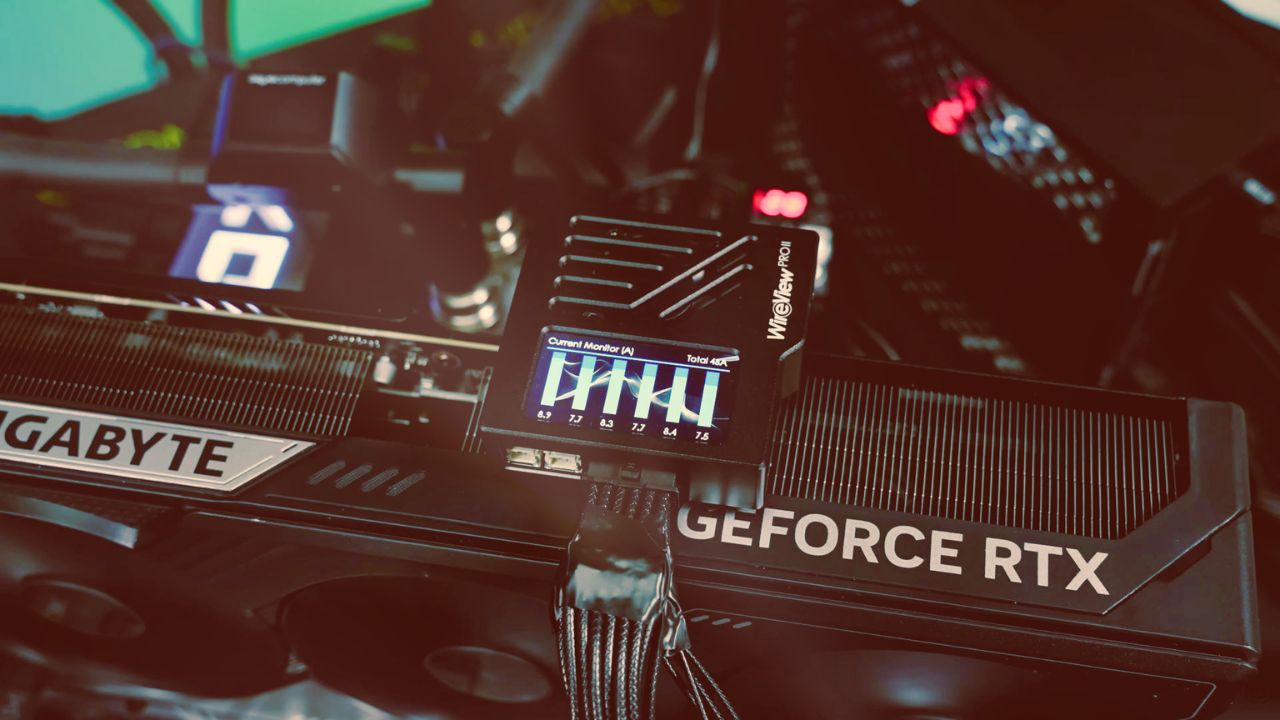
Using an RTX 5090 and monitoring the connection with the WireView Pro II, Der8auer found that current distribution on the ROG Equalizer was not especially equal at all.
Worse, it apparently behaved inconsistently from one reconnection to the next. Each time the cable was unplugged and plugged back in, the load distribution could shift. In some cases, the difference between the most heavily loaded pin and the least loaded pin reached as much as 4A.
That is a pretty ugly number for a cable marketed around balancing.
At that point, the setup was uneven enough for the WireView Pro II itself to raise warnings about the load differences. For a premium enthusiast product, that is not just disappointing. It is the sort of result that makes the entire design philosophy look suspect.
The “Comb” Wasn’t Just a Comb
The most interesting part of the story is what seems to be causing the issue.
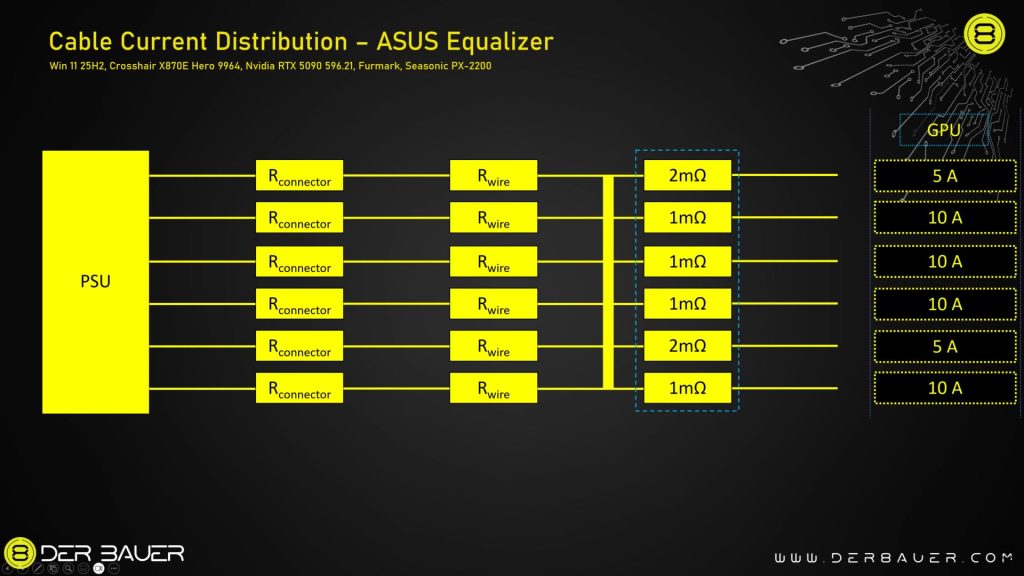
What looked like a simple cable comb on the ROG Equalizer was apparently not just there for cable management or aesthetics. According to Der8auer’s investigation, it was actually acting as an electrical bridge.
And that bridge introduced additional resistance into the setup.
That matters because once you add extra resistance into a power delivery path, you are no longer helping balance current. You may be doing the exact opposite. Der8auer previously illustrated that this bridge could add around 1 to 2 milliohms of extra resistance on top of what is already introduced by the PSU-side connector, GPU-side connector, and the wire itself.
That may sound tiny, but in high-current scenarios, tiny electrical penalties stop being tiny very quickly.
Remove the Bridge, Improve the Balance
To test whether that bridge was the problem, Der8auer removed it.
More specifically, he disconnected the bridge linking the top row of wires, then another insulated bridge joining the bottom row, and isolated the wires before retesting on the same setup.
The results improved significantly.
After the modification, the highest-load pin was carrying 8.9A, while the lowest-load pin carried 7.5A. That is still not perfect balance, but it is a lot better than seeing swings of up to 4A between pins.
Which creates an awkward conclusion for ASUS: once the Equalizer’s special bridging design was taken out of the equation, the cable reportedly performed better.
That is not exactly a glowing endorsement of the “equalizing” hardware.
A Smarter Design, or Just More Hardware?
This is the broader lesson buried inside the testing. In power delivery, adding extra design complexity does not automatically improve real-world performance.
Sometimes the industry seems unable to resist the urge to make things look more engineered, more premium, more specialized. But electrons are not impressed by branding, and they are not handing out bonus points for gold accents and clever naming.
If the added structure introduces more resistance, more stiffness, and less predictable current sharing, then the “advanced” design may simply be extra hardware standing in the way of a cleaner electrical path.
That seems to be the uncomfortable implication here.
The Other Problems: Stiffness and Contact Materials
Der8auer also pointed out a few practical downsides beyond current imbalance.
One is cable stiffness. The bridge makes the ROG Equalizer more rigid and reduces flexibility near the connector. That means users may need more clearance in their cases, which is never ideal in modern GPU setups where space is already a luxury item.
The other issue is the choice of contact plating.
The ROG Equalizer uses gold-plated pins, while most standard 12V-2×6 cables use tin-plated pins. On the surface, gold plating sounds like the premium option, because of course it does. But if the GPU-side connector is tin-plated, then mixing contact materials may not actually be beneficial.
According to Der8auer’s explanation, that mismatch could worsen connector wear and raise oxidation-related concerns over time. So even the supposedly premium material choice may come with trade-offs that are less glamorous than the marketing suggests.
Why This Matters Beyond One Cable
This is not just about one ASUS accessory. It speaks to a broader problem in the PC hardware space: premium solutions are often sold as engineering upgrades before enough real-world validation exists to prove they actually improve anything.
Enthusiast buyers are especially vulnerable to this because they are already primed to spend more for anything that promises better thermals, better stability, or better long-term reliability. A cable called “Equalizer” from a major gaming brand fits that script perfectly.
But if third-party testing shows worse balancing than conventional alternatives, then the premium pitch starts to collapse.
And once that happens, the product stops looking like a fix and starts looking like an expensive complication.
The Industry Problem With 12V-2×6 Still Isn’t Going Away
The deeper issue here is that the 12V-2×6 ecosystem still feels like a connector standard that cannot stop generating caveats.
Every new tweak, every revised cable, every “improved” implementation seems to come with another round of fine print. Better insertion. Better thermals. Better contact. Better balancing. Until, inevitably, somebody tests it and the answer is once again: well, sort of.
That does not inspire confidence.
At this point, what users really want is boring reliability. Not another premium add-on that may or may not improve things depending on resistance paths, reconnect cycles, contact plating, and how much room they have left in the case.
Final Thought
ASUS’s ROG Equalizer was supposed to be a cleaner answer to uneven current distribution on 12V-2×6 cables. Der8auer’s testing suggests it may actually be worse than standard cables in some scenarios, with the cable’s bridging design adding resistance instead of meaningfully improving load balance.
Ironically, removing the Equalizer’s special bridge seems to make it behave more like the thing it was supposed to outperform.
That is a tough look for a premium cable, and a useful reminder that in PC hardware, “more engineered” and “better” are not always the same thing.
Sometimes the smartest power delivery upgrade is not the fanciest solution. It is the one that gets out of the way.
