
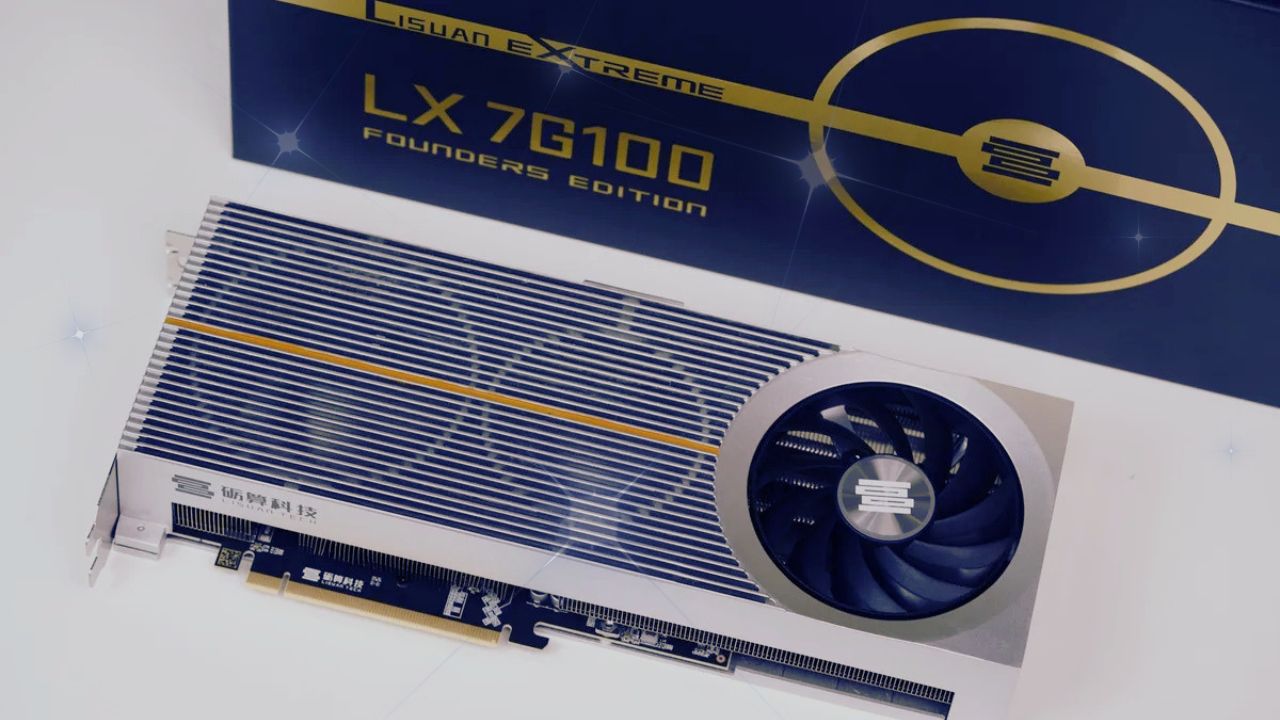
You would think a new graphics card needs killer benchmarks to make a splash. Apparently not.
Chinese GPU startup Lisuan Tech has reportedly sold out more than 30,000 preorders for its LX 7G100 in just 48 hours, despite early reviews painting a fairly unromantic picture of its actual gaming performance. On paper, this was supposed to be a challenger to Nvidia’s GeForce RTX 4060. In practice, it seems to land much closer to an RTX 3060-class product. And yet, customers lined up anyway.
That makes the LX 7G100 interesting for reasons that go well beyond frame rates. This is less a story about raw performance and more a story about market appetite, domestic branding, and a GPU industry where “good enough” plus novelty can still move serious volume.
Check out my other article: AI-Generated Video Sounds Efficient. Reality Is More Expensive
The Specs May Be Modest, but the Demand Was Not
Lisuan Tech priced the LX 7G100 at around $485 in China, and with over 30,000 units spoken for through preorders, that translates to more than $14.5 million in advance sales. For a new entrant in the graphics card business, that is not just a respectable debut. That is a very loud entrance.
The card itself has not exactly rewritten the laws of GPU physics. Lisuan Tech positioned it as an RTX 4060 rival, but independent testing suggests it performs closer to the older RTX 3060. That puts it one generation behind the target it was aiming at, and well behind the newer RTX 5060 family now shaping the mainstream market.
Normally, that kind of mismatch between promise and delivery would be a problem. In this case, it barely seems to have slowed momentum.
Why Buyers Showed Up Anyway
This is the part that makes the launch fascinating.
Consumers are clearly responding to more than just benchmark charts. Lisuan Tech’s early success suggests there is real demand for an alternative to the familiar Nvidia-AMD duopoly, especially in China, where interest in domestic hardware brands has become a much bigger factor.
There is also the simple power of curiosity. PC enthusiasts love a new contender, even when the first punch lands somewhere below heavyweight class. The LX 7G100 may not be the fastest card in its segment, but it is different, and in a hardware market that often feels like the same three SKU stacks wearing slightly different jackets, different can sell.
In other words, hype did not beat performance. It beat the usual rule that performance is the only thing that matters.
A Founders Edition Play Straight Out of Nvidia’s Handbook
Lisuan Tech also showed a surprisingly sharp instinct for launch theater.
The company rolled out a Founders Edition version of the LX 7G100, borrowing a very familiar strategy from Nvidia’s own playbook. This first batch was limited to 1,000 units, with each card individually numbered and signed by co-founder and co-CEO Xuan Yifang.
That batch disappeared almost immediately.
A second wave of Founders Edition cards is now set to ship on June 18, which gives the launch a collector-style premium feel that startups do not usually get to enjoy this early. It is a smart move. If you cannot win the benchmark war yet, you can still win attention, and attention has a funny habit of turning into revenue.
Lisuan Tech Is Already Expanding Beyond Gaming
The LX 7G100 is not the company’s only play.
Lisuan Tech says June 18 will also mark the arrival of two additional products:
LX Pro
A model aimed at professional engineering workloads
LX Ultra
A variant designed for cloud computing applications
The company is also working on an LX Max card intended for creative professionals, although that launch timeline is still unclear.
This broader lineup matters because it suggests Lisuan Tech is not trying to survive as a one-card curiosity. It wants to build an actual GPU portfolio across gaming, workstation, and infrastructure markets. That is a much harder game, but also the one that matters if the company wants to become more than a temporary headline.
The Price Is Awkward, but Apparently Not Fatal
One of the most eyebrow-raising details here is pricing.
At roughly $485, the LX 7G100 is being sold more like a GeForce RTX 5060 Ti 16GB-class product, even though its real-world performance appears closer to an older RTX 3060. That is not exactly an irresistible value pitch.
And yet, the sales happened.
That tells us one of two things. Either buyers are willing to pay a premium for the novelty and symbolism of a domestic GPU alternative, or Lisuan Tech successfully captured the launch window with strong messaging and scarcity tactics. Most likely, it is both.
Plenty of enthusiasts claim they only care about price-to-performance ratios. Then a limited-edition GPU signed by the founder shows up and suddenly spreadsheets become optional.
A Startup With Veteran DNA
Lisuan Tech may be new, but its founders are not newcomers to graphics.
The company was founded in 2021 by Xuan Yifang, Kong Dehai, and Niu Yixin, all veterans with experience at the now-defunct S3 Graphics. That background does not guarantee success, of course, but it does help explain how the company managed to move from startup status to a commercially viable gaming GPU in a relatively short period.
Even if the LX 7G100 lands below the level Lisuan Tech originally advertised, getting a competitive graphics product into the market at all is no small achievement. GPU development is brutally complex, hilariously expensive, and generally unforgiving to anyone without scale.
So yes, performing around two generations behind the cutting edge is not ideal. But for a first serious product, it is still a foundation.
What This Means for the GPU Industry
The most important takeaway here is not that Lisuan Tech has beaten Nvidia or AMD. It has not.
The real takeaway is that there is room in the market for a third story, especially when that story taps into local demand, national tech interest, and consumer fatigue with the usual giants. The LX 7G100 proves that buyers are willing to support a new GPU brand even when the numbers are merely decent rather than disruptive.
That should get the attention of the broader industry.
Because once a company proves it can sell tens of thousands of units on momentum alone, the next phase becomes much more dangerous for incumbents. If Lisuan Tech improves performance, tightens pricing, and keeps building out its software and ecosystem, then this stops being a curiosity and starts becoming a real strategic development.
Finally
Lisuan Tech’s LX 7G100 is not a benchmark king. It is not a category-defining value card either. But it may be something more important for the long term: proof that the GPU market is hungry for fresh blood.
Selling 30,000-plus units in 48 hours with lukewarm reviews is not normal. It is a sign that enthusiasm, branding, and the promise of an alternative can carry enormous weight, especially in a market that has felt locked down for years.
For now, the LX 7G100 looks like a hype-driven success. The real question is what happens when Lisuan Tech has to follow it up with something even better.
That is where the fairy tale either turns into a business—or into just another flashy launch with a very short afterlife.
