
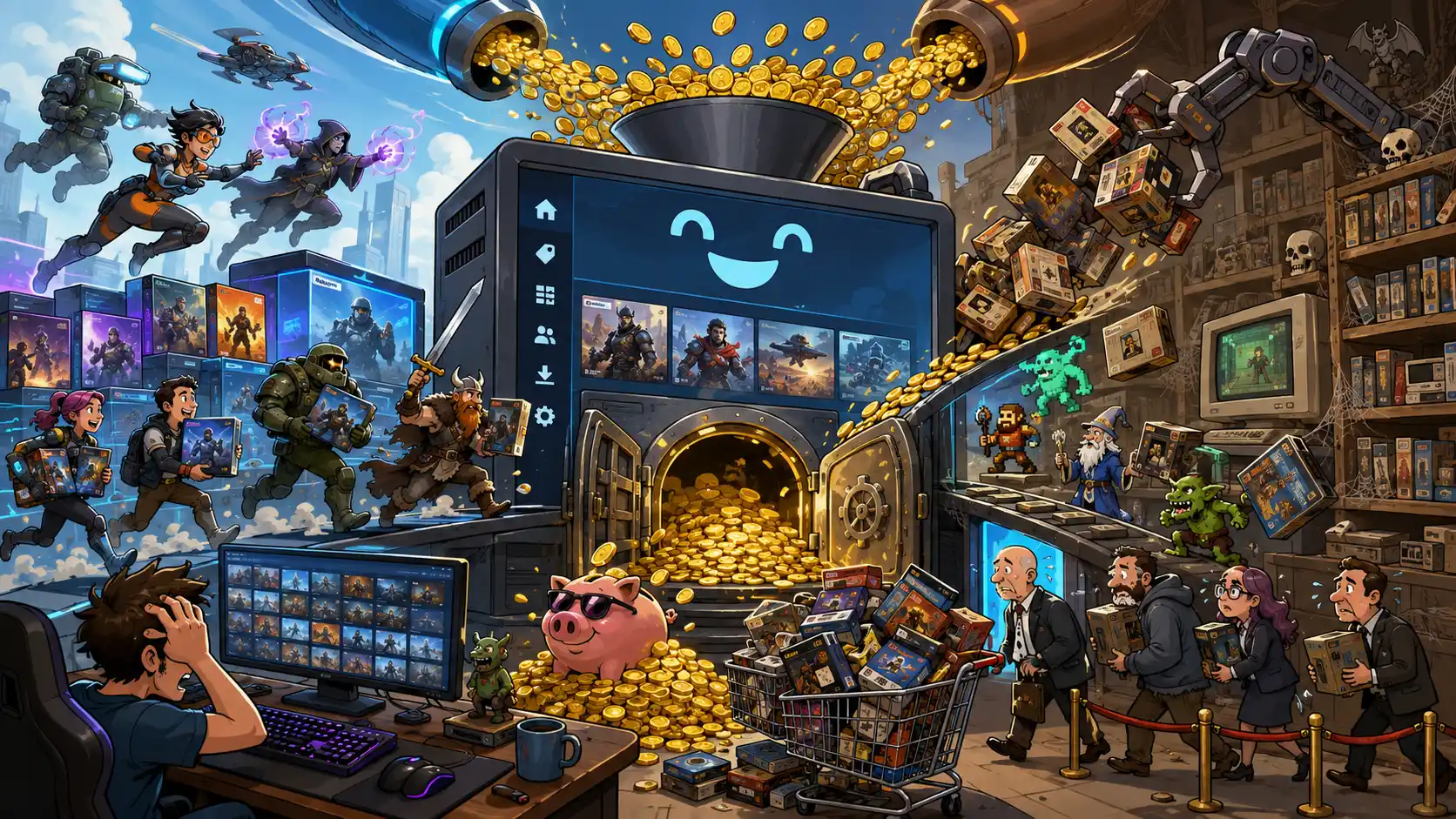
The videogame industry is currently performing one of its favorite magic tricks: generating more money than ever while repeatedly insisting that everyone making the games must be fired immediately.
Studios are closing. Projects are being cancelled. Developers are being laid off by the thousands. Executives keep appearing in carefully recorded videos to explain that the company had to make “difficult decisions,” usually from an office containing furniture worth more than an entire indie studio.
And yet, somewhere inside Valve’s headquarters, Steam is quietly printing money like a central bank run by people who communicate exclusively through patch notes.
According to estimates from Alinea Analytics, games on Steam generated $11.1 billion in gross revenue during the first half of 2026. That makes it the biggest six-month period in Steam’s history.
The figure was reportedly 14.5% higher than the first half of 2025 and even 8% above the second half of last year—which is especially impressive because the final six months normally include major holiday releases, seasonal discounts, and millions of people buying games they will absolutely play after finishing the other 146 titles in their backlog.
Any day now.
But Steam’s record revenue is not interesting simply because the number is large enough to make an accountant briefly experience human emotion.
The more revealing detail is that only 21% of Steam’s revenue during the first half of 2026 came from games released this year. That means nearly four-fifths came from older games.
Steam is not merely selling the future of PC gaming. It is continuously reselling its past. And that might be the real reason nobody can seriously challenge it.
Also read: Esports Has 400 Million Gen Z Fans and a Business Model That Still Barely Works
Steam Is Not a Store Anymore
Calling Steam a digital game store is technically correct in the same way that calling Google a website is technically correct.
Yes, Steam sells games.
It also manages libraries, cloud saves, multiplayer connections, user reviews, forums, mods, screenshots, achievements, wishlists, regional payments, refunds, update distribution, community events, and the ancient PC gaming ritual of opening a launcher with the intention of playing something before spending 40 minutes browsing discounts instead.
For many players, Steam is not one application among many. It is simply where PC games exist.
The launcher has become so deeply embedded in the experience that buying a game somewhere else can feel less like shopping at another store and more like importing furniture from a neighboring country.
You can do it. It may even be cheaper. But now there are extra forms, another password, and a strange launcher that starts automatically every time Windows wakes up.
Steam’s greatest achievement is not that it convinced people to buy digital games.
It convinced them that their game library should be permanent.
A physical console collection can be scattered across shelves, boxes, storage rooms, or whichever relative borrowed a game in 2011 and developed sudden memory loss.
A Steam library follows the player from one PC to another. A game purchased fifteen years ago can still be downloaded today, assuming its publisher has not replaced the original version with a remaster that somehow looks worse and runs at half the frame rate.
This permanence changes the economics of games. A title no longer has one commercial life. It can have several.
Old Games No Longer Die. They Just Wait for a Discount
Traditionally, games made most of their money near launch.
A new release arrived, occupied physical store shelves, received a marketing campaign, sold for several months, and was eventually pushed aside by newer games with larger numbers in their titles.
Digital distribution removed the shelf-space problem.
Steam can stock nearly everything forever. It does not need to remove a ten-year-old RPG to make room for this year’s open-world crafting game where the player punches trees and gradually develops administrative responsibilities.
As long as an older title still runs—and sometimes even when it barely does—it can continue generating revenue.
A sequel can revive interest in the original. A television adaptation can send thousands of new players toward an old franchise. A major patch can bring back former users.
A successful mod can extend a game’s lifespan by years. A YouTuber can upload a video titled something like “This Forgotten 2017 Game Is Better Than Every Modern AAA Release,” and suddenly the servers are full again.
Then there are Steam sales, where a game that has sat untouched on someone’s wishlist for four years finally becomes irresistible after dropping from $39.99 to $7.99.
Nobody needed it yesterday. At 80% off, however, not buying it would be financially irresponsible.
This is the strange psychology that powers Steam’s back catalog. Players are not only buying games they want to play now. They are buying the possibility of becoming the kind of person who will play them later.
Steam monetizes aspiration, nostalgia, curiosity, peer pressure, and the belief that next weekend will somehow contain 47 hours.
The Back Catalog Is Steam’s Real Competitive Moat
Steam’s competitors have often approached the market with seemingly reasonable plans.
Offer exclusive games. Give developers a better revenue split. Spend large amounts of money acquiring users.
Launch with a minimalist interface because apparently basic features such as reviews and shopping carts are decadent luxuries that must be earned slowly.
On paper, these strategies can work.
The problem is that Steam’s advantage is no longer just pricing, selection, or individual features. It is accumulated history.
Millions of players already have years—or decades—of purchases attached to their accounts. Their friends are there. Their wishlists are there. Their achievements are there. Their mods are there. Their screenshots from 2014, which seemed artistically important at the time, are also there.
Every year Steam remains dominant, the cost of leaving becomes slightly higher. This is what economists call a network effect. Normal people call it, “All my stuff is already here.”
A competitor can copy Steam’s storefront design. It can offer cloud saves. It can build forums, reviews, achievements, social tools, and mod support.
What it cannot easily copy is twenty years of consumer behavior.
Steam’s moat is not a single wall. It is millions of tiny conveniences piled on top of one another until switching platforms feels like moving house because another neighborhood offered a slightly nicer mailbox.
Publishers Tried to Leave Steam. The Customers Mostly Stayed
Major publishers have spent years attempting to reduce their dependence on Valve. From their perspective, the logic was obvious.
Why give Steam a percentage of every sale when they could build their own launcher, sell directly to customers, collect the data, control the ecosystem, and keep more of the money?
It was the classic corporate dream: eliminate the middleman and become the middleman yourself.
Electronic Arts pushed Origin. Ubisoft promoted Ubisoft Connect. Bethesda launched its own platform. Activision kept major PC releases on Battle.net.
For a while, every large publisher seemed determined to create another launcher. PC gamers responded by creating a folder full of launcher shortcuts and resenting every single one.
The publishers’ mistake was assuming that Steam was merely a payment processor. It was not.
Steam was where the audience already lived.
A publisher can keep a larger percentage of each sale on its own store, but that advantage becomes less exciting when fewer people want to purchase there.
Keeping 100% of a smaller number is one of those ideas that looks magnificent in a PowerPoint presentation right before reality enters the meeting without an appointment.
This is why several publishers eventually returned to Steam. They did not suddenly fall in love with Valve’s platform fee. They simply discovered that customer convenience is not an optional feature.
Gamers generally do not care about a publisher’s distribution strategy. They want to click “Buy,” download the game, and complain about shader compilation as efficiently as possible.
Steam helps them do that in one familiar place.
New Games Still Matter, but Steam Does Not Depend on Them
None of this means new releases are becoming irrelevant.
Major launches still produce enormous revenue, attract new users, and dominate public attention. According to Alinea Analytics, the biggest new games on Steam during the first half of 2026 included titles such as Forza Horizon 6, Resident Evil Requiem, Crimson Desert, Slay the Spire 2, and Subnautica 2.
New blockbusters remain essential to the platform. But Steam’s strength is that it does not need every new blockbuster to succeed.
A publisher may depend heavily on two or three major releases in a financial year. If one is delayed, underperforms, or launches in a technical condition normally associated with archaeological ruins, the entire company can miss its targets.
Steam’s risk is spread across almost everything.
A new AAA game sells ten million copies? Steam gets paid.
An indie co-op game becomes a viral sensation because four people can scream at one another while transporting furniture? Steam gets paid.
A twelve-year-old strategy title launches another expansion featuring three factions and a spreadsheet disguised as diplomacy? Steam gets paid.
A publisher discounts its entire catalog because the fiscal quarter ends in nine days? Steam gets paid.
Valve does not need to predict exactly which game will become successful. It owns the shopping mall. The tenants can fight over foot traffic.
Higher Prices Are Helping, Obviously
Part of Steam’s revenue growth has a very simple explanation: games cost more now.
Major releases are increasingly launching at higher prices. Premium editions frequently arrive with early access, cosmetic bonuses, season passes, soundtracks, digital art books, and other items created to answer the important question: “How much extra will someone pay to play this game on Thursday instead of Monday?”
Downloadable content, microtransactions, expansion packs, and in-game purchases also increase the amount of money each successful title can generate.
So yes, Steam’s gross revenue is rising partly because the average customer is being charged more.
Economics remains stubbornly committed to mathematics. But higher prices alone cannot explain the long-term expansion.
Steam’s annual gross game revenue reportedly grew from approximately $5.5 billion in 2017 to around $20 billion in 2025. That is not merely inflation wearing a gaming headset.
It reflects Steam’s growth across more countries, more currencies, more genres, more publishers, and more types of games.
PC gaming itself has also become more accessible and mainstream. Gaming laptops, handheld PCs, free-to-play titles, indie development tools, regional payment options, and international publishing have expanded the potential audience far beyond the traditional image of someone assembling a desktop tower large enough to influence local weather patterns.
Steam has positioned itself at the center of that expansion. Whenever the PC market grows, Valve is standing nearby with a payment page.
Steam Has Turned Games Into Long-Term Assets
The most important shift here is that games on Steam increasingly behave less like temporary products and more like long-term commercial assets.
A well-maintained title can keep selling for years. A live-service game can generate recurring spending. A strategy game can release expansions indefinitely, or at least until its DLC page requires its own search engine.
An RPG can return to the charts whenever a sequel, remake, adaptation, or controversy brings the franchise back into public discussion. An indie game can enjoy multiple waves of attention rather than one brief launch window.
This changes how publishers should think about their catalogs.
Older games are not merely finished products stored in a digital warehouse. They can be revived, bundled, updated, repackaged, remastered, discounted, or connected to newer releases.
Sometimes publishers understand this and carefully preserve their games. Other times, they remove the original version from sale, release an inferior replacement, shut down important features, and act surprised when customers react poorly.
Managing a back catalog requires patience, maintenance, and basic respect for preservation. These traits are not always abundant in an industry where five-year plans are frequently rewritten before lunch.
Still, Steam gives older games a commercial environment where preservation can be profitable. That may ultimately do more for game longevity than all the executive speeches about honoring beloved franchises.
Gross Revenue Is Not Valve’s Actual Revenue
There is an important distinction behind the $11.1 billion headline.
The figure refers to estimated gross revenue generated by games sold through Steam. It is not the amount Valve personally carried home in a wheelbarrow.
Developers and publishers receive the majority of the money, while Valve keeps its platform share after adjustments such as taxes, refunds, and chargebacks.
Steam’s standard revenue cut is commonly associated with 30%, although the percentage becomes lower for games that reach certain high revenue thresholds.
Even with those qualifications, Valve’s position remains absurdly strong.
The company does not need to fund the development of every title sold on Steam. It does not need to employ every team, own every franchise, or absorb every production failure.
Developers take the creative risk. Publishers take the financial risk. Valve maintains the infrastructure and collects a percentage when the experiment works.
It is a beautiful business model, provided you are Valve. The platform enjoys the diversification of owning thousands of games without the minor inconvenience of actually making thousands of games.
A Record Steam Does Not Mean a Healthy Industry
Steam’s record revenue might appear to suggest that the videogame business is thriving.
At the platform level, it probably is. At the studio level, the picture is much uglier.
The industry can generate enormous total revenue while individual companies remain unstable, developers face layoffs, and studios struggle to survive.
The money is not distributed equally.
A small number of successful games can generate a huge percentage of total spending. Established franchises benefit from recognition, marketing budgets, and large communities. Live-service giants keep players engaged for years, reducing the time and money available for everything else.
Meanwhile, thousands of games launch on Steam every year and immediately vanish into the algorithmic mist.
Steam has lowered the barrier to distribution, but it has not removed the barrier to attention.
Anyone can put a game on the platform.
Convincing people to notice it is the part that requires marketing, community building, strong reviews, creator coverage, timing, luck, and possibly an unexplained outbreak of internet enthusiasm.
The result is an ecosystem where Steam can become more profitable even while many developers become less secure.
A growing marketplace does not guarantee that every merchant inside it is doing well.
The casino can have its best year ever while most players leave with lighter pockets and a promotional keychain.
Steam’s Biggest Advantage Is That It Does Not Need to Pick Winners
The modern videogame business is built on enormous uncertainty.
Development budgets are rising. Production cycles are getting longer. Marketing costs are increasing. Players have more choices than ever and less patience for unfinished releases.
Publishers must decide which projects to fund years before knowing what audiences will want.
Console companies must invest in hardware, exclusives, subscriptions, and ecosystems.
Developers must spend years building something that may launch directly between two larger games and disappear faster than a corporate promise after an acquisition.
Steam avoids much of this risk.
Valve does not need to know whether the next major trend will be extraction shooters, survival crafting, cozy farming, roguelikes, social horror, or a genre where eight players operate a deeply unsafe restaurant.
It only needs those games to launch on Steam. This is the platform’s true power. Valve does not have to choose the winners. It merely charges admission to the race.
Steam Has Become PC Gaming’s Economic Memory
The $11.1 billion half-year is not just evidence that Steam is growing.
It shows how thoroughly Valve has transformed old games into an enduring economic engine.
New releases bring excitement, headlines, and launch-day revenue. But the vast majority of spending now comes from the enormous library that Steam has accumulated over decades.
That back catalog makes the platform more resilient. When new releases slow down, older games keep selling. When one publisher struggles, thousands of others remain active.
When a forgotten title goes viral, Steam is ready to monetize its resurrection.
Every game added to the platform strengthens the catalog. Every customer purchase strengthens their attachment to the ecosystem. Every returning publisher reinforces Steam’s position as the default destination for PC gaming.
Players stay because their libraries are there. Developers launch because the players are there. Publishers return because the customers they hoped would follow them elsewhere are, somewhat awkwardly, still there.
Steam is no longer simply a digital storefront.
It is PC gaming’s archive, social network, distribution system, discovery platform, marketplace, and extremely efficient backlog generator.
The videogame industry may continue restructuring, consolidating, downsizing, and setting fire to perfectly functional studios in the name of operational efficiency.
Steam will keep taking a percentage of whatever survives.
