
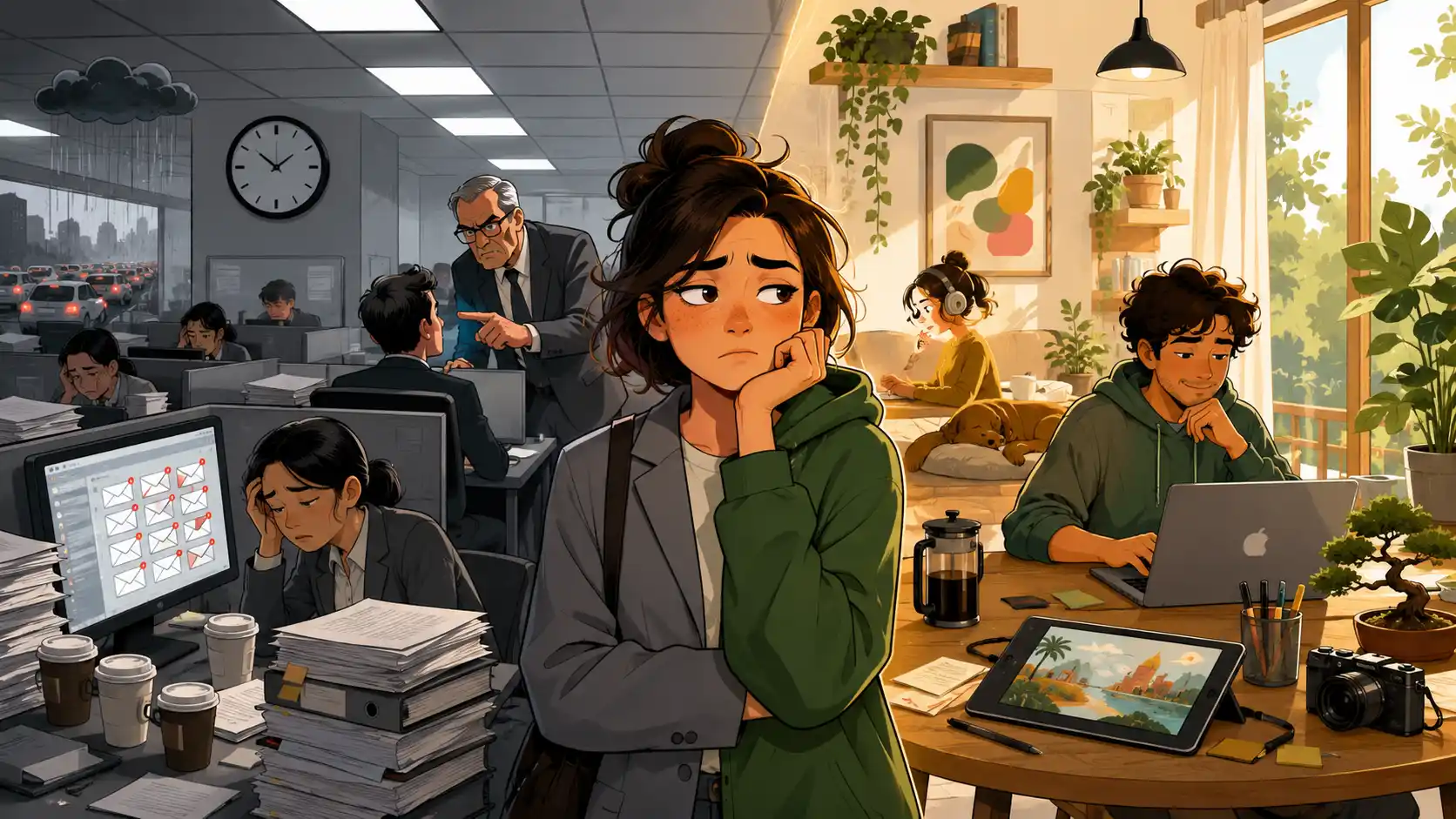
I know plenty of younger people who have little interest in the traditional corporate package: commuting every morning, sitting in an assigned chair for eight hours, asking permission to leave early, and attending meetings that could have been replaced by three sentences and a functioning adult.
Some work freelance. Some run small businesses. Some create content, take project-based jobs, or combine several income streams. Even among my millennial friends, remote work has become less of a temporary pandemic arrangement and more of a glimpse into a better possible life—one without spending two hours in traffic just to open the same laptop they own at home.
Those are anecdotes, of course. A few friends do not constitute a peer-reviewed study, no matter how aggressively they complain in the group chat.
But the broader research points in a similar direction.
Young workers are not abandoning work itself. They are questioning the traditional corporate bargain: surrender most of your waking hours, follow rigid rules that may have no relationship with productivity, tolerate bad management, and perhaps—after several annual reviews and one ceremonial pizza party—receive a slightly better title.
Check out my other article: Why Do Successful People Seem to Get More Stupid?
Young Workers Still Want Careers. Just Not at Any Cost
The stereotype says Gen Z is lazy, disloyal, overly sensitive, and allergic to hard work.
The data paints a less convenient picture.
Deloitte’s global surveys consistently find that Gen Z and millennials care about financial security, career development, meaningful work, mental wellbeing, and sustainable workloads. They are ambitious, but their definition of ambition is no longer limited to climbing toward a corner office while gradually forgetting the names of their children.
In Deloitte’s 2026 Gen Z and Millennial Survey, half of Gen Z respondents cited stress and burnout as barriers to pursuing leadership roles. Half also pointed to excessive responsibility, while 41 percent were concerned about work-life balance. Millennials reported nearly identical concerns.
That does not sound like a generation that hates achievement. It sounds like a generation that has looked at management and noticed that the reward for doing good work is often being given everybody else’s work too.
McKinsey has similarly found that Gen Z employees value development, advancement, flexibility, meaningful work, and caring leadership. A lack of career development is among their strongest reasons for considering departure, while growth opportunities and flexibility are major reasons to join or stay with an employer.
In other words, young people still want progress. They simply do not automatically associate progress with longer hours, larger teams, more office politics, and a company-issued phone that ensures the office can follow them into the bathroom.
The Office Is No Longer Automatically Seen as “Real Work”
For previous generations, the physical office was deeply connected to the idea of professional success.
A respectable job had a building, a desk, a manager, formal clothes, fixed hours, and perhaps a laminated identification card powerful enough to reassure your extended family that you had not ruined your life.
For baby boomers in particular, government institutions and large corporations often represented stability, social status, pensions, and a clear path upward. The alternatives were much less visible. There was no YouTube creator demonstrating how to build a business from a bedroom, no freelance platform connecting clients across continents, and no TikTok entrepreneur explaining passive income while standing suspiciously close to a rented Lamborghini.
Gen Z entered the workforce with a completely different menu of possibilities.
They have seen people build careers as designers, streamers, educators, consultants, video editors, independent developers, online sellers, podcasters, virtual assistants, and creators. Most will not become famous influencers, but fame is not the important part. The important part is that they have repeatedly seen work presented as something that can be organised around a person’s skills and life—not only around a corporation’s building and schedule.
This makes traditional office rules look less inevitable.
Research supports the growing demand for flexibility. McKinsey found that 87 percent of surveyed employees believed they would be more productive if they could work their preferred number of days from home rather than being required to attend the office five days a week. Another McKinsey study of Gen Z found that younger workers were more likely than older workers to hold independent jobs or multiple jobs.
In a 2025 study concerning Gen Z and public-service careers, 90 percent of respondents said more flexible working arrangements would make government work more attractive to them. Flexibility ranked alongside healthcare, retirement benefits, and job security—not exactly the demands of reckless teenagers planning to livestream their way into bankruptcy.
The message is not necessarily “I refuse to work in an office.”
It is more often: “Why must I be in the office every day when the work does not require it?”
Corporate culture has traditionally struggled with that question because the honest answer is sometimes uncomfortable: managers know how to monitor presence more easily than performance.
A person sitting at a desk looks employed. A person producing excellent work from home might secretly be doing laundry between assignments, which apparently represents the collapse of civilisation.
Corporate Culture Has Lost Control of Its Own Public Image
Young people are also entering employment after spending years hearing about toxic workplaces.
Bad corporate culture is no longer hidden inside private conversations between employees. It has become content.
Social media is filled with stories about abusive managers, unpaid overtime, mass layoffs, forced return-to-office policies, impossible targets, stagnant salaries, workplace harassment, fake “family” rhetoric, and companies expecting lifelong loyalty shortly before deleting 2,000 livelihoods in a spreadsheet.
Some of these stories are exaggerated. Some are missing context. But their cumulative effect matters.
Earlier generations may have experienced equally dysfunctional workplaces, but they did not have millions of people publicly documenting them. A terrible manager was once a local problem. Now the manager can become a viral case study by lunchtime.
Young workers therefore begin their careers with far less romanticism about corporate life. They have already seen behind the motivational posters.
And, unfortunately for employers, much of the pessimism is not imaginary.
Gallup’s 2026 State of the Global Workplace report found that only 20 percent of employees worldwide were engaged at work in 2025, the lowest level since 2020. Gallup estimated that disengagement cost the global economy roughly $10 trillion in lost productivity—approximately 9 percent of global GDP.
Around 40 percent of employees globally reported experiencing substantial stress during the previous day. Only 34 percent were classified as thriving, while most were struggling or suffering.
Those numbers do not prove that every office is toxic. They do suggest that widespread dissatisfaction is more than an internet trend invented by employees who dislike Monday mornings.
The World Health Organization defines burnout as a syndrome arising from chronic workplace stress that has not been successfully managed. Its characteristics include exhaustion, growing cynicism or mental distance from work, and reduced professional effectiveness.
The WHO also estimates that depression and anxiety cause the loss of around 12 billion working days every year.
Corporate culture, it turns out, may be bad not only for memes but also for global productivity.
The Creator Economy Offers an Alternative Fantasy
The rise of influencers and digital creators adds another important element.
For younger generations, the influencer is not merely a celebrity selling skincare. The creator represents an alternative model of work: independence, mobility, creativity, flexible hours, personal ownership, and the possibility of earning money from something you actually care about.
That image is enormously powerful, even when the reality is less glamorous.
Adobe’s research estimated that more than 165 million people joined the creator economy between 2020 and 2022. In its global study, 48 percent of creators said freedom of expression was a motivation, compared with 26 percent who cited money. Millennials represented the largest share of the creator economy at 42 percent, while Gen Z accounted for 14 percent at the time.
The fantasy is not simply “I want to be famous.”
It is: “I want ownership over my work.”
That distinction matters. Influencer culture tells young people that work can be personal, portable, creative, and connected to identity. Corporate employment often tells them to arrive at 8:30, use the approved PowerPoint template, and demonstrate passion for quarterly procurement optimisation.
One story naturally performs better on Instagram.
Of course, becoming a successful creator is brutally difficult. Income is unstable. Platforms can change their algorithms overnight. Most creators will never make enough money to live comfortably. Behind every influencer working beside a pool in Bali are thousands of people filming videos after their day jobs, receiving 413 views, and wondering whether the algorithm has a personal grudge.
This is where millennials often occupy an awkward middle ground.
We understand why younger workers find corporate life unattractive. Many of us have endured bad bosses, rigid rules, wasted commutes, pointless meetings, and organisations that demand loyalty while treating layoffs like routine software updates.
But millennials are also old enough to understand survivorship bias.
We remember the startup founders who promised to disrupt everything and then mostly disrupted their employees’ ability to pay rent. We have watched creators disappear, businesses fail, platforms collapse, and entrepreneurial dreams turn into unpaid invoices.
More importantly, many millennials now have children, mortgages, ageing parents, insurance payments, and other recurring reminders that “follow your passion” is not accepted as legal tender. So we stay.
Not because we believe corporate culture is wonderful, but because financial responsibility has a wonderful talent for converting rebellion into a monthly direct debit.
Gen Z, being younger and often less tied down, may have more freedom to experiment—or at least more willingness to try. Millennials can see the prison, but many of us have already purchased furniture for the cell.
Check out my other article: If We Know Better, Why Don’t We Work Better?
This Is Not Really a Generational War
It is tempting to frame everything as Gen Z versus boomers, with millennials sitting in the middle, exhausted as usual.
But generational labels can hide as much as they reveal.
Not all boomers worship the office. Not all members of Gen Z want to become influencers. Plenty of young people value predictable salaries, stable institutions, clear routines, and traditional careers. Plenty of older employees embraced remote work the moment they discovered life could contain fewer commutes and more actual sunlight.
McKinsey has warned against exaggerating generational differences, noting that workers across age groups share many priorities. Employees generally want fair pay, decent management, development, flexibility, meaningful work, and some evidence that their organisation does not actively despise them.
The real divide may not be between generations. It may be between people who still view traditional corporate practices as unavoidable and people who now know alternatives exist.
Gen Z happens to belong disproportionately to the second group because they grew up seeing those alternatives every day.
Gen Z Is Rejecting Performative Work
What young workers appear to dislike most is not effort, responsibility, or ambition. They dislike performative work: the rituals designed to make work visible rather than useful.
Being present for fixed hours regardless of workload. Replying to messages at night to demonstrate commitment. Attending meetings mainly so everyone can confirm that meetings are happening. Remaining at the office until the manager leaves. Accepting a promotion that brings 40 percent more stress and 8 percent more salary. Describing a workplace as a family right before asking the “family” to sacrifice another weekend.
These practices survived partly because employees once had limited visibility into alternatives and limited power to question them. That is changing.
Young workers can compare salaries publicly. They can expose bad management online. They can freelance across borders. They can build side businesses, learn skills independently, and watch thousands of people construct unconventional careers.
Most will still work for organisations. Most will still need managers, teams, deadlines, rules, and dependable salaries. The corporation is not about to vanish because someone made a TikTok about quitting. But the corporation is losing its monopoly over what a successful career is supposed to look like. That is the deeper shift.
Gen Z does not necessarily hate work. It does not even necessarily hate corporate work. It hates the idea that a job must consume a life in order to deserve respect.
And perhaps that is not youthful entitlement. Perhaps younger workers are simply asking the question older generations were too busy working to ask:
If the job gets done, why must everybody also pretend to suffer?
