
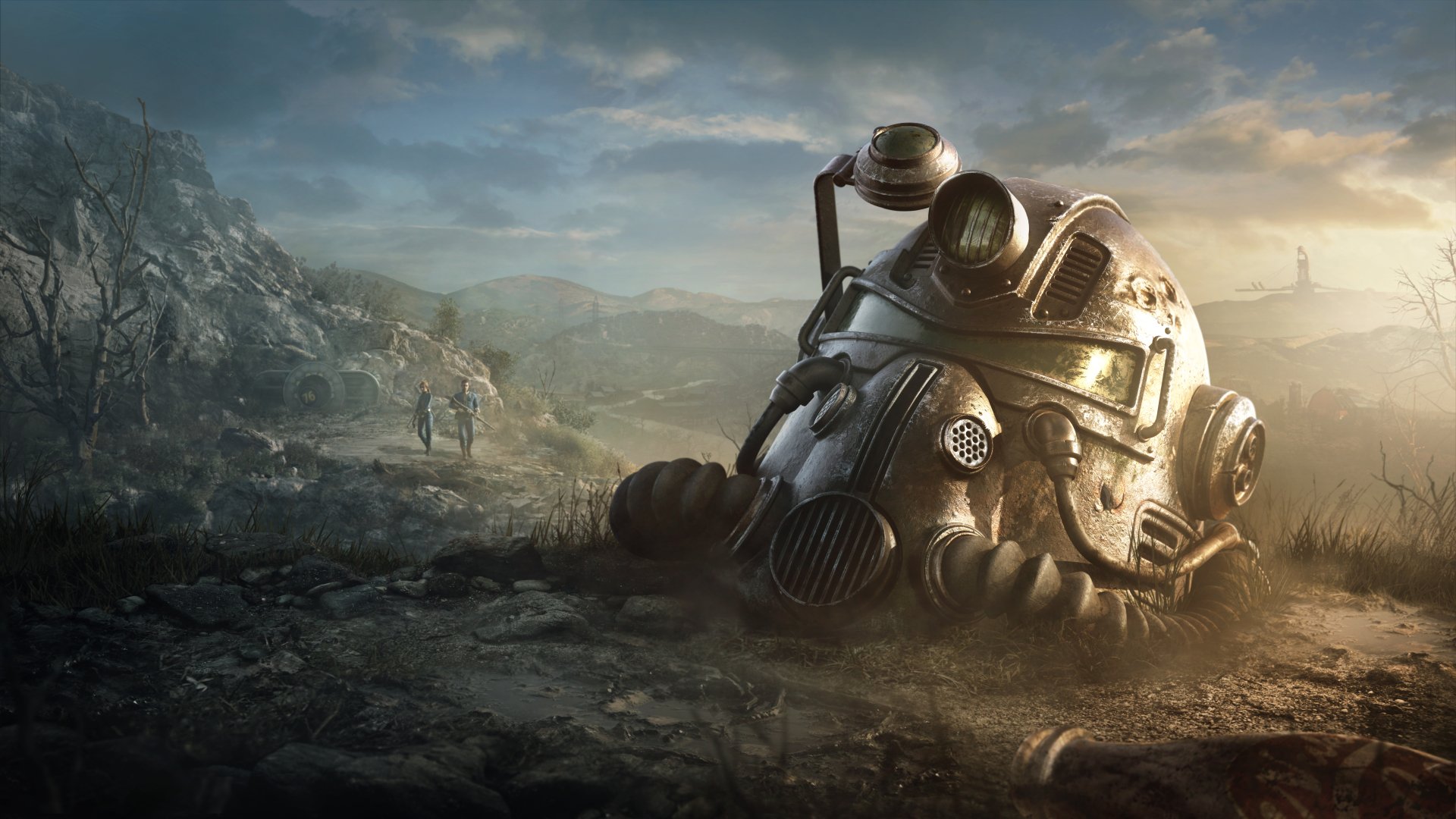
The Fallout timeline begins with a world obsessed with atomic energy, trapped in Cold War paranoia, and extremely confident that putting a nuclear reactor inside a family car was a perfectly reasonable idea.
By October 23, 2077, that world was gone.
The United States and China launched their nuclear arsenals, other nuclear powers followed, and human civilisation was reduced to irradiated ruins in roughly two hours. Cities disappeared. Governments collapsed. Millions died instantly, while many of the survivors received the less glamorous prize of radiation sickness, mutated wildlife, and canned food that somehow remained edible for another two centuries.
But the Great War did not happen suddenly.
Fallout’s apocalypse was the final result of decades of resource shortages, political extremism, corporate greed, military escalation, and governments repeatedly choosing the worst possible response to every available problem.
In other words, the bombs were merely the season finale.
To understand the world of Fallout, we need to return to the moment its history began moving away from ours.
When Did the Fallout Timeline Diverge From Our World?
The Fallout universe does not have one perfectly defined moment when it separated from real history.
Instead, the series suggests a gradual Divergence that became increasingly visible after World War II. Some historical events and people still existed in both timelines, but science, politics, culture, and technology began developing in very different directions.
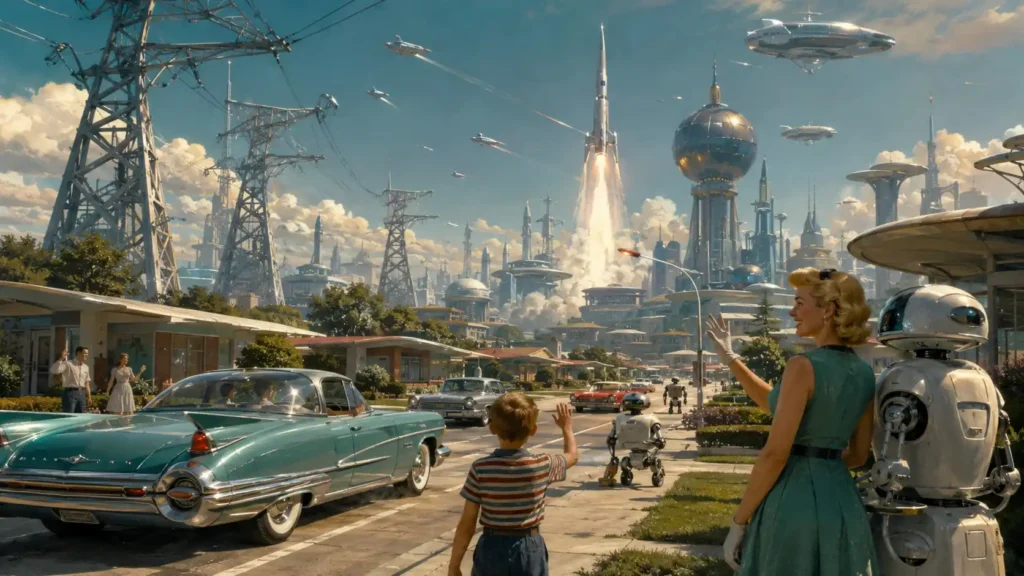
The easiest way to understand the Fallout universe is to imagine that the optimistic American vision of the 1950s never truly went away.
The future still arrived. It simply arrived wearing a cardigan.
Fallout’s America developed advanced robots, energy weapons, artificial intelligence, cybernetics, genetic engineering, fusion reactors, and powered military armour. However, its society remained culturally attached to mid-20th-century fashion, architecture, advertising, entertainment, and Cold War politics.
This is why Fallout can have laser rifles and domestic robots while computers still resemble industrial refrigerators with keyboards attached.
It is not simply “the 1950s, but in the future.” It is the future imagined by people living in the 1950s: a gleaming atomic utopia where robots handle the housework, cars run on nuclear energy, and absolutely nobody asks whether storing radioactive material beneath suburban neighbourhoods might create some minor regulatory concerns.
Fallout’s Strange Technological Progress
Technology in Fallout did not advance more slowly than it did in our world. It advanced in different directions.
In our timeline, the development of transistors, integrated circuits, and microprocessors eventually produced smaller and more powerful electronic devices. Computers went from occupying rooms to occupying desks, then laps, pockets, watches, refrigerators, and occasionally toilets for reasons civilisation may one day regret.
Fallout’s world placed much greater emphasis on:
- Nuclear energy
- Robotics
- Artificial intelligence
- Cybernetics
- Military technology
- Genetic engineering
- Large mainframe computers
As a result, computers remained bulky, monochromatic, and heavily dependent on command-line interfaces. Yet Fallout’s scientists still developed sophisticated networks, automated defence systems, intelligent machines, orbital communications, and robots capable of maintaining conversations for centuries.
Small electronics did exist. The Pip-Boy is the obvious example. But miniaturised computing never became as cheap, elegant, or widely available as it did in our world.
Nuclear technology, meanwhile, became part of daily life.
Also read: Exploring the Lore of STALKER: Shadows of Chernobyl and Call of Pripyat
Cars used nuclear or fusion-based engines. Homes and businesses relied on compact reactors. Portable fusion cells powered energy weapons. Companies sold atomic products with the same enthusiasm modern corporations reserve for subscription services.
This technology appeared miraculous, but it also created an enormous dependency on scarce raw materials.
Fallout’s civilisation had found brilliant new ways to consume energy. It had not found enough energy for everyone.
The United States Becomes the Thirteen Commonwealths
In 1969, the United States reorganised its 50 states into 13 Commonwealths.
The exact political authority of these Commonwealths remains somewhat unclear, but individual states continued to exist beneath the larger regional structure. The American flag was redesigned to represent the new system, although multiple versions of the 13-star flag appeared before the Great War.
This reorganisation did not make the country less politically unstable.
By the 21st century, the United States had become increasingly authoritarian, militarised, and obsessed with communist infiltration. Government agencies conducted secret experiments, detained suspected dissidents, manipulated the media, and cooperated closely with enormously powerful corporations.
America still advertised itself as the defender of freedom.
The definition of freedom had simply become flexible enough to include military occupation, corporate human experimentation, and shooting protesters while wearing power armour.
The Cold War also lasted far longer in Fallout’s timeline. The Soviet Union still existed in 2077, although it was no longer America’s primary rival. That role had been taken by the People’s Republic of China, which became the dominant communist superpower.
China and the United States competed economically, scientifically, and militarily as the world’s natural resources steadily disappeared.
That last part proved slightly inconvenient.
The World Runs Out of Oil
By the middle of the 21st century, the global economy was beginning to collapse under severe shortages of oil, uranium, and other critical resources.
The world had developed advanced nuclear technology, but oil was still essential for manufacturing, transportation, chemicals, plastics, and military logistics. Atomic cars could reduce petrol consumption, but they could not magically replace the entire petroleum-based global economy overnight.
Countries responded to scarcity with cooperation, efficiency, and careful long-term planning. That sentence is obviously a joke.
Instead, powerful nations hoarded resources, pressured weaker countries, and prepared for war.
In 2051, the United States placed increasing political and economic pressure on Mexico. American officials presented instability and pollution south of the border as threats to national security, then deployed military forces to secure Mexican oil facilities.
Officially, this was about protecting regional stability. Unofficially, America had discovered that invading another country sounded much more respectable when described as “safeguarding economic interests.”
The intervention did little to repair the American economy. Resource prices continued rising, smaller nations began collapsing, and international tensions grew worse.
The era later known as the Resource Wars was about to begin.
2052: The Resource Wars Begin
In April 2052, the European Commonwealth invaded the Middle East.
Europe depended heavily on Middle Eastern oil. As supplies shrank and prices increased, relations between the regions deteriorated until Europe decided to resolve the energy crisis through military conquest.
This was a bold strategy, especially because warfare is famously inexpensive and consumes almost no fuel.
The conflict became known as the Euro-Middle Eastern War, one of several struggles grouped under the broader Resource Wars. Fighting spread across the region while oil prices rose to catastrophic levels. Smaller countries went bankrupt, international trade deteriorated, and alliances began breaking apart.
The United Nations attempted to manage the crisis but quickly lost authority. Member states withdrew one after another, and on July 26, 2052, the organisation officially dissolved.
Humanity had entered a global emergency. It responded by deleting the group chat.
The New Plague and America’s Growing Paranoia
In 2053, a deadly disease known as the New Plague spread across the United States.
The infection was highly contagious and produced symptoms including bruising, swelling, sweating, and severe haemorrhaging. Authorities imposed quarantines and isolation measures, but the government also used public fear to justify increased surveillance and restrictions on political gatherings.
Anti-communist propaganda suggested that the disease was connected to foreign sabotage and even ideological disloyalty. Apparently, socialism had evolved from a political theory into an airborne pathogen. The outbreak killed tens of thousands of Americans, with some lore sources placing the total at approximately 200,000. Cities in Colorado were among the hardest hit.
The crisis also encouraged the government to invest more heavily in biological defence research. Several projects created to protect soldiers from diseases and biological weapons would later contribute to the development of the Forced Evolutionary Virus, better known as FEV.
Because in Fallout, every attempt to solve one catastrophe must begin manufacturing the next catastrophe immediately.
Nuclear Weapons Return to the Middle East
In December 2053, a nuclear weapon destroyed Tel Aviv.
A limited nuclear exchange followed in January 2054, escalating the Euro-Middle Eastern War and terrifying governments around the world. The attack proved that nuclear weapons were no longer merely tools of deterrence. Nations were willing to use them during conventional conflicts.
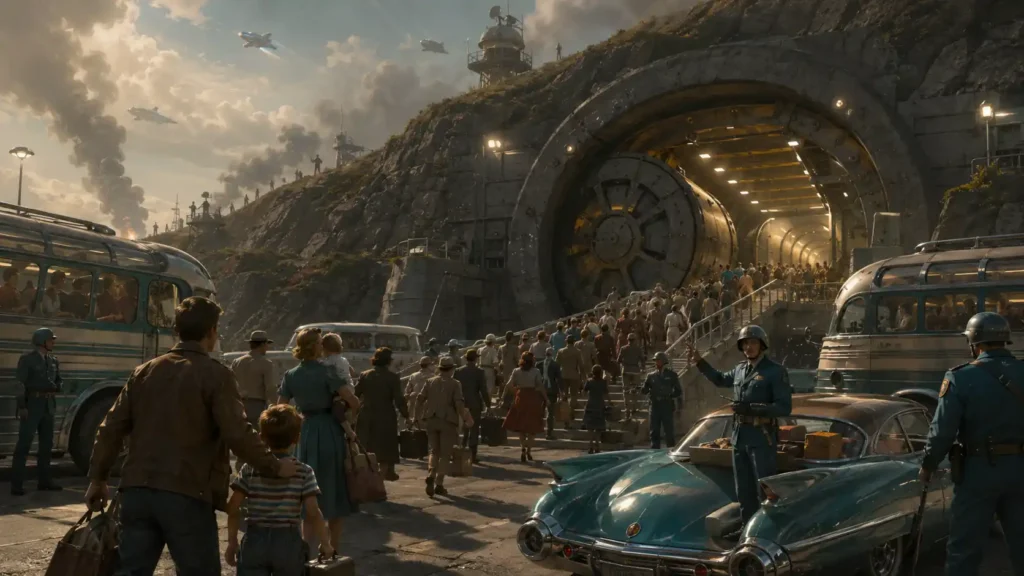
America responded by launching Project Safehouse, a government programme intended to construct underground shelters across the country. Vault-Tec received the contract.
Publicly, the vaults were designed to preserve American lives and allow society to survive a nuclear war. In reality, most would become secret human experiments operated in cooperation with the shadowy remnants of the US government.
Only 122 vaults were commissioned, nowhere near enough for the American population. Even if all of them had operated as advertised—and most absolutely did not—they could have protected only a tiny fraction of the country.
The shelters were marketed as salvation. They were closer to extremely expensive underground reality shows where cancellation usually involved everybody dying.
Europe Collapses
By 2060, the Middle East’s oil reserves were effectively exhausted. This made the Euro-Middle Eastern War pointless, although that realisation arrived only after both sides had devastated themselves.
The European Commonwealth fractured as member nations withdrew and turned against one another. Former allies fought over the resources that remained, plunging the continent into civil war.
The Middle East had been ruined. Europe was collapsing. The United Nations was gone. The global economy was failing.
America looked at this situation and decided the solution was more power armour.
The Development of Power Armor
In 2065, the United States accelerated research into powered military armour. Early prototypes were unreliable, expensive, and poorly suited for combat. Nevertheless, they established the foundation for one of Fallout’s most iconic technologies.
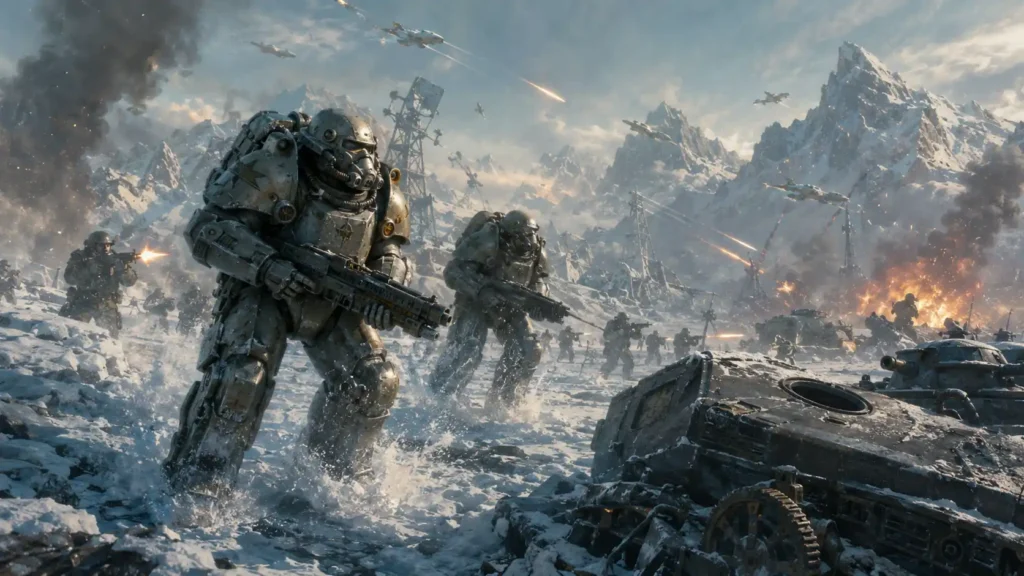
Power armour was designed to transform an individual soldier into a mobile heavy-weapons platform. A soldier wearing it could carry weapons normally requiring a crew, survive attacks that would kill ordinary infantry, and intimidate enemies simply by walking toward them like a patriotic refrigerator.
West Tek became one of the major contractors involved in the programme. The company would eventually help develop the T-45 and T-51 models, while also conducting biological research that evolved into FEV.
West Tek was effectively responsible for both power-armoured soldiers and super mutants. Vertical integration is a beautiful thing.
2066: China Invades Alaska
China faced its own energy crisis by 2066.
Its economy and military remained heavily dependent on fossil fuels, while the United States controlled some of the world’s last major oil reserves in Alaska. Negotiations over American oil exports failed, with the United States refusing to supply its primary geopolitical rival.
In winter 2066, China invaded Alaska and seized important oil infrastructure. The attack marked the beginning of the Sino-American War, a conflict that would last until the world ended in 2077.
Chinese forces used advanced weapons, including stealth technology, while sleeper agents operated inside the United States. America responded by deploying soldiers to the Alaskan front and expanding its military presence throughout Canada.
The first operational T-45 power armour units entered combat during the campaign. They were imperfect, but they proved devastating against Chinese infantry. Later T-51 models offered better protection, mobility, and battlefield performance, gradually giving American troops an advantage.
The war was no longer merely about Alaska. It became a global struggle between two exhausted superpowers fighting over the final drops of a dying world.
Canada Becomes “Little America”
Canada occupied an unfortunate position between the continental United States and the Alaskan battlefield.
American troops and military supplies had to pass through Canadian territory. The United States also exploited Canadian forests, minerals, infrastructure, and other resources to support the war.
Although the Canadian government initially cooperated, resentment grew as American forces became increasingly dominant. Protests, riots, and acts of resistance threatened supply lines to Alaska.
American public opinion also became openly hostile toward Canadian independence. Canada was increasingly treated as a subordinate state and mockingly described as Little America.
In June 2072, the United States began formally annexing Canada. The annexation was completed in 2076. Resistance was suppressed brutally. American troops executed protesters, occupied infrastructure, and imposed military control.
One infamous piece of pre-war footage shows power-armoured soldiers executing a Canadian captive before waving at the camera. The clip perfectly captures Fallout’s pre-war America: cheerful propaganda, advanced military technology, and war crimes presented with the energy of a cereal commercial.
America Invades Mainland China
The fighting in Alaska became a prolonged war of attrition.
China deployed biological weapons, while the United States intensified research into broad-spectrum immunity treatments. West Tek’s work eventually produced the Pan-Immunity Virion Project, which evolved into FEV after military researchers discovered its potential to alter human biology.
The United States also expanded the war far beyond Alaska.
In 2074, American forces launched a counteroffensive into mainland China, despite publicly maintaining that the country was fighting a defensive war.
American soldiers, naval units, and power-armoured infantry opened new fronts across Chinese territory. The campaign placed enormous pressure on the American economy, which was already supporting military operations in Alaska, Canada, and domestic cities.
Factories shifted from civilian production to military manufacturing. Consumer goods became scarce. Food and energy prices increased. Riots spread through American cities.
The government answered public frustration in the traditional Fallout manner: by deploying more soldiers.
The United States Falls Apart From Within
By 2076 and 2077, America was winning some battles abroad while collapsing at home.
Food shortages triggered riots. Energy scarcity disrupted daily life. Corporations exercised enormous influence over government policy. Political dissidents disappeared into detention centres. Military personnel were used to control civilians. Martial law spread across the country.
The American government still filled television and radio broadcasts with patriotic messages, promising victory and prosperity while citizens fought over basic necessities.
Companies continued advertising new products until the final moments. Vault-Tec promoted underground living. Nuka-Cola sold soft drinks. Chryslus advertised expensive fusion cars. General Atomics offered domestic robots.
The apocalypse arrived with excellent branding.
Senior government officials had already prepared private survival facilities. The president and members of the organisation that would become the Enclave withdrew to secure locations, including an offshore oil rig.
They did not intend to save the American public. They intended to outlive it.
January 2077: America Reclaims Anchorage
In January 2077, American forces finally reclaimed Anchorage.
T-51 power armour played a major role in breaking the Chinese occupation. General Jingwei, the commander of Chinese forces in Alaska, was killed, and the remaining troops were eliminated or driven away.
The campaign officially concluded later that month. The victory gave the United States a major propaganda triumph. Veterans were celebrated, and additional power-armoured units were transferred to the Chinese mainland.
For a brief moment, America appeared to be approaching victory. But the war in China continued. Resistance stiffened as American troops moved deeper into the country, supply lines became harder to maintain, and both sides remained unwilling to surrender.
By October 2077, the Sino-American War had lasted more than ten years. The world had run out of resources, money, patience, and reasonable adults. All that remained were the nuclear weapons.
October 23, 2077: The Great War Begins
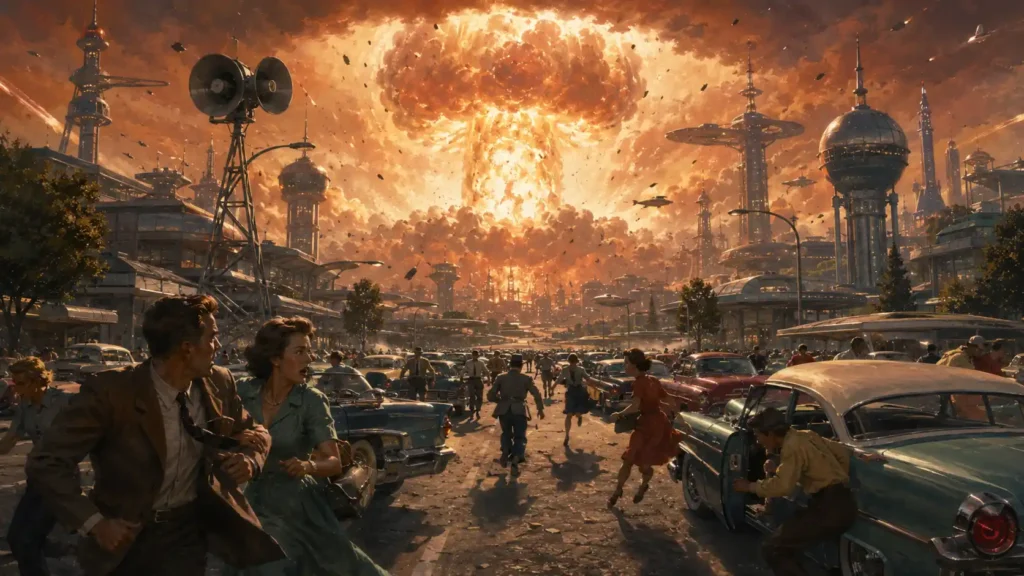
The Great War occurred on Saturday, October 23, 2077.
Early that morning, American military systems detected suspicious activity near the West Coast. Submerged objects were reported off California, while unidentified aircraft approached through the Bering Strait region.
At 9:13 a.m. Eastern time, American detection systems identified four probable missile launches. The alert level rose rapidly.
At 9:17 a.m., NORAD confirmed that nuclear missiles were inbound. The United States moved to DEFCON 1. At approximately 9:26 a.m., the president authorised nuclear retaliation.
The first confirmed strikes hit the United States shortly afterward. New York and Pennsylvania were among the early targets, followed by attacks across the West Coast and other major population centres.
By 9:47 a.m., nuclear weapons were falling across the country. Other nuclear powers launched their arsenals as the conflict escalated into a global exchange. Within approximately two hours, modern civilisation had ended.
There was no dramatic final speech. No heroic last-minute peace agreement. No scientist running into the command room with the solution.
Humanity spent more than a century building the atomic future. It required one morning to burn it down.
Who Launched the First Nuclear Weapons?
Fallout has never provided a completely unquestionable answer to this question.
Several in-universe sources claim that China attacked first. American detection systems apparently identified Chinese missiles, and some characters later repeated that version of events.
However, these accounts are not entirely reliable. Much of the surviving information comes from American military systems, government officials, propaganda, or people with incomplete knowledge.
Other theories suggest that the United States, Vault-Tec, the Enclave, an automated defence system, or even extraterrestrials may have initiated the exchange.
The Fallout television series further complicated the debate by revealing that senior Vault-Tec figures were willing to consider deliberately starting a nuclear war if doing so protected their corporate interests.
But willingness is not the same as proof. The most accurate answer remains that the exact responsibility is deliberately uncertain. And thematically, it may not matter.
Fallout is not primarily asking which country pressed the button first. It is showing how the entire world created circumstances in which somebody eventually would.
China and America had fought for more than a decade. Governments had normalised limited nuclear warfare. Resources were disappearing. Diplomacy had collapsed. Nationalism had replaced restraint. Corporations actively benefited from catastrophe.
The first launch may have started the Great War. The world had been preparing to destroy itself for decades.
Check out my other article: What Dying Light: The Beast Taught Me About Today’s Game Tech
What Happened Immediately After the Bombs?
The nuclear exchange did not kill everyone.
People far from major cities sometimes survived the initial blasts. Others reached private shelters, military bunkers, subway tunnels, caves, or Vault-Tec facilities. Some vault residents were protected as promised, at least until their experiments began.
Those exposed to high levels of radiation suffered burns, illness, genetic damage, and death. Black rain containing radioactive particles fell across parts of the world.
Military units attempted limited relief operations, but communications and command structures collapsed rapidly. Many soldiers abandoned their posts. Medical supplies disappeared. In some locations, painkillers and alcohol became the only available treatment.
Governments ceased functioning.
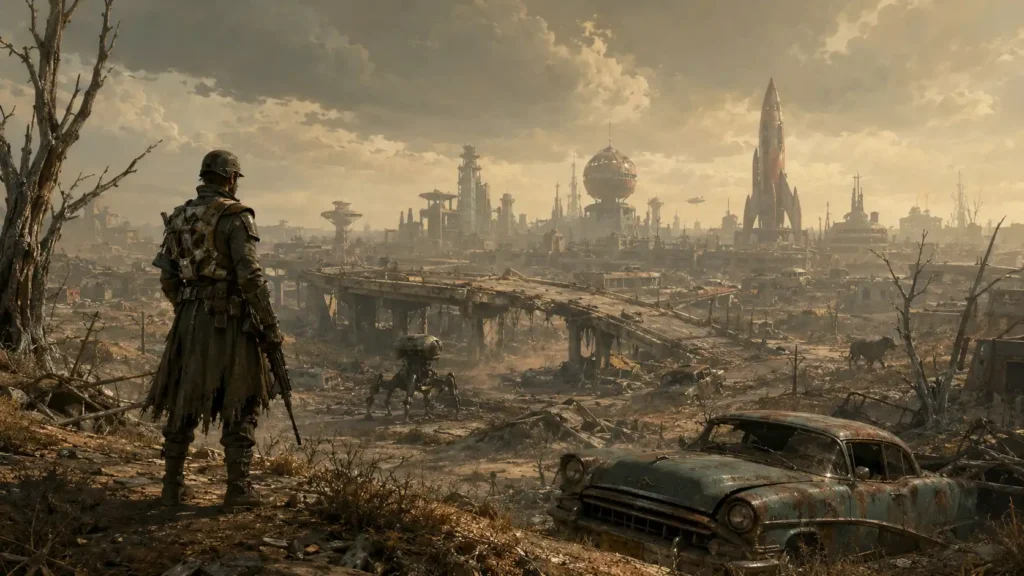
Survivors formed settlements, gangs, tribes, militias, cults, and eventually new nations. Radiation and biological experiments transformed humans and animals. Pre-war military projects escaped containment.
The ruins of America became the Wasteland.
Vault-Tec shelters became laboratories, tombs, or the foundations of new communities. The Enclave attempted to preserve the old government. Soldiers descended from the Mariposa mutineers formed the Brotherhood of Steel. Survivors leaving Vault 15 would eventually help establish Shady Sands and the New California Republic.
The old world was dead. Unfortunately, many of its ideas survived.
Fallout’s Apocalypse Was Not Really About Nuclear Weapons
The mushroom clouds are Fallout’s most recognisable image, but nuclear weapons are not the real cause of its apocalypse.
They are merely the final tool. Fallout’s world ended because every major institution failed in exactly the way it was designed to fail.
Governments valued power over citizens. Corporations valued profit over human life. Military leaders believed every political problem could be solved through superior firepower. Citizens were kept frightened, distracted, and divided. Technology advanced faster than society’s ability to use it responsibly.
The world possessed robots, fusion energy, artificial intelligence, power armour, and advanced medicine. It had enough scientific knowledge to create something close to a technological paradise.
Instead, it used those achievements to build better weapons, more convincing propaganda, and underground laboratories where corporations could torment people after civilisation collapsed.
That is why Fallout’s famous opening line remains so effective: War never changes.
Weapons change. Uniforms change. Flags change. The excuses become more sophisticated. But greed, fear, ambition, and the desire to dominate other people remain remarkably durable.
Much like a 200-year-old box of Sugar Bombs.
