
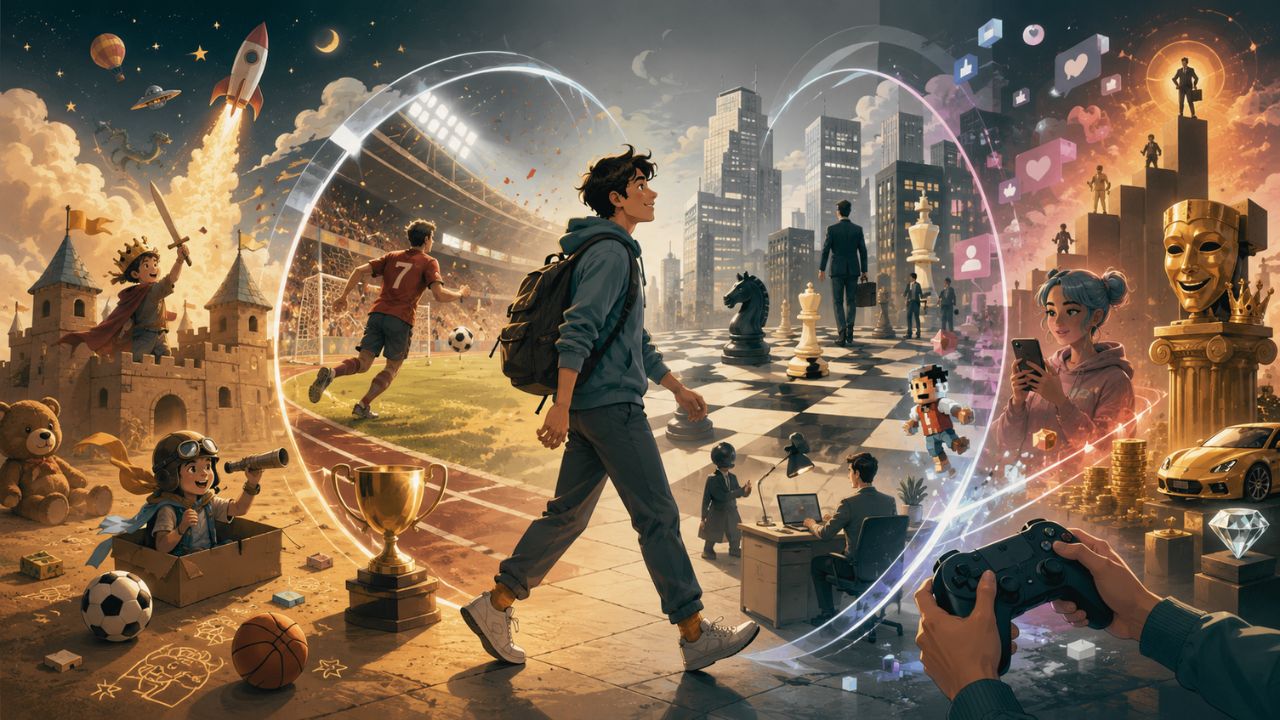
Human beings have been given many impressive names.
Homo sapiens means the wise human, which already feels slightly optimistic considering how often people reply to obvious scams with their banking information.
Homo faber describes humans as makers: creatures who build tools, cities, machines, institutions, and flat-pack furniture with three mysterious screws left over.
Then there is Homo ludens: the human who plays.
The term was popularized by Dutch historian Johan Huizinga in his 1938 book Homo Ludens. His central idea was not merely that humans enjoy playing games. That would be about as revolutionary as announcing that cats enjoy sitting inside boxes. Huizinga argued something much bigger: Play is one of the foundations of human culture.
We do not create games only after the serious work of civilization is finished. Many of the things we consider serious—law, war, religion, poetry, art, politics, competition, ceremony, and social status—contain elements of play within them.
Humanity did not build civilization and then invent games to kill time on Sunday afternoons. In many ways, we played civilization into existence.
Play Is Older Than Human Culture
Huizinga begins Homo Ludens with a wonderfully simple observation: animals play too.
Young dogs wrestle. Cats chase objects that have committed no identifiable crime. Primates engage in mock fights where both participants understand that the violence is not entirely serious. Animals did not wait for humans to invent battle passes.
This matters because it suggests that play is not merely a cultural product. It exists before organized human society, formal education, written language, or people arguing online about whether a hot dog is technically a sandwich. Huizinga therefore described play as older than culture itself. Culture requires human society, but play does not.
Of course, humans took this ancient instinct and did what humans always do: made it more complicated, attached rules to it, created governing bodies, sold merchandise, and eventually argued about it on Reddit.
But the instinct came first.
What Actually Counts as Play?
Defining play is surprisingly difficult. We recognize it when we see children pretending a cardboard box is a spaceship. We recognize it when adults spend six hours managing a fictional medieval kingdom and call it “relaxing.”
But what makes an activity playful? For Huizinga, play generally has several important qualities.
First, play is voluntary. It is entered freely. The moment someone forces you to participate, the experience starts feeling less like play and more like mandatory office karaoke.
Second, play exists partly outside ordinary life. Players temporarily step into another reality with its own meaning.
A football match is just people moving a ball across grass—unless everyone agrees that the lines, goals, teams, score, and referee matter. Chess is just thirty-two carved objects sitting on a board—unless two players accept that one piece represents a king, another can only move diagonally, and horses apparently travel in the shape of the letter L.
Third, play has boundaries. It happens within a particular place and period: a stadium, a stage, a playground, a game board, a server, a match, a tournament, or an imaginary kingdom beneath the dining table.
Finally, play creates order. It follows rules.
Those rules may be arbitrary, but they are not meaningless. In fact, the arbitrary limitations are often what make the activity interesting. Basketball would be significantly easier if players were allowed to carry ladders. Dark Souls would be significantly easier if the player character owned a modern assault helicopter.
Neither improvement would necessarily make the experience better. Play transforms unnecessary limitations into meaningful challenges.
Welcome to the Magic Circle
One of the most influential ideas associated with Homo Ludens is the magic circle. The magic circle is the symbolic boundary separating the world of play from ordinary reality. Inside that circle, different rules apply.
A boxing ring permits behavior that would normally lead to arrest. A video game lets you become a warrior, mayor, farmer, football manager, intergalactic criminal, or unusually violent plumber.
The events are not “real” in the ordinary sense, but the experiences and emotions can still be real. The football supporter knows that twenty-two adults chasing a ball will not determine the future of human civilization. Their nervous system has received a different memo.
The magic circle works because players agree to treat something artificial as meaningful. That agreement may sound trivial, but it is astonishingly powerful. Humans can enter an invented system, accept its rules, and experience genuine tension, joy, disappointment, pride, loyalty, fear, or belonging inside it.
That is not just how games work. It is also how much of society works.
Civilization Runs on Imaginary Rules
Consider money.
A banknote is a decorated piece of material. The number inside your banking app is not a physical object sitting inside your phone. It has value because millions of people, companies, and governments agree to treat it as valuable.
Consider national borders.
The Earth itself does not display a glowing line when you cross from one country into another. Humans created the boundaries, documented the rules, and built institutions to enforce them.
Consider job titles, academic degrees, wedding ceremonies, courtrooms, uniforms, elections, ranks, brands, and social etiquette. All of them depend on collective participation in symbolic systems.
This does not mean they are fake or unimportant. Quite the opposite. A system can be invented and still have real consequences.
The rules of chess are invented, but losing a world championship still matters. Money is symbolic, but landlords remain distressingly committed to it. A nation is socially constructed, but immigration officers are unlikely to accept “borders are imaginary” as a valid travel document.
Humans are extremely good at creating shared realities. We invent roles, symbols, rituals, boundaries, and rules—and then organize our lives around them. In that sense, society resembles an enormous collection of overlapping games. The problem is that nobody shows us the complete rulebook, several players began with more resources, and the tutorial keeps insisting that success is available through hard work while quietly selling premium currency.
Adults Never Stop Playing
Adults often treat play as something childish.
Children play. Adults work. Children run around pretending to be heroes. Adults sit in meetings pretending the new quarterly reporting structure is exciting. But adults do not actually stop playing. We simply disguise play beneath more respectable vocabulary.
We call it networking, career development, romance, or even office politics. In workplaces, employees compete for promotions, recognition, bonuses, titles, and access to more important rooms. Organizations create hierarchies, performance scores, targets, rankings, and awards.
That is a game structure.
In dating, people follow unwritten rules about timing, attention, availability, status, and presentation. Everyone claims to value honest communication, then spends thirty minutes analyzing whether a two-hour delay between messages indicates emotional independence or the collapse of Western civilization.
That is also a game structure.
On social media, users collect followers, likes, shares, views, badges, streaks, and verification marks. People who insist they are “not gamers” may still spend five hours per day grinding engagement points on Instagram. They simply chose a game with worse character customization.
Social Media Is an Infinite Game With No Ending
Traditional games usually tell us what victory looks like. Reach the finish line. Defeat the final boss. Social media rarely provides an ending.
There is always another follower to gain, another notification to check, another post to improve, another person whose apparently perfect life can make yours feel like a poorly managed side quest. The scoreboard never switches off. This is what happens when game-like systems escape the traditional boundaries of play. The magic circle begins to leak.
Your Instagram statistics affect your mood at breakfast. Your professional profile follows you home. Your ranking inside a competitive game shapes your self-esteem. Your productivity app makes you feel guilty for breaking a streak because you were sick.
Play is no longer a temporary world we enter. The game follows us everywhere. And unlike most games, the rules are often controlled by companies whose primary objective is not your personal growth, spiritual fulfilment, or successful completion of the human experience.
They would mostly like you to remain on the platform. Preferably forever.
The Gamification of Everything
Modern institutions have realized that people respond strongly to game mechanics. Give someone a task and they may ignore it.
Give them the same task with points, progress bars, daily streaks, rankings, celebratory animations, and a small cartoon owl threatening their family, and suddenly it becomes difficult to stop. This is called gamification: applying game-design elements to activities that are not traditionally games. Language-learning apps use levels and streaks. Online platforms reward engagement.
Even financial apps may use flashing graphics, instant feedback, achievements, and social competition to make investing feel less like capital allocation and more like opening loot boxes with your retirement savings.
Gamification can be useful. Progress indicators make improvement visible. Immediate feedback can help people learn. Challenges can turn boring routines into manageable goals. But there is an important difference between play and gamification.
Play is normally valuable in itself. Gamification often borrows the emotional machinery of play to make people perform an external task. Sometimes that task is learning Spanish. Sometimes it is exercising. Sometimes it is producing more work for the same salary while a digital badge politely congratulates you for becoming Employee Paladin Level 12.
Research on workplace gamification has warned that systems focused heavily on quantitative rewards can neglect work quality and may eventually damage motivation rather than improve it. The issue is not that game mechanics are inherently manipulative. The issue is who designed the game, what behavior it rewards, and whether the players truly chose to participate.
There is a significant difference between playing because you want to and being told that Friday’s mandatory team-building activity will be “super fun.”
Not Every Game Is Fair
If society contains game-like systems, then we must ask an uncomfortable question: Who wrote the rules?
Many games begin with equal conditions. Each chess player receives the same pieces. Every football team starts the match at zero. Competitive video games attempt—sometimes successfully, sometimes with the grace of a drunk giraffe—to balance players and equipment.
Life is not designed with the same concern for balance. People begin with different levels of wealth, health, education, social support, citizenship, safety, connections, and opportunity. Some players spawn beside a treasure chest. Others spawn in a poison swamp with no map. Yet society often discusses success as though everyone joined the same ranked match under identical conditions.
Winners are praised for strategy, discipline, intelligence, and effort. Losers are told to work harder, improve their mindset, purchase a course, and stop blaming the matchmaking system. This is one danger of viewing life purely as a game.
Games make outcomes appear deserved because players supposedly accept the same rules. Reality is messier. The rules may be invisible. They may change midway through the match. They may benefit the people who designed them. Some players may not even know which game they are participating in.
The language of games can motivate us, but it can also hide structural inequality behind the comforting fiction of fair competition. Sometimes you did not lose because you lacked skill. Sometimes the person on the other side purchased the entire server.
Play Is Not the Opposite of Seriousness
One common misunderstanding is that play cannot be serious. But anyone who has watched a child build an imaginary world knows how intensely serious play can become.
Anyone who has watched an esports final knows that digital competition can produce real pressure, discipline, teamwork, sacrifice, and emotional devastation. Anyone who has lost a twelve-year Minecraft world to corrupted data knows grief in its purest and most block-shaped form.
For Huizinga, play was not simply the opposite of seriousness. Play can contain seriousness while still remaining play.
Religious rituals may contain theatrical and game-like structures without becoming meaningless. Courts follow formal rules, roles, costumes, procedures, and carefully controlled spaces, but their decisions have enormous consequences. Politics contains performance, competition, symbolism, teams, spectacle, and strategic moves, yet the outcomes shape real lives.
Games may be artificial, but artificial does not mean insignificant. Human beings constantly use invented structures to express real values. A sport can become a symbol of national identity. A fictional story can help someone understand grief. A playground can teach children cooperation, negotiation, fairness, deception, creativity, and the ancient diplomatic art of insisting that the ball was definitely still inside the line.
Play gives us a low-risk environment in which to test possible worlds.
Games Teach Us How to Fail
Ordinary life often treats failure as permanent evidence of personal inadequacy. You failed an exam, lost a job, made a bad investment, damaged a relationship, or attempted to cook something from an online recipe and created an object now being studied by geologists.
Games treat failure differently.
- Failure is information.
- You try again.
- You adjust your strategy.
- You understand the system more clearly.
In a well-designed game, failure does not automatically destroy motivation. It creates feedback. This may be one of the greatest psychological values of play. It gives humans a framework for exploring difficulty without interpreting every mistake as an identity crisis.
Children learn through repeated experiments. They stack blocks, watch them fall, and rebuild. Adults often stack one metaphorical block incorrectly and immediately conclude that their career is over, everyone secretly hates them, and they should move to another country to raise goats.
A more playful approach to life does not mean refusing responsibility. It means treating some failures as part of learning rather than proof that the player is fundamentally broken.
Play Lets Us Become Someone Else
Games allow people to temporarily adopt different identities. A cautious person can play aggressively. Someone with a routine job can spend the evening commanding armies, designing cities, solving murders, managing football clubs, or deciding which fictional villager deserves a carefully selected gift.
Play creates a protected space for experimentation. This is especially clear in role-playing. The player does not simply control a character. They test decisions. Would I reload the save because an NPC looked slightly disappointed?
Games turn philosophical questions into actions. They do not merely ask what you believe. They ask what you will do when the dialogue wheel appears. Of course, choices inside games do not perfectly reveal someone’s real morality. A player can behave monstrously because they are curious about alternate outcomes. But even that curiosity matters. Play gives us permission to explore possibilities without fully becoming them. It lets us visit another self and return home afterward.
We Need Play Because Life Has Too Many Consequences
Most adult activities are judged by usefulness. Will this make money? Will this improve your career?
Under this logic, hobbies gradually become side businesses. Exercise becomes data. Rest becomes recovery for future productivity. Even leisure is forced to submit a quarterly report.
Play resists that pressure because genuine play does not always need an external purpose. You draw because drawing is enjoyable. You play music because making sound feels good. You explore a digital world because you want to know what is behind the mountain. You joke with friends because laughter does not need a five-year strategic plan. This apparent uselessness is not a flaw. It may be the point.
When every action must produce measurable value, human life becomes efficient but strangely empty. Play reminds us that an experience can matter without becoming productive. A moment can be worthwhile because it was joyful, interesting, beautiful, funny, or shared.
No spreadsheet required.
Maybe Life Is Not About Winning
Calling life a game can easily become another motivational cliché. But Homo ludens offers a different lesson. The value of play is not limited to victory. People play because the activity itself is meaningful. A child does not build a sandcastle because sandcastle construction offers excellent long-term career prospects.
Friends do not play football because every match advances humanity toward a measurable objective. Players do not explore every corner of an open world because the fictional economy desperately needs their support. We play because participation creates experience.
Because rules create possibilities.
Because imagination allows reality to become temporarily larger.
Because challenges are satisfying when we choose them.
Because shared play connects us to other people.
Perhaps the biggest mistake is not treating life too much like a game. Perhaps it is treating life like the wrong kind of game. We imagine it as a ranked competition with one global leaderboard, where everyone must collect the same achievements: money, status, property, recognition, influence, and professionally photographed happiness. But life may be closer to an enormous sandbox.
There are structures, limitations, and other players. Some areas are badly designed. The economy is unbalanced. The tutorial is incomplete. Several mechanics appear to have been added without proper testing. Still, there are many ways to participate. You can compete. You can cooperate. You can ignore the main quest for several years because you became strangely invested in a hobby nobody else understands.
The game does not become meaningless simply because there is no single way to win. Maybe humans are not defined only by what we know or what we make. Maybe we are also defined by the worlds we imagine, the rules we invent, the roles we inhabit, the challenges we voluntarily accept, and the joy we find in doing things that do not need to be done.
We are Homo ludens. The playing human.
