
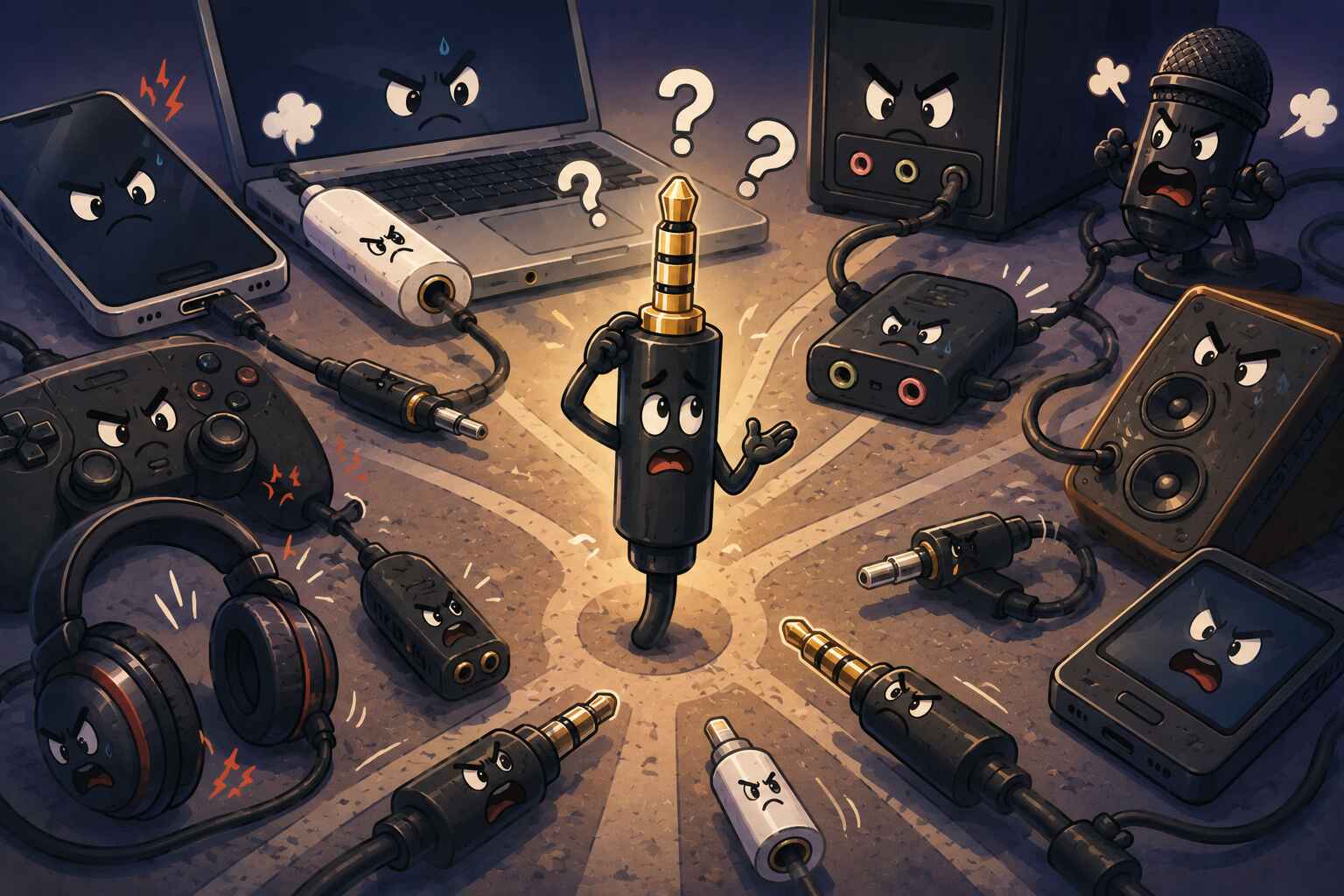
At some point in your life, this has happened. You plug in your earphones. Left side works. Right side is dead. You rotate the plug slightly. Both sides come back.
You move one millimeter too far. Silence again. So now you’re holding the cable at a very specific angle like it’s a sacred geometric position discovered through trial and error.
And in that moment, you think:
Why does this always happen with headphone jacks?
Not once. Not twice. Almost every pair eventually does this. Meanwhile, your USB port seems fine. You plug things in for years. No ritual hand positioning required.
So what makes the 3.5mm jack so prone to becoming… temperamental? The answer is less dramatic than you think. And much more mechanical.
Check out my other article: The Death of the Gaming Keyboard
Before Music, It Connected Humans
The 3.5mm jack is older than recorded music as we know it. Its ancestor appeared in the late 1800s inside telephone switchboards. Operators manually connected calls by plugging cables into panels — physically routing conversations between cities.
These connectors needed three things:
- Fast insertion
- Thousands of daily uses
- Easy replacement when worn out
The solution was simple: a metal plug pressing against spring contacts.
Over time, it was miniaturized:
- 6.35mm (¼ inch) — still used for guitars and pro audio
- 3.5mm (⅛ inch) — for portable electronics
- 2.5mm — briefly relevant, mostly forgotten
When portable music exploded in the late 1970s, the 3.5mm jack became the global standard for personal audio. It was small, cheap, easy to manufacture, and electrically simple. But the design itself? Still fundamentally mechanical. And that’s the key.
What’s Actually Happening Inside the Jack
Let’s zoom in.
That innocent little 3.5mm plug isn’t just a metal stick. It’s divided into separate zones:
- Tip — left audio
- Ring — right audio
- Sleeve — ground
Each section carries part of your music like a tiny electrical relay team. Inside the socket, waiting for it, are thin metal springs. Their entire job is to press against those segments with just the right amount of force.
When you insert the plug:
- The springs bend outward.
- Then snap back inward.
- And clamp down like tiny metal hands holding on for dear life.
That pressure is everything. No pressure, no music. But pressure comes with a side effect: friction. And friction is just physics slowly keeping receipts.
Every time you plug in or unplug:
- Metal rubs against metal.
- Microscopic layers wear away.
- Spring tension relaxes just a little.
- Dust and pocket lint get pushed deeper inside like unwanted roommates who never leave.
Nothing catastrophic happens. No sparks. No dramatic failure. Instead, the connection becomes… sensitive. After hundreds — sometimes thousands — of insertions, the springs don’t grip quite as confidently. Tiny gaps appear. Slight rotations change contact pressure.
And because your music is traveling as a continuous electrical wave, even the smallest inconsistency becomes audible. A faint crackle. One channel fades out. A distortion that disappears when you twist the plug “just right.”
Nothing exploded. It just stopped being perfectly aligned.
Why Analog Makes It Feel Worse
Here’s the uncomfortable truth: The 3.5mm jack is brutally honest. It carries analog signals — continuous electrical waves that directly represent sound. There’s no buffer. No translator. No digital babysitter smoothing things over. If contact pressure changes slightly, you hear it immediately.
- Move the cable a millimeter → crackle.
- Insert it 95% of the way → one ear disappears.
- Add a thin layer of lint → static joins the band.
Analog doesn’t negotiate. It doesn’t say, “That’s close enough.” It says, “This is exactly how good your connection is right now.” Digital systems hide small imperfections behind thresholds and error correction. Analog simply reports the truth in real time. So the port isn’t suddenly dying. It’s aging — audibly.
And once you realize that, the infamous “wiggle test” stops feeling mysterious. It’s not magic. It’s just pressure, friction, and physics having a very small, very honest argument inside your pocket.
So Why Doesn’t USB Act Like This?
Now let’s compare it to USB — especially modern USB-C.
USB connectors are built differently:
- Multiple flat contact pads instead of rounded segments
- More structured alignment guides
- Digital signal transmission instead of analog
But the biggest difference is this: USB is digital.
Digital communication doesn’t gradually degrade in the same way analog does. It works within tolerance thresholds. As long as the signal stays above a certain integrity level, everything appears perfect.
When a USB port wears:
- Data still transmits correctly.
- Charging still works.
- No subtle “half-working” state appears.
Until one day it just doesn’t connect anymore. Digital systems hide gradual wear better because error correction and signaling protocols compensate for minor contact variation.
The headphone jack has no such buffer. It’s raw electrical contact straight to your ears. So USB isn’t necessarily wearing less. It just hides the aging process better.
Why the 3.5mm Jack Feels “Dramatic”
The headphone jack combines three factors:
- Purely mechanical contact
- Spring-based pressure system
- Analog signal transmission
That combination guarantees one thing: You will eventually notice its wear.
Not because it’s poorly designed. Not because it’s ancient. But because it’s honest about physics. It exposes every microscopic change in pressure and alignment through audible feedback.
USB, on the other hand, uses digital protocols that mask small imperfections until they cross a failure threshold.
One port whispers its decline. The other waits, then stops speaking entirely.
The Real Difference
The headphone jack combines three factors:
- Mechanical spring pressure
- Constant friction
- Analog signal transmission
That combination guarantees gradual, noticeable wear.
USB combines:
- Structured contact design
- Digital signaling
- Error tolerance
That combination hides gradual wear. So it’s not that the 3.5mm jack is uniquely flawed. It’s that it reveals its aging in real time.
You hear physics happening. And once you understand that, the sacred “hold-the-cable-just-right” position stops feeling like bad luck. It becomes predictable engineering.
