
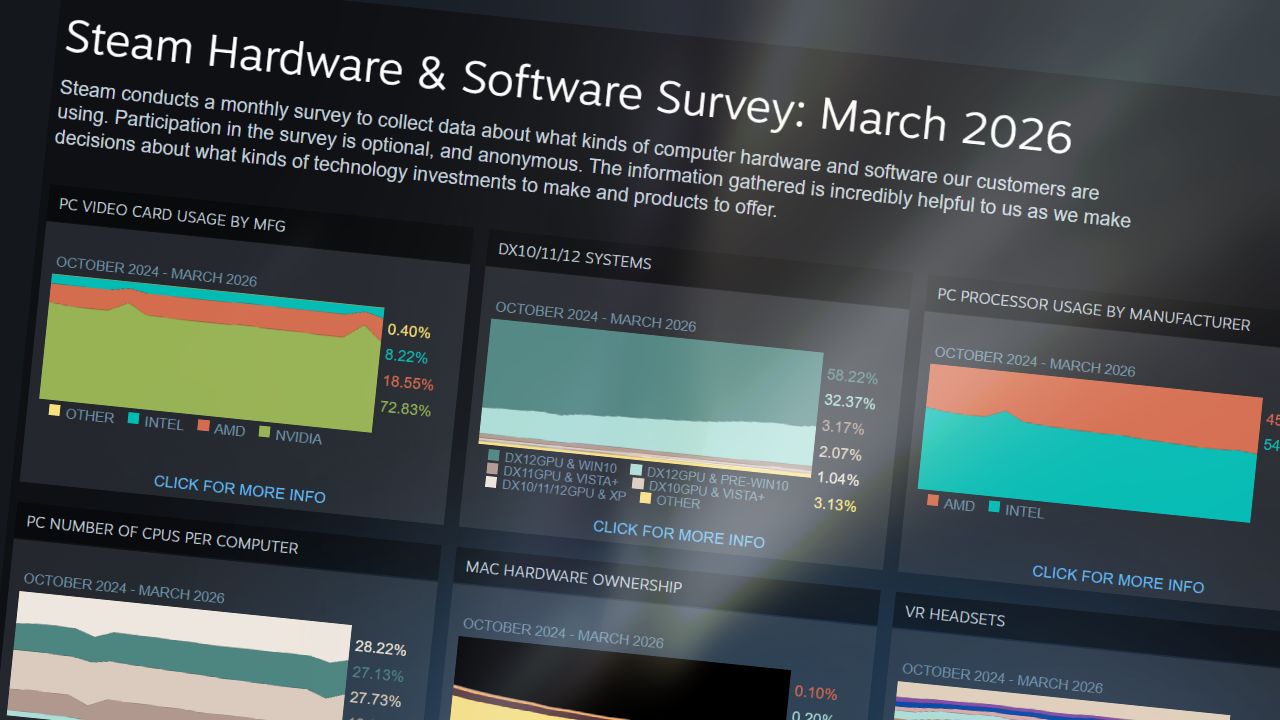
Steam’s latest Hardware Survey is out, and as usual, it is part useful market snapshot, part statistical fever dream.
March 2026 brought a few genuinely notable changes. Some of them look like natural market movement, like 16 GB of system RAM overtaking 32 GB again. Others, especially Linux suddenly blasting past the 5% mark on Steam, feel less like a gradual shift and more like the chart briefly sneezed.
Still, even with the usual survey quirks, this month’s results offer a fascinating look at where the PC gaming market is heading, what players are prioritizing, and which trends may be real versus temporarily distorted.
Windows Still Dominates, but Linux Pulls Off a Strange Breakout
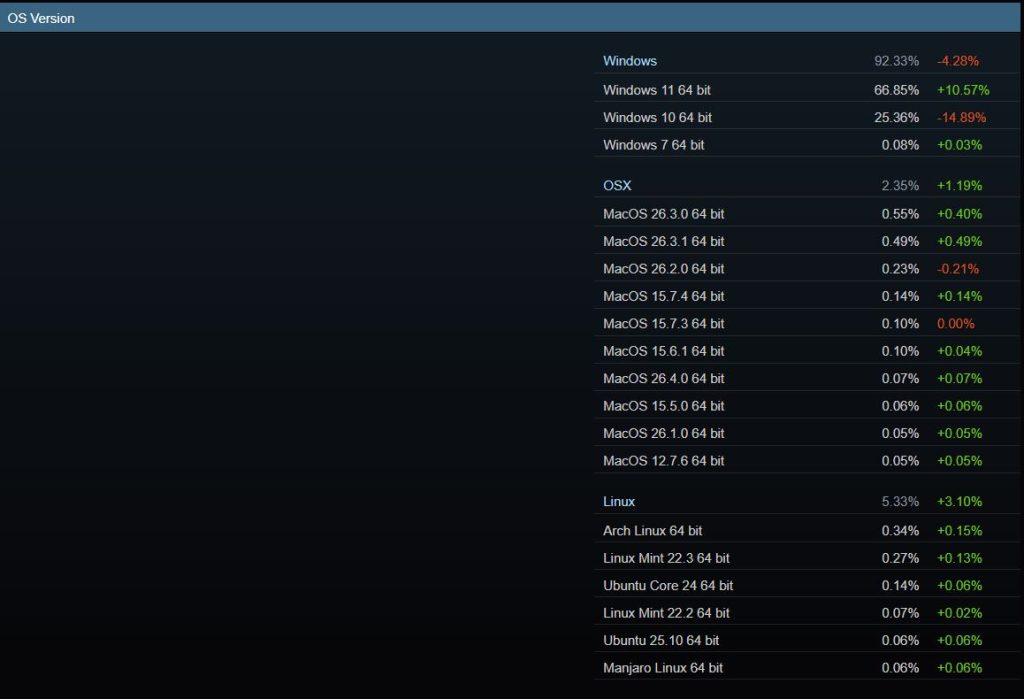
The biggest eyebrow-raiser this month is the operating system split.
Windows 11 64-bit remains the dominant OS on Steam with 66.85% share , helping keep Windows overall at 92.33% . That is still an overwhelming majority, so nobody is sending Windows into retirement just yet.
But the real surprise is Linux, which surged to 5.33% . That is a huge move for a platform that has historically struggled to consistently stay above 2% on Steam. Crossing 5% for the first time is a milestone, but the speed of the jump makes it hard to read as a normal month-to-month shift.
That usually suggests some kind of sampling anomaly or regional weighting effect rather than a sudden mass migration of gamers waking up and deciding this is finally the year of desktop Linux. We have heard that one before.
Even so, it is still an interesting moment. If Linux settles back down next month, this spike will look more like a survey wobble. If it holds meaningfully higher than its old baseline, then Proton, Steam Deck influence, and broader Linux gaming maturity may be starting to show up more clearly in Valve’s data.
Checkout my other article: USB Explained: The Universal Standard That Isn’t
The RTX 3060 Refuses to Leave the Stage
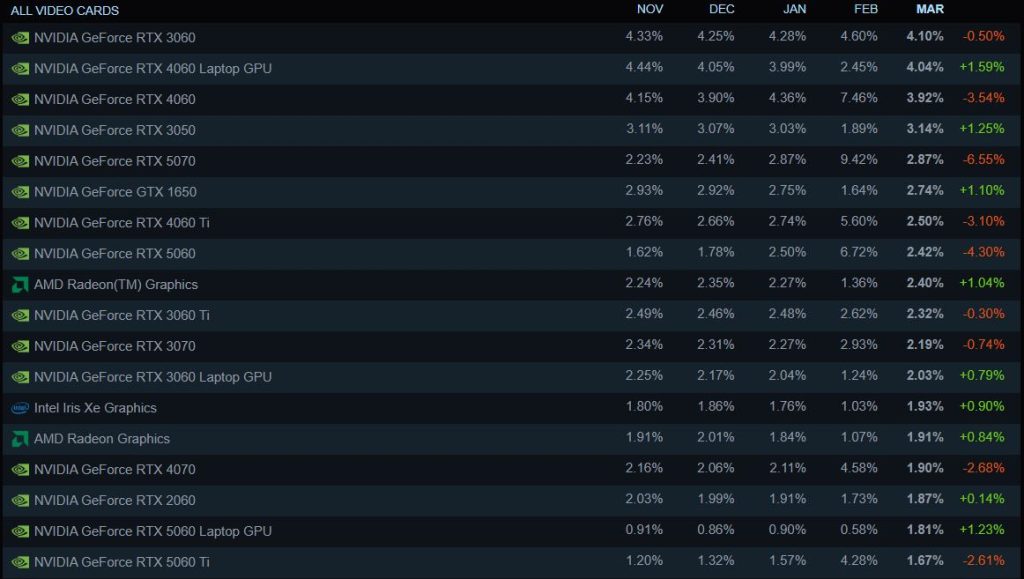
On the GPU side, the GeForce RTX 3060 is back on top with 3.92% share .
That is not exactly shocking. The RTX 3060 has become the cockroach of PC gaming hardware discourse: impossible to ignore, surprisingly resilient, and somehow still everywhere. Despite constant hype around newer generations, it continues to represent the kind of practical, midrange purchase that defines the broader PC market better than flashy flagship launches ever do.
Meanwhile, the dramatic February surge for NVIDIA’s RTX 50-series cards appears to have cooled off. That earlier spike now looks less like a lasting momentum shift and more like a temporary distortion. In March, those cards fell closer to their January levels.
Among the RTX 50 family, the RTX 5070 remains the most popular with 5.40% share , while the rest of the lineup is spread more thinly across the survey. AMD’s Radeon RX 9070 also made an appearance, though only at 0.15% , which is more “proof of life” than market breakthrough.
16 GB of RAM Is Back on Top
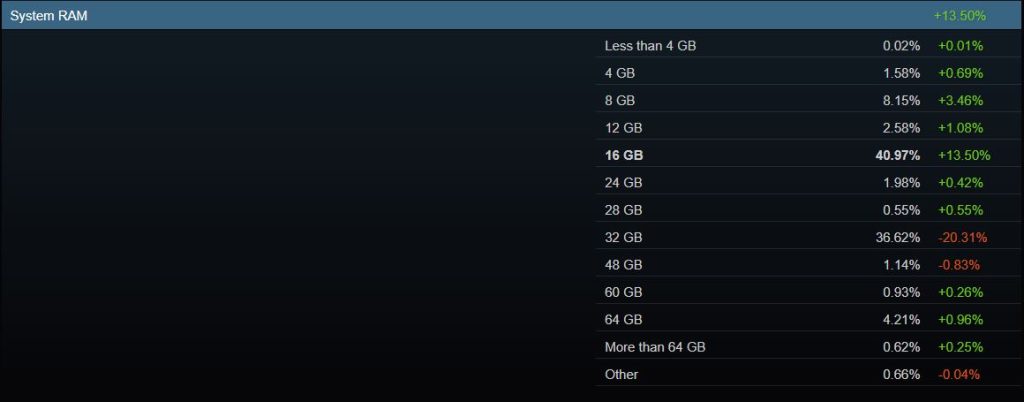
One of the most meaningful shifts in the survey is in system memory.
16 GB RAM climbed to 40.97% share , overtaking 32 GB , which fell to 36.62% after a steep 20.31% drop . That is a notable reversal, especially after 32 GB had been building momentum as the new enthusiast sweet spot.
The likely explanation is not especially glamorous: pricing.
As RAM prices climbed, more users seem to have stuck with or returned to 16 GB configurations rather than jumping to 32 GB. That makes sense in a market where gamers are balancing upgrade priorities carefully. When budgets tighten, memory capacity becomes one of the easier places to compromise, especially compared to a full GPU replacement.
This shift does not necessarily mean 16 GB has become the ideal target again. It just means affordability still beats aspiration when real money is involved.
VRAM Trends Suggest Gamers Are Thinking Longer-Term
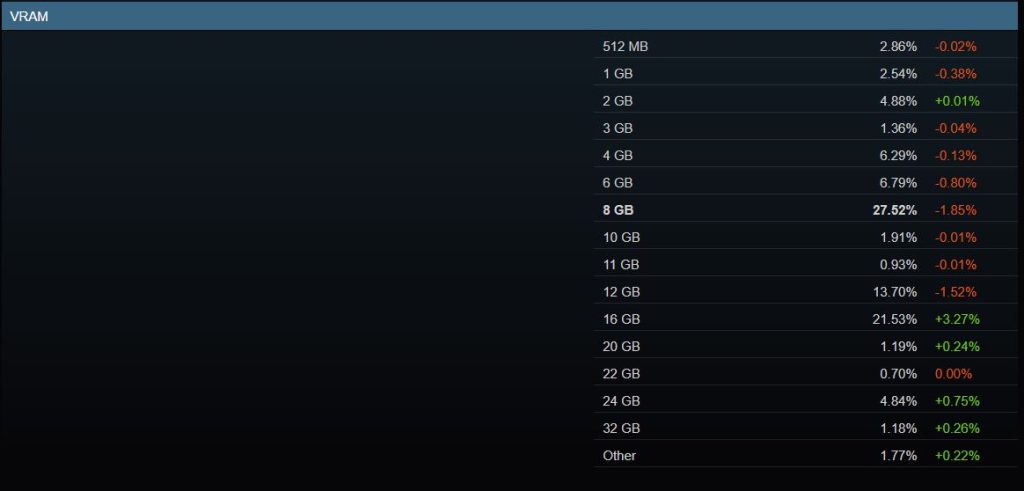
If system RAM is where people are cutting back, VRAM may be where they are trying not to.
8 GB VRAM is still the most common configuration at 27.52% share , which keeps it firmly in mainstream territory. But 16 GB VRAM GPUs rose sharply to 21.53% , gaining 3.27% in the latest survey.
That increase matters.
Unlike system memory, GPU memory is not something users can upgrade later. Once you buy the card, you are married to the VRAM budget for the life of the hardware. That makes higher-VRAM GPUs feel increasingly attractive in a market where modern games are not exactly becoming gentler with texture memory demands.
In other words, gamers may be willing to live with 16 GB of system RAM for now, but they are showing more interest in graphics cards that offer more breathing room for future titles.
That is a pretty rational strategy, honestly. Swapping RAM sticks is annoying. Replacing an entire GPU is expensive enough to qualify as an emotional event.
The Rest of the Snapshot Still Looks Familiar
Beyond the headline shifts, the broader profile of the average Steam user remains pretty recognizable:
- 16 GB system RAM is the most common setup
- 6-core CPUs hold 27.77% share
- Intel CPU clock speeds in the 2.3 GHz to 2.69 GHz range account for 20.38%
- 1920 x 1080 remains the dominant primary display resolution at 51.93%
- 3840 x 1080 leads multi-monitor desktop resolutions at 49.08%
- English rose to 39.09%
- 1 TB+ total storage still leads at 50.11%
- 100 GB to 249 GB of free drive space accounts for 22.98%
- Meta Quest 3 sits at 27.66% among VR headsets
That is a fairly classic Steam profile: midrange GPU, 1080p gaming, 6-core CPU, plenty of storage, and a system built more around sensible longevity than bleeding-edge specs.
Checkout my other article: Bluetooth Latency Explained: The Gap Between Theory and Reality
What This Means for the Industry
The March survey reinforces a few important ideas about the PC gaming market.
First, the average PC gamer is still highly cost-conscious. The return of 16 GB as the most common memory configuration suggests that even when enthusiasts and hardware vendors talk up “ideal” specs, mainstream buyers are still making pragmatic decisions.
Second, older, value-friendly GPUs continue to define the actual market more than new launches do. The RTX 3060 staying on top is a reminder that installed base matters far more than launch-week excitement.
Third, VRAM is becoming a more central part of the buying conversation. As game requirements climb and complaints around memory limitations become more common, buyers seem more aware that VRAM capacity has long-term consequences.
And finally, Linux’s sudden rise is worth watching, even if it turns out to be temporary. Whether this was a statistical blip or the beginning of a broader step up, it shows that platform share on Steam is not as frozen as it once seemed.
Final Thoughts
Steam’s March 2026 Hardware Survey is a mix of the expected and the suspiciously dramatic.
The expected part is easy: 1080p is still king, the RTX 3060 is still absurdly relevant, and mainstream players are still trying to get the most life out of reasonably priced builds.
The dramatic part is Linux vaulting past 5% and 32 GB RAM suddenly losing ground to 16 GB. One of those trends may stick. The other may quietly evaporate next month like it never happened.
That is the fun of Steam Hardware Survey season. It is never just a hardware report. It is also a reminder that the PC market is messy, price-sensitive, and occasionally a little chaotic. Which, to be fair, is very on-brand for PC gaming.
