
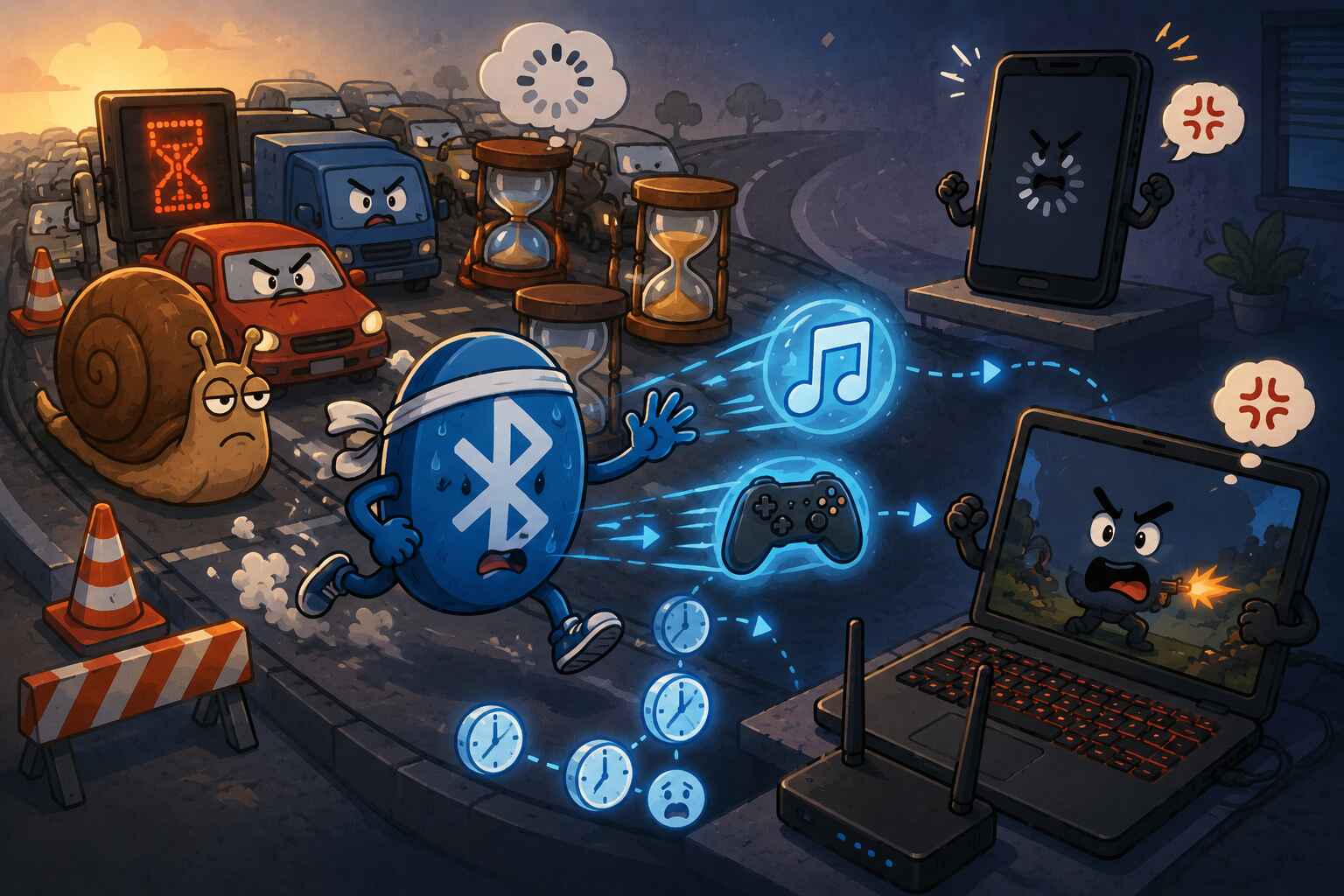
Bluetooth is one of those technologies we use every day… and quietly distrust.
You connect your earbuds, play a video, and suddenly:
- The lips move first
- The sound follows
- Your brain files a complaint
Meanwhile, your cheap 2.4GHz gaming headset with a tiny USB dongle? Perfectly in sync. No drama. No betrayal.
So naturally, the question appears: “If both are wireless… why is one flawless and the other feels… late?”
Short answer: They are not the same thing.
Long answer? Let’s unpack one of the most misunderstood pieces of modern tech.
Check out my other article: Why the 3.5mm Jack Always Ends Up Problematic
Before Bluetooth: When Wireless Required… Aim
Before Bluetooth, we had Infrared (IrDA). And it was… an experience.
- Devices needed line-of-sight
- You had to align them like you were calibrating a satellite
- Move slightly → connection gone
It worked, technically. But it was less “wireless freedom” and more “wireless anxiety.”
The world didn’t just need wireless. It needed something invisible, forgiving, and always-on. That’s where Bluetooth came in.
Bluetooth’s Original Sin: It Was Never Meant to Be Fast
Bluetooth was introduced in the late 1990s with a simple mission: Replace cables. Not outperform them.
That distinction matters more than most people realize. From day one, Bluetooth prioritized:
- Low power consumption
- Stability in crowded environments
- Universal compatibility
And quietly sacrificed: Latency.
Not because engineers failed. Because they chose not to optimize for it.
Bluetooth Versions: Evolution Without Revolution
The Early Days (1.0–2.1): “It Works… Usually”
The first generations of Bluetooth were… rough.
- Pairing was unreliable
- Connections dropped randomly
- Latency? Easily 200–300 ms
But hey—it was wireless. And at the time, that was magic.
Bluetooth 3.0: The Identity Crisis
Bluetooth 3.0 introduced a strange idea: “What if we use WiFi… but still call it Bluetooth?”
This “High Speed” mode allowed faster transfers using WiFi under the hood.
But for audio? Nothing really changed. Latency remained stubbornly high.
Bluetooth 4.0: The Split Personality
Bluetooth 4.0 introduced Bluetooth Low Energy (BLE). This was a turning point.
Bluetooth now had two personalities:
- Classic Bluetooth → for audio
- BLE → for sensors, wearables, IoT
BLE was efficient, fast in bursts, and battery-friendly. But, it’s not suitable for high-quality audio (yet).
Bluetooth 5.0–5.3: Better, But Not Faster (Where It Matters)
Bluetooth 5.x improved:
- Range
- Stability
- Device capacity
What it didn’t magically fix: Audio latency. Because the core pipeline—the way audio is processed—remained mostly the same.
LE Audio & LC3: The “Almost There” Moment
Then came Bluetooth LE Audio and the LC3 codec.
This is the biggest modern upgrade:
- More efficient compression
- Better quality at lower bitrate
- Lower latency potential
And new features like:
- Auracast (broadcast to multiple devices)
- Isochronous channels (better sync)
But here’s the key word: Potential. In real-world usage, latency still sits around 80–120 ms (good scenario). Better than before. Still not “instant.”
The Real Problem: You’re Measuring the Wrong Thing
When you see: “Bluetooth latency = 50 ms.”
That number usually refers to: Transmission latency only.
Which is like saying: “My car can go 200 km/h.”
Cool. But your commute still takes an hour.
The Full Bluetooth Latency Pipeline (The Real Culprit)
Here’s what actually happens when you play audio:
Audio Source
→ Encoding (compress audio)
→ Buffering (prepare data)
→ Transmission (Bluetooth link)
→ Buffering (stability on receiver)
→ Decoding (reconstruct audio)
→ Playback (timing & sync)
Each step adds delay.
Let’s break the damage.
1. Encoding: Delay Before Anything Happens
Bluetooth cannot send raw audio. So it compresses it first.
This alone adds:
- SBC: ~100 ms
- AAC: ~80–150 ms
- LC3 / aptX LL: ~20–40 ms
The delay starts before Bluetooth even transmits anything.
2. Buffering: The Silent Latency Monster
Both sender and receiver add buffer. Why?
Because wireless is chaotic:
- Interference
- Packet loss
- Timing inconsistency
Buffer ensures smooth audio but adds higher delay. Typical buffer: 50–150 ms.
3. Transmission: The “Marketing Number”
Actual Bluetooth transmission: ~10–30 ms.
Yes, it’s relatively fast. No, it’s not the main problem.
4. Decoding + Playback: The Final Stretch
- Decoding: ~10–30 ms
- Playback sync: ~10–40 ms
Especially important for true wireless earbuds (left/right sync).
Also read: Why Smartphone Batteries Suddenly Matter More Than Speed
The Reality Check
Add everything together: 100–300+ ms total latency.
That’s why:
- Videos feel slightly off
- Games feel delayed
- Your brain notices
Why Bluetooth 5.3 Doesn’t Feel Revolutionary
Because improvements focus on:
- Transmission efficiency
- Power management
- Stability
But the biggest delays come from encoding and buffering. And those: still exist.
Meanwhile… The 2.4GHz Dongle Just Works
Now let’s talk about your “magic” wireless headset.
First: It’s not Bluetooth. It just uses the same 2.4GHz frequency band.
Why Dongles Feel Instant
1. Private Connection, No Negotiation
Bluetooth:
- Talks to everything
- Negotiates profiles
- Manages multiple devices
Dongle: One device ↔ one receiver.
No complexity. No waiting.
2. Minimal or No Compression
Bluetooth: Must compress audio.
Dongle: Can use light or near-raw transmission.
Less processing = less delay.
3. Fixed Timing (This Is Huge)
Bluetooth:
- Dynamic scheduling
- Frequency hopping
- Adaptive timing
Dongle: Fixed update loop (e.g., 1000Hz).
Predictable timing = instant feel.
4. Aggressive Performance Tuning
Bluetooth: “Be stable and efficient.”
Dongle: “Be fast, I don’t care about battery.”
Different priorities. Different results.
The Future of Bluetooth: Bluetooth 6.2 and The Attempt to Fix Time Itself
If previous Bluetooth upgrades were about:
- Better range
- Better efficiency
- Better coexistence
Then Bluetooth 6.x is trying something more ambitious: Fix how Bluetooth handles time.
Not speed. Not bandwidth. But timing accuracy.
And that’s where Synchronous Channels (often referred to as isochronous / time-bound transmission) come in.
The Core Problem Bluetooth Is Trying to Solve
Right now, Bluetooth works like this: “Send data whenever possible, adjust if needed.”
That means:
- Packets arrive at slightly different times
- Devices must buffer and re-align data
- Audio/video sync becomes… flexible (and not in a good way)
So instead of fixing delay directly, Bluetooth 6.x tries to fix the reason delay exists: Unpredictable timing.
What Is Synchronous Communication (SCI)?
Think of current Bluetooth as: Sending messages whenever the road is clear.
SCI changes it to: Sending messages on a strict schedule, like a train system.
Every packet:
- Has a reserved time slot
- Arrives at a predictable interval
- Is expected at a precise moment
Why This Matters for Latency
Remember the biggest hidden problem earlier? Buffering.
Devices buffer audio because:
- They don’t trust when packets will arrive
With SCI, devices can finally predict timing accurately.
Which means:
- Smaller buffers
- Less need for delay compensation
- More consistent playback
The Real Upgrade: Consistency > Raw Speed
This is subtle, but important. Bluetooth 6.2 is not trying to make transmission faster.
It’s trying to make transmission predictable. And in real-world systems:
- Predictability reduces the need for buffering
- Buffering is what creates most of the delay
So… Will This Kill Bluetooth Latency?
Short answer:
- It will reduce it
- It won’t eliminate it
Even with perfect timing, you still have:
- Encoding delay
- Decoding delay
- Some level of buffering (just smaller)
So instead of:
- 150–300 ms
We might realistically see: 30–70 ms more consistently.
Why This Is Still a Big Deal
Because current Bluetooth has two problems:
- High latency
- Inconsistent latency
SCI mainly fixes #2. And honestly? Humans notice inconsistency more than raw delay
A stable 60 ms feels better than:
- 40 ms → 120 ms → 80 ms fluctuations
The Catch (Because There’s Always One)
For this to work:
- Both devices must support it
- Chipsets must be updated
- Software stacks must adapt
And knowing the ecosystem…This will take years to fully matter.
