
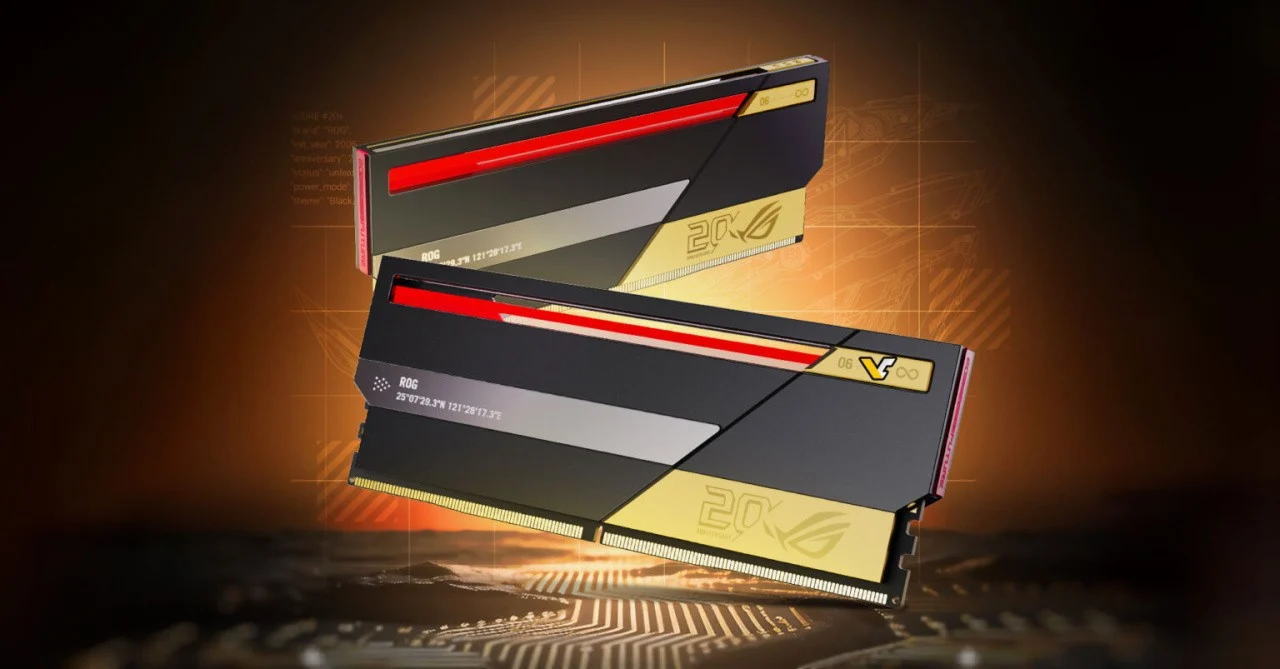
ASUS has finally stepped into the memory market with something that feels very on-brand: flashy, expensive, a little dramatic, and clearly aimed at enthusiasts who think BIOS menus are part of the fun.
At its ROG 20th Anniversary event, the company unveiled its first-ever ROG-branded DDR5 memory modules. And rather than easing into the category with a safe, boring kit, ASUS went straight for a premium 48 GB setup with aggressive timings, RGB, and a special motherboard-level mode that lets users switch between two very different performance profiles.
Because apparently regular EXPO and XMP were not theatrical enough.
ASUS Enters the DDR5 Arena
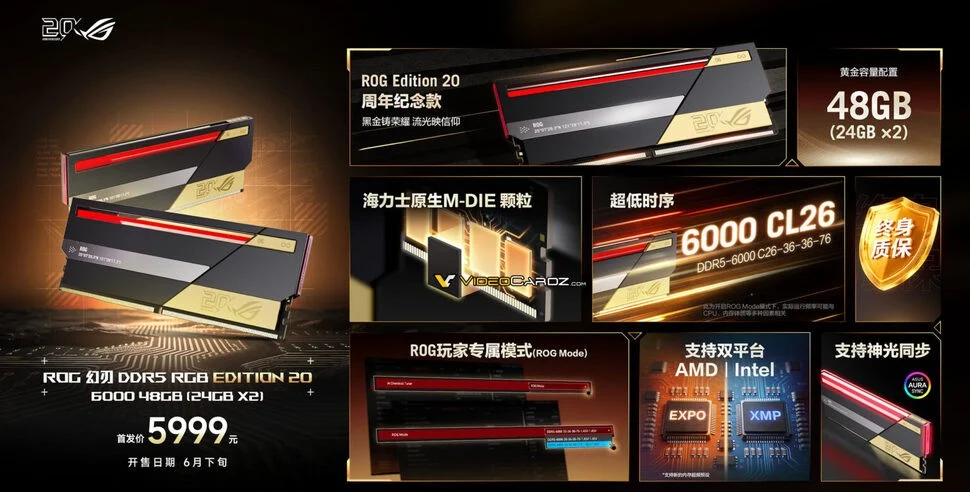
The new kit arrives under the name ROG RGB Edition 20 DDR5, marking ASUS’s first serious move into branded system memory. Rumors about ASUS entering this space had been floating around for a while, but now it is official.
At launch, ASUS appears to be offering a single configuration:
- 48 GB total capacity
- 2 x 24 GB modules
- Hynix M-die memory chips
That last detail matters. Hynix M-die has built a strong reputation among enthusiasts for stability and overclocking headroom, so ASUS clearly is not targeting the casual “just make it boot” crowd here.
Two Modes, Two Personalities
The headline feature is something ASUS calls ROG Mode, a new BIOS option available on supported ROG motherboards.
This mode gives users a choice between two distinct operating profiles:
Low-Latency Mode
- 6000 MT/s
- CL26
- Timings: 26-36-36-76
- Voltage: 1.45V
High-Bandwidth Mode
- 8000 MT/s
- CL36
- Timings: 36-48-48-110
- Voltage: 1.40V
In plain English, ASUS is giving users a switch between tighter timings and raw speed.
The 6000 CL26 setting is likely the more gaming-friendly option, where lower latency can matter more than headline bandwidth. Meanwhile, the 8000 MT/s mode is built for users who want maximum throughput, even if it means giving up some responsiveness in the timing department.
It is a clever idea. Instead of forcing buyers to choose one tuning philosophy when they buy the kit, ASUS is packaging both into the experience and tying it directly into its motherboard ecosystem.
XMP and EXPO Support Keep Things Flexible
To ASUS’s credit, this is not a one-platform stunt.
The ROG DDR5 modules support both:
- Intel XMP
- AMD EXPO
That means the kit is designed to play nicely across modern Intel and AMD platforms, at least in terms of basic profile compatibility. The special ROG Mode feature is obviously meant to shine on ASUS’s own motherboards, but broader support is still important for a first-generation product.
Big Heatsinks, Bright RGB, Maximum ROG Energy
This would not be a Republic of Gamers product if it looked understated.
ASUS has equipped the modules with a tall aluminum heat spreader dressed in a mix of gold, red, black, and silver, along with RGB lighting that syncs through Aura Sync. The design sounds unapologetically bold, which is exactly what you would expect from a brand that has never once confused subtlety with strength.
The module height is also worth noting. These are described as very tall sticks, so anyone planning to pair them with a large air cooler should probably do the adult thing and check clearance before clicking checkout.
ASUS Is Also Building a Broader Memory Ecosystem
The launch is not just about one premium kit. ASUS also says it is working with 14 memory brands on a broader ROG-Certified DDR5 initiative.
That list includes names like:
- BIWIN
- V-Color
- Lexar
- Klevv
- Kingston
- Corsair
- G.Skill
- T-Force
The goal appears to be deeper validation between third-party memory kits and ROG motherboards. That may not sound glamorous, but it could be genuinely useful. Memory compatibility remains one of PC building’s least fun mini-games, and anything that reduces profile roulette in the BIOS is welcome.
Pricing: Premium, Naturally
ASUS is listing the kit at 5999 RMB, which works out to roughly $900 US.
Yes, that is a lot for 48 GB of DDR5 memory. But it is also not wildly out of line with the current top-end memory market, especially for enthusiast-grade kits with premium binning, aggressive specs, and the usual halo-product tax layered on top.
The company is targeting a late June launch.
So no, this is not value RAM. This is “I want my memory kit to have a performance mode and a fashion identity” RAM.
Check out my other article: ASUS’s Premium GPU Cable May Be Solving the Wrong Problem
What This Means for the PC Hardware Market
ASUS entering the memory segment is interesting for a few reasons.
First, it shows how far major PC brands are pushing toward fully integrated ecosystems. Motherboards were not enough. Coolers were not enough. PSUs, cases, monitors, GPUs, peripherals, and now RAM all need to live under one banner. The ROG logo is becoming less of a product line and more of a whole hardware universe.
Second, the ROG Mode concept is smarter than it may sound at first glance. DDR5 tuning can be confusing even for experienced builders, and ASUS is turning that complexity into a branded feature. Instead of expecting users to manually chase timings and voltages, it is presenting two curated paths: one for latency, one for bandwidth.
That is enthusiast hardware packaging itself with a little more usability, which is honestly not a bad direction.
Final Thoughts
ASUS’s first ROG DDR5 kit is exactly what you would expect from a debut under the ROG name: ambitious, flashy, expensive, and designed to make specs part of the spectacle.
The standout feature is not just the 48 GB capacity or the Hynix M-die binning. It is the idea that one memory kit can shift roles depending on what kind of performance you want, all through a dedicated BIOS option.
Whether that is enough to justify the near-$900 price tag is another question entirely. But as a statement product, ASUS has definitely made one.
