
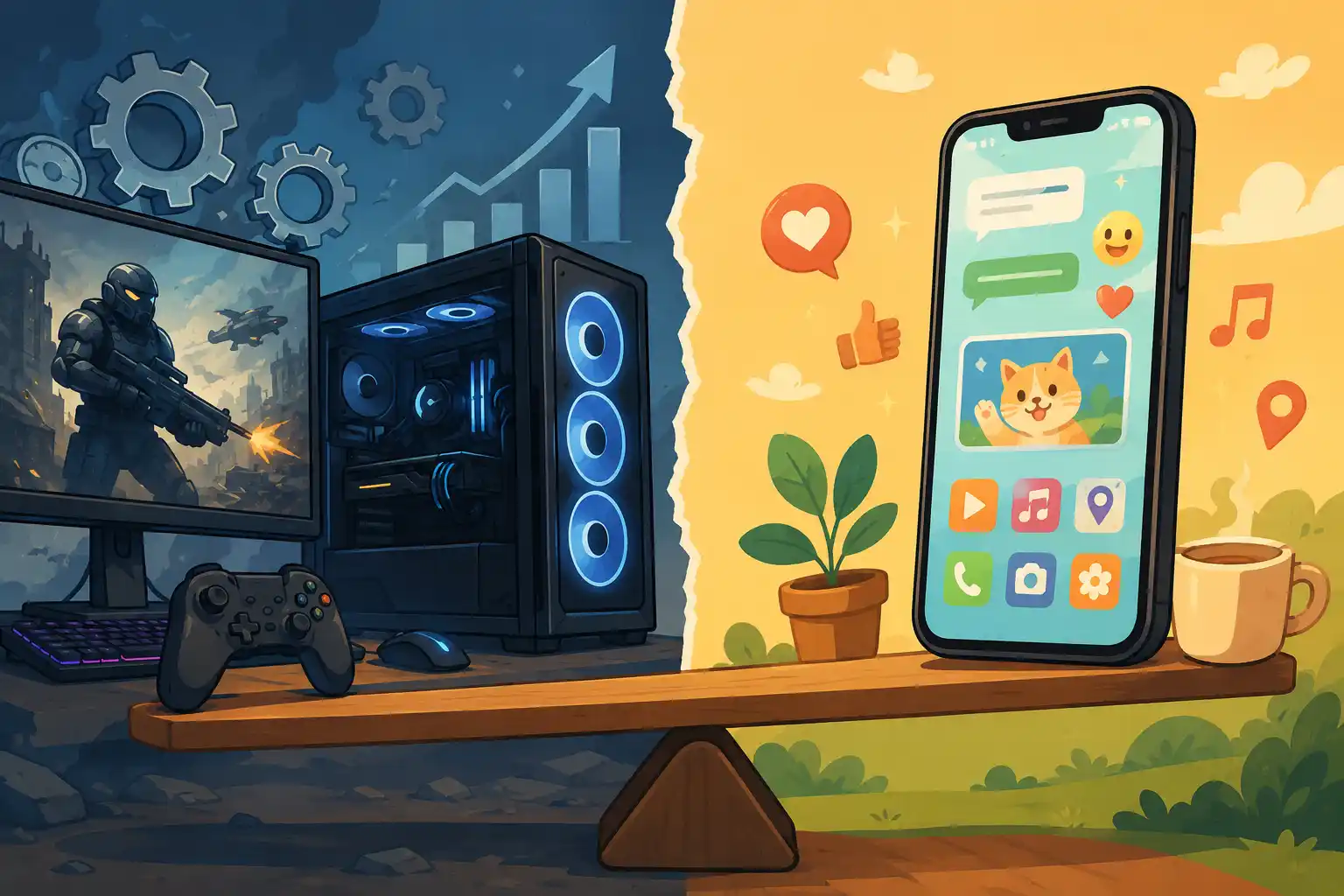
PC vs smartphone is a comparison that usually revolves around performance, gaming, or productivity. PCs are more powerful, smartphones are more portable—that much is obvious. But there’s another, far more interesting difference hiding beneath the hardware.
Every few years, the PC gaming community goes through the same ritual. A new graphics card launches. A shiny new feature appears. Suddenly, your perfectly capable GPU is informed—very politely—that it is now too old to join the party.
“Oh, you have an RTX 2070 Super? That’s ancient.”
Meanwhile, over in smartphone land, someone is happily scrolling Instagram on a 10-year-old phone while WhatsApp, Spotify, Google Maps, YouTube, and twenty-seven other apps fight for attention without turning the device into a miniature nuclear reactor.
Which raises an interesting question. Why isn’t mobile software getting heavier?
Sure, games occupy more storage than ever. Genshin Impact laughs at your remaining free space. Call of Duty Mobile practically requests a dedicated SSD. But despite growing download sizes, most smartphone apps don’t demand dramatically more CPU power, GPU performance, or RAM every year.
On PCs, however, it often feels like software keeps finding new reasons to justify new hardware.
Is it simply because phones are more optimized? Partly. But the more interesting answer has very little to do with technology. It has everything to do with economics.
Maybe you’re interested: Why Are So Many Games Doing IP Collaborations? The Business Strategy Behind Video Game Crossovers
Bigger Doesn’t Mean Heavier
The first thing worth separating is something many people mix together: software size and software weight.
Modern mobile games are enormous. Higher-resolution textures, voice packs, cutscenes, multiple language files, downloadable content—they all consume storage.
But once installed? Most mobile apps are surprisingly lightweight.
Scrolling through TikTok doesn’t require an RTX 5090. Sending a WhatsApp message shouldn’t require liquid cooling. Even many AAA mobile games are carefully designed to avoid sustained heavy CPU and GPU usage.
Why? Because smartphones live under one very strict law: Battery physics doesn’t negotiate.
A desktop GPU can happily consume 300 watts while sounding like it’s preparing for takeoff. A smartphone chip usually has only a few watts available before it starts heating up, draining battery, and throttling performance.
Mobile developers therefore optimize for a completely different question.
PC developers often ask:
“How much more can we compute?”
Mobile developers ask:
“How can we make this feel faster without doing more work?”
It’s a very different philosophy.
Android Has a Billion Bosses
Market size completely changes the rules. Every year, more than a billion smartphones are sold worldwide. That means Android developers aren’t targeting enthusiasts. They’re targeting… well… everyone.
Someone is using the latest flagship. Someone else is still using a phone whose charging cable has become a permanent family member.
If your app suddenly requires flagship-level hardware, congratulations—you’ve just thrown away millions of users. That makes compatibility incredibly valuable. Instead of raising hardware requirements, developers spend enormous effort squeezing more performance from existing devices.
Ironically, mobile software often becomes better optimized instead of simply becoming heavier.
Then Why Does PC Feel Different?
Because PCs live in a completely different economy. GPU manufacturers don’t make billions from app stores or digital ecosystems.
They primarily make money when people buy new GPUs. That’s not criticism. That’s just the business. Naturally, every new generation needs compelling reasons to exist.
Sometimes those reasons are genuine breakthroughs. Sometimes they’re better implementations of existing ideas. And sometimes, they’re a little more complicated.
Take Frame Generation.
Officially, NVIDIA limits DLSS Frame Generation to newer RTX generations because of improved hardware like the Optical Flow Accelerator. That’s true.
But it’s also true that modders have managed to get Frame Generation running on older GPUs like the RTX 2070 Super with surprisingly decent results.
Is it identical? No.
Is the newer hardware better? Absolutely.
Does that mean the older hardware is completely incapable? Apparently not.
Reality often sits somewhere between technical necessity and product strategy.
Artificial Demand? Maybe. Artificial Exclusivity? Definitely.
The interesting thing isn’t whether companies are lying. They’re usually not. The interesting part is that technical limitations and business incentives often point in exactly the same direction.
Supporting older hardware means:
- more validation
- more driver testing
- more customer support
- less incentive to upgrade
Limiting features to newer hardware means:
- simpler development
- guaranteed experience
- clearer marketing
- stronger upgrade motivation
Conveniently, everyone can justify the decision using different arguments.
Engineering gets cleaner. Marketing gets stronger. Sales get happier. It’s one of those rare situations where everybody inside the company wins.
Except maybe your bank account.
But Wait… iPhones Force Upgrades Too
At this point you might be thinking: “Hold on. My friend literally had to replace his iPhone because WhatsApp stopped supporting it.”
That’s a fair point. And interestingly, it’s a different type of obsolescence. WhatsApp isn’t computationally demanding.
You’re sending text. Occasionally a sticker. Maybe an embarrassing voice note.
The problem isn’t horsepower. It’s software support. Apple controls the hardware, operating system, and developer platform. Eventually, older iPhones stop receiving new iOS versions.
Developers adopt newer security frameworks and APIs. Apps follow.
Older phones get left behind—not because they’re slow, but because they’re no longer part of the supported ecosystem. That’s policy-driven obsolescence rather than performance-driven obsolescence.
Check this out? In-Game Ads Are Already Here. The Real Question Is How Weird the Industry Wants to Make Them
Consoles Secretly Agree With Smartphones
Here’s where things become really interesting. Consoles behave far more like smartphones than PCs.
Sony, Microsoft, and Nintendo don’t primarily want you replacing your console every two years. They want you buying games. That’s where the ecosystem makes money.
As a result, developers spend years optimizing for fixed hardware.
Compare launch titles on the PlayStation 4 with games released near the end of its life. Same console. Completely different visual quality.
The hardware didn’t evolve. The optimization did. Console developers assume users won’t upgrade. PC developers often assume they eventually will. That difference changes everything.
Three Markets, Three Philosophies
At this point, a pattern starts emerging.
Smartphones optimize for compatibility because reaching billions of users matters.
Consoles optimize for longevity because keeping players inside the ecosystem matters.
PC hardware often optimizes for differentiation because selling the next generation matters.
Same silicon. Different incentives. Different software.
So… Is Software Actually Getting Heavier?
Yes. And no.
Some modern software absolutely requires more computational power. Real-time ray tracing isn’t free. AI workloads aren’t magic. Modern game worlds are genuinely more complex.
But many software trends today are no longer driven purely by hardware limitations. They’re also shaped by business models. Storage keeps growing because storage is cheap. Features become exclusive because exclusivity sells products.
Compatibility expands or contracts depending on who benefits from it. Technology didn’t stop advancing.
It simply started following economics.
The Bigger Picture
For decades, we believed software naturally became heavier because computers became faster. Today, that relationship isn’t nearly as straightforward.
A smartphone powerful enough to edit 4K video spends most of its day showing cat videos. A five-year-old GPU can often still play modern games—until one specific feature says otherwise.
A perfectly functional phone may lose WhatsApp not because it lacks power, but because its software birthday has passed. In other words, modern hardware rarely becomes obsolete because physics says so.
More often than we’d like to admit, it becomes obsolete because the ecosystem has decided it’s time. And that might be the biggest shift in computing over the last decade.
Not faster processors. Not smarter AI. Not prettier graphics.
But the realization that technology no longer evolves according to engineering alone.
It evolves according to incentives.
