
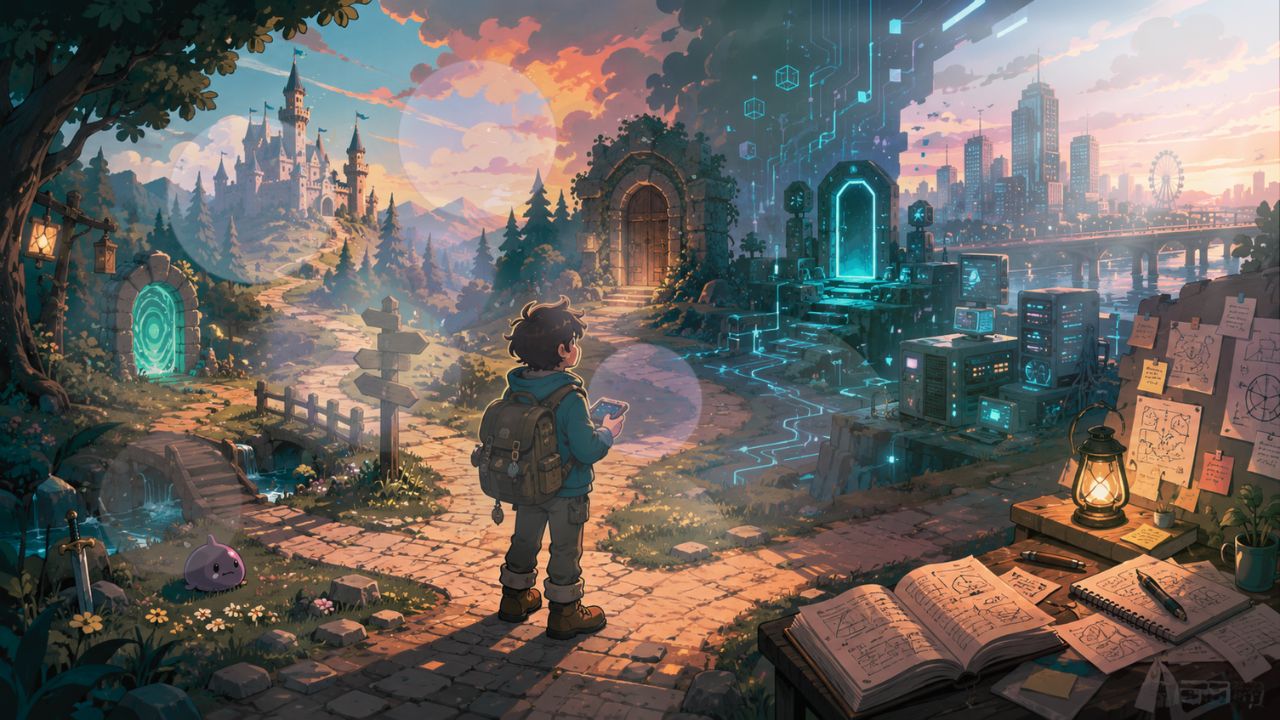
I have always loved two things: games and learning. For me, they have never been separate.
I grew up in Purworejo, a small town in Central Java. When I was still in elementary school, English was not yet taught at my school. But I was already learning it through RPGs.
Games like Final Fantasy IV became my accidental language teachers. I learned words because I needed to understand where to go, what an item did, why a kingdom was collapsing, and which suspicious old man was definitely about to betray the party.
It was not formal education. But it was still learning.
That experience stayed with me. It taught me that learning does not only happen in classrooms, universities, textbooks, or carefully organized online courses with thumbnails of people pointing at large arrows.
Learning can happen anywhere.
It can happen while playing a game, watching a film, repairing a computer, reading an article, arguing with a friend over coffee, or falling into a completely unnecessary three-hour rabbit hole because one small question refused to leave your head.
And I love those rabbit holes.
Curiosity Without a Practical Purpose
A lot of modern advice tells us that learning should be useful.
Learn a skill that improves your career. Read a book that increases productivity. Study something that can be monetized, optimized, packaged, and perhaps sold as a course before lunch.
There is nothing wrong with practical learning. But I also love learning things that may never be useful to me.
Sometimes I want to understand how a technology works simply because it exists. Sometimes I become interested in a historical event because it resembles a fictional conflict in a game. Sometimes a game mechanic sends me into behavioural economics, psychology, politics, philosophy, hardware design, or some obscure corner of human history.
There is not always a plan.
Curiosity is the plan.
That is also why Zilbest may look slightly random.
You may find an article about PC gaming next to an essay about workplace psychology, an explanation of computer hardware, a deep dive into game lore, or a discussion about why people are attracted to simple answers.
On the surface, these subjects may not seem closely related. To me, they are.
They are all different ways of understanding how people, systems, technology, and ideas work.
Why It Is Called Zilbest
Zilbest was originally my in-game name.
It was the name I used while exploring virtual worlds, fighting monsters, making terrible strategic decisions, and occasionally blaming lag for things that were absolutely my fault.
Eventually, the name became more than an identity inside games. It became a place for my curiosity outside them.
Zilbest is where I write about the questions that interest me, the connections I notice, and the ideas I am still trying to understand.
I do not write because I have mastered every subject discussed here. I write because writing is one of the best ways I know to learn.
There Is More Than One Way to See Something
One idea ties most of Zilbest together: perspective.
I do not believe that every complicated question has one simple answer.
A game can be entertainment, art, technology, business, culture, social space, and psychological machinery at the same time. Work can provide meaning and destroy it. Technology can solve problems while quietly creating new ones. The same decision can look intelligent from one position and absurd from another.
Different perspectives do not always mean that every answer is equally correct.
Facts still matter. Evidence matters. Logic matters. But our understanding is often incomplete.
We see the world through our experiences, incentives, knowledge, fears, identities, and assumptions. Sometimes the most useful thing we can do is not immediately decide which side is right, but ask what each side can see—and what it cannot.
Zilbest does not exist to provide the final answer to everything. That sounds exhausting, and definitely suspicious.
Instead, it tries to offer another angle. A hidden connection. A different question. A perspective that may make something familiar look unfamiliar again.
Playing with Life
The tagline of Zilbest is Playing with Life.
It is not about treating life as something trivial. It is about approaching life with the spirit of play: curiosity, experimentation, imagination, and the willingness to try another way.
Games teach us to explore.
They let us test systems, make mistakes, change strategies, and see what happens. We learn through interaction rather than merely receiving information.
I think life can be approached in a similar way.
We can examine the rules we inherited. We can question assumptions that appear obvious. We can try different perspectives instead of committing ourselves permanently to the first answer that makes us comfortable.
To play with life is to take it seriously enough to explore it.
What You Will Find Here
Zilbest covers games, technology, psychology, industry, culture, philosophy, and whatever else manages to hijack my attention that week.
The subjects may vary, but the intention remains the same:
- To make complicated ideas easier to understand.
- To connect subjects that are usually kept apart.
- To learn without pretending that learning must always be productive.
- And to remind ourselves that games, stories, devices, companies, habits, and everyday experiences can all teach us something about the world. Or at least give us better questions.
Let Us Keep Learning
I do not have all the answers. The older I get, the more confident I become that nobody does—especially the people who appear extremely confident on social media.
Zilbest is not a collection of final conclusions. It is a record of curiosity.
It began with games, but it was never only about games.
It is about learning from anything, looking at familiar things from different perspectives, and enjoying the process of understanding life a little better than we did yesterday.
Yabes Elia
Owner and Author, Zilbest