
In the world of Fallout, nuclear war destroyed civilisation in roughly two hours.
Vault-Tec needed several decades.
Long before the bombs fell on October 23, 2077, the company had already turned the approaching apocalypse into an enormous business opportunity. It sold underground shelters to terrified Americans, covered everything in cheerful blue-and-yellow branding, and promised that carefully selected citizens would survive until it was safe to rebuild.
That was the advertisement.
In reality, most Vaults were never designed primarily to save their inhabitants. They were laboratories. Their residents were test subjects. Their Overseers were researchers, administrators, or unwilling accomplices.
Vault-Tec did not merely prepare for the end of the world. It built a corporate strategy around it.
In case you missed it: Fallout Timeline Explained: How the World Ended in 2077
What Was Vault-Tec?
Vault-Tec Corporation was one of the largest defence contractors in pre-war America.
Its most famous product was the Vault: a massive underground shelter designed to protect people from nuclear war. But Vault-Tec also worked in nuclear engineering, medicine, life-support systems, surveillance, virtual reality, robotics, weapons, and social engineering.
The company developed technology capable of keeping communities alive underground for decades. Its Vaults contained water-purification systems, reactors, medical facilities, farms, automated security, and central computers.
Many of those inventions were genuinely impressive. The problem was that Vault-Tec rarely looked at advanced technology and asked, “How can this help humanity?”
It usually asked, “What happens if we lock 500 people underground with it?”
Project Safehouse
The Vault programme began under Project Safehouse, launched by the US government in 2054.
By then, the world was already falling apart. The United Nations had collapsed. The Resource Wars were spreading. The New Plague had killed thousands. Nuclear weapons had already been used in the Middle East.
Vault-Tec secured the government contract after building a successful prototype near its Los Angeles headquarters. Only 122 Vaults were commissioned.
That sounds substantial until you remember that pre-war America had hundreds of millions of people. Even if every Vault had worked perfectly, they could have protected only a tiny fraction of the population.
And most did not work perfectly.
Vault construction was also absurdly expensive. Vault 13 alone reportedly cost hundreds of billions of dollars. Project Safehouse was partly funded through junk bonds, because apparently even nuclear survival needed questionable financing.
The Vaults were never a complete rescue plan. They were a highly selective lottery where losing meant nuclear fire and winning might mean becoming part of a fungus experiment.
How Vault-Tec Became So Powerful
During the Sino-American War, Vault-Tec became one of the most influential corporations in the United States.
Its facilities were treated as critical defence infrastructure. Its projects received limited oversight. Its executives had access to senior government officials, military leaders, and other powerful corporations.
As America became increasingly authoritarian, the line between government and business nearly disappeared. Vault-Tec was officially a contractor.
In practice, it became something closer to a private government with better merchandise.
Fear also helped its growth. Every war, disease outbreak, and political crisis made the Vault programme look more necessary. The closer the world came to destruction, the more valuable Vault-Tec became.
The apocalypse was terrible for civilisation. It was excellent for business.
Vault-Tec University
Vault-Tec also created its own educational pipeline.
The company took control of a college in Morgantown and transformed it into Vault-Tec University, or VTU. Traditional academic programmes were gradually replaced with training for Vault operations.
Students studied medicine, psychology, engineering, leadership, survival, and crisis management. The university even had a full-scale simulation Vault.
Many future Vault-Tec scientists, executives, and Overseers studied there.
VTU did not merely train employees. It trained people to think according to Vault-Tec’s philosophy:
- The experiment must continue.
- Authority must be obeyed.
- Residents asking questions are displaying fascinating behavioural instability.
Vault Boy and the Marketing of Armageddon
Vault-Tec understood something many evil organisations forget: Terrifying plans need friendly branding.
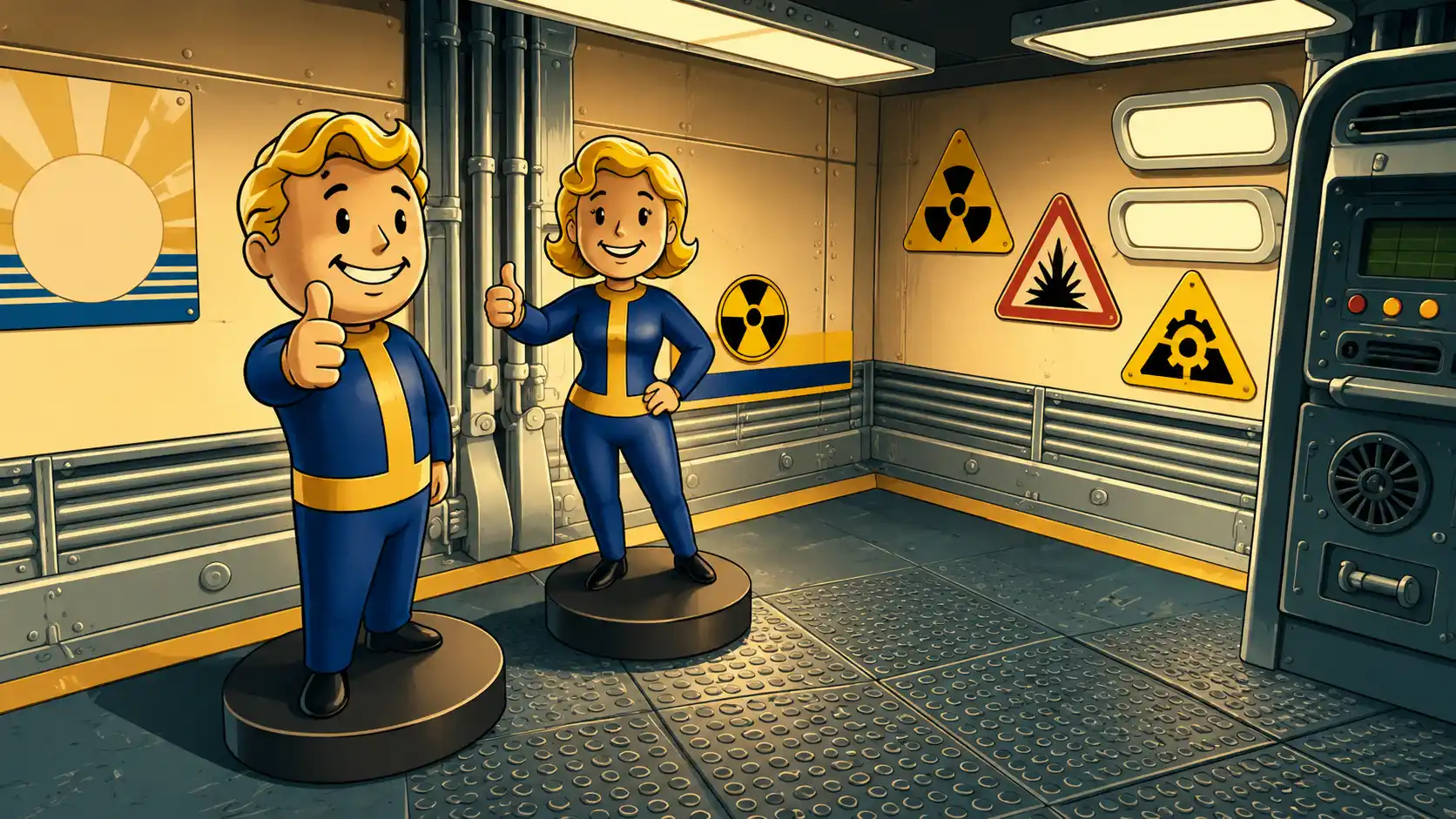
Its advertisements showed smiling families, clean corridors, modern technology, and cheerful optimism. At the centre of this image was Vault Boy, the company’s permanently enthusiastic mascot.
Vault Boy appeared in advertisements, manuals, training videos, safety guides, and merchandise.
Radiation poisoning? Thumbs up. Severe injury? Thumbs up. Discovering your Vault was designed to test whether humans can survive without sleep? Still thumbs up.
The company also sold clothing, lunchboxes, bobbleheads, jackets, snow globes, and other merchandise. Vault-Tec did not simply sell survival. It sold a lifestyle. The fact that the lifestyle sometimes involved annual human sacrifice was apparently hidden in the terms and conditions.
Cooper Howard: Selling the End of the World
The Fallout television series expanded Vault-Tec’s history through Cooper Howard.
Before becoming the Ghoul, Cooper was a famous actor and war veteran. Vault-Tec recruited him as a spokesperson, using his face and reputation to make the company appear trustworthy.
He became the friendly celebrity telling American families that everything would be fine underground. This approach still exists today, although celebrities usually promote insurance, mobile games, or crypto rather than subterranean human experiments.
Cooper eventually discovered that the Vaults were not simply shelters. They were part of a much larger plan to control the future.
The Vaults Were Human Experiments
The central truth of Vault-Tec is that most Vaults were never supposed to operate normally. Only 17 of the 122 publicly known Vaults were genuine control Vaults. The others contained experiments.
Some studied social behaviour:
- A Vault requiring one human sacrifice every year
- Two populations deliberately encouraged to distrust each other
- A Vault where every decision was settled through gambling
- An AI creating crises to identify the ideal leader
Others focused on biology and medicine:
- Radiation exposure
- Infectious diseases
- Genetic selection
- Mutation
- Addiction
- Cryogenic preservation
Some tested experimental technology, including virtual reality, subliminal messaging, automated government, and agricultural organisms. And some seemed to answer questions nobody responsible had ever asked.
What happens if a Vault contains too many guns and too little space? What happens if musicians hear hidden combat commands? What happens if one man lives underground with a box of puppets?
The answer was usually: something preventable and horrible.
The Enclave and the Real Purpose of the Vaults
The experiments were linked to the Enclave, a secret organisation made up of senior government officials, military leaders, scientists, and powerful industrial figures.
The Enclave saw itself as the legitimate continuation of the United States. More accurately, it was the continuation of the people already controlling the United States while everyone else still believed elections were involved.
The Vaults collected data on long-term isolation, population control, leadership, reproduction, scarcity, disease, and psychological stress. One possible goal was to prepare for space colonisation.
A generation ship would face many of the same problems as a Vault: limited resources, confined populations, social conflict, and long-term survival. The Enclave therefore wanted to use Vault residents as test subjects for humanity’s future. Testing these questions through voluntary research would have been less evil.
But it would also have lacked Vault-Tec’s favourite ingredient: unsuspecting civilians.
Vault-Tec’s Most Important Technologies
Despite its crimes, Vault-Tec created several technologies that genuinely helped rebuild civilisation.
The GECK
The Garden of Eden Creation Kit, or GECK, was designed to help Vault residents establish settlements on the surface. Depending on the version, it contained seeds, fertilisers, water-purification equipment, and advanced restoration technology.
It was essentially civilisation in a box.
Communities such as Vault City depended heavily on GECK technology. This proves Vault-Tec was capable of creating useful things. It simply preferred storing them beside experiments where everyone slowly lost their minds.
VATS and Other Systems
Vault-Tec also developed or supported advanced medical equipment, reactors, simulation systems, cryogenic technology, and the Vault-Tec Assisted Targeting System, better known as VATS.
VATS turns a frantic gunfight into a calm statistical exercise. Because nothing says survival like calculating whether shooting a mutant in the left kneecap has a 73% success rate.
The Overseers
Each Vault normally had an Overseer responsible for maintaining order and managing resources. Many Overseers also received secret instructions related to the experiment.
Some were told to observe residents. Others had to manipulate events, conceal information, release pathogens, or maintain isolation. Not every Overseer followed orders.
Dr. Olivette of Vault 81 sabotaged her Vault’s experiment and prevented its residents from being deliberately infected with diseases.
Others embraced Vault-Tec’s authority, became dictators, or simply failed under impossible conditions.
Vault-Tec’s system was effective because the company did not need to control every Vault directly. It created a hierarchy, gave one person secret authority, isolated everyone underground, and allowed human nature to handle the rest.
Did Vault-Tec Start the Great War?
The Fallout television series revealed that Vault-Tec executives discussed deliberately causing nuclear war.
Their logic was simple. As long as peace remained possible, Vaults were merely expensive insurance. If the world ended, Vault-Tec could shape whatever society came afterward.
Senior executives discussed allowing different corporations to influence their own Vault experiments and dominate parts of the post-war economy. Medicine, energy, robotics, and agriculture could all become controlled monopolies. Vault-Tec would control the system connecting them.
However, the series does not prove that Vault-Tec actually launched the first weapon.
China, the United States, the Enclave, automated defence systems, or another actor may still have started the Great War.
Vault-Tec had motive. It had discussed the possibility. But direct responsibility remains unconfirmed. It is entirely possible the company planned to cause the apocalypse and was beaten to it by governments already doing an excellent job.
Bud’s Buds: The Future of Middle Management
The television series also introduced Bud Askins and his programme called Bud’s Buds. Bud believed the best people to rebuild civilisation were junior executives.
Humanity had spent thousands of years developing governments, philosophy, and social institutions. Bud looked at all of that and decided the future belonged to middle management.
Vaults 31, 32, and 33 were designed around this idea.
Vault 31 stored Vault-Tec employees in cryogenic suspension. Over time, they would be awakened, placed into the other Vaults, and guided into leadership positions. The civilian residents did not know they were part of a selective breeding and social-engineering programme.
Bud himself survived as a brain mounted on a small robot. He had finally reached the ultimate managerial form: A head with no visible responsibility.
Why Vault-Tec Failed
Vault-Tec expected nuclear war to wipe the surface clean. Instead, many people survived outside the Vaults and created their own settlements, factions, and nations.
The Vault experiments also failed constantly.
Residents rebelled. Overseers disobeyed. Equipment broke. Mutations escaped. Communities opened their doors early. People discovered the truth.
Vault-Tec tried to design humanity’s future like a corporate workflow. Humanity refused to stay inside the spreadsheet. By the time of the Fallout games, most Vaults had become ruins, tombs, settlements, or scavenging sites.
Vault-Tec no longer controlled the world. But its failures continued shaping it.
Vault-Tec Did Not Preserve America
Vault-Tec claimed it was preserving American civilisation. But it did not preserve democracy, equality, civil rights, or accountability. It preserved technology, corporate hierarchy, classified research, and the belief that powerful people should decide humanity’s future without asking humanity.
That is Vault-Tec’s real legacy.
The bombs destroyed America’s cities. Vault-Tec preserved many of the ideas that helped destroy them. It promised Americans a place in the future. It simply neglected to mention that many of them would enter that future as data points.
At least they received matching jumpsuits.
