
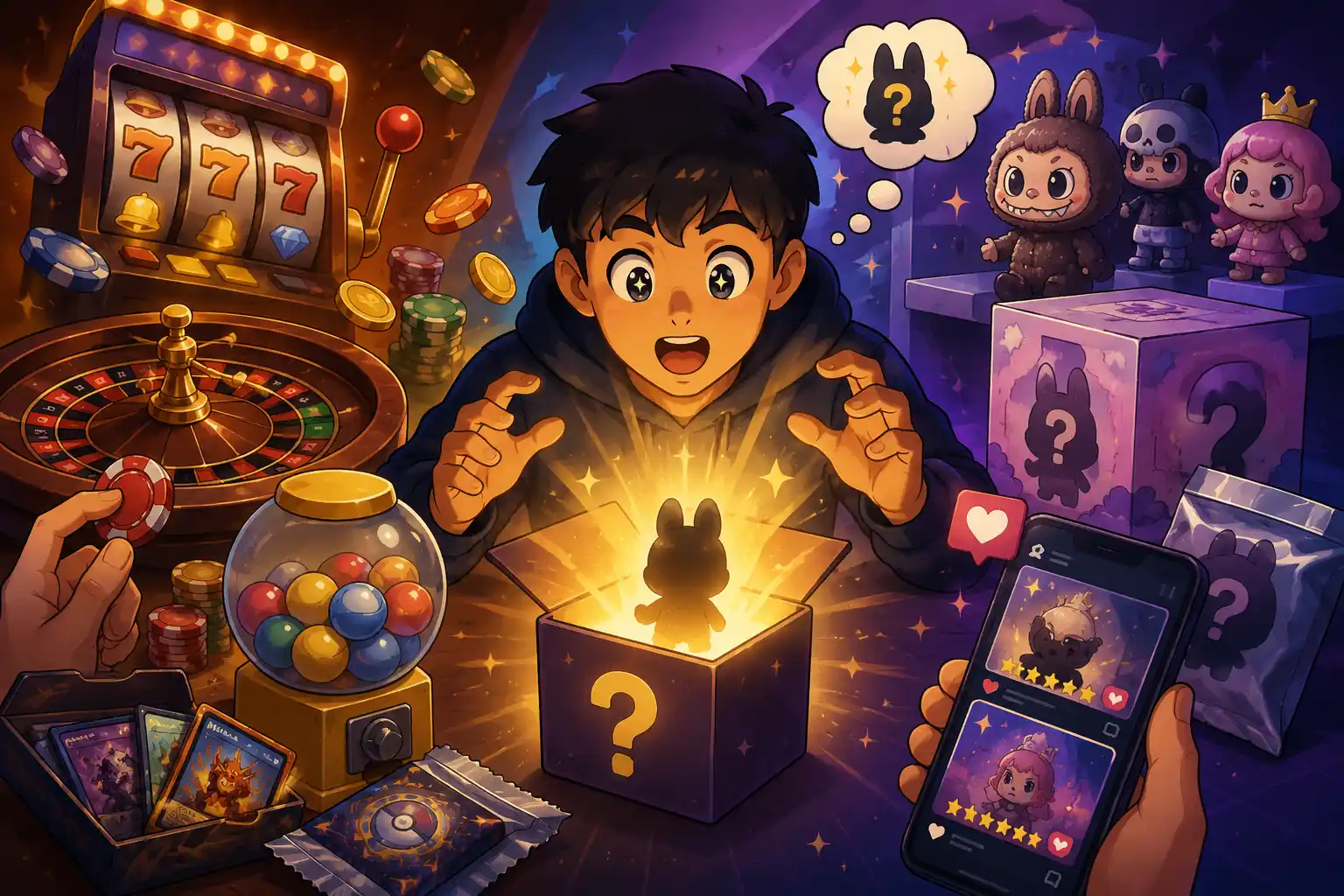
“It’s just one more pull.”
Those five words have probably emptied more wallets than any luxury brand ever could.
Of course, it’s not just gacha games.
People happily buy Pokémon card booster packs without knowing what’s inside. They line up for Labubu blind boxes hoping to get the hidden edition. They spin roulette wheels in casinos, purchase mystery boxes online, and feed coins into capsule toy machines that dispense whatever fate has in store.
Logically, it sounds ridiculous.
Imagine walking into a restaurant and ordering “Chef’s Surprise,” only to discover there’s a 94% chance you’ll receive plain rice and a 0.5% chance you’ll get wagyu steak. Most people would immediately walk away.
Yet replace dinner with anime characters, vinyl figures, trading cards, or shiny weapon skins, and suddenly thousands of people voluntarily participate.
Why? The answer isn’t simply “because people are addicted.” The real answer is far more interesting. Humans have evolved to love uncertainty.
Also read: Why Do Bad Things Happen to Good People?
We Don’t Buy the Prize. We Buy the Possibility.
If you could buy your favorite Labubu directly for $30 or purchase blind boxes for $15 each, which option makes more sense?
Mathematically? Buying the figure directly. Emotionally? Many people still choose the blind box. Because the product isn’t really the figure. The product is hope.
Every unopened box contains a tiny story. “Maybe this is the rare one.” That possibility is surprisingly valuable.
Psychologists have known for decades that uncertain rewards can be even more motivating than guaranteed ones. One of the earliest demonstrations came from psychologist B. F. Skinner, whose experiments on operant conditioning showed that rewards delivered unpredictably produced remarkably persistent behavior. Animals continued pressing levers even when rewards arrived only occasionally, because they never knew which attempt would pay off.
Humans are, admittedly, much more sophisticated. We press the button while convincing ourselves we’re making an investment.
Why Random Rewards Are So Powerful
Behavioral psychology describes this as a variable-ratio reinforcement schedule.
Instead of receiving a reward every time, you receive one after an unpredictable number of attempts. Casinos use it. Slot machines use it. Many loot boxes use it. Gacha games use it. Even collectible card packs follow the same basic principle.
Researchers have repeatedly found that this schedule produces some of the highest rates of persistent behavior because every unsuccessful attempt still leaves open the possibility that the next one could be the winner. It creates an unusually strong motivation to keep trying compared with fixed, predictable rewards.
From an evolutionary perspective, this makes sense. Our ancestors didn’t find food every time they searched. Hunters didn’t catch an animal every day. Gatherers didn’t discover berries behind every bush.
Nature rewarded persistence unpredictably. Our brains adapted accordingly. Modern technology simply discovered that the same mechanism also sells virtual dragons.
The Magic of “Almost”
Curiously, winning isn’t always what keeps us playing. Sometimes losing is just as motivating.
Imagine spinning a roulette wheel. The ball lands on black. You chose red.
Close.
Or imagine opening a blind box. You wanted the secret edition. Instead, you receive the common figure standing right beside it in the collector’s guide.
Again. Close.
Psychologists call these near misses, and they have fascinated researchers for years. Studies using brain imaging have shown that near misses activate many of the same reward-related brain regions as actual wins, despite being objective losses. Instead of telling our brains, “Game over,” near misses often create the feeling that success is getting closer.
Logically, every pull is independent. Emotionally, your brain whispers: “You’re getting warmer.”
No. You’re opening a sealed cardboard box.
The Best Part Often Happens Before You Open It
Here’s an interesting question. When exactly is a blind box the most exciting?
After you’ve displayed it on your shelf for six months? Probably not.
Many collectors would admit that the most exciting moment is somewhere between paying for it and tearing open the packaging.
That isn’t an accident.
Neuroscientific research suggests that anticipation itself plays a major role in how the brain processes rewards. The expectation of a possible reward can generate intense excitement before the reward is even obtained. In many cases, the anticipation fades quickly after ownership.
This is one reason unboxing videos attract millions of viewers. The audience already knows how the story ends. They watch for the suspense. The uncertainty. The emotional roller coaster squeezed into thirty seconds. The figure is almost secondary.
Scarcity Turns Desire Into Urgency
Now imagine the company adds four words: Limited Edition. Ends Tomorrow.
Congratulations.
You’ve just met another powerful psychological bias.
Behavioral economists have shown that people place greater value on opportunities they believe are scarce. Robert Cialdini popularized this as the scarcity principle, while numerous consumer studies have demonstrated that limited availability increases perceived value and purchase intention.
It explains why companies love phrases like:
- Limited release
- Secret edition
- Convention exclusive
- Only available this month
- While supplies last
Scarcity doesn’t necessarily make the product better. It makes saying “I’ll think about it” feel dangerous.
Why We Keep Going After Losing
At some point, you’ve probably heard someone say: “I’ve already spent this much. I can’t stop now.”
This is the sunk-cost fallacy.
Economists define sunk costs as resources that cannot be recovered. Rationally, previous spending shouldn’t influence future decisions. Humans disagree.
Research by psychologists Hal R. Arkes and Catherine Blumer demonstrated that people often continue investing in losing situations simply because they’ve already invested heavily.
The money is gone. But stopping feels like admitting defeat. Ironically, spending more often feels emotionally easier than accepting the loss.
It’s Not Just About Dopamine
If you’ve spent enough time online, you’ve probably seen someone explain everything with one sentence: “It’s just dopamine.”
Reality is considerably more complicated.
Dopamine is involved in motivation and learning, but it is not simply the brain’s “pleasure chemical.” Modern neuroscience suggests it plays a major role in predicting and pursuing rewards rather than merely enjoying them.
That’s an important distinction. Not everyone who buys blind boxes has a problem.
Many people genuinely enjoy:
- collecting
- completing sets
- appreciating the artwork
- trading duplicates
- sharing the experience with friends
Opening a Pokémon booster pack with your child isn’t the same as chasing losses at a casino. The underlying psychological mechanisms overlap. The context, risks, and consequences do not.
That’s why psychologists generally distinguish between healthy collecting, enthusiastic hobbies, and problematic gambling-related behaviors rather than treating them as identical.
Why Showing the Odds Doesn’t Stop Us
One of the biggest changes in recent years is that many countries now require games to disclose their gacha rates. At first glance, that seems like a perfect solution.
Surely if players know that a five-star character only has a 0.6% drop rate, they’ll think twice before pulling.
Right? Surprisingly, not always.
Research in behavioral economics suggests that humans are remarkably poor at reasoning about very small probabilities. Psychologist and Nobel laureate Daniel Kahneman showed that we tend to overweight rare possibilities while simultaneously struggling to intuitively understand what those probabilities actually mean.
For example, a 0.6% chance sounds tiny. Yet many players subconsciously translate it into something like: “It’s unlikely… but it could definitely be me.”
And that’s true. It could be you. It could also be the person next to you. Or someone on the other side of the planet. The probability doesn’t care.
What’s even more interesting is that displaying the odds can sometimes make the system feel more legitimate rather than less attractive. The game appears transparent. Fair. Scientific, even.
After all, the numbers are right there. But knowing the probability isn’t the same as understanding it. Most people don’t naturally think in probabilities. We think in stories.
Then social media enters the chat.
One player posts a screenshot of getting the featured character in a single pull. Another uploads a video of opening the hidden Labubu on the first blind box. Someone wins big at roulette. These moments spread everywhere because they’re exciting.
The thousands of ordinary outcomes—the duplicates, the failed pulls, the empty wallets—rarely go viral.
Psychologists call this the availability heuristic. Proposed by Amos Tversky and Daniel Kahneman, it describes our tendency to judge how likely something is based on how easily examples come to mind.
If your feed is full of lucky pulls, your brain quietly concludes: “People seem to win all the time.”
Statistically? Nothing has changed. Algorithmically? Everything has. In other words, the odds printed on the screen compete against thousands of emotionally memorable success stories. Unfortunately for mathematics, stories are much better at getting likes.
Check out my other article: The Reality of Modern Youth, According to Scientific Data
The Oldest Trick Is Older Than Technology
Long before smartphones existed, people bought lottery tickets. Long before anime games, children traded baseball cards. Long before Labubu, Japan popularized capsule toy machines. Long before loot boxes, casinos had already perfected uncertainty.
Technology didn’t invent our fascination with random rewards.
It simply scaled it.
Whether it’s a five-star character, a rare trading card, a hidden-edition Labubu, or a roulette wheel, we’re rarely paying only for the prize.
We’re paying for possibility. And perhaps that’s the most human part of all.
After all, our entire species has survived by believing that the next hunt, the next harvest, or the next opportunity might finally be the one that changes everything.
Sometimes it’s a mammoth. Sometimes it’s a legendary character. Sometimes it’s your seventh duplicate.
Your brain, unfortunately, gets excited before it knows which one it’s going to be.
Scientific References
- B. F. Skinner (1938). The Behavior of Organisms.
- Ferster, C. B., & Skinner, B. F. (1957). Schedules of Reinforcement.
- Schultz, W. (1997). “Dopamine neurons and their role in reward mechanisms.” Current Opinion in Neurobiology.
- Schultz, W., Dayan, P., & Montague, P. R. (1997). “A neural substrate of prediction and reward.” Science.
- Clark, L., et al. (2009). “Gambling near-misses enhance motivation to gamble.” Neuron.
- Arkes, H. R., & Blumer, C. (1985). “The Psychology of Sunk Cost.” Organizational Behavior and Human Decision Processes.
- Cialdini, R. B. (2009). Influence: Science and Practice.
- Kahneman, D. (2011). Thinking, Fast and Slow.
