
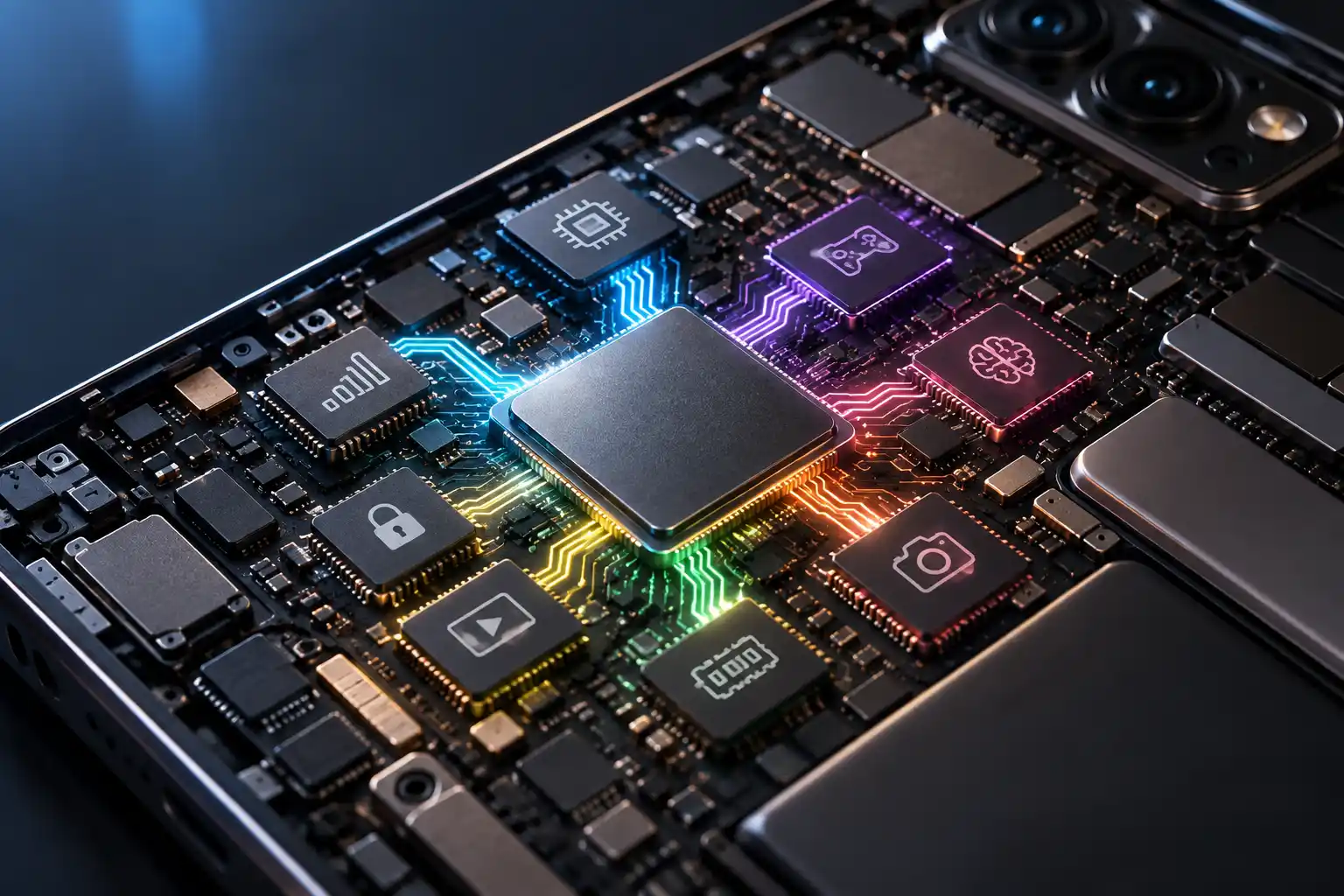
Look at the specifications of almost any Android flagship and you’ll probably find something like Snapdragon 8 Elite, Dimensity 9500, or Exynos 2600 somewhere near the top. Most people simply call this the phone’s “processor.”
That’s not exactly wrong in everyday conversation, but it hides what is actually inside that tiny piece of silicon. A Snapdragon chip isn’t merely a CPU in the same way we commonly think about a Ryzen or Core processor inside a desktop PC.
It’s a System on a Chip, or SoC. And the name is surprisingly literal.
Instead of containing just a CPU, a modern smartphone SoC can combine the CPU, GPU, AI processor, image processor, memory controller, video engines, security hardware, connectivity features, and many other components into one highly integrated chip.
In other words, your phone doesn’t really have one processor. It has a tiny collection of specialized processors working together.
What Does SoC Actually Mean?
SoC stands for System on a Chip. The basic idea is to take many of the components required for a computing system and integrate them into a single integrated circuit.
Arm describes an SoC as a complete processing system contained within a single package, potentially incorporating CPUs, memory-related components, interfaces, peripherals, accelerators, and other specialized hardware.
This is quite different from how we traditionally imagine a desktop PC.
Inside a desktop, you might have a CPU installed in its socket, a separate graphics card with its own GPU and VRAM, separate RAM modules, storage devices, networking hardware, and a motherboard connecting everything together.
A smartphone doesn’t have that luxury. There isn’t enough space. Battery power is limited. Cooling is extremely limited. And carrying around a phone the size of an RTX 5090 would probably require considerably larger pockets.
So smartphone designers integrate as much functionality as practical into an SoC. That’s why calling Snapdragon, Dimensity, Exynos, Tensor, or Apple’s A-series simply a “CPU” doesn’t tell the whole story. The CPU is merely one resident of a surprisingly crowded neighborhood.
Might be related: Si-C Batteries Explained: Why Smartphone Batteries Are Suddenly Getting Huge
What’s Actually Inside a Smartphone SoC?
The exact components vary between chip designs and generations, but modern smartphone SoCs generally contain several major processing blocks.
The CPU, or Central Processing Unit, is probably the most familiar. It handles general-purpose computing: running operating-system code, executing applications, managing logic, and doing the countless miscellaneous calculations required throughout the day.
Modern smartphone CPUs typically contain several cores with different performance and efficiency characteristics. Some are intended for demanding workloads, while others prioritize low power consumption.
Then there’s the GPU, or Graphics Processing Unit. Gaming is the obvious use case, but GPUs aren’t exclusively gaming hardware. They’re designed to perform many calculations in parallel, making them useful for graphics rendering and other highly parallel workloads.
Next comes a component that has become increasingly prominent during the AI boom: the NPU, or Neural Processing Unit. An NPU is specialized hardware designed to accelerate machine-learning workloads. Features such as image enhancement, speech processing, generative AI, object recognition, and other on-device AI workloads can take advantage of this dedicated hardware rather than relying entirely on the CPU.
Modern SoCs may also distribute AI workloads between the NPU, GPU, and CPU depending on what type of calculation needs to be performed. Qualcomm, for example, describes its AI Engine as a heterogeneous system involving its Hexagon NPU alongside the Adreno GPU and CPU.
Then we have perhaps the most underappreciated component: the ISP, or Image Signal Processor. When you press the shutter button on your phone, the camera sensor doesn’t magically produce the polished photograph you see in your gallery. The raw sensor information needs substantial processing.
The ISP plays a major role in that pipeline, dealing with things such as exposure, noise reduction, color processing, HDR, autofocus-related information, and other computational photography tasks.
This is one reason why judging smartphone cameras purely by megapixels or sensor specifications can be misleading. The silicon processing the image matters too.
There can also be a DSP, or Digital Signal Processor, designed for specialized signal-processing workloads such as audio, sensors, and other mathematical operations.
Dedicated hardware can handle video encoding and decoding as well, allowing your phone to efficiently record and play high-resolution video without asking the general-purpose CPU to do everything.
Then there are memory controllers, cache, display engines, security processors, connectivity hardware, and plenty of smaller components that most people will thankfully never have to think about. Otherwise, smartphone specification sheets would need a table of contents.
Why Put All of This Into One Chip?
At first, integrating so many components sounds mostly like a way to make phones smaller. That’s certainly one advantage, but it isn’t the only one.
Moving data between separate chips requires physical connections and consumes energy. The farther information has to travel, the more complicated the system can become.
Putting major components close together allows them to communicate efficiently while reducing the amount of physical space required. And smartphones desperately need both advantages.
A desktop computer can have a large power supply, multiple cooling fans, enormous heatsinks, and a dedicated graphics card consuming hundreds of watts.
A smartphone has a battery measured in a few thousand milliamp-hours and cooling that mostly consists of creatively spreading heat through an object approximately the size of your hand.
Efficiency isn’t merely desirable. It’s mandatory. That makes SoCs particularly suitable for smartphones, tablets, wearables, and other compact devices where space and power consumption matter enormously.
But integration provides another important advantage. Different parts of the SoC can specialize in different jobs.
Your Phone Doesn’t Need One Extremely Powerful Processor
Imagine running a restaurant where one employee does absolutely everything. They take orders, cook the food, wash the dishes, handle payments, manage inventory, clean the tables, and somehow answer customer complaints at the same time.
You could theoretically operate this way. You would also probably have a terrible restaurant. Modern computing increasingly works by giving different types of work to hardware designed specifically for them.
The CPU is flexible and good at general-purpose computing. The GPU is excellent at massively parallel calculations and graphics. The NPU specializes in machine-learning workloads. The ISP specializes in image processing. Dedicated media hardware handles video encoding and decoding efficiently.
Instead of making the CPU responsible for absolutely everything, the SoC can send particular workloads to the hardware best suited to perform them. This concept is often called heterogeneous computing. And it’s becoming increasingly important as smartphones attempt to perform more sophisticated tasks without dramatically increasing their power consumption.
What Happens Inside the SoC When You Take a Photo?
Taking a photograph is a good example because it looks incredibly simple from the outside. You open the camera. Point it at your cat. Press the button. Congratulations. Another 6 MB has been permanently dedicated to documenting an animal doing absolutely nothing.
Behind the scenes, however, considerably more is happening. The camera sensor captures incoming light and converts it into electrical information. That information has to be processed into something resembling the photograph you expect.
The ISP performs substantial image processing. Algorithms may combine multiple exposures for HDR, reduce noise, adjust colors, sharpen details, or compensate for difficult lighting.
Machine-learning hardware can become involved in recognizing objects or scenes and assisting computational photography algorithms. The CPU coordinates various software operations. The GPU can participate in appropriate computational workloads.
If you’re recording video instead, dedicated video hardware can handle encoding into formats suitable for storage and playback.
The exact pipeline differs between platforms and manufacturers, but the important lesson is that one apparently simple action can involve several specialized parts of the SoC working together.
This is also why smartphone photography has become so computational. A modern phone camera isn’t merely a lens and sensor. It’s also a computer trying extremely hard to make your badly lit dinner look appetizing.
SoC vs CPU: What’s the Difference?
These terms are frequently used interchangeably in everyday conversation, which can make things confusing.
A CPU is a specific type of processor responsible primarily for general-purpose computation. An SoC is the larger integrated system that can contain the CPU alongside many other components.
“Processor” is a broader term and is frequently used casually to describe the entire SoC. You’ll often see websites refer to Snapdragon or Dimensity chips as smartphone processors, and there’s nothing particularly disastrous about doing so.
“Chip” is even broader casual terminology. So when someone says their phone has a “Snapdragon processor,” everyone understands what they mean. Technically, however, Snapdragon isn’t merely the CPU. The CPU lives inside the Snapdragon SoC alongside several other processing engines.
Not Everything in Your Phone Is Inside the SoC
The name “System on a Chip” can create another misconception: that literally the entire smartphone exists inside one chip. It doesn’t. Your phone still contains plenty of separate components.
RAM and NAND storage, for example, can exist outside the SoC itself. There are also power-management components, radio-frequency hardware, sensors, camera modules, amplifiers, and many other pieces scattered around the device.
Exactly what gets integrated depends on the platform.
Even the term “Snapdragon” can sometimes refer to more than the SoC itself. Qualcomm increasingly describes Snapdragon as a platform because the complete solution can encompass technologies beyond the main silicon, including connectivity and RF components.
SoC therefore shouldn’t be interpreted as “everything inside the phone.” A better way to think about it is many of the phone’s most important computing components integrated into one chip.
Why GHz Doesn’t Tell You Which SoC Is Faster
Understanding SoCs also explains why smartphone performance cannot be reduced to one number. Suppose Phone A advertises a CPU running at 3.8 GHz while Phone B reaches 4.0 GHz. Phone B must be faster, right? Not necessarily.
Clock speed is only one variable. CPU architecture matters. Core configuration matters. Cache matters. Memory bandwidth matters. GPU performance matters enormously for games. The NPU matters for certain AI workloads. The ISP influences imaging capabilities.
Manufacturing technology affects efficiency, while the phone’s cooling system influences how long the SoC can sustain demanding workloads before reducing its performance. Software optimization matters too.
Two phones can even use the same SoC and deliver noticeably different performance because manufacturers configure power limits, cooling systems, memory, and software differently.
That’s why benchmark results can be useful, but reading one benchmark number as an absolute measurement of how “good” an SoC is misses much of the picture.
A smartphone SoC isn’t one engine. It’s closer to an entire team. And like most teams, having one ridiculously talented member doesn’t automatically fix everything else.
