
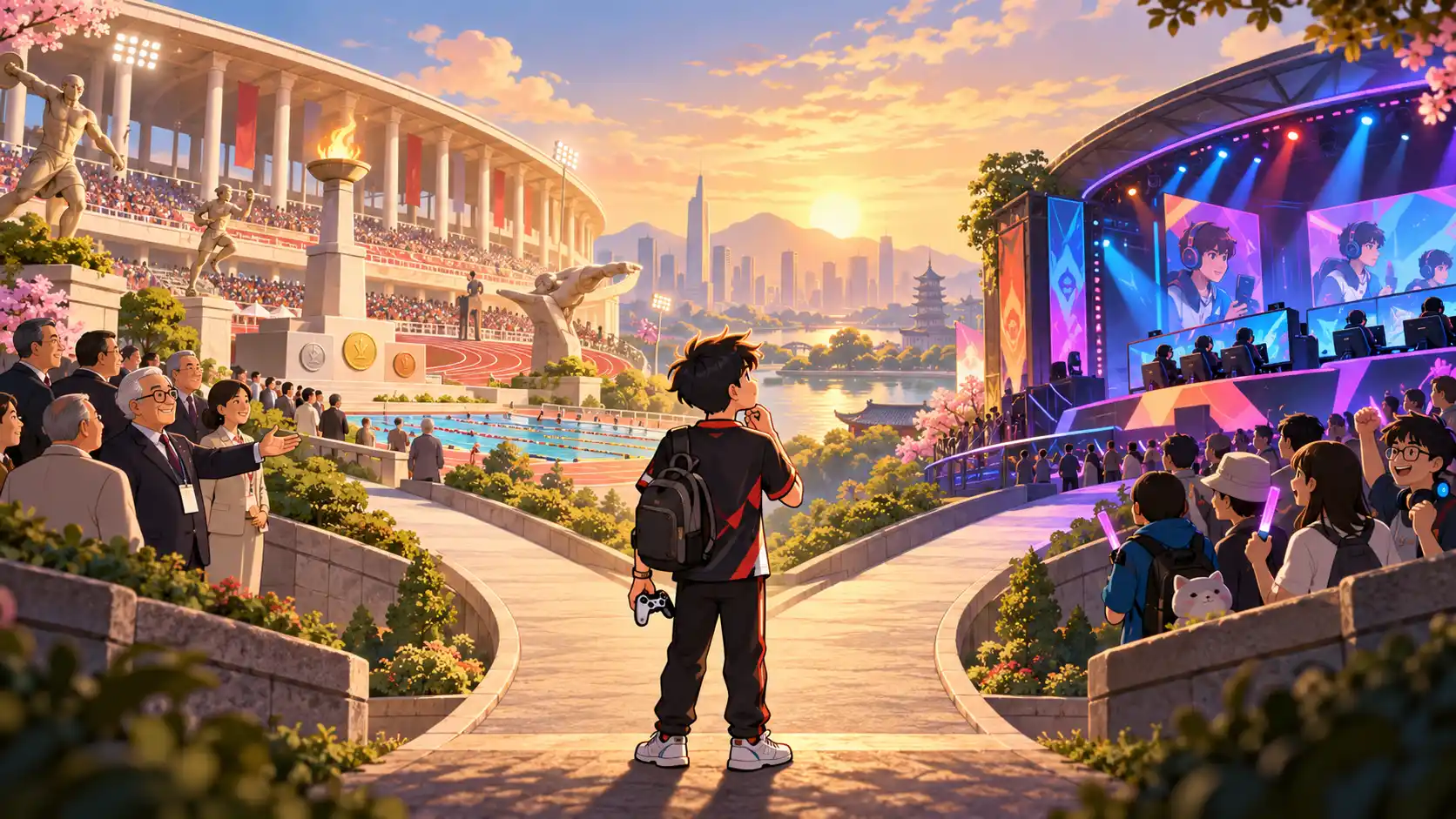
Esports spent years asking to be treated like a sport. The Asian Games gave it medals, national flags, and a place beside athletics and swimming. After the 2026 Aichi-Nagoya Games, the Olympic Council of Asia plans to move esports to a separate Asian Esports and Mind Sports Games. Kuwait is set to host the first edition in 2027, although the competition programme has not yet been announced.
Is that a promotion or a demotion? Perhaps the more uncomfortable question is whether esports and the Asian Games ever wanted the same thing from each other.
Legitimacy Depends on Who Is Watching
An Asian Games medal can do something the M Series cannot. It can make an esports player’s achievement legible to a government official, a national sports body, or a relative who still thinks an esports career is a particularly elaborate way to avoid homework. Representing a country can change how players are recognized outside gaming circles.
But an MLBB fan does not need the Asian Games to tell them the M Series matters. The game has its own players, rivalries, history, and competitive hierarchy. The comparison is imperfect, but football offers a useful analogy: an Olympic gold medal means something, yet the World Cup remains the competition that defines the sport’s elite. Messi and Ronaldo would still be Messi and Ronaldo without Olympic football.
So legitimacy is doing two jobs here. The Asian Games gave esports recognition from sporting institutions. Established esports competitions already had recognition from their fans. Losing the first does not erase the second.
The institutional benefit is real, though. Simone Biles shows what a multi-sport event can do for an extraordinary athlete in a sport without football’s or basketball’s year-round commercial machinery. The Olympics did not invent gymnastics excellence, but they gave it a stage before a much wider public. An Asian Games medal could offer an esports player a smaller version of that opportunity.
Was Esports Supposed to Bring the Audience?
There was a possible benefit for the Asian Games, too. Research has identified aging Olympic audiences as a concern, while sporting institutions have looked to newer competitions to connect with younger people. That does not prove the OCA added esports for one specific demographic target. Still, the appeal is easy to understand: include games, and perhaps young people will pay attention to the Games.
The trouble is that interest does not transfer so neatly. My daughter is in high school. Some of her friends know RRQ, even though they did not follow the Asian Games or SEA Games before esports joined their programmes and do not follow those events now. That is an anecdote, not a survey. But it raises a fair question: why would knowing an esports team make someone interested in swimming, weightlifting, or the event hosting them?
Esports tickets were reportedly among the hottest at the 2023 Hangzhou Asian Games. That shows interest in esports at the Asian Games. It does not show that those fans became viewers of the Asian Games more broadly. I have not found evidence measuring that conversion.
Gaming is enormous, but any one esport occupies a much smaller corner of it. Someone who plays games might never watch esports. Someone who follows MLBB might have no interest in League of Legends, let alone athletics. Newzoo has reported that 71% of esports fans in its surveyed markets watched only one game. “Young gamers” are not a single audience an organizer can simply add to its event.
Who Decides What Deserves a Medal?
The choice of games makes the relationship stranger. The 2018 demonstration event included Clash Royale, Arena of Valor, League of Legends, Hearthstone, StarCraft II, and Pro Evolution Soccer 2018. Hangzhou 2023 featured Dream Three Kingdoms 2 alongside titles such as Dota 2 and League of Legends. The 2026 programme includes Mobile Legends: Bang Bang and Puyo Puyo Champions, among others.
A changing lineup is understandable. Games are privately owned, their communities change, and a publisher can stop supporting a competitive scene. But when a medal is meant to recognize excellence, the organizer should be able to explain why one game earns a place and another does not. Otherwise, the prestige of the medal ends up doing a lot of work for the selection committee.
Take StarCraft II. It helped build modern esports and still had major competitions in 2018. Calling it “dead” would be unfair to its players and fans. Yet several omitted titles had much larger esports audiences that year, including Dota 2, Counter-Strike: Global Offensive, PUBG, and Overwatch. If attracting contemporary esports viewers was a priority, its inclusion invites a question.
For many Southeast Asian fans, choosing Arena of Valor over MLBB in 2018 raised another version of that question. MLBB’s competitive scene was younger then, but its Indonesian professional league was already running. There may have been sound practical reasons for the selection. Fans still had little reason to treat the resulting lineup as a universal ranking of esports importance.
There is a notable ownership pattern, too. Five of the six 2018 games had some connection to Tencent: Arena of Valor through TiMi, League of Legends through Riot, Clash Royale through Supercell, and Blizzard’s Hearthstone and StarCraft II through Tencent’s minority stake in Activision Blizzard. Those ties differed enormously. A minority investment does not imply control over a selection, and this pattern is not evidence that anyone paid for a place. It does remind us that every esports title is someone’s product. Publisher cooperation and commercial interests inevitably sit inside a selection process that is unusual by traditional sports standards.
What should the selection achieve? If the Asian Games wants to spotlight competitors with few other opportunities, a smaller title can be an excellent choice. A Puyo Puyo player is no less skilled because their audience is smaller. If the aim is to attract fans of today’s biggest games, however, leaving those games out works against it. Both aims are defensible. They do not always lead to the same programme.
The Bill Comes Due
Cost offers another possible reason for separation. Running esports is more involved than “put some computers in a room.” Each game needs its own rules, equipment, staff, competitive format, qualification system, broadcast, and publisher cooperation. A title can even disappear from the programme: Hearthstone was removed before Hangzhou after its operating arrangements in mainland China broke down.
We do not know whether costs or disappointing audience conversion drove the OCA’s decision. Its published decision to separate esports after 2026 gives no detailed explanation. Claiming either as the reason would mean pretending to have attended a meeting I did not attend.
Definitely related: Esports Has 400 Million Gen Z Fans and a Business Model That Still Barely Works
As a business question, though, it is difficult to ignore. If a multi-sport organizer pays to stage several complex competitions and mainly attracts viewers who watch only those matches, how much does it gain by keeping them inside an already crowded programme?
Esports knows the difference between attention and a sustainable business. Hours watched can rise because a broadcast runs longer; the number alone does not tell us how many unique people watched, whether they will return, or whether the organizer earned enough to cover its costs. A large viewing total cannot settle whether the Asian Games benefited from hosting esports.
So What Changes After 2026?
For most esports fans, probably little. MLBB’s biggest rivalries will continue in its own ecosystem. The same goes for other established games. A new OCA event will not automatically become their defining championship, any more than the Asian Games did.
For individual players, national teams, and smaller competitive scenes, the change may matter much more. An Asian Games medal speaks a language people outside esports understand. A dedicated event could offer more places to compete, but it may also offer fewer encounters with that wider public. We cannot judge the trade until we know its games, participants, broadcasts, and whether the event lasts beyond its first edition.
I doubt the separation will suddenly revive or sink esports. I also doubt that adding esports was enough to make a teenager care about the entire Asian Games. Perhaps the original partnership asked too much of both sides: esports sought recognition from established sporting institutions, while those institutions hoped esports would bring its young audience along. A medal could provide some of the recognition. There is little reason to assume it brought the whole audience.
The new Games might find a clearer purpose by giving overlooked competitors their own continental stage. That would be valuable, even if the rest of the gaming world does not immediately show up. It would also mean accepting that an athlete’s opportunity to be seen and an organizer’s hope for millions of new fans are two different goals.
