
A new esports study has arrived with a wonderfully large number attached to it.
According to The Esports Generation: Who They Are & Why They Spend, more than 400 million Gen Z consumers worldwide regularly engage with esports. The white paper, produced by ESL FACEIT Group, Hero Esports, and Niko Partners, surveyed 8,000 Gen Z esports fans across eight markets and examined their viewing habits, spending, media consumption, and brand preferences.
The findings are certainly attractive.
Among the surveyed fans, 85% said they notice branding in esports, 74% said advertising and brand participation influence their purchasing behaviour, and 66% said they had bought something because of a collaboration involving an esports team, game, or player.
That is the kind of data that makes sponsorship executives sit slightly straighter in their chairs.
Four hundred million young consumers. Strong brand recognition. Purchasing influence. Passionate communities. Live events. Merchandise. Fashion. Electronics. Food and beverages.
It sounds enormous. And it is enormous.
But it may not mean what the esports industry wants it to mean. Because esports has never really had an audience problem.
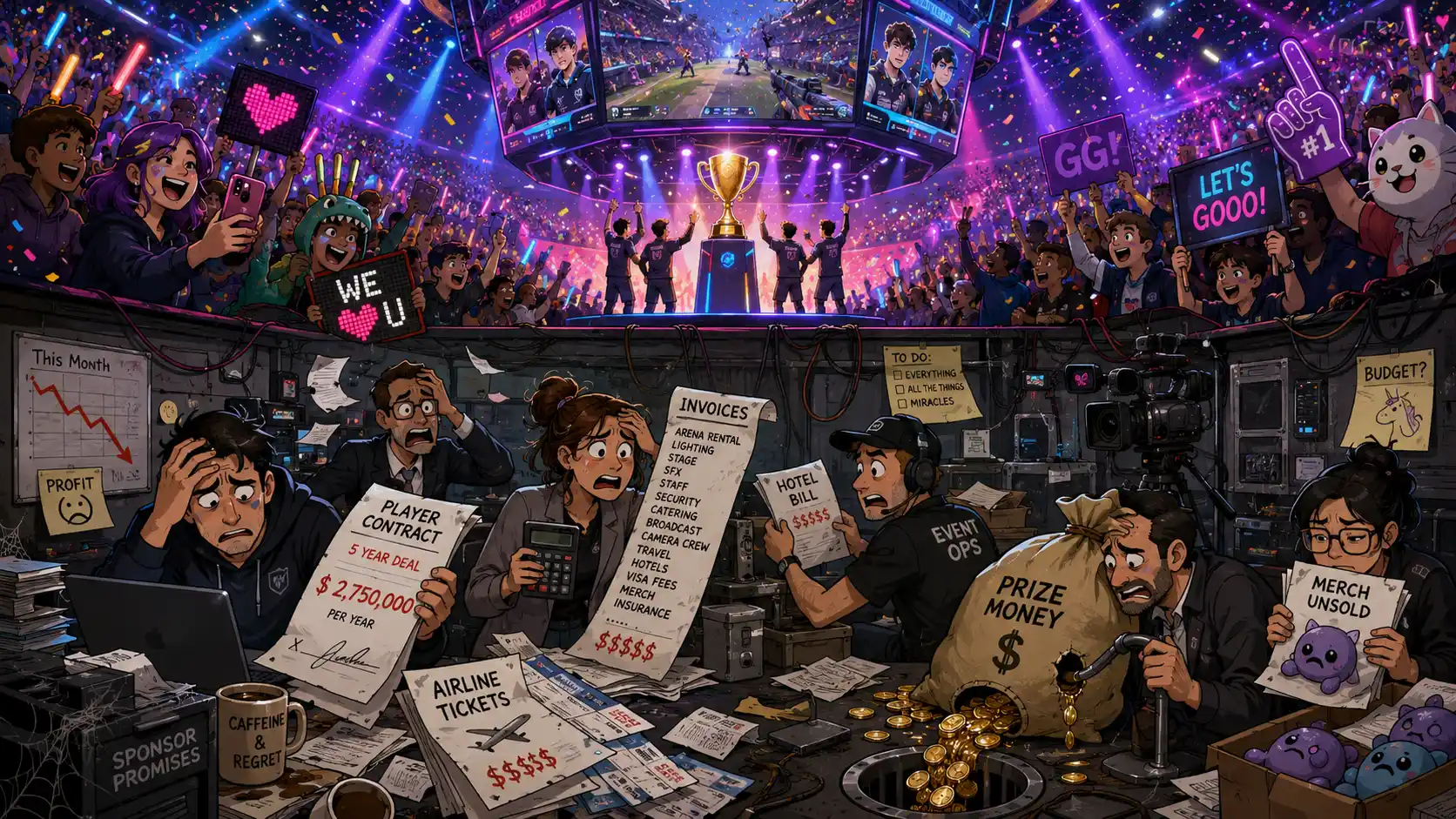
It has a cost problem, an ownership problem, and a spectacularly stubborn inability to turn attention into sustainable revenue.
Check out my other article: AI-Generated Video Sounds Efficient. Reality Is More Expensive
First, Gaming and Esports Are Not the Same Industry
This should be obvious. Somehow, it still needs to be said.
Gaming is the enormous global entertainment industry that includes everything from Candy Crush and The Sims to Baldur’s Gate 3, Genshin Impact, Minecraft, Call of Duty, EA Sports FC, and someone’s father quietly playing digital solitaire for four hours.
Esports is the competitive spectator business built around a relatively small selection of those games.
Every esports fan is connected to gaming. Not every gamer cares about esports.
Someone can spend hundreds of hours playing single-player RPGs without knowing who won the latest League of Legends championship. A teenager can play Valorant every evening but never watch VCT. Millions can enjoy Mobile Legends while treating professional matches as optional background noise.
This distinction matters because reports sometimes place esports beside film, music, or television as if they are equivalent entertainment industries. They are not.
Gaming is comparable with film and music.
Esports is more comparable with a professional sports league, a creator-led media format, a live entertainment business, or a competitive show built on top of an existing intellectual property.
Once that distinction is made, the picture becomes considerably less flattering.
Gaming Is the Giant. Esports Is a Room Inside the Giant.
Newzoo says the global games market generated $201.6 billion in 2025, crossing $200 billion for the first time. It involved approximately 3.6 billion players worldwide. Mobile gaming alone generated $113.3 billion, while console and PC generated $44.7 billion and $43.6 billion respectively.
Gaming is not a niche competing for a seat at the entertainment table. Gaming may already own the table, several chairs, and a suspiciously expensive cosmetic skin for the table.
By comparison, estimates of the global esports market generally place its 2025 value at approximately $2.4 billion to $2.6 billion, depending on the methodology used. That means esports represents only around 1.2% to 1.3% of the broader games market.
Even allowing for different definitions, the gap is immense.
| Market | Approximate 2025 value |
|---|---|
| Global games market | $201.6 billion |
| Recorded music market | $31.7 billion |
| Global cinema box office | $33.6 billion |
| Japanese anime market | About $25 billion |
| Global esports market | About $2.4–$2.6 billion |
Recorded music generated $31.7 billion in 2025, according to IFPI. Global cinema ticket sales reached approximately $33.55 billion. Meanwhile, Japan’s anime industry reached roughly ¥3.84 trillion, or around $25 billion, in 2024.
These categories are not perfectly comparable. The games figure includes consumer spending on game software and services, recorded music excludes several adjacent music businesses, cinema box office excludes most streaming revenue, and anime market totals often include merchandising and overseas activity.
Still, the scale tells us something useful.
Gaming belongs in the same broad conversation as music and film. Esports does not.
The 400 Million Figure Is Impressive—But It Needs Context
Four hundred million Gen Z esports consumers represent an enormous cultural audience. But audience size is not the same as commercial value.
Newzoo’s consumer research found that 80% of surveyed consumers play videogames, while 85% engage with games in some form. Earlier generational research found that 81% of Gen Z respondents had played games within the previous six months.
So the broader Gen Z gaming audience could plausibly number well above one billion globally.
Against that background, 400 million esports fans look less like “the entire gaming generation” and more like a highly engaged segment living inside a much larger gaming population.
That is not an insult.
A community of 400 million people is not small unless your standard comparison is oxygen. But esports should be understood as a specialised layer of gaming culture, not as another word for gaming itself.
The more useful question is not whether esports has reach. It clearly does.
The question is whether that reach produces enough money for the people paying to maintain the ecosystem. That is where the RGB lighting begins to flicker.
A Podcast Can Be Made With Two Microphones and Mild Delusion
Consider podcasting.
A beginner can create a podcast with a laptop, an affordable microphone, free editing software, and the courageous belief that the world requires another two-hour conversation between friends.
A simple independent podcast might cost almost nothing beyond equipment and time.
A more professional show may require studio rental, cameras, editors, researchers, producers, graphic designers, social clips, and marketing. Costs can range from several hundred dollars per episode to thousands, or considerably more for premium branded productions.
But the basic economics remain attractive.
A podcast does not need:
- an arena;
- five-star player hotels;
- tournament referees;
- gaming PCs;
- visas;
- international flights;
- backup internet;
- anti-cheat systems;
- a prize pool;
- an observer team;
- a giant LED screen;
- enough stage lighting to summon Batman.
A podcast can also scale without its core production cost rising proportionally. A show with 10,000 listeners and a show with one million listeners may still involve the same host, the same table, and the same microphone.
The global podcast business is difficult to measure consistently. One industry estimate placed total annual podcast revenue at roughly $3.9 billion to $5 billion, while commercial research estimates vary considerably depending on whether they count only advertising or include technology, hosting, subscriptions, events, and related services.
Even using the lower estimate, podcasting may already generate more annual revenue than esports. And it does so without needing to put ten professional gamers on salaries before recording begins.
Anime Is Expensive, but at Least It Creates Something That Can Live Forever
Anime provides a more serious comparison because producing it is labour-intensive and expensive.
According to a 2026 presentation from the United Nations Industrial Development Organization’s Tokyo office, anime episodes that once cost approximately ¥15 million now generally require at least ¥20 million, while high-quality productions can reach ¥50 million to ¥60 million per episode.
Using rough currency conversions, that means:
- a standard modern anime episode may cost more than $130,000;
- a premium episode may cost approximately $325,000–$390,000;
- a 12-episode season could cost roughly $1.6 million to more than $4.5 million, before substantial marketing and distribution expenses.
Anime is not cheap. It requires writers, directors, animators, background artists, compositors, voice actors, musicians, editors, producers, and an alarming number of exhausted human beings drawing hair.
Yet anime has one major advantage over esports:
It creates durable intellectual property.
A successful anime can generate money through:
- streaming licences;
- television rights;
- international distribution;
- cinema releases;
- Blu-rays;
- soundtracks;
- manga;
- figurines;
- clothing;
- toys;
- mobile games;
- sequels;
- character licensing;
- collaborations;
- theme cafés;
- merchandise that somehow costs $90 because a fictional swordsman is printed on it.
The initial production may be expensive, but the finished work can remain commercially valuable for years or decades. A character created today may still sell figures in 2040.
An esports group-stage broadcast from last Thursday is unlikely to enjoy the same afterlife.
Esports Events Are Expensive—and Expire Almost Immediately
A major esports tournament combines the economics of sports, broadcasting, technology, and live entertainment.
The organiser may need to pay for:
- the prize pool;
- venue rental;
- stage construction;
- LED screens;
- lighting;
- sound systems;
- broadcast equipment;
- internet infrastructure;
- referees;
- tournament administrators;
- commentators;
- analysts;
- observers;
- camera operators;
- producers;
- graphics;
- security;
- insurance;
- flights;
- accommodation;
- food;
- visas;
- practice rooms;
- gaming equipment;
- backup gaming equipment for when the first gaming equipment somehow decides to stop working.
Public cost estimates vary dramatically, but professional multi-team LAN events can easily cost hundreds of thousands of dollars. Larger international productions can exceed $1 million, sometimes before the prize pool, team support, or publisher expenses are fully considered.
Unlike an anime series, however, the tournament’s commercial value is concentrated around the live moment. The final matters today. A month later, fans have moved to the next tournament.
A year later, only the greatest matches and individual clips retain meaningful audience value. The full broadcast becomes archival content, patiently waiting for six people and one very determined statistics researcher.
Esports continually requires new spending to regenerate attention:
- another season;
- another qualifier;
- another roster;
- another venue;
- another broadcast;
- another trophy;
- another cinematic trailer explaining that this time, apparently, everything is on the line.
The product expires, so the machine must keep moving.
And Then Someone Has to Pay the Players
Tournament costs are only one side of the system.
Esports organisations must separately pay for:
- player salaries;
- transfer fees;
- buyouts;
- coaches;
- analysts;
- managers;
- training facilities;
- bootcamps;
- housing;
- travel;
- content production;
- social media staff;
- sales teams;
- legal support;
- administration.
At the elite level, organisations compete for a limited pool of proven players. Salaries rise. Buyouts rise. Expectations rise.
Winning can perversely make the next season more expensive.
Successful players gain negotiating power. Rival teams make offers. Support staff expect better compensation. Fans demand that the organisation retain the championship roster. Management is trapped between preserving performance and preserving solvency.
And prize money does not necessarily save the organisation.
Depending on the game, contracts, and tournament, players may receive most of the winnings. The team may retain only a minority.
That creates one of esports’ strangest arrangements: The organisation pays the salaries required to win the tournament, while the players may keep most of the money awarded for winning it.
This is not necessarily unfair to players. They are the ones competing and sacrificing their short careers. But it is not an especially comforting business model for the organisation paying everyone’s monthly invoices.
Tundra Esports offered a recent illustration of the problem when it left competitive Dota 2 despite operating a highly successful roster. According to its founder, elite player salaries, expensive buyouts, operational costs, and limited prize-money participation made the division increasingly difficult to justify.
In esports, trophies can be valuable symbols. Unfortunately, landlords remain stubbornly reluctant to accept them as payment.
Everyone Pays—Except Much of the Audience
The esports economy often contains several layers of spending:
The game publisher develops the title and may support the competitive ecosystem.
The tournament organiser pays to produce the event.
The esports organisation pays players and staff.
The sponsor pays for visibility.
The streaming platform distributes the broadcast.
The fan often watches everything for free.
Free access is wonderful for audience growth. It is considerably less wonderful for direct revenue.
Traditional sports have spent decades building mature income streams around:
- broadcasting rights;
- tickets;
- subscriptions;
- merchandise;
- licensing;
- concessions;
- hospitality;
- local identity;
- long-established clubs;
- stadium economics.
Esports has some of these, but many remain comparatively weak.
Media rights are inconsistent. Tickets rarely cover full production costs. Merchandise can work for the largest organisations but is difficult to scale. Digital goods usually belong to publishers, not teams. Revenue-sharing systems vary by title and can disappear when ecosystems are redesigned.
So sponsorship remains essential.
That is why studies emphasising brand awareness and purchase influence matter so much. Esports needs to prove that fans are commercially attractive because sponsorship is not merely supplementary revenue.
For much of the ecosystem, it is life support wearing a branded jersey.
Check out my other article: Why Do Successful People Seem to Get More Stupid?
Esports Also Has an Ownership Problem
Perhaps the biggest structural weakness is that esports organisations usually do not own the thing around which their entire business is built. A football club does not require permission from a corporation to continue playing football.
An esports organisation can only compete in a game as long as the publisher permits the ecosystem to exist.
The publisher owns:
- the game;
- the characters;
- the maps;
- the logos;
- the software;
- the servers;
- the rules;
- the commercial rights;
- the ability to change everything on Tuesday because a patch was ready.
Tournament organisers may require licences to use the game, broadcast footage, branding, merchandising, and sponsorship assets. The publisher can restructure the league, replace partners, change qualification systems, reduce support, or close the ecosystem altogether.
Teams can spend years building audiences around a title they do not control.
Imagine running a football club while another company owns the ball, writes the rules, approves every tournament, and can delete the sport after the next quarterly meeting.
That is esports.
Anime Has IP. Podcasts Have Ownership. Esports Teams Have Jerseys.
A podcast creator can own the show, its audience relationship, its archive, and its brand.
An anime production committee can own rights to characters, stories, merchandise, adaptations, and future releases.
A film studio may spend $100 million on a movie, but it owns an asset that can generate licensing, streaming, sequel, and library revenue.
Esports organisations often own:
- their name;
- their logo;
- their content;
- their merchandise;
- their fan community.
Those assets can be valuable. But the competitive product—the reason many fans arrived—is controlled by someone else.
Even players are temporary assets. Contracts expire. Rosters change. A beloved star can leave and take part of the audience with them.
The organisation is therefore expected to build permanent loyalty around an inherently temporary arrangement.
Good luck. Please enjoy this complimentary LED wristband.
Large Audience, Tiny Market
The contrast becomes especially stark when audience and market value are placed together.
The white paper estimates 400 million Gen Z esports fans. Yet the total esports economy is estimated at only around $2.4–$2.6 billion annually.
That works out to roughly $6–$6.50 in annual industry revenue per Gen Z esports fan, even before accounting for older esports viewers or differences in the two datasets.
This is not a formal industry calculation—the audience and revenue estimates use different definitions—but it illustrates the monetisation challenge.
Compare that with gaming.
The global games industry generated $201.6 billion from approximately 3.6 billion players, equal to around $56 per player annually on average.
Again, the comparison is imperfect. Players and esports fans overlap, regional spending varies enormously, and esports-market estimates exclude portions of adjacent gaming revenue.
Still, the gap is revealing.
Gaming has become exceptionally good at monetising players through:
- game sales;
- subscriptions;
- downloadable content;
- battle passes;
- cosmetics;
- mobile spending;
- platform fees;
- advertising;
- direct-to-consumer stores.
Esports helps create attention, loyalty, content, and long-term engagement around those games.
But much of the resulting spending flows toward the game and its publisher—not necessarily toward the tournament organiser or esports team responsible for creating the competitive spectacle.
Esports can help make the bakery smell wonderful. It does not always get to sell the bread.
The Report Is Not Wrong. The Optimism Is Just Incomplete.
None of this means the new Gen Z report is misleading. The audience is real. The engagement is real. The purchasing influence is real.
Esports has clearly become an important cultural force among younger consumers. It creates communities, careers, emotional moments, and global events that would have been unimaginable two decades ago.
The mistake comes when cultural relevance is treated as evidence of business health. Those are separate achievements.
An industry can be popular and financially fragile. It can generate millions of viewers while losing money. It can influence billions in consumer purchases while capturing only a tiny percentage of that value. It can create stars without building sustainable employers around them.
Anime knows this problem well. Its global market has grown rapidly, yet many production studios and animators continue to face difficult economics because much of the value is captured elsewhere in the distribution and licensing chain.
The difference is that anime at least produces reusable intellectual property.
Esports often produces one magnificent weekend—and then begins planning the next expensive weekend immediately.
Esports Does Not Need More Proof That People Care
The industry has spent years proving that esports is not a niche. It has filled arenas. It has produced broadcasts watched by millions.
It has attracted major brands, governments, publishers, celebrities, investors, and media companies. It now has a report estimating 400 million Gen Z consumers.
Fine.
The audience argument has been won.
The harder question is what happens after everyone arrives.
Who pays for the players? Who funds the prize pool? Who rents the arena? Who builds the stage?
Who pays the observers, referees, technicians, camera crews, hosts, analysts, security teams, and production staff?
Who owns the intellectual property? Who captures the transaction when a fan spends money? Who continues funding the entire machine when sponsorship budgets tighten?
Those are not glamorous questions.
They do not look particularly exciting on a giant LED screen. But they will determine whether esports becomes a durable industry or remains a spectacular marketing expense with trophies.
Four hundred million Gen Z fans are not the problem. The problem is building a business that can survive the cost of entertaining them.
