
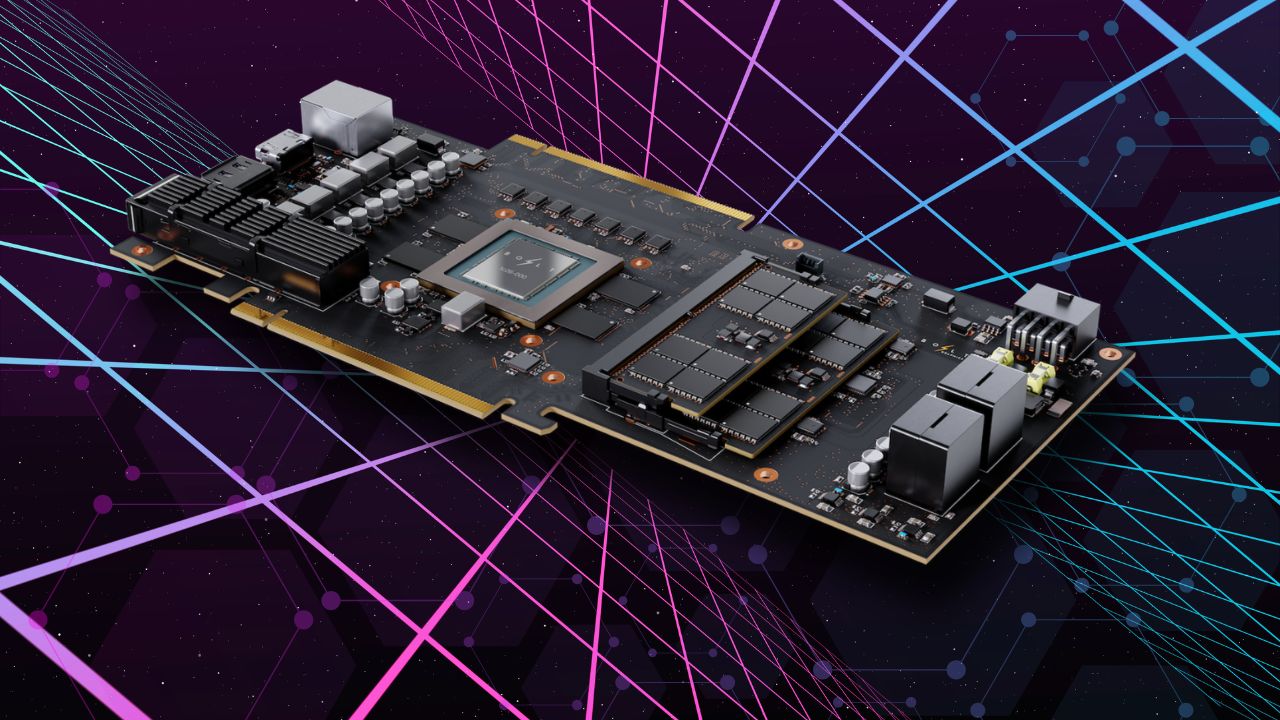
For a market that has spent years acting like “GPU competition” means choosing which Nvidia card you can’t afford this month, Bolt is at least trying to make things interesting. In an interview, Darwesh Singh lays out an ambitious plan: build a new GPU company in the US, avoid going headfirst into the most brutal part of the market, and target creators and professional users first before taking a swing at gaming. Sensible? Maybe. Wild? Absolutely. Boring? Not even slightly.
And to Bolt’s credit, this is not a pitch built around vague “AI-powered synergy” wallpaper. The company showed working FPGA-based prototypes, explained its architecture in unusual detail, and openly acknowledged the giant neon sign hanging over the whole project: making a good GPU is hard, but making one with competent drivers and software support is the real boss fight.
This article is a summary of a video interview between Stephen Burke of Gamers Nexus and Darwesh Singh, Bolt Founder & CEO. I encourage you to watch the full interview that I have embedded below.
Bolt’s Big Idea: Don’t Start With Gamers
Singh is very clear that Bolt’s long-term dream includes gaming GPUs. But Bolt is not charging into that market on day one with a plastic sword and good vibes. Instead, it wants to start with content creation and professional workloads first: game developers, 3D artists, animators, and workstation users.
That strategy makes sense. Gaming is one of the harshest possible proving grounds for a new GPU company. You need broad game compatibility, mature drivers, developer relationships, and enough stability to survive the internet posting “it crashed in Menu Simulator 2027, company doomed” within six seconds of launch.
Bolt’s approach is basically the inverse of Intel’s early Arc rollout. Rather than trying to support everything at once, Singh says the company plans to be selective, work closely with customers, and bring applications onboard one by one. In theory, that gives Bolt a chance to establish a foothold where buyers care more about specific workloads than whether a ten-year-old DirectX title runs flawlessly at 2 a.m. on a modded Windows install.
Why the Card Looks Like a GPU Designed by a Mad Scientist
One of the most entertaining parts of the interview comes when Stephen Burke looks at Bolt’s card render and essentially asks: what on earth is this thing?
Fair question.
Bolt’s design includes:
- user-expandable DDR5 SODIMM slots
- LPDDR5X soldered onto the board
- an RJ45 Ethernet port
- PCIe connectivity that does not look like a normal consumer GPU design
- a second connector intended for linking multiple GPUs together with a cheap, non-proprietary cable
In other words, this is not a conventional graphics card. It is closer to a single-board computer masquerading as a GPU, which is honestly the kind of sentence the GPU industry needs more often.
Singh explains that the memory setup is intentional. LPDDR5X and DDR5 are more available and cheaper than the exotic memory types used in many high-end GPUs. Bolt is trading away some bandwidth in exchange for higher capacity, lower cost, and broader supply availability. Users could even choose their own memory capacities by installing different DDR5 modules. That means the company is aiming for flexibility rather than the usual “here is your VRAM amount, please do not question the sacred SKU ladder.”
The memory is presented as a unified pool, with applications filling LPDDR5X first and spilling over into DDR5 as needed. Singh argues that latency remains competitive and far better than going out over PCIe to system memory.
Check out my other article: AI-Generated Video Sounds Efficient. Reality Is More Expensive
A GPU With CPU DNA
Bolt’s architecture is also unusual in a way that matters far more than the board layout. Singh describes it as a tightly coupled system with a high-performance CPU core in the middle, vector cores attached to it, and specialized hardware accelerators for tasks such as ray tracing, math functions, and physics simulation.
That is a different approach from the more traditional host-device programming model used in current GPUs, where the CPU and GPU are more clearly separated. Bolt’s design appears to blur those boundaries on purpose.
There is one catch, and it is not a small one: Bolt is using RISC-V in the architecture. Singh acknowledges that this introduces extra work when bringing existing games over. In plain English, this is part of why Bolt is not sprinting straight into mainstream gaming. A novel architecture is exciting when you are reading about it. It is less exciting when you are the one who has to port software to it.
Still, Bolt says it has already been talking with major studios and publishers, and that those conversations suggest there is interest in the architecture—especially for future rendering approaches.
Bolt Is Betting Hard on Path Tracing
If there is one theme that runs through the interview, it is this: Bolt believes the future of graphics is path tracing, and it is building for that future rather than optimizing around the industry’s rasterization-heavy past.
Singh argues that today’s GPUs were fundamentally built around rasterization, with ray tracing added later as an extra block of hardware. Bolt’s claim is that getting truly strong path tracing performance requires rethinking the architecture from the ground up rather than bolting ray tracing onto an older design. Yes, the irony of using the word “bolted” here with a company named Bolt is unavoidable. No, I will not apologize.
The company presented performance framing around ray-triangle intersections per pixel at 4K and 120 FPS, positioning itself as stronger than current GPUs in that specific area. Singh was careful to frame this as a particular rendering-oriented metric rather than a blanket “we beat Nvidia at everything” claim. That distinction matters. This is not a universal gaming benchmark. It is a focused demonstration of where Bolt thinks its design should excel.
Bolt’s thesis is straightforward:
- future games will want more path tracing
- studios will use it if the performance becomes practical
- existing GPUs are not ideal for that transition
- Bolt wants to be the company built for that shift from day one
That is a bold bet. It also happens to be one of the few strategically interesting ways to challenge the current market leaders. Competing head-on in raster performance alone would be like opening a burger shop by saying, “Our main edge is that we also have burgers.”
Memory, Cache, and the Trade-Off Bolt Is Making
Because Bolt is using lower-cost, more available memory types, it needs another way to keep performance competitive. The answer is cache—a lot of it.
Singh says Bolt is designing around workloads that are memory-bound, especially rendering and HPC-style tasks, and wants to keep as much data on-chip as possible. That reduces the energy cost of moving data off-chip to DRAM, which is a major architectural trade-off versus companies that rely on very high-bandwidth external memory.
This is one of the most technically interesting parts of the conversation because it shows Bolt is not just choosing “cheap memory” and hoping for the best. It is making a broader architectural trade: lower memory cost and higher capacity on one side, heavier cache investment and different performance priorities on the other.
That does not guarantee success, of course. But it does suggest the design is a deliberate response to real economic constraints, not simply a startup discovering that HBM is expensive and then acting surprised.
The Power Angle: Also, Please Don’t Catch Fire
One of the lighter moments in the interview comes when Singh mentions he had an RTX 4090 catch fire while gaming at a conference. He uses that anecdote to explain why Bolt wants to avoid repeating that kind of experience.
Bolt’s entry-level card, as described here, targets around 120 watts and includes 32GB of LPDDR5X soldered on board, with the possibility of exceeding 100GB total memory capacity when expanded with larger DIMMs.
That power envelope is notable. Instead of trying to build a 500-watt status symbol for people who enjoy benchmarking and rewiring their home’s electrical system, Bolt seems interested in something more practical and scalable.
There’s Even Ethernet Because This Thing Can Run an OS
Yes, really.
The RJ45 port is not there because Bolt expects LAN parties to make a glorious return through the side of a graphics card. Singh says the GPU can run Linux, includes CPU cores, and is designed to be remotely managed in environments such as home labs or denser deployments. The Ethernet interface is meant for firmware flashing, telemetry, and remote control.
That tells you a lot about Bolt’s mindset. This product is being designed as something that could live in workstation, developer, and infrastructure-like environments—not just as a card you slap into a gaming tower and forget about until the next driver update breaks one game you care about.
Prototype Today, Silicon Tomorrow
To Bolt’s credit, the interview does not pretend the final product is already here. The demos shown are based on AMD Xilinx FPGAs, which Bolt is using to validate hardware designs before committing to expensive chip production. Singh explains that this lets the company prove functionality, test image correctness, and iterate before tape-out.
The company says it has already taped out a smaller 12nm test chip and is now working toward a full 5nm chip, with a target of taping that out at the end of the year and aiming for mass production by the end of the following year.
Bolt also demonstrated Blender integration through a plugin next to Cycles, using FPGA hardware to progressively path trace scenes in the viewport. It was slow—as expected for this kind of validation setup—but the point was not polished real-time performance. The point was to show real software integration and prove the rendering pipeline works.
That is an important distinction. In GPU land, “we have a render” and “we have a working software stack tied to test hardware” are worlds apart.
Check out my other article: Denuvo’s Nightmare: How Hypervisor Bypasses Could Change Gaming Forever
Pricing Ambition: Below the 5090, Thankfully
Singh does not lock in final prices, which is fair because the product is not shipping yet. But he does say Bolt intends to cover the mid-range to high-end and that its cards will come in well below RTX 5090 pricing. More importantly, he stresses that Bolt does not want to make a rare, ultra-expensive halo product that nobody can buy.
That is probably the right instinct. The market does not need another “look at our technological masterpiece, now available in quantities of twelve” launch. It needs competition people can actually purchase.
What This Means for the Industry
Bolt is still early. Very early. It has prototypes, architectural ideas, software demonstrations, and a roadmap—but not a finished retail GPU sitting on shelves. That means skepticism is healthy.
Still, the company is interesting for a few reasons.
1. It is not pretending the easy part is the hard part
Anyone can say “we’ll beat Nvidia.” Bolt is at least talking honestly about software enablement, selective market entry, and the brutal challenge of game support.
2. It has a differentiated architecture
Whether that architecture wins or not, it is clearly not just another clone of existing GPU design trends. The combination of RISC-V, vector cores, cache-heavy trade-offs, and path-tracing focus gives Bolt a real point of view.
3. It is targeting a strategic gap
Nvidia has spent years climbing the data-center money mountain. That leaves room for someone else to chase creator-focused and eventually gaming-adjacent opportunities, especially if they can offer lots of memory at saner prices.
4. Its success depends on execution, not just ideas
Great architecture alone does not build an ecosystem. Drivers, developer tools, application support, and manufacturing follow-through are where this story will either become compelling—or become a cautionary tale people cite in forum threads for the next decade.
Final Thoughts
Bolt is not here yet, but it is one of the more intriguing GPU startups to appear in a long time. Darwesh Singh and the company are not taking the easy path, which is admirable and slightly terrifying in equal measure. The plan is ambitious: start with creators, prove the architecture, build software support carefully, and eventually push into gaming with hardware designed for a more path-traced future.
Will it work? That is the multi-billion-dollar question.
But at the very least, Bolt understands something the GPU market desperately needs: competition should do more than exist on a slide deck. It should challenge assumptions, force better pricing, and maybe—just maybe—deliver a graphics card that does not double as an accidental space heater with trust issues.
