

There is something comforting about selfish people. Not pleasant, obviously. You probably do not want one managing your retirement fund, borrowing your car, or becoming responsible for distributing the office snacks.
But selfish behavior usually makes sense.
Someone scams you because they want your money. A corrupt official abuses power because power benefits them. A company squeezes customers because somebody looked at an Excel sheet and discovered that morality was not included in this quarter’s KPIs.
You lose. They gain. Terrible? Yes, but not exactly confusing.
The truly strange situations are the ones where nobody seems to win. A manager sabotages another department so aggressively that the entire company misses its target—including their own team. Two people reject a perfectly reasonable compromise because accepting it would mean allowing the other person to feel victorious. Everyone walks away poorer, angrier, and somehow convinced they have defended civilization.
This peculiar corner of human behavior fascinated Italian economic historian Carlo M. Cipolla, who wrote a short, partly satirical essay in 1976 called The Basic Laws of Human Stupidity.
Cipolla’s central idea was brutally simple:
Some people cause losses to others without gaining anything themselves—and may even suffer losses alongside everyone else.
He called this stupidity. And although Cipolla’s model is far too simple to function as a serious scientific theory of human behavior, the question behind it is considerably more interesting: Why are humans so good at creating situations where everybody loses?
Carlo Cipolla’s Surprisingly Efficient Map of Humanity
Cipolla was an economic historian, which perhaps explains why he approached humanity the way an economist might approach a suspiciously complicated spreadsheet.
Forget personality tests. Forget whether someone is an introvert, extrovert, ENTJ, Capricorn, Ravenclaw, or somebody who puts pineapple on pizza and therefore cannot be trusted with public infrastructure.
Cipolla classified human interactions using only two questions:
- Does the person acting gain or lose?
- Do the other people involved gain or lose?
That produces four broad categories:
| Type | Outcome for Themselves | Outcome for Others |
|---|---|---|
| Intelligent | Gain | Gain |
| Bandit | Gain | Loss |
| Helpless | Loss | Gain |
| Stupid | Loss | Loss |
The labels are intentionally provocative.
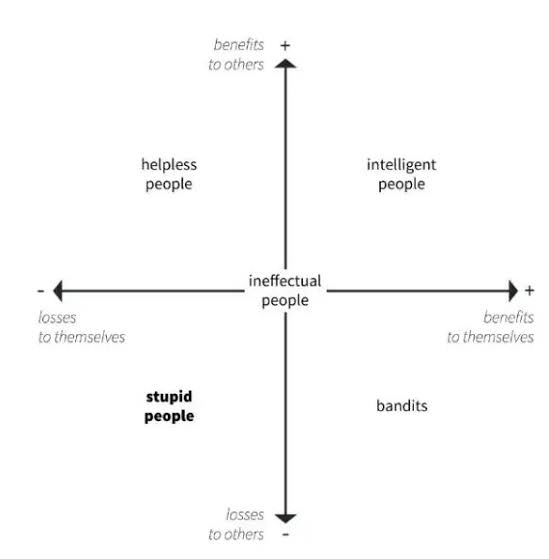
An intelligent action creates benefits for both sides. A good trade, successful cooperation, or mutually beneficial partnership fits here. A bandit benefits at someone else’s expense. A helpless person creates a benefit for somebody else while suffering a loss themselves. And then we reach Cipolla’s favorite quadrant. The stupid person causes losses to others while gaining nothing—or actually losing something too.
Cipolla went much further. Across his famous five “laws,” he argued that we consistently underestimate how many stupid people exist, that stupidity can appear regardless of education or social status, and ultimately that the stupid person is more dangerous than the bandit.
That last claim sounds suspiciously familiar if you have read Dietrich Bonhoeffer’s very different theory of stupidity. Bonhoeffer also argued that stupidity could be more dangerous than evil. But the two thinkers were describing different problems.
For Bonhoeffer, stupidity was fundamentally about the surrender of independent thought—what happens when otherwise intelligent people become intellectually dependent on authority, ideology, conformity, or collective identity. Cipolla was less interested in how people think. He looked at the scoreboard. Who gained? Who lost? And what on Earth happened here?
Selfish People Are Weirdly Easier to Deal With
Cipolla’s distinction between the bandit and the stupid person contains the most useful part of his model.
Imagine somebody steals $100 from you. You are down $100. They are up $100. The interaction is awful, but the incentive is obvious. That matters because incentives create predictability. You can increase the punishment for stealing. Improve security. Change access to resources. Make cooperation more profitable than exploitation. Negotiate. Regulate. Install an extremely judgmental security camera.
The bandit’s behavior responds, at least theoretically, to costs and benefits.
Now imagine someone destroys something worth $100 to you while spending $100 of their own money doing it. Nobody gained anything. The economic value of the situation has simply been converted into smoke. How do you negotiate with that? This is why Cipolla considered stupidity especially dangerous. Rational self-interest places boundaries around bad behavior.
Someone motivated by profit generally stops when the cost becomes larger than the potential reward. But if the reward is unclear—or nonexistent—the normal tools for predicting behavior become much less useful.
Except there is a problem. Humans do not only care about money.
People Gain Things That Don’t Appear on the Spreadsheet
Cipolla’s diagram makes “gain” and “loss” look beautifully objective. Reality immediately arrives to ruin the diagram.
Suppose I spend $20 to make you lose $100 because you cheated me. Economically, I am poorer. But perhaps I feel justice was served. Maybe my reputation improves because everyone now knows that cheating me has consequences. Perhaps watching your downfall produces an emotional satisfaction worth far more than $20 to me.
I may even knowingly hurt myself simply because seeing you suffer makes the sacrifice worthwhile. Suddenly Cipolla’s neat little box marked STUPID develops accounting problems.
Humans optimize for many things besides material benefit:
- status
- belonging
- fairness
- revenge
- identity
- pride
- moral satisfaction
- avoiding humiliation
- making sure Steve from Accounting does not get away with what he did in the Q2 meeting
Economists would describe these preferences more broadly as part of our utility. We do not merely maximize money. We pursue whatever outcomes we personally value. And behavioral research suggests that humans are perfectly willing to pay real costs to enforce some of those values.
We Will Literally Pay Money to Punish People
In a famous 2002 Nature study, economists Ernst Fehr and Simon Gächter examined what researchers call altruistic punishment.
Participants played public-goods games in which cooperation benefited the group. Some participants contributed generously. Others behaved like free riders, benefiting from everyone else’s cooperation while contributing little themselves. Then researchers gave participants an opportunity to punish the free riders.
There was a catch. Punishment cost money. Participants could spend some of their own resources just to reduce someone else’s payoff. A perfectly narrow model of selfish economic behavior would predict: “No thank you. I enjoy retaining money.” Humans had other ideas.
Participants were willing to sacrifice some of their own payoff to punish people they considered unfair, even when there was no direct material reward for doing so. Fehr and Gächter found that the possibility of punishment could also sustain higher levels of cooperation.
From Cipolla’s perspective, paying money merely to hurt somebody else looks suspiciously close to his stupid quadrant. I lose. You lose. Excellent work, everyone.
But psychologically and socially, it can make sense.
Groups need mechanisms for discouraging cheating. If nobody ever punishes free riders because punishment is personally costly, exploitation becomes attractive. Our willingness to punish people at a cost to ourselves may therefore help sustain cooperation. Which produces a wonderful human contradiction:
Behavior that looks individually irrational can sometimes help create collectively rational societies.
Unfortunately, humans are also perfectly capable of taking that mechanism and driving it directly through a wall.
At Some Point, Winning Stops Meaning Getting a Good Outcome
Imagine two coworkers disagree over a project. Initially, the conflict is practical. Person A wants option one. Person B wants option two. Both believe their proposal will work better. This is normal.
Then Person A publicly criticizes Person B’s proposal. Now the disagreement is no longer entirely about the project. Status enters. Person B responds aggressively. Person A feels attacked. Evidence becomes ammunition. Compromise begins to look suspiciously like surrender.
Eventually, both sides may prefer a worse project outcome over allowing the other person to “win.” The objective quietly changes from “find the best solution” to “do not let that bastard be right.“
Humans are extraordinarily talented at this transformation. Once ego, face-saving, status, and identity enter a disagreement, a perfectly solvable problem can become a negative-sum conflict. The original stakes may even disappear.
Ask two people halfway through a long personal feud what started it and there is a reasonable chance you will receive an answer like: “Well, technically it began because he moved my chair.” Twenty-seven months later, both families are involved.
This also connects to something we explored in The Reputation Afterlife: Why Shameless Confidence Can Outlive Competence.
In that article, the question was why some people can survive obvious failures without seriously revising their self-image. One answer is that criticism becomes easier to reject once the critic has been mentally disqualified. The critics are jealous. The employees are disloyal. The experts are biased. The customers simply don’t understand the vision.
Once protecting identity becomes more important than accurately evaluating reality, admitting a mistake becomes extremely expensive psychologically. So people double down. Then double down on the doubling down. Eventually they may be defending a decision that hurts themselves merely because changing course would require saying: “I was wrong.”
Humans have paid considerably more for considerably less.
Sometimes Nobody Is Stupid. The Game Is.
Here Cipolla’s framework becomes even more interesting when we bring in game theory. Because sometimes terrible collective outcomes do not require anyone to behave irrationally at all. Consider the classic Prisoner’s Dilemma.
Two people would both be better off cooperating. But each individual has an incentive to defect because they cannot trust the other person to cooperate. If both defect, both end up worse off than if they had cooperated. Each person can make a rational decision from their own perspective. The final outcome is still terrible.
Welcome to humanity. Similar structures appear everywhere. Two companies enter an aggressive price war. Each cuts prices because allowing the competitor to undercut them seems dangerous. Eventually both destroy their margins. Countries enter arms races because neither can safely disarm unless it trusts the other side to do the same. Businesses overexploit shared resources because leaving some behind merely allows competitors to take them instead. Employees optimize individual performance metrics in ways that make the organization less effective.
Nobody needs to wake up and announce: “Today I shall behave stupidly.” The incentives can do the work for them. This leads to a more interesting possibility than Cipolla’s original model:
Sometimes stupidity isn’t inside the people. It’s inside the game they’re playing.
Rational Employees Can Build an Irrational Company
Organizations are particularly good at producing this problem.
Imagine a company wants to grow. Sales is rewarded for increasing revenue. Marketing is rewarded for generating leads. Operations is rewarded for reducing costs. Customer service is rewarded for shortening call times. Finance is rewarded for controlling expenses. Every department now has a perfectly rational objective. And every department optimizes aggressively.
Marketing produces enormous quantities of low-quality leads because lead volume looks excellent. Sales closes customers who are poorly suited to the product because revenue looks excellent. Customer service rushes people off the phone because average handling time looks excellent. Operations cuts useful expenses because cost reduction looks excellent.
The company’s dashboards glow green. Customers are furious. Profit declines. Nobody necessarily behaved irrationally. Each person responded to the incentives placed in front of them. The system simply rewarded local success while producing global failure.
This is the kind of scenario where “stupidity” stops being a satisfying explanation. Calling the employees stupid tells us almost nothing. Changing the structure tells us much more.
Bad incentives can turn intelligent people into components of an unintelligent machine. And this is another point where Cipolla and Bonhoeffer almost meet from opposite directions. Bonhoeffer’s warning asks what happens when people surrender independent judgment to a collective.
Cipolla’s framework asks us to notice the resulting losses. But game theory adds another uncomfortable possibility: Everyone may still be thinking independently. They are simply responding intelligently to a badly designed system.
Groups Can Win Internally While Everyone Loses Externally
Another problem appears when people stop identifying with the whole system and begin identifying with a subgroup.
Department A does not think if the company can succeed, instead it thinks: How can Department A succeed? A political faction may not ask whether a regulation will benefit the entire country. They might simply think which decision improve their own faction.
The result can be what we might call local victories and global defeats. At smaller scales, this can feel satisfying because humans naturally divide the world into “us” and “them.” At larger scales, it produces the peculiar situation Cipolla noticed: Losses everywhere.
Yet participants may still feel victorious because they are measuring a different scoreboard. This is why apparently stupid behavior deserves more analysis than simply declaring: “Those people are idiots.”
Sometimes the people aren’t failing to optimize. They’re optimizing for the wrong level of the system.
So Was Cipolla Right?
As actual scientific theory? Not really. Cipolla’s categories are too clean for human life.
People do not permanently belong to one quadrant. The same person may produce mutually beneficial outcomes on Monday and cause a three-department catastrophe by Thursday afternoon.
Gain and loss are also subjective. An action that loses money may gain prestige. A painful sacrifice today may produce benefits years later. Revenge may create emotional satisfaction. Generosity can look like a personal loss while strengthening relationships, reputation, or community trust.
And sometimes we simply cannot know the consequences yet. Calling someone “stupid” because an action appears negative-sum from our perspective may merely reveal that we do not understand what they value.
Cipolla’s essay was deliberately humorous and exaggerated. Treating his five laws like physics would therefore be a wonderful demonstration of the phenomenon under investigation. But as a mental model, his framework remains surprisingly useful.
Not because it tells us which people are stupid. Because it forces us to ask a question we often forget: Who is actually benefiting from this? We instinctively assume harmful behavior must have a beneficiary. Someone must be making money. Someone must be gaining power. Sometimes that is true. Other times the explanation is pride, revenge, identity, mistrust or escalation.
A system where everybody rationally protects themselves until everybody collectively loses. And occasionally, yes, someone may simply have made a terrible decision. No twelve-dimensional chess. No mastermind sitting in a dark room stroking an unusually cooperative cat. Just, simply, a bad idea.
The Scariest Outcome Is Sometimes the One Nobody Wanted
Evil is intellectually convenient. There is an antagonist. There is intent. Somebody gains. That gives us a story we understand.
Cipolla’s stupid quadrant is more unsettling because it describes something messier: I lose. You lose. Everyone loses. But modern psychology, economics, and game theory suggest that such outcomes do not necessarily require stupid people. They can emerge from perfectly recognizable human tendencies.
We punish unfairness even when punishment costs us. We protect our pride. We refuse compromises because losing face feels worse than losing resources. We distrust cooperation when betrayal would leave us vulnerable. And sometimes millions of individually understandable choices accumulate into an outcome almost nobody actually wanted.
Perhaps that is the more useful version of Cipolla’s warning.
Instead of walking around trying to identify the stupid people—and with remarkable coincidence always discovering that they belong to the other political party, department, fandom, family branch, or graphics-card preference—we might occasionally examine the situation itself.
What are people being rewarded for? What are they afraid of losing? What does each side consider a victory? Could everyone improve their position by changing the rules of the game?
And above all: If this continues, who actually wins? Because when the answer is nobody, it may be worth reconsidering the plan before everyone proudly marches together into the bottom-right corner of Carlo Cipolla’s diagram.
