
Calling someone stupid usually means one of two things.
Maybe they failed an exam. Maybe they tried to assemble IKEA furniture backwards. Maybe they confidently plugged a USB cable in the wrong way, flipped it, somehow still got it wrong, flipped it again, and briefly questioned whether geometry was real.
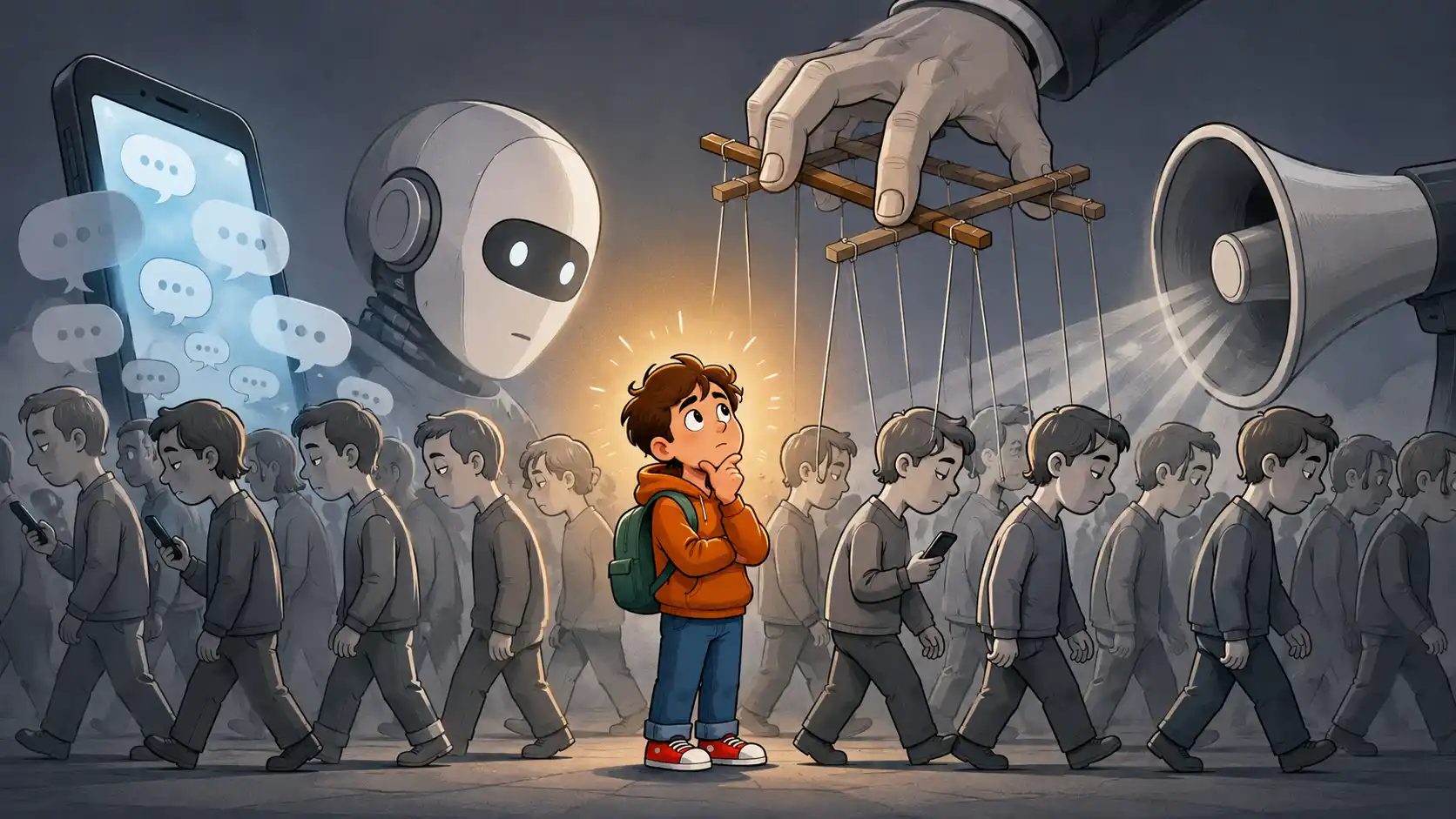
Dietrich Bonhoeffer meant something much more disturbing. For the German theologian and anti-Nazi dissident, stupidity wasn’t simply low intelligence. It wasn’t ignorance. It wasn’t even doing something spectacularly foolish. It was the surrender of independent thought.
And that, Bonhoeffer argued, could be more dangerous to society than evil itself.
This article is a summary of a video embedded below, featuring philosopher and Big Think columnist Jonny Thomson, who explores Bonhoeffer’s ideas about stupidity and connects them to modern politics, social media, artificial intelligence, expertise, conformity, and our increasingly impressive ability to have strong opinions about subjects we discovered eleven minutes ago. Big Think describes Thomson’s framework around three conditions: outsourcing our thinking, willful ignorance, and conformity.
Stupidity Is Not the Same as Being Dumb
Bonhoeffer developed his reflections on stupidity while imprisoned by the Nazis. He had opposed the Nazi regime, participated in resistance activities, and was eventually executed in 1945, shortly before the Flossenbürg concentration camp was liberated.
From that historical context came one of his most unsettling observations: stupidity could be a more dangerous enemy of the good than evil.
Why? Because evil is recognizable.
A dictator committing atrocities is relatively easy to identify as a threat. So is a murderer, a corrupt official, or—if we want the Hollywood version—a dark wizard standing dramatically in front of a volcano while an orchestra explains that this gentleman probably does not have good intentions.
Once evil becomes visible, people can oppose it. Stupidity is different.
Bonhoeffer wasn’t talking about IQ. An extremely intelligent scientist can still behave stupidly in his sense. Nor was he describing ordinary ignorance. Not knowing something merely means you don’t know it.
There is an enormous difference between: “I don’t know,” and: “I don’t know, I don’t want to know, and nothing you show me will make me reconsider.”
The second one is where things get interesting. And slightly terrifying.
1. We Outsource Our Thinking
Thomson’s first element of Bonhoefferian stupidity is outsourcing critical thought to someone—or something—else.
Humans outsource mental tasks constantly. We use calculators because dividing 7,493 by 37 manually is an excellent way to discover you suddenly have other priorities. We use GPS because memorizing every road in Jakarta would leave precious little brain capacity for remembering passwords.
None of this is inherently problematic.
But philosopher Robert J. Howell introduced a much more uncomfortable thought experiment in his paper Google Morals, Virtue, and the Asymmetry of Deference. Howell asks us to imagine something like “Google Morals”: a system capable of telling us what we morally ought to do. The paper appeared in Noûs, volume 48, in 2014, after first appearing online in 2012.
Imagine asking: Should I lie to protect my friend? Should I leave my partner? Should I take this job? Should I eat meat?
And instead of using the system to help us think, we simply accept:
ANSWER GENERATED. MORALITY COMPLETE. PLEASE CONTINUE WITH YOUR DAY.
Howell’s thought experiment suddenly feels considerably less hypothetical in the age of ChatGPT, Claude, and other AI assistants. Thomson’s point isn’t that using AI for advice automatically makes someone stupid. The important distinction is between using a tool to improve your reasoning and letting the tool replace your reasoning.
Ask AI to challenge your assumptions? Useful. Ask it for arguments you haven’t considered? Useful.
Ask it what your values should be and then blindly obey whatever appears on screen? Congratulations. Humanity spent billions of dollars building artificial intelligence so that we could voluntarily stop using our natural version.
2. Ignorance Isn’t Stupidity. Willful Ignorance Is.
Socrates is famously associated with recognizing the limits of his own knowledge. Whether every famous Socratic quote floating around Instagram would survive a meeting with an actual classics scholar is another question, but the philosophical principle matters:
Recognizing that you don’t know something is the beginning of inquiry, not its failure.
Thomson contrasts ordinary ignorance with the ancient Greek concept of amathia—roughly, a kind of culpable or willful ignorance.
Suppose you know almost nothing about nuclear energy. That’s fine.
Most people know almost nothing about most things. There simply isn’t enough lifetime available to become a nuclear engineer, epidemiologist, economist, historian, semiconductor architect, constitutional lawyer, nutrition scientist, and person who finally understands what every setting in Microsoft Excel does.
The problem begins when someone refuses to learn while maintaining absolute confidence.
They don’t say: “I haven’t studied this.”
They say: “I don’t need to study this because I already know everyone who disagrees with me is wrong.”
Information stops becoming something to evaluate. It becomes something to defend against. And this connects directly to another thinker Thomson discusses: Chris Ranalli.
Definitely related: The Reputation Afterlife: Why Shameless Confidence Can Outlive Competence
Indoctrination Is About How You Believe
In his 2022 paper Closed-minded Belief and Indoctrination, philosopher Chris Ranalli argues for an account of indoctrination centered on closed-minded belief and what he calls “epistemically insulating content”—ways of holding beliefs that discourage serious consideration of alternatives.
That’s important because indoctrination isn’t necessarily defined by which side you’re on. An atheist can be indoctrinated. A religious believer can be indoctrinated. A socialist can be indoctrinated. A capitalist can be indoctrinated. A vegan can be indoctrinated.
A person whose entire identity somehow revolves around defending a particular graphics-card manufacturer can presumably manage it too.
The important question is not simply: What do you believe?
It is: What would happen if evidence challenged that belief?
If every disagreement becomes evidence that your opponents are corrupt, brainwashed, evil, ignorant, or secretly part of The Conspiracy™, your belief has constructed its own immune system. Contradictory evidence no longer weakens it. Contradictory evidence strengthens it. That’s an extremely difficult intellectual fortress to enter.
3. Conformity Can Make Smart People Stupid
This is perhaps Bonhoeffer’s most disturbing observation. He lived surrounded by educated people.
Germany in the 1930s did not suddenly experience a nationwide collapse in IQ. Universities still contained intelligent academics. Government ministries contained capable administrators. Engineers remained engineers. Doctors remained doctors.
Yet intelligent people became participants in an extraordinarily destructive political system. How? Bonhoeffer’s answer involved the social effects of power and conformity.
People stopped functioning as independent individuals and increasingly became representatives of a collective. The party thinks this. Our people believe this. Everyone knows this. You don’t want to be one of them, do you?
Independent reasoning gradually becomes socially expensive. Conformity becomes cheap. And humans, being the bargain hunters that we are, notice.
The Smartest Person in the Room Can Still Be Stupid
Thomson also invokes Austrian writer Robert Musil, who distinguished ordinary stupidity from what might be called intelligent stupidity. This is an important addition because we often imagine stupidity as the opposite of intelligence. It isn’t always.
A brilliant person can deploy enormous intellectual ability toward ridiculous conclusions.
Intelligence gives you better tools. It doesn’t guarantee that you’re building the right house. In fact, intelligence can sometimes make the problem worse because clever people are extremely good at producing clever justifications for things they already want to believe.
Give someone greater rhetorical ability and they may become better at discovering the truth. Or they may simply become better at winning arguments on Reddit. Human progress is complicated.
Expertise Can Become Its Own Trap
Another version appears in philosopher Nathan Ballantyne’s work on epistemic trespassing.
Ballantyne describes the problem of experts moving beyond domains where they possess the relevant expertise while retaining the confidence that expertise gave them. His book Knowing Our Limits was published by Oxford University Press in 2019.
Imagine an astrophysicist who knows an extraordinary amount about black holes. That does not automatically make them an expert in monetary policy. A celebrated economist does not automatically understand immunology. A brilliant software engineer does not receive +20 Wisdom when discussing geopolitics.
The trap is obvious: being demonstrably right about difficult things in one field can make you assume you’re unusually good at being right generally. Expertise becomes confidence. Confidence travels. Knowledge does not necessarily come along for the ride.
This is another reason Bonhoeffer’s stupidity has little to do with conventional intelligence. Nobody is immune.
Why Stupidity Can Be Worse Than Evil
Bonhoeffer’s argument now becomes clearer. Evil has an enormous weakness: People recognize it as evil. That recognition creates resistance.
Bonhoeffer wrote that evil contains the seeds of its own destruction because it produces unease and opposition. His reflections on stupidity appear in material later collected in Letters and Papers from Prison.
Stupidity can operate differently. It can normalize the system that evil requires.
The dictator cannot personally enforce every order. The corrupt executive cannot personally falsify every document. The abusive institution cannot survive if everyone constantly asks: “Wait. Why are we doing this?”
Systems require participation. They require people who follow procedures, repeat slogans, enforce rules, protect identities, and occasionally decide that asking another question sounds exhausting.
Evil may design the machine. Stupidity keeps filling it with fuel.
Power Encourages People to Stop Thinking
Thomson takes this argument into modern institutions.
Consider political parties. Politicians theoretically represent their own judgment and their constituents. But party systems also create enormous pressure to vote according to the party line.
Businesses do something similar. Organizations love employees who are “aligned.” Alignment can be useful. A company where everyone runs toward a different objective is less an organization and more a multiplayer lobby without voice chat. But alignment can mutate into obedience.
Could be related: The Seduction of Certainty: Cognitive Closure
Harry Frankfurt and the Rise of Bullshit
This leads Thomson to philosopher Harry Frankfurt and his famous essay On Bullshit, originally published in Raritan in 1986.
Frankfurt distinguishes the bullshitter from the liar. The liar still cares about truth. They know reality points in one direction and deliberately attempt to point you somewhere else.
The bullshitter has a different relationship with truth: They don’t particularly care.
Their statement exists to create an impression, win an argument, gain status, avoid responsibility, or achieve some other purpose. Truth is optional equipment.
This explains an enormous amount of public discourse. We’re constantly expected to have opinions. New war? Opinion. Election? Opinion. New AI model? Opinion.
But nobody can know enough about everything. So modern communication creates a strange incentive: admitting uncertainty can make you look uninformed, while speaking confidently can make you look authoritative. Even when you are confidently manufacturing intellectual vapor.
Social Media Built a Factory for Conformity
Social media adds another ingredient. Likes, reposts, shares, and followers provide immediate feedback about which opinions your community rewards.
Say the approved thing? Reward. Challenge your group? Silence, hostility, unfollows—or the modern digital ritual in which twelve strangers carefully explain that you are literally history’s greatest monster.
This creates a powerful incentive to adopt beliefs socially rather than intellectually. Thomson describes this as a kind of distributed conformity.
Traditional authoritarianism needed someone telling people what to believe. Social media can accomplish something similar without a central dictator. The algorithm discovers which content keeps you engaged. Your community rewards certain positions. You learn what gets applause. Eventually, nobody needs to issue instructions.
The Most Important Question Is Not “Are They Stupid?”
This might be the most useful lesson from Thomson’s lecture. Whenever people encounter Bonhoeffer’s theory, the temptation is obvious. You immediately think of someone else.
“Oh yes. Bonhoeffer perfectly describes those people.”
Your political opponents. The people in that other community. That annoying uncle. The person with 37 consecutive comments beneath a YouTube video explaining how every scientist on Earth has somehow overlooked something he discovered while eating cereal.
But that misses the point.
The uncomfortable question is: Where am I doing this?
- Which beliefs have I outsourced?
- Which opinions do I hold because people around me hold them?
- Which subjects have I refused to investigate?
- Which experts do I trust outside their actual expertise?
- Which opinions would I struggle to abandon because abandoning them would threaten my identity?
That’s considerably less fun. Philosophy has an unfortunate habit of doing that.
Descartes: Empty the Apple Basket
Thomson turns to René Descartes, whose method of radical doubt asks us to reconsider beliefs we may have inherited without examination.
The basic idea is simple. Many beliefs entered our heads before we were capable of seriously evaluating them, from parents, teachers, religion, culture, friends, and now algorithms. So occasionally we should inspect the inventory. Not because everything we believe is wrong, but because we should know why we believe it.
Ask yourself: What evidence would change my mind?
If the answer is “nothing,” you’re no longer describing an ordinary empirical belief. You’re describing a membership card.
Karl Popper: Try to Prove Yourself Wrong
Thomson offers another useful tool through philosopher Karl Popper and falsification. Instead of continuously searching for information confirming what you believe, deliberately seek out the strongest arguments against it.
Think eating meat is morally acceptable? Read serious arguments from vegetarians and vegans.
Believe capitalism is clearly superior? Read thoughtful socialist economists.
Think capitalism is obviously evil? Read its strongest defenders.
Think your favorite game is objectively a masterpiece? Read the Steam reviews. Actually, perhaps some epistemic environments are too hostile.
The principle remains useful: Don’t test your beliefs against idiots. Test them against the smartest version of the opposing argument.
If your position survives, it becomes stronger. If it doesn’t, congratulations. You discovered something. That’s supposed to be the point.
Learn to Say “I Don’t Know”
Toward the end of the lecture, Thomson returns to one of philosophy’s least fashionable habits: Admitting ignorance.
Ancient skeptics associated suspension of judgment with ataraxia, or tranquility. There is something liberating about realizing you don’t need an opinion about everything.
“I don’t know enough about that.” is a perfectly respectable sentence. Possibly one of humanity’s greatest inventions. Unfortunately, it performs terribly as a YouTube thumbnail.
The crucial distinction is between temporary ignorance and willful ignorance.
- “I don’t know, so I’ll learn” is intellectual humility.
- “I don’t know and don’t care whether I’m wrong” is Bonhoeffer’s danger.
We Need People Who Disagree With Us
Thomson’s final prescription isn’t pure individualism. Thinking for yourself does not mean thinking entirely by yourself. In fact, that can produce another form of stupidity.
Good reasoning requires disagreement. Organizations need dissent. Friendships benefit from ideological variety. Institutions become dangerous when loyalty becomes more important than criticism.
Thomson connects this to Steven Levitsky and Daniel Ziblatt’s 2018 book How Democracies Die, which examines the erosion of democratic institutions and political norms.
A healthy system needs people capable of saying: “I think we’re wrong.” Because a system where nobody is allowed to disagree has lost one of its most important error-correction mechanisms.
Stupidity Is Something We Do
Bonhoeffer’s theory becomes much more useful once we stop treating stupidity as a category of people. There aren’t simply intelligent people over here and stupid people over there. There are situations in which all of us surrender our thinking.
We defer to authority. We defend identities. We repeat slogans. We wander outside our expertise. We mistake confidence for knowledge. We choose belonging over truth.
And increasingly, we have machines perfectly willing to generate sophisticated-sounding answers whenever thinking ourselves feels inconvenient.
That doesn’t mean we must distrust every institution, expert, friend, political party, or AI system. Quite the opposite. Civilization requires intellectual cooperation because no individual can independently verify everything.
The question is whether we use other minds as inputs to our thinking or as replacements for it. Bonhoeffer’s warning is ultimately not about stupid people. It’s about what happens when perfectly intelligent people stop exercising the independence that intelligence requires.
And perhaps the healthiest response is also the simplest. Ask more questions. Seek disagreement. Know the limits of your expertise. Be suspicious when your group makes disagreement socially impossible.
