
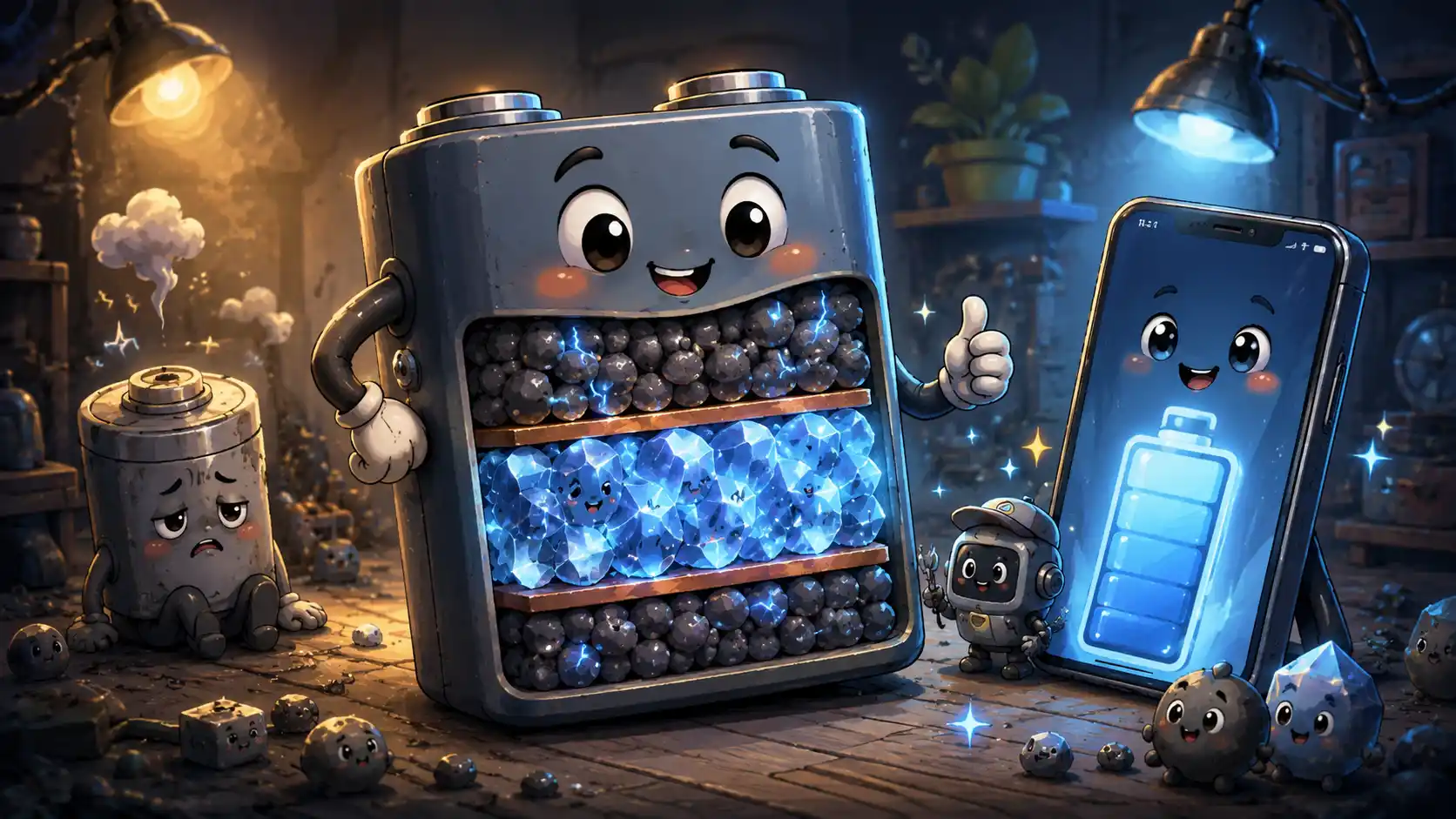
For years, smartphone battery capacity seemed to have reached an unofficial ceasefire. Flagship phone? Around 5,000mAh. Mid-range phone? Around 5,000mAh. Next year’s flagship with a faster processor, brighter display, three more AI features, and a camera bump visible from orbit? Still around 5,000mAh.
Then something changed.
We started seeing phones with 6,000mAh batteries. Then 7,000mAh. Some newer devices are pushing toward 9,000mAh and even 10,000mAh without turning into portable power banks with Android installed. One important reason is silicon-carbon battery technology.
But despite the futuristic name, silicon-carbon—or Si-C—batteries are not replacing lithium-ion batteries. They are changing something inside them. And that seemingly small change may be one of the biggest improvements smartphone batteries have received in years.
Silicon-Carbon Is Still a Lithium-Ion Battery
This is probably the first misconception worth clearing up. A silicon-carbon battery is generally still a lithium-ion battery.
The basic structure remains familiar:
- A cathode
- An electrolyte
- A separator
- An anode
The important change happens mainly in the anode.
Most conventional lithium-ion batteries use graphite as their primary anode material. During charging, lithium ions move toward the anode and are stored within the graphite structure. Silicon-carbon batteries replace some of that graphite—or supplement it—with silicon combined with carbon-based materials.
So this: Traditional lithium-ion battery → graphite anode
becomes something closer to: Silicon-carbon lithium-ion battery → silicon-enhanced carbon anode
That distinction matters because Si-C isn’t a completely new battery chemistry in the way people often imagine solid-state batteries. It is more like giving an existing lithium-ion battery a significantly upgraded storage compartment.
Graphite Is Reliable. Silicon Is Ambitious.
Graphite became the standard anode material for good reasons. It is relatively stable, conductive, well understood, and capable of surviving hundreds or thousands of charging cycles. But graphite has a limit. Its theoretical specific capacity is roughly 372mAh per gram.
Silicon, depending on how the calculation is defined, can theoretically store roughly 3,600 to 4,200mAh per gram. That is around ten times as much. Which immediately raises the obvious question: Why didn’t battery manufacturers just replace graphite with silicon decades ago?
Because silicon has the structural temperament of an inflatable castle.
The Problem: Silicon Swells Dramatically
When lithium enters silicon during charging, the silicon forms lithium-silicon alloys. As this happens, silicon can expand in volume by roughly 300 percent. Graphite expands too, but much less dramatically. That means a silicon particle can repeatedly go through something like this:
- charge → swell
- discharge → shrink
- charge → swell
- discharge → shrink
Now repeat that hundreds of times. The result isn’t difficult to imagine.
Silicon particles can fracture. The electrode can crack. Parts of the material can lose electrical contact with the rest of the battery. Eventually, some silicon may still physically exist inside the cell but no longer participate effectively in storing energy. A battery material capable of holding enormous amounts of lithium is not very useful if it gradually destroys itself while doing so.
It Also Keeps Breaking Its Own Protective Layer
There is another problem hiding on the surface of the anode. Lithium-ion batteries naturally form something called the solid electrolyte interphase, usually shortened to SEI. When the electrolyte first reacts with the anode, some electrolyte decomposes and creates a thin protective layer.
That sounds unfortunate, but a stable SEI is actually essential. It lets lithium ions pass while reducing continued unwanted reactions between the electrolyte and anode. Graphite can maintain a reasonably stable SEI. Silicon makes things more complicated. Because silicon expands so dramatically, its protective layer can crack.
Fresh silicon is exposed. More electrolyte reacts with it. A new SEI forms. Then the silicon shrinks and expands again. The layer cracks again. And the battery continues spending lithium and electrolyte repairing something that keeps breaking. Over time, this contributes to capacity loss and shorter cycle life.
So silicon has two major problems at once: It mechanically damages itself, and that damage creates additional chemical degradation. Excellent capacity. Terrible workplace behaviour.
This Is Where Carbon Comes In
The trick is not simply adding silicon to an electrode and hoping for the best. Modern silicon-carbon anodes are engineered so that carbon helps control silicon’s weaknesses.
Carbon can serve several purposes. First, it provides a conductive network. Silicon is not particularly good at conducting electrons. Carbon materials can create pathways that help electrons reach silicon particles even as the electrode changes shape.
Second, carbon can act as a mechanical buffer. Depending on the design, silicon particles can be embedded inside porous carbon, coated with carbon, surrounded by carbon structures, or arranged in more complicated composite architectures. The empty spaces and flexible structures give silicon somewhere to expand.
Instead of letting every silicon particle push directly against its neighbours until the electrode starts disassembling itself, engineers try to provide room for that expansion. There is no single universal silicon-carbon design.
Manufacturers and researchers are experimenting with things such as:
- Silicon nanoparticles
- Silicon oxide
- Porous silicon-carbon composites
- Carbon-coated silicon
- Core-shell structures
- Nano-silicon architectures
“Silicon-carbon battery” is therefore better understood as a family of anode technologies than one exact recipe.
So Does Silicon Give You Ten Times the Battery Capacity?
Absolutely not. This is where theoretical material numbers can become dangerously enthusiastic marketing material. Silicon may offer around ten times the theoretical gravimetric capacity of graphite as an anode material. But an anode is only one part of a complete battery.
A cell also contains:
- Cathode material
- Electrolyte
- Separator
- Current collectors
- Packaging
- Binders
- Conductive additives
And commercial silicon-carbon anodes still contain plenty of carbon and other materials. The cathode also has to supply the lithium being stored in the anode. Improving one side does not magically multiply the capacity of everything else. So silicon’s enormous theoretical capacity translates into a much smaller—but still very useful—improvement at the complete-cell level.
And in smartphones, even a 10 or 20 percent improvement in energy density is enormously valuable.
That’s Why Smartphone Batteries Are Suddenly Getting Bigger
For years, smartphone manufacturers faced a simple geometry problem. If you wanted substantially more battery capacity, you generally needed more battery. More battery requires more internal volume. More internal volume means a thicker phone, a larger phone, less room for cameras and cooling, or some combination of all three.
Silicon-carbon changes that equation. Increasing the battery’s energy density means manufacturers can store more energy within roughly the same volume. That improvement can be spent in two ways.
Keep the phone similar and increase battery capacity
This is what creates those increasingly absurd-looking numbers. Instead of roughly 5,000mAh, manufacturers can push beyond 6,000, 7,000, or even higher without increasing thickness proportionally.
Keep the capacity similar and make the battery thinner
This is particularly valuable for foldable phones. Foldables already sacrifice enormous amounts of internal space to:
- Hinges
- Multiple displays
- Camera modules
- Structural reinforcement
- Cooling systems
A thinner battery containing the same amount of energy can therefore be just as valuable as a larger battery. This is why looking only at the mAh number can undersell silicon-carbon. The real advantage is more energy per unit of internal space. Phone designers can decide where to spend that extra room.
Silicon Percentage Is Becoming Its Own Arms Race
There is another interesting trend happening alongside growing battery capacity. Manufacturers are increasingly advertising the percentage of silicon in their anodes.
Early commercial silicon-enhanced batteries used relatively modest amounts because adding more silicon makes the swelling problem increasingly difficult to manage.
Recent generations have pushed that percentage higher. Some commercial designs have moved from around 10 percent silicon toward 15 percent, 20 percent, and beyond, while experimental or newer designs are going even further. This is important because merely saying that a phone has a “silicon-carbon battery” tells us surprisingly little. Two Si-C batteries can use very different silicon concentrations, particle sizes, carbon structures, binders, electrolytes, and manufacturing methods.
Higher silicon content can potentially increase energy density. It can also make maintaining cycle life significantly harder. So the real engineering race isn’t simply: Who can put the most silicon into a battery? but who can put more silicon into the battery without making it die embarrassingly quickly?
Does Silicon-Carbon Mean Faster Charging?
Not automatically. Many phones using Si-C batteries also happen to offer extremely fast charging, which makes the technologies easy to associate. But silicon-carbon does not inherently mean 100W, 150W, or any particular charging speed.
Fast charging depends on the whole battery system:
- Electrode structure
- Electrolyte chemistry
- Cell temperature
- Charging voltage
- Thermal management
- Battery-management software
- Physical cell design
In fact, aggressively charging silicon creates additional challenges because lithium must enter the expanding material quickly and evenly. So Si-C can be compatible with fast charging, but fast charging is not an automatic property of silicon-carbon chemistry.
What About Battery Lifespan?
This is another area where the answer is less exciting than the marketing department would prefer. Silicon does not inherently improve cycle life. If anything, silicon’s expansion makes achieving good longevity more difficult.
The reason modern Si-C batteries are interesting is that manufacturers are increasingly managing to combine higher silicon content with acceptable consumer battery lifespan. Carbon structures, specialised binders, better electrolytes, nano-engineering, improved SEI control, and smarter charging systems all contribute.
Some manufacturers now claim their Si-C batteries can retain around 80 percent capacity after well over a thousand charging cycles. But those numbers should be treated as properties of specific battery implementations, not silicon-carbon as a universal technology. A poorly designed silicon-rich battery can still degrade quickly.
Is Silicon-Carbon Safer?
Also not inherently. Most silicon-carbon smartphone batteries still use the same broad liquid-electrolyte lithium-ion architecture as conventional batteries. That means Si-C does not automatically gain the potential non-flammable electrolyte advantages associated with some solid-state batteries.
Silicon also brings its own challenges because of its expansion and highly reactive surface. Commercial batteries compensate through careful material design, protection systems, manufacturing controls, and battery-management electronics.
There is no particular reason to panic about a phone simply because it uses silicon-carbon. But there is equally little reason to assume: silicon-carbon = automatically safer battery. Its main advantage is energy density.
Silicon-Carbon and Solid-State Batteries Aren’t Really Competitors
This is where battery terminology becomes slightly confusing. Silicon-carbon primarily changes the anode. Solid-state technology primarily changes the electrolyte. They address different parts of the battery. That means the two technologies could eventually coexist.
A future battery could theoretically combine: a silicon-rich anode + solid electrolyte + advanced cathode. Researchers are already exploring combinations along those lines. Of course, putting expanding silicon against a rigid solid electrolyte introduces an entirely new selection of mechanical problems.
Battery engineering rarely lets anyone solve one problem without unlocking the next boss fight.
The Battery Revolution Was Already Happening
Solid-state batteries receive enormous attention because they promise something that sounds revolutionary: replacing the liquid electrolyte inside today’s batteries. Silicon-carbon is less dramatic. It doesn’t replace lithium-ion. It doesn’t completely reinvent the battery. It improves one material inside an architecture we already manufacture by the billions.
Nevertheless, that comparatively modest change is already having a visible effect.
Phones that spent years hovering around 5,000mAh are suddenly moving beyond 6,000 and 7,000mAh. Extremely thin devices can carry surprisingly large batteries. Foldables can reclaim precious internal space. The important breakthrough wasn’t discovering that silicon can store lots of lithium. Scientists have known that for decades.
The breakthrough was gradually figuring out how to make silicon useful without allowing it to destroy the electrode every time the battery charges. That may not sound as futuristic as a completely new battery technology.
However, unlike many battery revolutions that are perpetually five years away, silicon-carbon is already sitting inside devices people can buy today. Sometimes the future doesn’t arrive with a completely new battery. It could arrive when engineers finally convince one very promising material to behave itself.
