
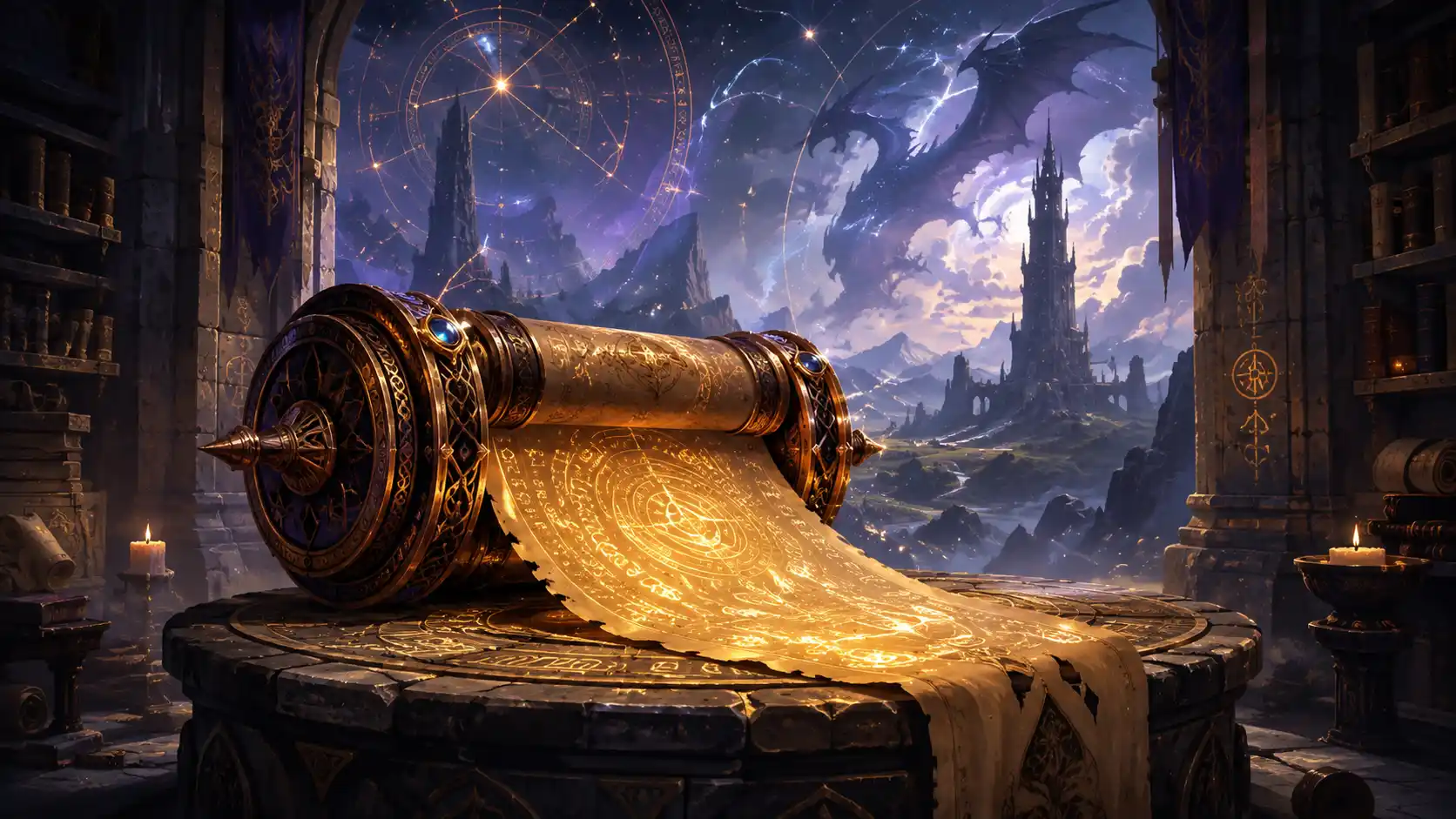
If you have played Skyrim, Oblivion, or Morrowind, there is a decent chance you’ve spent hundreds of hours in a series called The Elder Scrolls without ever stopping to ask one fairly obvious question: What exactly is an Elder Scroll?
Not The Elder Scrolls as in Bethesda’s RPG franchise. The actual scrolls.
They exist physically inside the games. People search for them. Empires collect them. Specialized monks spend their entire lives learning how to read them. In Skyrim, one is even used as part of a plan involving Alduin.
And yet describing exactly what an Elder Scroll is turns out to be surprisingly difficult.
They are books, except they aren’t really books. They contain prophecies, except they don’t simply predict one predetermined future. They physically exist, except apparently counting them doesn’t work properly. And according to Paarthurnax, they are artifacts from outside time itself.
So, yes. We are starting our Elder Scrolls lore journey with the perfectly reasonable magical documents after which the entire franchise is named. Naturally, they make almost no sense.
An Elder Scroll Is More Than a Magical Book
Physically, Elder Scrolls look relatively straightforward.
They are enormous ancient scrolls stored inside elaborate cylindrical cases. When opened, they contain strange glowing patterns and symbols that most people cannot properly interpret. But treating one like an unusually powerful spellbook badly undersells what it actually represents.
In Skyrim, Paarthurnax describes an Elder Scroll as something originating from outside normal time—a fragment of creation that paradoxically has both always existed and, in some sense, does not exist normally at all. That distinction matters.
An ordinary historical book records something that already happened. A prophecy predicts something that might happen. An Elder Scroll can contain information about the past, present, and possible future while apparently existing outside the normal sequence connecting those things.
They’re less like books and more like windows into reality. Except the window may show tomorrow. Or yesterday. Or several versions of tomorrow simultaneously.
This is already becoming inconvenient.
Nobody Knows Who Created the Elder Scrolls
Perhaps the strangest thing about some of the most powerful artifacts in Tamriel is that nobody seems to know where they came from.
Dexion Evicus, one of the Moth Priests encountered during Skyrim: Dawnguard, admits that even after decades studying them, the Scrolls remain mysterious. The Moth Priests don’t know who wrote them. They don’t know exactly where they originated. They can’t even fully explain how they work.
That is significant because the Moth Priests aren’t random scholars who found a mysterious parchment in somebody’s attic. Their entire religious and scholarly tradition revolves around studying Elder Scrolls.
And their professional conclusion is essentially: We have studied these things for generations. They remain extremely weird.
There are theories connecting the Scrolls to divine creation, but the games deliberately avoid giving us a simple creator. Nobody hands us a neat mythology saying, “Akatosh made the Elder Scrolls on Tuesday.” Instead, they appear to belong to a deeper layer of the universe than many conventional magical artifacts.
An in-game text associated with the Cult of the Ancestor Moth goes even further, describing the Scrolls as writings whose knowledge exceeds both Aedra and Daedra. That makes them unusual even in a universe where gods regularly interfere with mortal affairs.
The Elder Scrolls Don’t Simply Predict the Future
Calling Elder Scrolls “books of prophecy” is technically useful but also slightly misleading.
They can reveal the future. But that doesn’t necessarily mean the future already exists as one immutable sequence of events waiting to happen.
Before a prophecy is fulfilled, different possibilities can apparently exist around it. The person reading a Scroll is therefore not necessarily watching a recording of an unavoidable future.
They’re glimpsing something far messier. Possibilities. Outcomes. Events that may become true. This fits one of the recurring ideas throughout The Elder Scrolls: history is not always as fixed as we’d like it to be.
Time can break. Multiple contradictory events can apparently occur. Mortals can become gods. Gods sometimes disagree about what happened. And occasionally someone builds a giant brass robot and reality starts filing a formal complaint.
The Elder Scrolls belong comfortably inside that universe. They don’t necessarily function as cosmic spoilers. They appear closer to records of reality itself—including portions of reality that haven’t settled into history yet.
This Is Why Reading One Is Dangerous
Unfortunately, humanity invented eyeglasses before Tamriel invented a safe Elder Scroll reader.
For most ordinary people, simply opening one does not automatically provide glorious cosmic knowledge. An in-game text called Effects of the Elder Scrolls separates readers according to their ability to comprehend what they’re seeing.
Someone completely untrained may get almost nothing useful from it. Those with greater understanding can begin extracting information. But genuinely comprehending an Elder Scroll comes with a price.
Repeated readings can damage the reader’s sight, eventually causing permanent blindness. This is where the Cult of the Ancestor Moth enters the story.
Meet the Moth Priests
The Moth Priests are specialists dedicated to studying and interpreting Elder Scrolls.
Historically associated with the Imperial City and White-Gold Tower, they use their readings to interpret prophecy and provide knowledge to the Emperor. They’re essentially Tamriel’s most prestigious archival department.
Except the documents occasionally reveal the structure of reality and destroy your eyesight. The priests develop specialized techniques to safely—or at least more safely—interpret them.
In Skyrim: Dawnguard, we learn about the Ritual of the Ancestor Moth. Certain moths associated with secluded Ancestor Glades possess a connection to ancient magic. By attracting enough of them, a reader can gain the “second sight” necessary to interpret an Elder Scroll.
Even with training, however, reading Scrolls repeatedly eventually blinds the priests.
The in-game book Pension of the Ancestor Moth describes this almost as the natural conclusion of their vocation: each reading becomes more profound, periods of blindness increase, and eventually a final reading leaves the priest permanently unable to see.
Imagine getting tenure, except your retirement package is cosmic enlightenment and irreversible eye damage.
You Can’t Even Reliably Count Them
Here’s where things become especially bizarre. At different points in Tamrielic history, the Imperial authorities have collected Elder Scrolls inside the Imperial Library. You might reasonably assume someone could therefore walk around with a clipboard and count them.
Apparently not. The in-game book An Accounting of the Elder Scrolls tells the story of someone attempting exactly that. He tries to catalogue the collection. Different monks give contradictory locations for apparently identical Scrolls. Categories overlap. Records refuse to make sense.
Eventually a monk explains the problem: The Scrolls don’t exist in countable form. As a demonstration, a collection is counted and found to contain fourteen Scrolls. One is removed. They count again. Now there are eighteen. And apparently there had always been eighteen.
This is either profound metaphysics or Tamriel’s worst inventory management system. Probably both. The implication is important, though. An Elder Scroll isn’t merely a physical object obeying normal rules while containing supernatural information.
The object itself does not fully obey normal reality.
Its location, number, relationship with time, and possibly even accessibility seem connected to whatever strange metaphysical rules govern the Scrolls.
The Scrolls May Even Choose Who Finds Them
Dexion makes another fascinating observation during Dawnguard. He suggests that Elder Scrolls have something resembling a will of their own. If a Scroll did not want someone to find it, according to him, they probably wouldn’t.
We should be careful here because Elder Scrolls lore frequently mixes established facts with interpretations made by characters inside the universe.
Dexion isn’t necessarily giving us an objective rule written into the source code of reality. But his statement fits what we repeatedly see. Scrolls disappear. They surface at historically important moments. Their numbers refuse to behave. Heroes encounter them when they become relevant to prophecy.
At minimum, the Elder Scrolls behave less like passive artifacts than ordinary magical objects do. Whether they’re literally conscious is another question. And this franchise has enough metaphysical questions already.
How Were Elder Scrolls Used in Skyrim?
The Scrolls become particularly important in The Elder Scrolls V: Skyrim.
Long before the events of the game, ancient Nord heroes faced Alduin, the immensely powerful dragon known as the World-Eater. Unable to defeat him conventionally, they used an Elder Scroll at the Throat of the World.
They didn’t kill Alduin. They effectively cast him forward through time.
Thousands of years later, the Last Dragonborn uses the same Scroll at the same location to peer backward through the Time-Wound created by that event and witness the ancient battle.
Think about what’s happening here. The Elder Scroll isn’t merely telling the Dragonborn: “Once upon a time, three Nords fought Alduin.” It allows the Dragonborn to perceive an event across time at the exact location where reality itself was damaged.
That gives us perhaps the clearest demonstration of what these artifacts really are. They’re not simply archives. They’re connected to the structure of time and reality itself.
So What Actually Is an Elder Scroll?
The frustrating answer is: Nobody completely knows. But we can assemble a working definition.
An Elder Scroll is an ancient, mysterious artifact existing partially outside ordinary time that contains—or provides access to—knowledge of events across the past, present, and possible future.
They cannot be reliably counted. Their origins are unknown. Reading them properly requires extraordinary preparation and can eventually cause blindness.
And despite centuries of study, even the Moth Priests still don’t fully understand them. Dexion openly acknowledges that uncertainty despite spending decades studying the subject.
Which may be precisely the point. The Elder Scrolls aren’t simply magical MacGuffins. They represent one of the defining ideas behind the entire universe: reality is larger, stranger, and much less stable than the people living inside it understand.
History can contradict itself. Prophecy can involve possibilities rather than certainty. Time can be damaged. And the most important documents in existence apparently refuse to remain properly filed.
Perhaps Bethesda couldn’t have picked a better name for the franchise.
Because underneath the dragons, wars, assassins, elves, Daedric Princes, and suspiciously persistent prison sentences, The Elder Scrolls has always been a series about discovering fragments of an enormous world whose complete truth remains just beyond your reach.
The Scrolls themselves are exactly that idea made physical.
