
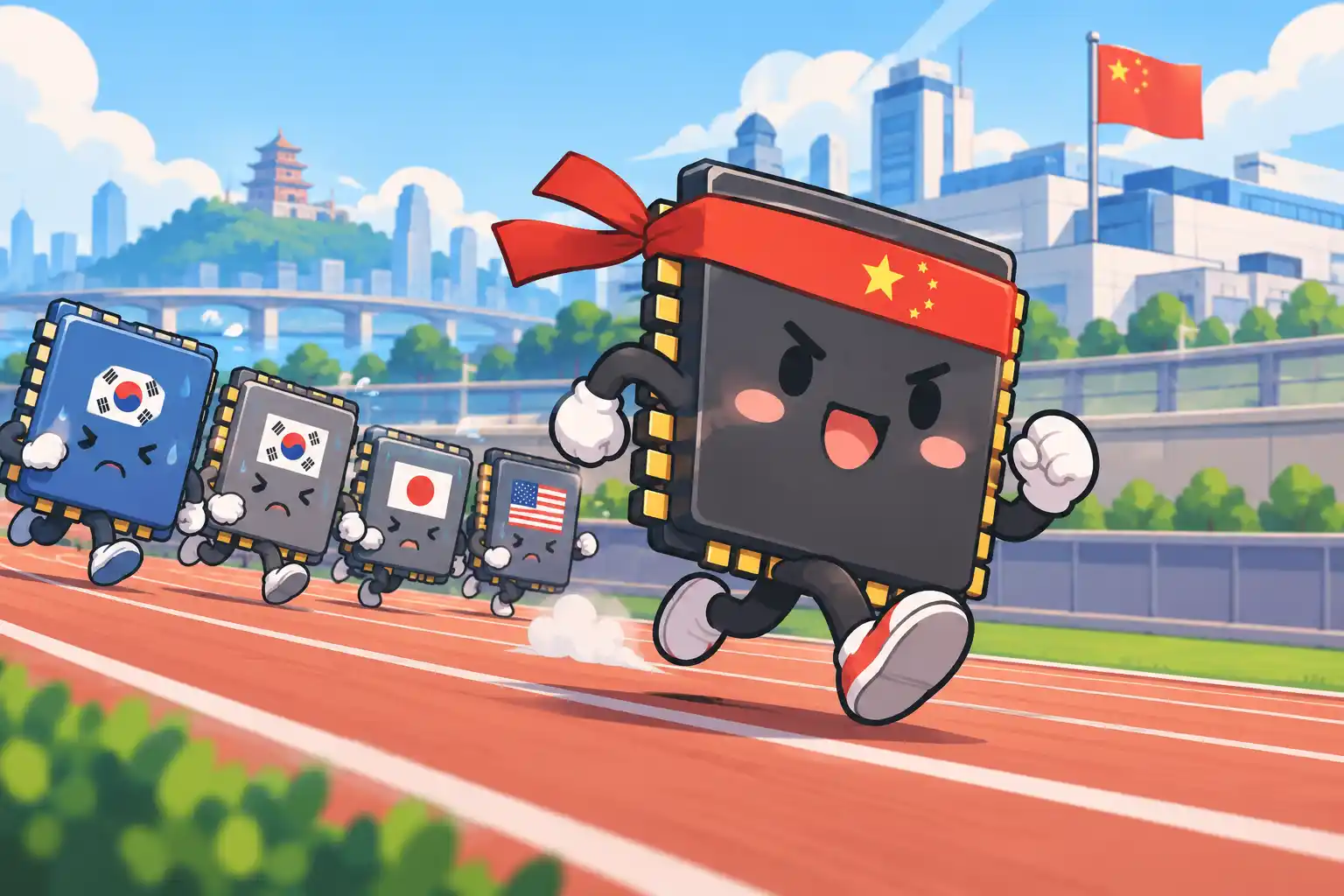
Imagine entering one of the most brutal semiconductor markets in the world nearly three decades after the established leaders. Then imagine getting hit by export controls, losing access to important manufacturing equipment, and still telling investors a few years later: We are going to become number one.
That is roughly where Yangtze Memory Technologies Co., better known as YMTC, finds itself today.
The Wuhan-based company is now one of the world’s largest NAND flash manufacturers and has reportedly set an extraordinarily ambitious target: become the world’s biggest NAND producer by the end of 2027.
That means overtaking companies such as Samsung, SK hynix, Micron, and Kioxia. Not bad for a company founded in 2016. But YMTC’s story is more interesting than another “China challenges Samsung” headline.
The company did not simply copy existing NAND designs and scale them with cheap capital. It developed an unusual architecture called Xtacking, survived years of increasingly restrictive U.S. export controls, and is now pouring billions into new production capacity.
The technology question is mostly settled. YMTC can make competitive NAND. The harder question now is whether it can make enough of it.
First, What Exactly Does YMTC Make?
We previously looked at CXMT, China’s rapidly expanding DRAM manufacturer. YMTC operates in the other major memory market: NAND flash.
DRAM is fast, temporary working memory. Your system RAM is DRAM. NAND stores data even when power disappears. Your SSD uses NAND.
Very simplified:
- DRAM → working memory
- NAND → storage
Samsung, SK hynix, and Micron participate in both markets. China now has CXMT attacking the DRAM side and YMTC attacking NAND. Apparently competing with one memory giant at a time was considered inefficient.
NAND Stopped Getting Smaller and Started Getting Taller
Modern NAND is weird. Early flash memory was largely planar, meaning manufacturers increased density by shrinking cells and packing more of them horizontally. Eventually that became increasingly difficult.
So NAND manufacturers changed strategy. They started building upward. Welcome to 3D NAND. Instead of thinking about houses spread across increasingly expensive land, imagine building an apartment tower.
More floors. Same basic footprint. Over time, NAND manufacturers went from dozens of layers to more than 200, and now toward 300 layers and beyond. This creates tremendous density.
It also creates manufacturing problems that sound like someone designed semiconductor fabrication after losing a bet.
Manufacturers must create extremely tall stacks of microscopic layers and then etch impossibly deep, narrow channels through them while maintaining precise dimensions across an entire wafer.
Samsung, SK hynix, Micron, Kioxia, and YMTC are all engaged in this increasingly vertical competition. But YMTC took a slightly different route.
YMTC’s Secret Weapon: Xtacking
YMTC introduced Xtacking in 2018. The idea sounds surprisingly simple. A NAND chip essentially needs two major parts:
- the memory array, where the actual bits live,
- and the peripheral logic, which controls reading, writing, addressing, and communication.
Traditionally, manufacturers integrate these components within the same overall NAND manufacturing process. YMTC instead separates them. One wafer contains the NAND memory cells. Another wafer contains the CMOS logic. Then YMTC bonds the two wafers together using hybrid bonding and billions of tiny vertical metal connections.
Think of it as semiconductor lasagna. Except if one layer is slightly misaligned, nobody gets dinner and your fab loses a frightening amount of money.
Why Make Two Wafers Instead of One?
Because memory cells and logic circuitry have different requirements. The NAND array wants a process optimized for storing huge amounts of data. The peripheral logic wants something closer to a conventional high-performance logic process. Manufacturing them separately means YMTC can optimize each independently.
There are several potential advantages. First, the logic circuitry can be built for faster I/O. Second, separating the peripheral circuits from the memory array can improve effective bit density. And third, YMTC can theoretically develop the logic and NAND portions in parallel rather than forcing both to move through exactly the same development cycle.
YMTC says Xtacking can shorten product development by at least three months and manufacturing cycle time by around 20%. Those figures are company claims, but the architecture itself is very real.
It also comes with obvious drawbacks. You now need to manufacture two wafers, align them extremely precisely, bond them reliably, and maintain good yield across both.
Congratulations. You improved semiconductor manufacturing by adding more semiconductor manufacturing.
Then YMTC Became Technologically Difficult to Ignore
YMTC’s early NAND generations were not particularly threatening to established manufacturers. That changed quickly.
The company’s 232-layer generation attracted substantial attention because independent analysis found extremely competitive bit density. By then, YMTC was no longer merely a domestic Chinese alternative.
It had become technologically credible against companies with decades more manufacturing experience. That matters because there is a huge difference between, “China can manufacture NAND” and, “China can manufacture NAND that is competitive with Samsung, Micron, SK hynix, and Kioxia.” The second statement is much more significant.
And YMTC continued developing the architecture rather than treating Xtacking as a one-generation trick. Its current product history includes Gen 5 TLC NAND using Xtacking 4.0, with mass production beginning in 2024, followed by Gen 5 QLC products in 2025.
Maybe related: Loongson Explained: Can China Build a CPU Without Intel, AMD, or Arm?
So Is YMTC Already as Big as Samsung?
No. But it is much closer than it used to be. Counterpoint’s latest Q2 2026 NAND revenue data puts Samsung first at about 28%, followed by SK hynix at 19%. YMTC reached approximately 14%, tied with Kioxia and just behind Micron at 15%.
That distinction matters because different reports measure NAND market share differently. Some track revenue. Others track wafer output, shipments, or bits shipped.
So you may see slightly different rankings depending on the metric. What is clear is that YMTC is no longer a tiny player. It is now firmly in the global top tier. And getting from roughly 14% to number one by the end of 2027 would require extraordinary growth.
Samsung is not exactly planning to spend the next year taking a nap.
Then the United States Tried to Slow It Down
YMTC’s rise became politically sensitive long before its current expansion. In 2022, Apple reportedly considered using YMTC NAND in some iPhones. That was a major validation.
Apple is not famous for selecting critical components because the supplier had a convincing PowerPoint presentation. Its suppliers must meet demanding requirements around reliability, yield, power consumption, volume, and quality. But the possible Apple relationship also attracted political criticism in the United States.
Later that year, YMTC was added to the U.S. Commerce Department’s Entity List. The restrictions made it significantly harder for the company to acquire, maintain, and upgrade certain American semiconductor manufacturing equipment. And contrary to some simplistic narratives, those restrictions did hurt.
YMTC’s expansion slowed. Maintaining production became more difficult. Its market growth stalled. They changed the company’s trajectory considerably. What they did not do was permanently freeze YMTC.
YMTC Started Replacing the Tools
YMTC’s long-term response was predictable. If American manufacturing equipment became difficult to access, it needed Chinese alternatives.
Companies such as AMEC, Naura, and Piotech have been expanding in areas including etching and deposition. And those particular technologies matter enormously for 3D NAND.
This is one reason NAND represents a very different semiconductor challenge from cutting-edge CPUs and GPUs. Leading logic chips depend heavily on increasingly advanced lithography.
Modern NAND gets much of its density by stacking cells vertically. That shifts a large part of the engineering challenge toward:
- deep etching
- deposition
- cleaning
- planarization
- bonding
- yield control
China is still far from fully independent across semiconductor manufacturing equipment. Lithography remains a particularly difficult weakness. But Chinese companies have made much more progress in several of the equipment categories heavily used by NAND production.
That helps explain an apparent contradiction: China still struggles to manufacture a cutting-edge gaming GPU. Yet YMTC can make globally competitive NAND.
Different chips have different bottlenecks. Semiconductors are rude like that.
Now YMTC Wants to Scale
And this is where the current story becomes much more interesting. YMTC’s parent is preparing a massive Shanghai STAR Market IPO, seeking roughly 33 billion yuan, or around $4.9 billion.
Most of that capital is expected to go toward production expansion and advanced R&D. That aligns perfectly with YMTC’s biggest remaining problem. Its technology is competitive. Its manufacturing capacity is not yet Samsung-scale.
The company’s target of becoming the world’s largest NAND manufacturer therefore requires an enormous increase in output. New fabs and production-line upgrades are supposed to provide it. In other words: Xtacking got YMTC into the race. Factories determine whether it can win.
And the Timing Could Not Be Better
Or worse. Depending on when you own NAND stocks. The NAND market is currently enjoying an extraordinary boom.
Counterpoint says the global NAND market grew about 70% in Q2 2026 alone, following approximately 90% growth in the previous quarter, while prices increased another 55% quarter over quarter.
AI infrastructure is one major reason. We normally associate AI with GPUs and HBM. Unfortunately for every other computer component, AI would also like those.
Large inference systems need enormous amounts of high-performance storage for models, databases, embeddings, cached data, and other workloads. Enterprise SSD demand has therefore exploded. That means YMTC is expanding during an unusually favorable part of the memory cycle. Which sounds wonderful. Until you remember how memory cycles work.
Memory Manufacturers Have Seen This Movie Before
Memory is one of technology’s great boom-and-bust industries. The script is remarkably consistent. Demand rises. Prices increase. Manufacturers become extremely profitable. Everyone expands capacity.
New capacity comes online. Supply exceeds demand. Prices collapse. Manufacturers cut output. Supply tightens. Prices rise. Manufacturers expand again.
Apparently the industry’s institutional memory is stored in DRAM and disappears whenever someone turns the power off. That cycle matters enormously for YMTC.
If the company aggressively doubles production while Samsung, SK hynix, Micron, and Kioxia are also investing, NAND could eventually move from shortage to oversupply.
YMTC could successfully become the world’s largest NAND manufacturer and simultaneously help destroy the profitability that made its expansion so attractive.
Semiconductor victory can be weird.
But That Could Be Great for SSD Buyers
For PC users, this is where YMTC becomes more than a Chinese industrial-policy story. NAND is a global commodity. Even if YMTC sells a large proportion of its output inside China, increased Chinese supply changes the competitive landscape.
If Chinese PC, smartphone, and data-center manufacturers buy more YMTC NAND, that means fewer purchases from Samsung, Micron, Kioxia, or SK hynix. Those companies then have to sell their output somewhere else. More supply generally pressures prices.
So if YMTC’s capacity expansion succeeds, one possible result is cheaper NAND—and eventually cheaper SSDs. Not immediately. Not automatically. But potentially significantly.
Your future 4TB SSD may therefore owe part of its price tag to an industrial-policy competition happening in Wuhan.
Could YMTC Actually Overtake Samsung?
This is where we have to separate “possible” from “likely.” Technologically, YMTC has already passed an important test. Its NAND is not obviously generations behind. Xtacking is a legitimate architectural approach.
Its products have demonstrated competitive density and performance. It has grown into a major global supplier despite significant restrictions. So dismissing the 2027 target as pure fantasy would be difficult. But becoming number one is still enormously ambitious.
Samsung has decades of manufacturing experience, massive global customer relationships, huge production capacity, advanced enterprise SSD products, and its own continuing NAND roadmap.
SK hynix, Micron, and Kioxia are not standing still either. YMTC therefore has to expand rapidly while maintaining, yield, reliability, cost efficiency, equipment availability, product quality, customer demand.
Doing something once is engineering. Doing it millions of times without breaking profitability is manufacturing. Those are very different skills.
So Did Export Controls Fail?
Not exactly. They made YMTC’s expansion harder. They restricted access to valuable manufacturing equipment and support. They forced the company to redesign parts of its supply chain. Those effects were real.
But they also created an extremely strong incentive for YMTC and its suppliers to develop domestic alternatives. That doesn’t mean China has achieved semiconductor equipment independence. Far from it.
But YMTC illustrates why technological restrictions rarely produce a simple binary outcome. They can slow development. They can increase costs. They can prevent access to the best tools. They can also encourage investment into substitutes.
The outcome depends on whether those substitutes eventually become good enough. YMTC is becoming one of the most important tests of that question.
YMTC Has Already Passed the First Test
When YMTC was founded in 2016, asking whether it could become the world’s largest NAND manufacturer would have sounded ridiculous. Today? Still ambitious. No longer ridiculous. That difference is the real story.
YMTC has already demonstrated that China can design competitive 3D NAND. Xtacking has survived multiple generations. Its market share has grown into the global top tier. Its products are appearing in increasingly high-performance storage.
The next challenge is not inventing NAND. It is scale. Can YMTC dramatically expand production while relying increasingly on Chinese semiconductor equipment? Can it maintain competitive yields? Can it survive the inevitable downturn in memory prices? And can it do all of that faster than Samsung, SK hynix, Micron, and Kioxia can respond?
If the answer is yes, Samsung may genuinely lose its NAND crown. If the answer is no, YMTC will still have accomplished something significant.
