
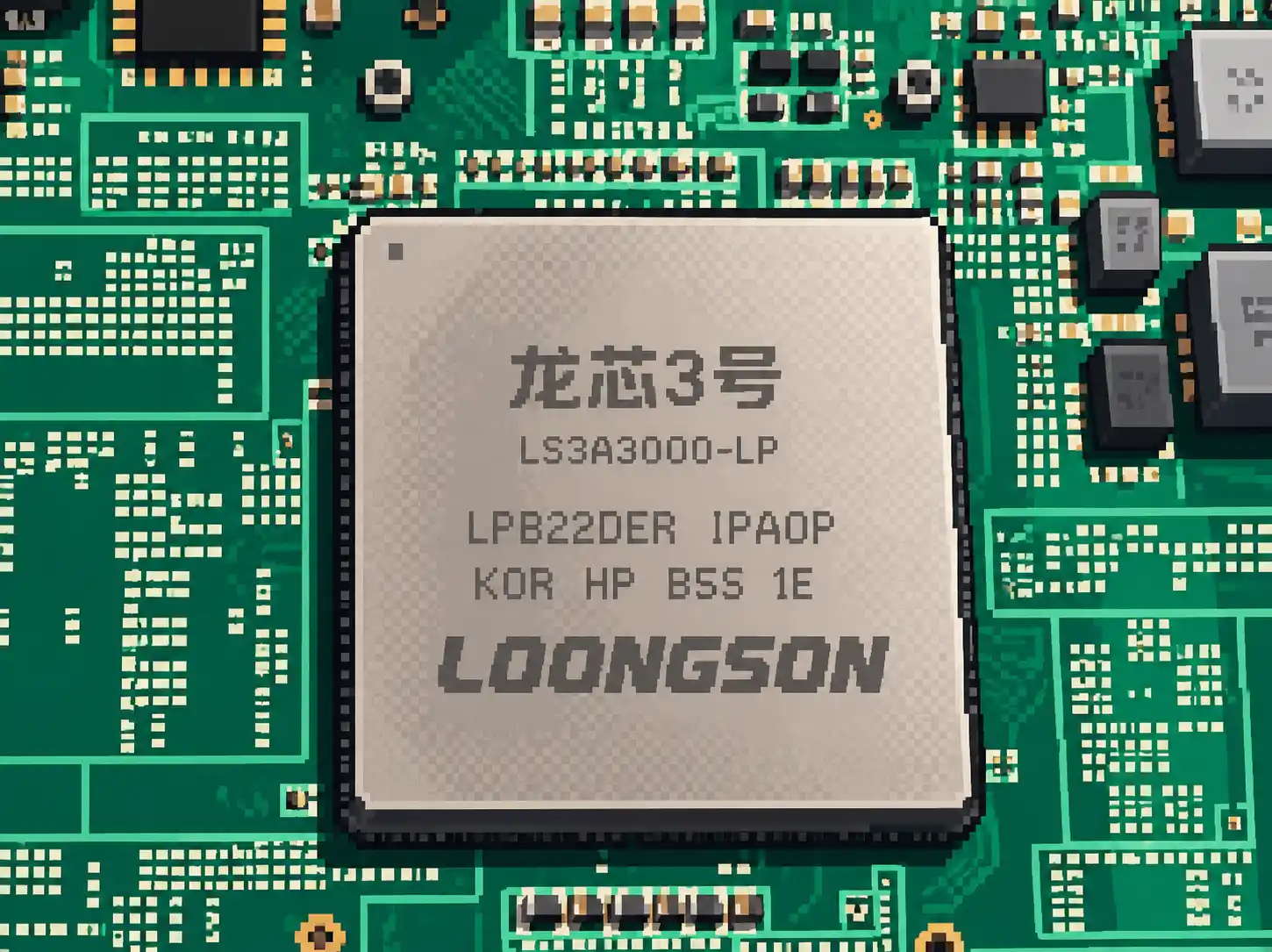
Imagine spending years designing your own CPU architecture because you no longer want to depend on Intel, AMD, Arm, or anyone else.
You finally succeed. The chip boots. The cores work. The benchmarks run. Congratulations. Now none of your existing software understands what the CPU is saying.
That is, in very simplified form, the problem Loongson volunteered to solve.
Loongson is one of China’s oldest domestic CPU projects, and unlike many other Chinese chip companies, it has gone unusually far in pursuit of technological independence. It does not merely design processors. It has also created its own instruction-set architecture, called LoongArch.
That makes Loongson much more interesting than “China made another CPU.” The real question is whether a company can build not just a processor, but an entire computing ecosystem around a new architecture. Designing a CPU is difficult. But convincing the rest of computing to care that it exists may be worse.
Definitely related: CXMT Explained: Can China Break the Global Memory Monopoly?
Meet Loongson
Loongson traces its origins back to the Chinese Academy of Sciences, where development of the original Godson processors began in 2001.
Early Loongson chips used the MIPS instruction set, a well-established RISC architecture that once appeared in everything from workstations to game consoles. Over time, however, Loongson moved toward something much more ambitious.
Instead of continuing to depend on MIPS licensing or adopting Arm, the company created its own instruction set. That became LoongArch, publicly introduced in 2021.
Today Loongson sells processors for desktops, laptops, servers, industrial systems, storage appliances, and government computers.
Its better-known modern desktop chip is the 3A6000, while newer 3B6000 and 3C6000 families push the architecture into higher-core-count systems and servers. And that is where the story gets weird.
Because Loongson did not merely decide to compete with Intel and AMD. It decided to stop speaking their language entirely.
Wait, What Does “CPU Architecture” Actually Mean?
When people say “CPU architecture,” several different things tend to get mashed together. The most important distinction is between an instruction-set architecture, or ISA, and a microarchitecture. The ISA defines the instructions software can use.
Think of it as the language.
Examples include:
- x86-64, used primarily by Intel and AMD
- Arm, used by Apple, Qualcomm, MediaTek, and many others
- RISC-V, an open instruction set
- LoongArch, used by Loongson
The microarchitecture is how a particular CPU actually implements that language. AMD’s Zen processors and Intel’s Core processors both understand x86-64, but internally they are very different machines.
Likewise, Loongson can create multiple generations of CPU cores while keeping LoongArch as the underlying instruction set. This distinction matters because Loongson’s biggest challenge is not simply making a fast CPU core. It is making software speak LoongArch.
Why Not Just Use Arm?
That would certainly have been easier. China already has plenty of Arm-based processors, including chips used in smartphones and servers.
Arm comes with a mature software ecosystem, experienced developers, operating-system support, compilers, and decades of industry adoption. But Arm is still foreign technology.
For a company whose long-term goal includes reducing dependence on outside intellectual property, that matters.
Loongson originally depended on MIPS. Moving to LoongArch gave it much greater control over its own architectural future. No Intel. No AMD. No Arm. No MIPS. Maximum independence. And also maximum homework.
Because the moment you create a new ISA, every operating system, compiler, application, runtime, library, driver, and optimization suddenly becomes someone’s problem. Usually yours.
Is LoongArch Really Completely New?
Loongson describes LoongArch as an independently designed architecture, with its own instruction encodings, ABI, and architectural definitions.
That does not mean it emerged in a vacuum.
Loongson had spent roughly two decades designing MIPS-based processors before creating LoongArch, and independent developers have noted that the architecture retains ideas familiar from MIPS while also sharing concepts with newer RISC designs such as RISC-V.
That is not especially suspicious by itself.
Modern CPU architectures often converge on similar solutions because computers are annoyingly consistent about what they need. You can independently design two cars and somehow both will end up with wheels.
LoongArch uses a fairly classical RISC structure, including fixed-width instructions, a load/store design, general-purpose registers, and dedicated vector extensions. The important part is that LoongArch is not binary-compatible with MIPS, x86, Arm, or RISC-V.
Software built for those architectures does not simply run on it. That incompatibility is both the point and the problem.
The Loongson 3A6000 Is Surprisingly Serious
The chip that made people start paying more attention to Loongson was the 3A6000. It contains four physical cores and eight threads, based on Loongson’s LA664 microarchitecture.
Four cores does not sound especially impressive in a world where mainstream desktop CPUs routinely have eight, twelve, sixteen, or more. But the interesting part is what is inside each core.
LA664 is a wide, out-of-order design with sophisticated branch prediction, simultaneous multithreading, substantial cache resources, and support for Loongson’s 128-bit LSX and 256-bit LASX vector instructions.
Independent microarchitecture testing by Chips and Cheese found the core far more capable than many people expected. In some workloads, its performance per clock landed around older high-performance AMD designs, roughly in early Zen territory.
That is a meaningful achievement. Loongson is not building glorified embedded processors anymore. These are real general-purpose high-performance cores.
Unfortunately, there is one very large number missing from the celebration. Clock speed.
Good IPC Does Not Automatically Mean Good Performance
The 3A6000 tops out around 2.5 GHz. Modern AMD and Intel desktop CPUs routinely boost beyond 5 GHz. That creates an enormous disadvantage.
A CPU can execute a respectable number of instructions every clock, but if the clocks arrive half as frequently, absolute performance still suffers.
Independent testing has shown that the 3A6000 can achieve respectable instructions-per-cycle figures in some workloads, but still loses badly in overall throughput because competitors operate at much higher frequencies and often execute fewer instructions to complete the same work.
Manufacturing technology is part of this. TechInsights concluded that the 3A6000 was likely produced using SMIC’s 12nm-class FinFET process. That is considerably older than the process technologies used by cutting-edge AMD and Intel processors.
A mature node is not automatically bad. But achieving high frequency and strong efficiency becomes much harder when competitors have access to denser, more advanced manufacturing.
Physics remains stubbornly uninterested in industrial policy.
Might be related too: Lisuan Explained: Why Building a GPU Takes More Than Money
The Memory System Is Not Helping Either
Loongson’s core architecture is arguably more impressive than its surrounding platform. Independent testing of the 3A6000 has shown relatively modest memory bandwidth compared with modern Intel and AMD systems.
The platform uses DDR4 rather than DDR5, and the memory controller has historically been one of Loongson’s weaker areas. That matters because a CPU does not spend its entire life happily calculating numbers inside registers. It constantly needs data from caches and main memory.
A powerful execution core waiting on a weak memory subsystem is basically a sports car stuck behind a delivery truck. You still technically own a sports car. You are just doing 35 km/h.
Then Why Do Some Benchmarks Look Surprisingly Good?
Because performance depends heavily on software. This is one of the most important lessons from independent Loongson testing. When workloads are portable, well compiled, and do not contain years of x86-specific hand optimization, Loongson can look much more competitive.
Phoronix, for example, found the newer 12-core 3B6000 performing surprisingly well in some Linux workloads. In one C-Ray test, it roughly matched a Ryzen 5 9600X. That does not mean Loongson has suddenly matched Zen 5. The Ryzen had half as many cores. Other workloads heavily favored AMD and Intel.
But it demonstrates something important: Some of Loongson’s performance deficit comes from hardware. Some comes from software. And those are very different problems.
Building the CPU Was the Easy Part
Loongson’s biggest long-term challenge may be the software ecosystem. Intel and AMD enjoy an almost invisible advantage.
When AMD launches a new Ryzen processor, nobody asks: “Will Firefox work?”
Of course it will.
The entire desktop ecosystem already speaks x86. Loongson has to build that trust from scratch. The good news is that LoongArch has moved well beyond an isolated proprietary experiment.
It now has official support in major open-source infrastructure. GCC supports LoongArch. LLVM and Clang support LoongArch. The architecture is supported by the upstream Linux kernel. Debian has also added LoongArch support through its loong64 architecture.
Inside China, operating systems such as Kylin, UOS, openEuler, and Loongnix support Loongson hardware, while major applications including WPS Office and Chinese communication platforms have been ported.
That does not create an x86-sized ecosystem overnight. But it does mean LoongArch has crossed an important threshold. It is becoming a platform developers can actually target.
Can Loongson Run x86 Software?
Not directly. An x86 application contains instructions a LoongArch CPU does not understand. Loongson’s solution is binary translation.
Its current ecosystem includes the Loongson Architecture Translator, or LAT, which can translate x86 and x86-64 software for LoongArch systems. This is not a unique idea.
Apple uses Rosetta 2 to run x86 Mac software on Arm-based Apple Silicon. Microsoft has its own translation technologies for Windows on Arm.
Loongson is attempting something similar. The problem is that translation is never free. The system must convert instructions, manage differences between architectures, translate system behavior, and somehow avoid turning all of this into a performance disaster.
At some point the CPU starts looking less like a processor and more like an exhausted United Nations interpreter.
Apple Makes This Look Much Easier Than It Is
Apple successfully moved Macs from x86 to Arm with surprisingly little pain. That may make architecture transitions look easy. They are not.
Apple controlled almost everything:
- the operating system
- the hardware
- the developer tools
- the APIs
- the product lineup
- the translation technology
- the release schedule
It also has enormous influence over developers. Loongson does not control the global PC ecosystem. That means Apple’s transition proves two things simultaneously: Changing CPU architectures is possible. And having absurd levels of ecosystem control helps enormously.
China Can Also Create Customers
There is another reason Loongson does not need to defeat Ryzen at retail.
China has a huge domestic market and an active policy of replacing foreign technology in government and critical infrastructure.
Programs commonly associated with the Xinchuang domestic IT initiative encourage organizations to adopt Chinese processors, operating systems, databases, and other core technologies.
That gives Loongson something most new CPU architectures do not have: customers who care about things other than benchmark leadership.
For a government workstation, the priority may be:
- Is it domestically controlled?
- Does it meet security requirements?
- Can it run approved office software?
- Can it be supplied reliably?
“Can it get 240 FPS in Counter-Strike?” may appear slightly lower on the procurement spreadsheet.
Loongson announced in 2026 that shipments of the 3A6000 had exceeded one million units across major industry deployments. That does not make it Intel. But it is far beyond experimental volume.
And Loongson Is Scaling Up
The company is already moving beyond four-core desktop CPUs. The 3B6000 increases the design to 12 cores and 24 threads. The 3C6000 family pushes LoongArch into servers with configurations reaching 16, 32, and 64 cores depending on packaging.
Loongson is targeting storage, cloud systems, enterprise servers, and other infrastructure where domestic supply and architectural independence can matter as much as raw single-thread performance.
Future processors such as the upcoming 3B6600 are expected to bring newer cores, DDR5 support, higher frequencies, and significant IPC improvements.
Loongson has suggested performance targets approaching older modern Intel generations. Those claims should remain in the “interesting, please wait for independent benchmarks” category.
Semiconductor marketing has never met a benchmark projection it could not become emotionally attached to.
Does Loongson Need to Beat AMD?
Probably not. At least not yet.
If the question is: Would a PC gamer outside China choose a current Loongson system instead of Ryzen or Core? Almost certainly not.
AMD and Intel offer much higher overall performance, vastly better software compatibility, newer platforms, easier availability, and decades of optimization. But that may be the wrong measure of Loongson’s success.
The more important question is: Can China operate useful general-purpose computers without depending on x86, Arm, or another foreign CPU architecture?
A decade ago, that idea looked highly theoretical. Today there are LoongArch desktops, Linux distributions, compilers, productivity applications, binary translators, server processors, and more than a million deployed 3A6000 chips.
The compromises are still substantial. The architecture is behind in manufacturing technology. Clock speeds remain low. Software support remains tiny compared with x86. Translation adds overhead. Gaming is nowhere near mainstream-ready.
But Loongson has already demonstrated something arguably more interesting than winning Cinebench. It has shown that building an independent CPU ecosystem is possible. The catch is that the processor itself may be the easiest part.
Intel and AMD inherited decades of software written specifically for their architecture. Loongson has to build that advantage one compiler patch, one application port, one driver, and one translated executable at a time. China wanted a CPU architecture it could control. It got one.
Now comes the much harder task of convincing computers to speak it.
