
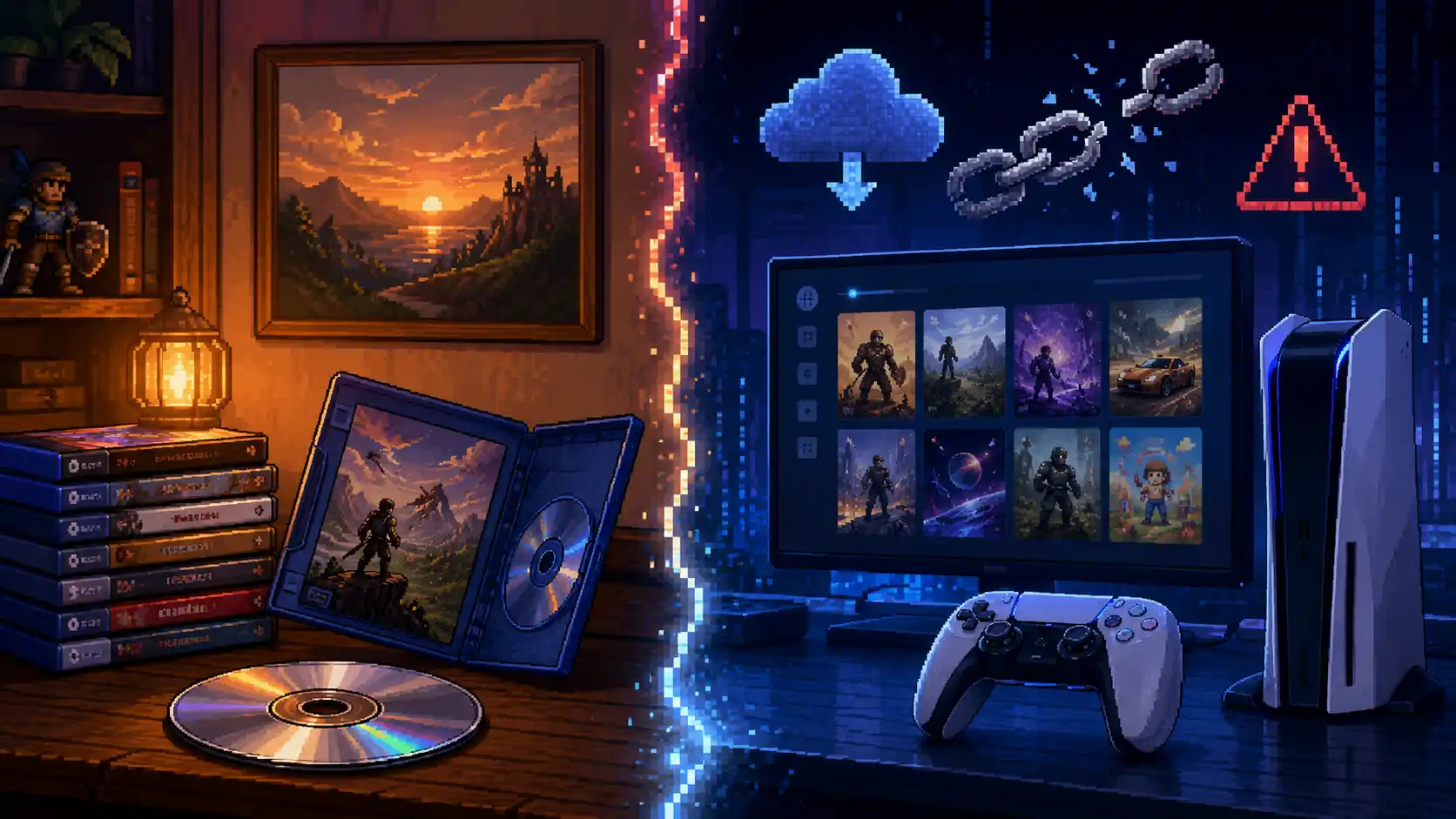
Sony has announced that it will stop producing physical discs for new PlayStation games beginning in January 2028.
Naturally, the internet reacted as if Sony had announced that the PlayStation 6 would run exclusively on human tears.
For many gamers, physical games represent more than a method of installing software. They represent ownership. Permanence. Childhood memories. Shelves filled with colorful boxes that silently tell visitors, “Yes, I have spent an unreasonable amount of money here.”
There is something romantic about physical games.
You buy a box. You open it. You smell the freshly printed cover for reasons nobody can fully explain. You insert the disc into the console and hear the machine begin spinning like it is preparing to launch a small aircraft.
It feels real.
Compared with that, buying a digital game feels strangely anticlimactic. You press a button, a progress bar appears, and several hours later your internet provider has delivered entertainment directly into your storage drive.
No box. No manual. No sacred plastic circle.
But while physical games are romantic, they are becoming increasingly impractical as a mass-market distribution system.
And whether players like it or not, Sony probably did not make this decision based on vibes.
Sony Is a Company, Not a Preservation Society
Sony is not ending physical game production because one executive woke up and declared war on Blu-ray discs.
Sony is a corporation.
Corporations have many complicated departments, but most of them eventually arrive at the same spiritual destination: a spreadsheet.
If physical games were still generating enormous growth and billions in irreplaceable profit, Sony would not be abandoning them. It would be releasing more discs, larger discs, premium discs and perhaps a subscription service in which a new disc is mailed to your house every month.
Instead, Sony has decided to phase them out. The reason is fairly obvious: most PlayStation customers already buy their games digitally.
Sony’s recent financial reporting shows that digital downloads account for the overwhelming majority of full-game purchases on PlayStation. The precise ratio varies by quarter, but digital sales have consistently represented roughly three-quarters or more of full-game unit sales.
By the final quarter of Sony’s 2025 fiscal year, the digital ratio had reportedly reached around 85%. That means the transition is not simply Sony forcing customers into a digital future against their will. Customers have been walking there voluntarily for years.
Physical software also represents a shrinking part of the wider retail gaming business. Even GameStop CEO Ryan Cohen dismissed Sony’s decision as largely irrelevant to GameStop, arguing that physical game software now represents only a small portion of the company’s business. GameStop’s own fiscal-year figures still put software at a higher percentage than Cohen suggested, but they also showed software revenue declining significantly while areas such as collectibles grew.
The company historically associated with selling physical games now makes much of its money selling statues, trading cards and objects that gamers place beside the games they no longer buy physically.
That feels almost poetic. Or possibly like a warning from capitalism.
PC Gaming Abandoned the Disc Years Ago
The easiest way to understand the future of console gaming is to look at PC gaming, which has already been living in it for years.
I genuinely cannot remember the last time a PC game required me to own an optical disc drive.
Modern gaming PCs rarely include one. Most cases do not even provide a place to install one anymore. Adding a DVD drive to a new gaming PC now feels less like building a computer and more like preserving an artifact from an ancient civilization.
Even boxed PC games became increasingly strange during the transition. You could buy a large, beautifully printed box, open it, and discover a code that told you to download the entire game from Steam. The box was essentially an elaborate delivery mechanism for twelve letters and numbers.
Despite abandoning physical media, PC gaming did not collapse.
It grew.
Steam, Epic Games Store, GOG, Xbox, EA, Ubisoft and many other platforms now distribute games almost entirely through digital downloads. PC gamers accepted this because digital distribution was simply more convenient.
No swapping discs. No scratched media. No waiting for retailers to restock. No discovering that Disc 4 of a six-disc installation has developed a mysterious circular wound.
You buy the game, download it and play it. At least, theoretically.
We will return to that last part.
Physical Games Are Not as Practical as We Pretend
Physical game supporters often discuss discs as though they provide a completely independent, permanent copy of the finished product.
Sometimes they do. But modern games can complicate that idea.
Games regularly launch with day-one patches, bug fixes, downloadable content, balance updates and online components. Some discs contain a version that is technically playable but far from the version players would actually want to experience.
An online game may become useless when its servers close, regardless of whether you own the disc. A physical copy of an always-online game is not necessarily permanent ownership. Sometimes it is merely a very attractive coaster that remembers better days.
However, we should not exaggerate this problem either.
The claim that most modern physical games are empty discs or completely useless without the internet is not supported by the available evidence.
DoesItPlay, a community project that tests whether physical games can function without downloads or online connections, reports that around 94% of the thousands of games in its database offer offline play. It also reports that approximately 73% require no download at all, although the exact condition varies by platform and game.
So physical games still provide genuine practical value. The issue is not that discs no longer work. The issue is that most customers no longer care enough about those advantages to continue buying them.
Digital games are faster to purchase, easier to access and more convenient to manage. Publishers avoid manufacturing, packaging, shipping, warehousing and unsold inventory. Platform holders get a direct relationship with the customer and a larger share of the transaction.
From a business perspective, physical distribution involves producing millions of objects, transporting them around the world and hoping someone buys the correct quantity in each country.
Digital distribution involves copying data.
One of these business models requires trucks. The other requires a server and a remarkably long terms-of-service agreement.
But Physical Games Still Protect Consumers
This is where the argument becomes more complicated. Physical discs may be inefficient, but they provide rights that digital platforms have failed to replace.
A physical game can usually be sold. It can be lent to a friend. It can be traded. It can be purchased second-hand. Different retailers can compete on price.
A customer can finish a game, sell it and recover part of the purchase cost. Digital purchases usually remain locked permanently to one account, even after the player is finished with them.
Physical retail also creates competition.
A game might launch for $70, but different stores can offer discounts. Used copies can push the price lower. Retailers can clear old stock. Someone’s regrettable preorder can become someone else’s bargain.
On a digital-only PlayStation, Sony controls the store, the transaction and the conditions under which the game is sold. That is extremely efficient. It is also a little like allowing the landlord to own the only supermarket in your building.
Digital distribution is not automatically anti-consumer. Steam demonstrates that a digital platform can win customers by offering convenience, regular discounts, community features, refunds and a generally reliable service.
But a closed console ecosystem creates a much greater danger. When the platform owner is also the only meaningful retailer, convenience can slowly become control.
Preservation Matters, but Discs Alone Will Not Save It
Another major argument for physical media is preservation. This is a legitimate concern.
The Video Game History Foundation found that 87% of classic games released in the United States are no longer commercially available. Those games are considered effectively out of print, making legal access extraordinarily difficult.
That is an alarming number.
Imagine if 87% of older films, books or music simply vanished from legal circulation. People would call it a cultural emergency. In gaming, we usually call it Tuesday.
Physical copies can help preservationists recover and document games after publishers stop selling them. Collectors, museums, libraries and nonprofit organizations preserve hardware, discs, cartridges, source materials, magazines and other pieces of gaming history.
But physical media is not a complete preservation strategy. Discs deteriorate. Hardware becomes rare. Copyright remains complicated. Online servers disappear.
Libraries and archives can preserve digital copies under limited circumstances, but they face severe restrictions on sharing those games remotely with researchers and the public. The Video Game History Foundation argues that the legal framework gives game preservation institutions fewer options than archives working with books, films or recorded music.
So yes, game preservation matters enormously. But asking Sony to manufacture commercial discs forever is not a serious long-term preservation policy.
We need better copyright exemptions, institutional archives, legal emulation, offline versions, source-code preservation and rules requiring publishers to leave games functional after official support ends.
Preservation should be treated as cultural infrastructure, not something performed by six exhausted volunteers in a basement surrounded by broken Sega Saturns.
The Disc Is Not the Real Problem
This brings us to the most important point.
The disappearance of physical media would be much less frightening if digital purchases actually behaved like purchases.
But they often do not.
Digital platforms use the word “buy,” yet what customers receive is frequently a conditional licence attached to an account, a storefront and a set of contractual relationships they cannot see.
The purchase feels permanent. The legal reality sometimes is not.
Sony itself has provided a disturbing example—not with games, but with video content sold through the PlayStation Store.
In 2023, Sony warned some PlayStation customers that previously purchased Discovery television content could be removed because of licensing arrangements. The removal was eventually avoided after Sony reached updated agreements, but the incident exposed how fragile a digital “purchase” could be.
More recently, Sony reportedly informed UK customers that hundreds of previously purchased StudioCanal movies and television shows would become inaccessible from September 1, 2026. The affected content was sold through PlayStation as purchased media rather than temporary rentals.
Customers paid Sony. Sony displayed the word “Buy.” Then a licensing agreement changed somewhere behind the curtain, and the permanence of that purchase changed with it. Apparently, “buy” now means “borrow indefinitely until two corporations stop getting along.”
Ubisoft Demonstrated the Gaming Version
The clearest gaming example is Ubisoft’s treatment of The Crew.
Ubisoft delisted the game in December 2023 and shut down its servers on March 31, 2024. Because The Crew depended heavily on online infrastructure, the shutdown made the game unplayable.
That alone caused controversy. But Ubisoft then went further.
Players reported that Ubisoft began revoking licences from people who had purchased the game, moving it into an inactive section of Ubisoft Connect and preventing owners from downloading it again.
The company may argue that the licence terms allowed it and that the game could no longer function without its servers. Legally, that may be relevant.
But to the average consumer, the situation is much simpler. They saw a button labelled “Buy.” They gave Ubisoft money. Years later, Ubisoft decided that the product no longer existed in any meaningful form.
The controversy helped strengthen the broader Stop Killing Games campaign, which argues that publishers should provide a reasonable end-of-life plan for games they have sold.
That does not necessarily mean maintaining servers forever. It could mean releasing an offline mode, allowing private servers, removing mandatory authentication or providing customers with a final functional build.
Nobody expects a publisher to support every game until the sun consumes the Earth. But customers should not need to investigate corporate server roadmaps before deciding whether the word “buy” is being used creatively.
EA Shows Another Weakness of Digital Ownership
EA is not as clean an example of deliberate permanent revocation. However, the EA app has repeatedly produced reports from users whose purchased games or downloadable content disappeared from their libraries.
EA maintains official troubleshooting pages specifically for finding missing games, advising customers to check accounts, purchase history, subscriptions and hidden content.
Some cases may involve account mistakes, expired subscriptions or technical bugs rather than intentional removal. But that still reveals a weakness in digital ownership.
Your ability to access a game depends on a database correctly remembering that you paid for it.
With a physical disc, the evidence of ownership is sitting in your hand. With a digital game, the evidence of ownership is a row in a server somewhere. Hopefully, the row is feeling well today.
This does not make digital distribution inherently bad. Technical problems can be fixed, and physical media can also fail. But it changes the relationship. You do not merely depend on the game working.
You depend on the launcher working, the account system working, the authentication server working, the licensing database working and customer support believing you when one of those systems suddenly forgets your existence.
We Do Not Need to Save the Disc. We Need to Save What It Represented
This is why the debate should not simply be framed as physical versus digital. The plastic disc itself is not sacred.
It is bulky, inefficient and increasingly unnecessary. PC gaming moved beyond optical media years ago. Most PlayStation owners already prefer digital downloads. Sony is responding to an economic reality that consumers helped create.
But the disc represented something important.
It represented continued access. It represented resale. It represented lending. It represented competition between stores. It represented the ability to preserve a game without asking permission from the company that sold it.
Those rights do not have to disappear merely because games are delivered digitally.
Digital games could theoretically include transferable licences. Platforms could allow resale or account-authorized lending. Console makers could permit competing storefronts. Publishers could guarantee offline access after server shutdowns. Stores could provide DRM-free archival downloads after a product reaches the end of its commercial life. Consumer laws could require the word “Buy” to mean something meaningfully different from “Rent until licensing conditions change.”
The technology is not the obstacle. The obstacle is that the current system is much more profitable without those rights.
The Digital Future Is Inevitable. Bad Digital Ownership Is Not.
Sony is probably making the correct business decision.
The physical game market is shrinking. Digital distribution is cheaper, easier and preferred by most consumers. Continuing to manufacture millions of discs for an increasingly small audience may no longer make financial sense.
Physical games will probably survive in some form through collector’s editions, limited releases and specialist companies, much like vinyl records survived the rise of streaming.
That is fine. Not every old format needs to remain the dominant format forever. We no longer install games from stacks of floppy disks, and society has somehow continued. But gamers are justified in being worried.
Not because shiny plastic circles are disappearing, but because the industry wants to replace ownership with access while continuing to charge ownership prices.
The future does not need to come inside a box. It does, however, need better rules.
A digital purchase should remain accessible after it has been purchased. A game should have a reasonable plan for server shutdowns. Customers should understand exactly what they are buying. Preservation institutions should be allowed to protect gaming history legally. Platform holders should not be able to use digital convenience as an excuse to eliminate competition and consumer rights.
Sony may be right that the disc has reached the end of its practical life. But before we bury it, perhaps we should remove the rights attached to it and carry them into the digital future.
Otherwise, we are not replacing physical ownership with digital ownership. We are replacing it with a very expensive rental service that occasionally forgets to mention the expiration date.
