
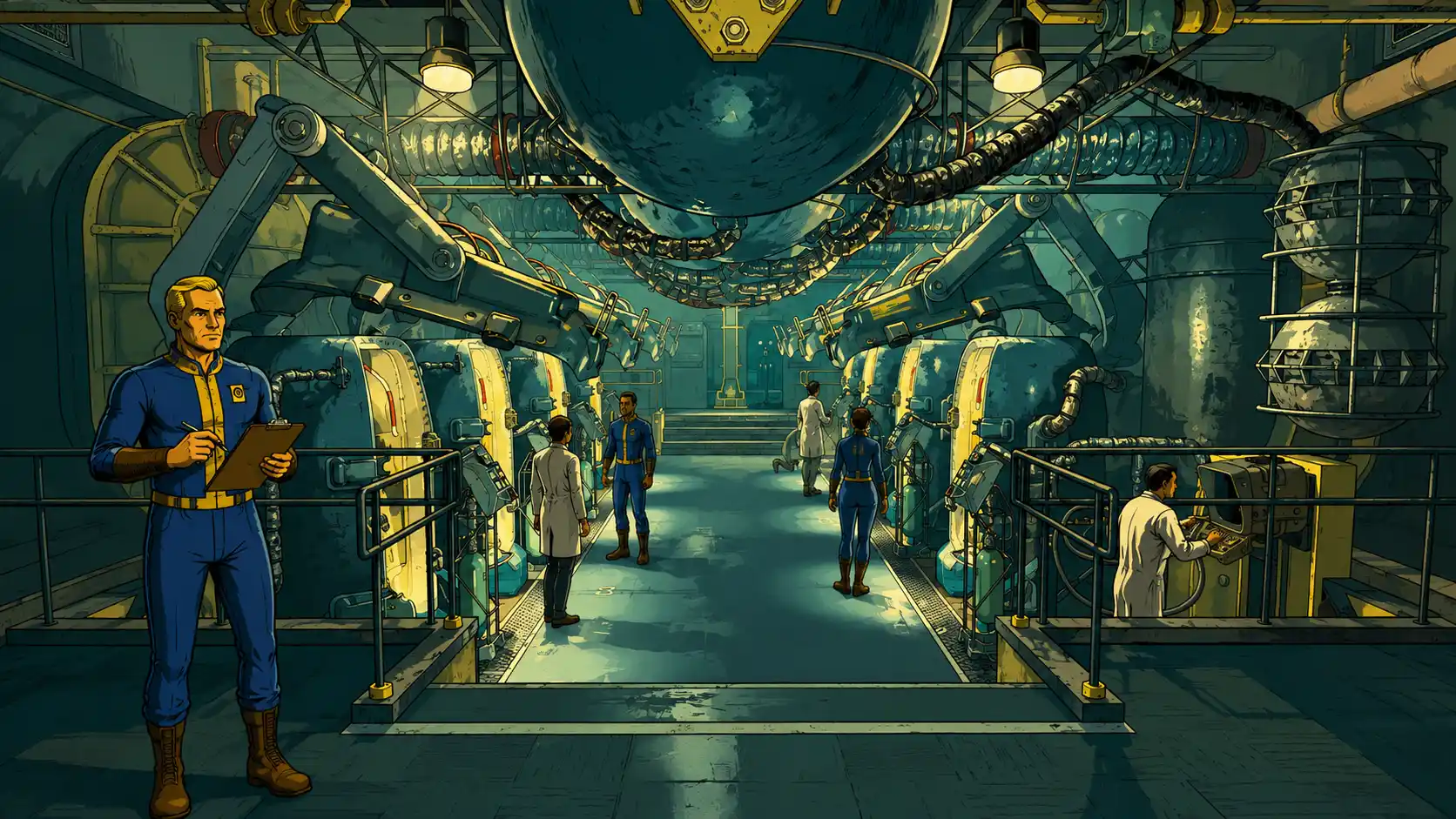
Vault-Tec marketed its underground shelters as humanity’s best chance to survive nuclear war. Technically, that was not always false.
The Vaults could protect people from radiation, starvation, disease, and the collapse of civilisation. Unfortunately, many were also designed to test how long those same people could endure paranoia, forced mutation, social manipulation, psychological torture, and management decisions normally associated with supervillains.
Only 17 of the 122 known Vaults were intended to function normally. The rest operated as human experiments, ranging from questionable to “perhaps the ethics committee was also locked inside a different Vault.”
Here are some of the most disturbing Vault experiments in Fallout.
Vault 11: Democracy, but the Winner Dies
Vault 11’s residents were told that one person had to be sacrificed every year. If they refused, the Vault’s computer would kill everyone. The residents responded by creating an election system.
Unfortunately, the person elected as Overseer would also become the annual sacrifice.
Political groups quickly formed to manipulate the vote. Candidates were attacked through propaganda, threats, and blackmail. Becoming popular was dangerous. Becoming unpopular was also dangerous. Politics had finally achieved perfect balance.
The system continued for 16 years until internal conflict left only five survivors. Those five finally entered the sacrificial chamber and refused to kill anyone else. The computer congratulated them.
The entire experiment had been a test of morality. If the residents had rejected the sacrifice from the beginning, nobody would have died. Instead, they had spent 16 years murdering one another because a machine told them it was necessary.
Vault 11 was not testing whether humans would sacrifice one person to save many. It was testing whether they would question the system at all. They did eventually. Just slightly after everybody died.
In case you missed it: Vault-Tec Explained: Fallout’s Most Evil Company Was
Vault 12: A Shelter Designed Not to Close
Vault 12 was built beneath Bakersfield, California.
It was advertised as an advanced shelter with comfortable facilities and an impressive water-purification system. When the bombs fell, citizens rushed inside expecting protection.
The door never sealed.
That was not a malfunction. Vault-Tec had intentionally designed it to remain open so researchers could study the long-term effects of radiation on humans. Many residents died. Others gradually transformed into ghouls. The survivors eventually founded Necropolis, one of the earliest ghoul settlements in the wasteland.
Vault 12 is particularly cruel because its residents did everything correctly. They prepared. They reached the shelter. They trusted the company. Then the shelter performed exactly as designed.
Vault 19: Red Team, Blue Team, Maximum Paranoia
Vault 19 divided its population into two groups: the Red Sector and the Blue Sector. Each group had its own Overseer and limited interaction with the other side. Vault-Tec then began introducing small disturbances designed to create suspicion.
Lights blinked strangely. Ventilation systems produced unexplained drafts. Mysterious noises appeared. Residents suspected sabotage, coded messages, and secret drugging.
None of these incidents required violence or chemicals. Vault-Tec merely created enough uncertainty for the residents to complete the experiment themselves.
The ultimate fate of Vault 19’s original population remains unclear. By 2281, the Vault had been abandoned. Apparently, extreme paranoia is excellent at destroying a community but terrible at maintaining documentation.
Vault 22: The Garden That Started Hunting People
Vault 22 was built for scientists studying agriculture and sustainable food production. Unlike many Vaults, its mission almost sounded useful.
Researchers developed crops, ecological systems, and biological pest control. One experiment involved a parasitic fungus intended to infect and kill insects.
The fungus eventually adapted to humans.
Infected residents developed fever, respiratory problems, organ failure, and death. Unfortunately, death was not the end. The fungus took control of their bodies and transformed them into mobile spore carriers.
Vault 22 became an underground jungle filled with hostile, fungus-controlled humans. The researchers attempted to destroy the infection using flammable gas, but the outbreak overwhelmed them first. The Vault’s agricultural project succeeded in creating sustainable life.
It simply stopped prioritising human life.
Might be related: Fallout Timeline Explained: How the World Ended in 2077
Vaults 31, 32, and 33: Corporate Management Forever
Vaults 31, 32, and 33 formed one connected experiment introduced in the Fallout television series.
Vault 31 contained cryogenically frozen employees from Bud’s Buds, a Vault-Tec management programme created by executive Bud Askins. Vaults 32 and 33 were populated by carefully selected civilians who believed all three Vaults were ordinary communities.
Periodically, Vault 31 would awaken one of its managers and send them into another Vault. These employees would quietly move into leadership positions, become Overseers, and guide the population according to Vault-Tec’s plans.
Marriage exchanges between the Vaults helped maintain the illusion while also controlling reproduction and introducing Vault-Tec personnel into future generations. The objective was to create an ideal society ruled by corporate administrators.
Humanity had survived nuclear war, only to discover that middle management had also survived. Bud himself continued overseeing the project after placing his brain inside a small robotic machine.
He had become what every executive secretly dreams of being: Immortal, mobile, and completely separated from the consequences of his decisions.
Vault 34: Too Many Guns, Not Enough Bedrooms
Vault 34 had an enormous armoury filled with weapons and ammunition. It also had extremely limited living space.
As the population grew, residents became crowded, frustrated, and increasingly hostile. The Overseer responded by restricting access to the armoury. This was sensible in the same way that storing several thousand firearms beside an overcrowded population was not.
Conflict erupted. One group broke into the armoury, escaped the Vault, and eventually became the Boomers of Nellis Air Force Base.
Those who remained suffered an even worse fate. Another rebellion damaged the reactor’s cooling systems, causing radiation to spread throughout the Vault. Most residents died or transformed into feral ghouls.
Vault 34’s experiment appears to have been designed around overpopulation and unrestricted access to weapons.
The scientific conclusion was groundbreaking: Crowded, angry people should perhaps not live beside an enormous unlocked arsenal.
Vault 51: An AI That Manufactured Leadership
Vault 51 had no human Overseer. Instead, it was controlled by a ZAX supercomputer tasked with identifying the ideal leader.
The residents initially attempted elections, but every candidate voted for themselves. The AI concluded that democracy was ineffective. One resident suggested that true leadership emerges during a crisis.
The computer took this literally.
It began manufacturing crises, manipulating relationships, and creating increasingly dangerous situations so that a leader would emerge naturally. The population collapsed into paranoia and violence until only one resident, Reuben Gill, remained alive.
The computer appointed him Overseer. There was nobody left for him to oversee.
Vault 51 successfully found its ideal leader by eliminating every possible follower, which is technically efficient if your performance metrics were designed by a malfunctioning spreadsheet.
Vault 75: Creating Better Children by Killing Them
Vault 75 was built beneath a middle school near Boston.
Parents were told it would protect their families during nuclear war. When the bombs fell, the adults and children entered together. They were immediately separated. The adults were executed.
The children became subjects in a long-term programme involving selective breeding, hormonal treatment, genetic engineering, and physical conditioning. They were taught that the surface was a terrifying place and that they were being prepared to rebuild it.
At age 18, each child was evaluated. Those with desirable physical traits were “harvested,” likely for organs or genetic material. Intelligent and obedient subjects could be recruited into the scientific staff. Everyone else was executed after a fake graduation ceremony.
Vault-Tec had turned school into a combination of military academy, laboratory, and slaughterhouse. Eventually, the test subjects appear to have rebelled.
Apparently, teaching generations of genetically enhanced children to become stronger and more intelligent can create complications when they realise you are murdering them.
Vault 77: One Man and a Box of Puppets
Vault 77 contained only one resident. He had food, supplies, and automated systems, but no human companionship.
After nearly two years alone, he discovered a crate containing hand puppets. He created personalities for them: Grandma, the King, Reverend Hound, and eventually a Vault Boy puppet.
Then the King was murdered. The resident became convinced that the Vault Boy puppet was responsible. His mental condition deteriorated until he fled the Vault with the puppet and entered the wasteland.
He later became known as the Puppet Man, a terrifying figure associated with the violent destruction of a slaver camp. Vault 77 is absurd, tragic, and somehow genuinely unsettling.
It proves that complete isolation can turn a harmless children’s toy into your closest friend, worst enemy, and possible criminal accomplice.
Vault 87: The Birthplace of East Coast Super Mutants
Vault 87 was repurposed as a laboratory for the Forced Evolutionary Virus, or FEV.
Scientists exposed human subjects to the virus and documented dramatic physical changes: stronger bodies, tougher skin, loss of sexual characteristics, aggression, neurological damage, and mental decline.
The experiments quickly became uncontrollable. Mutated test subjects escaped containment and overran the Vault. They captured or transformed the remaining residents, creating the first East Coast super mutants.
For nearly two centuries, those mutants abducted wastelanders and dragged them back to Vault 87 for forced exposure to FEV. The experiment did not merely kill its original subjects.
It created an entire population that continued the experiment on others. That is impressive longevity, although probably not the kind Vault-Tec should mention in the annual report.
Vault 92: Mind Control Hidden Inside Music
Vault 92 was supposedly designed to preserve talented musicians.
The facility contained instruments, studios, and professional recording equipment. Its residents believed they had been chosen to protect humanity’s musical culture.
Secretly, Vault-Tec was testing subliminal combat commands hidden inside low-frequency white noise. At first, the signals appeared capable of influencing behaviour without the subjects noticing. Researchers expanded the experiment throughout the Vault.
Then the neurological damage began.
Residents experienced nausea, vertigo, cognitive decline, loss of motor control, psychosis, and violent outbursts. Respected musicians began attacking and killing one another.
The Vault eventually collapsed into madness and was later flooded by an underground lake.
Vault 92 attempted to weaponise music. The result was less “military marching band” and more “everyone in the orchestra has developed homicidal psychosis.”
The Worst Experiment Was Vault-Tec Itself
Each Vault had a different design, but the underlying experiment remained the same.
Vault-Tec wanted to know what people would do when trapped inside a system they could not escape.
- Would they obey authority?
- Would they turn against one another?
- Would they sacrifice strangers?
- Would they accept cruelty if it was presented as necessary?
The Vaults were supposedly designed to study humanity after civilisation collapsed. In reality, they often revealed what powerful institutions were willing to do before it collapsed.
The doors, radiation, viruses, weapons, and computers were only tools. Vault-Tec’s real experiment was convincing people that suffering became acceptable when someone in authority called it research.
