
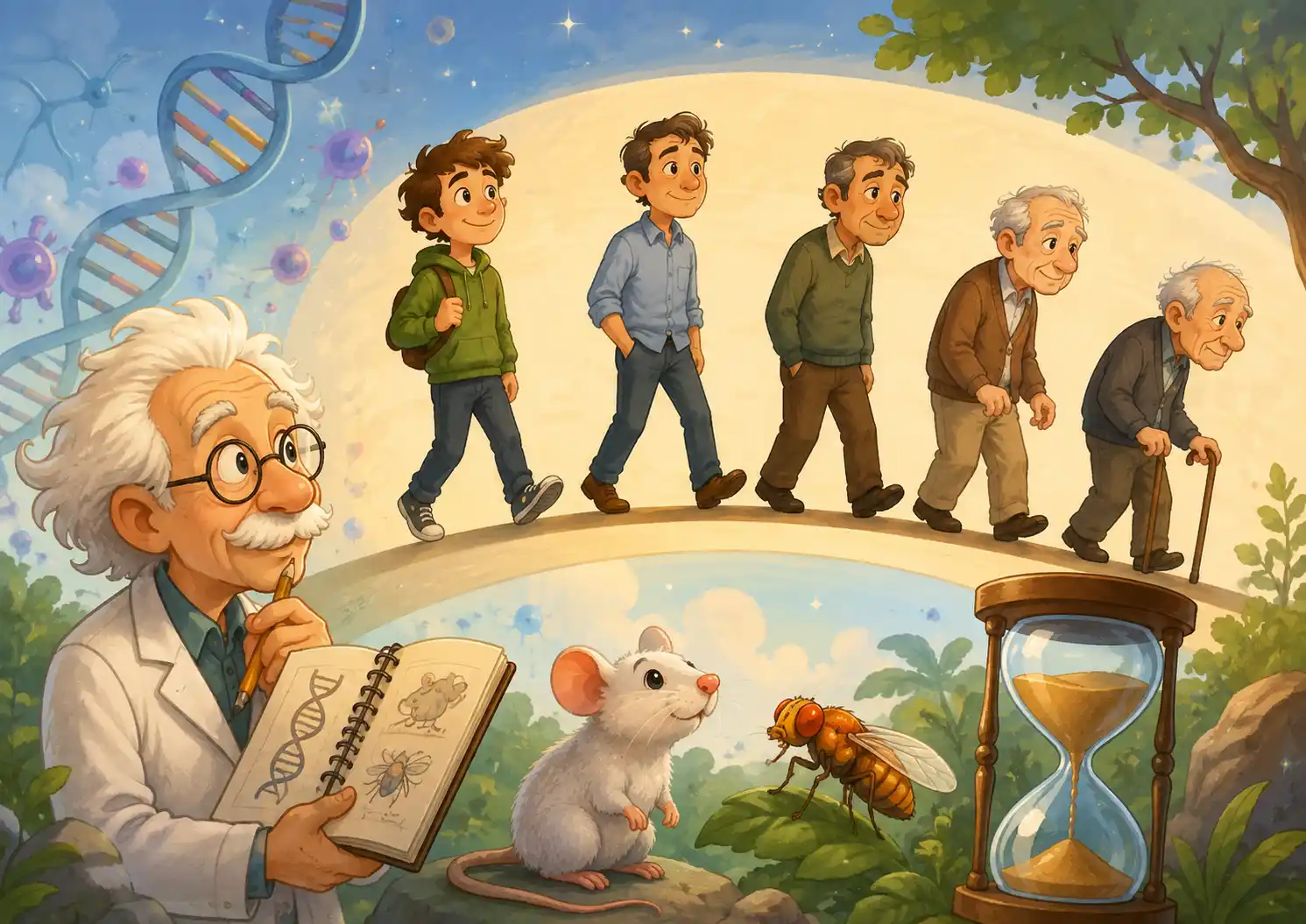
Human beings are remarkably bad at accepting terms and conditions.
We click “I agree” on software licenses without reading them, complain when subscriptions renew automatically, and appear genuinely offended by one particularly ancient clause hidden in the biological contract:
You will eventually die.
Naturally, humanity has spent centuries looking for a loophole.
Francis Bacon thought science might eventually prolong life indefinitely. René Descartes reportedly became increasingly interested in longevity as he grew older. Benjamin Franklin imagined a future where disease, including old age itself, might be prevented or cured.
Several centuries later, we have antibiotics, organ transplantation, vaccines, intensive care units, gene sequencing, and watches that can tell us we slept terribly with unprecedented precision.
Immortality, however, remains stubbornly unavailable. The strange thing is that before asking whether humans can stop aging, there is another question worth asking:
Why does aging exist in the first place?
That question sits at the center of a fascinating lecture by science writer Jonathan Weiner, author of Long for This World: The Strange Science of Immortality. Weiner explores not only humanity’s obsession with living longer, but also one of biology’s stranger discoveries: evolution may never have had much reason to make us last very long at all.
This article is a summary from Jonathan Weiner’s lecture video on the Linda Hall Library that I embedded below. Please watch the video if you have the time, because Weiner’s full lecture contains much more history, context, and discussion than I can reasonably squeeze into one article without accidentally turning Zilbest into a graduate seminar.
Humans Have Been Trying to Negotiate With Death for a Very Long Time
The dream of extending human life did not begin with Silicon Valley billionaires injecting suspiciously expensive substances into themselves. People have been thinking about it for centuries.
Weiner begins his lecture by walking through several major historical figures who believed scientific progress might eventually allow humans to dramatically extend life.
Francis Bacon, one of the early champions of what became the scientific method, was fascinated by longevity. In an almost suspiciously appropriate ending, Bacon reportedly died after becoming ill while experimenting with preserving a chicken using snow. The chicken apparently survived the experiment better than Bacon did.
Benjamin Franklin was similarly optimistic.
Writing in the eighteenth century, Franklin imagined science eventually solving problems ranging from transportation and agriculture to disease and aging. Many things that sounded fantastical during his lifetime eventually became ordinary.
Mechanical flight? Done. Massive improvements in agriculture? Done. Eliminating aging? The progress bar appears to have stopped somewhere around 3%. This recurring optimism makes sense.
Whenever medicine succeeds at extending human life, the next question becomes obvious: How much further can we go?
But there is an important distinction hiding inside that question.
Living Longer Is Not the Same as Increasing Human Lifespan
Over the last century, average life expectancy increased dramatically in many parts of the world. That sounds like humans became biologically capable of living much longer.
Not exactly.
Weiner emphasizes the distinction between life expectancy and lifespan. Life expectancy is essentially the average number of years people in a population are expected to live.
Maximum lifespan asks something different: How long can an individual human potentially survive?
For most of history, average life expectancy was dragged downward by infant mortality, infectious disease, accidents, malnutrition, childbirth complications, violence, and numerous other things humans generally prefer not to include in tourism brochures.
Yet even in ancient societies, some individuals lived surprisingly long lives. In other words, medicine has been spectacularly successful at helping more people reach old age. That does not necessarily mean we have substantially changed the underlying biological limits of aging itself.
We have become much better at keeping people from dying early. Preventing aging is a very different problem. And understanding that problem requires going somewhere slightly uncomfortable: evolution.
Might be related? The Physics of Time Travel: Wormholes, Paradoxes, and Black Holes
The Old Theory: We Age So Younger Generations Can Replace Us
One of the earliest evolutionary explanations of aging came from German biologist August Weismann. His idea sounds intuitive.
Older organisms eventually become weak, consume resources, and compete with younger members of the population. Therefore, aging and death might have evolved because removing older individuals makes room for younger generations.
Biological retirement policy.
Thank you for your contribution. Please surrender your nutrients and vacate the ecosystem. At first glance, it makes sense.
If organisms were immortal, perhaps older individuals would accumulate indefinitely, resources would become scarce, and younger generations would struggle to survive.
Weismann therefore suggested that aging might actually be adaptive. Death would not merely be a failure of biology. It would be part of the design.
There is just one rather large problem.
Peter Medawar Asked a Better Question
British biologist Peter Medawar later attacked Weismann’s explanation. The problem was circular. Weismann essentially argued: Older organisms become weak and useless, therefore evolution removes them.
But the original question was: Why do organisms become weak in the first place?
You cannot explain aging by saying old organisms age. That is less an evolutionary theory and more a dictionary definition wearing a lab coat. Medawar approached the problem differently. His answer begins with an unpleasant but important fact about nature:
Most wild animals never get the opportunity to become old.
Nature Usually Kills You Before Aging Gets the Chance
Imagine a mouse. A mouse living safely in a laboratory may survive for several years. A wild mouse has a slightly more eventful calendar.
- Predators want to eat it.
- Disease wants to kill it.
- Winter wants to freeze it.
- Food shortages want to starve it.
For wild organisms, surviving long enough to reproduce is already difficult. This creates enormous evolutionary pressure on traits that improve survival and reproduction early in life.
Grow quickly. Reach sexual maturity. Find a mate. Reproduce. Pass on your genes. Congratulations. Evolution’s customer support ticket has now been resolved.
What happens twenty years later is considerably less important from natural selection’s perspective. And that is where Medawar’s idea becomes powerful.
Natural Selection Gets Weaker With Age
Evolution by natural selection does not design organisms toward some theoretical state of perfection. It favors traits that increase reproductive success.
Suppose a genetic mutation causes a fatal disease at age five. That mutation will probably face strong evolutionary pressure. People carrying it may never reproduce. The mutation struggles to spread. Now imagine another mutation that causes problems at age ninety-five. Evolution cares considerably less.
Most individuals throughout evolutionary history would never have survived long enough for the mutation to matter. And many who did survive that long would already have reproduced decades earlier.
So genes that cause problems late in life can remain in populations much more easily than genes that cause problems early. Natural selection gradually loses its ability to “see” us as we get older.
There is no evolutionary engineer sitting inside your genome saying: “Interesting. Kevin’s knees are deteriorating at 74. We should patch this in version 2.1.”
Kevin already had children. Evolution has moved on.
Your Body Was Never Designed to Last Forever
This leads to one of the more brutal implications of evolutionary aging theory. From evolution’s perspective, maintaining an organism indefinitely would be extraordinarily expensive.
Bodies require constant repair. DNA gets damaged. Proteins break. Cells malfunction. Tissues deteriorate. Maintaining everything perfectly for hundreds of years would require enormous biological investment.
But why invest that much energy if predators, infections, accidents, starvation, or environmental hazards are likely to kill the organism first anyway?
Imagine evolution building a mouse capable of surviving fifty years. That would be an impressive mouse. Unfortunately, the owl that eats it at fourteen months does not care. The extra forty-eight years of durability provided exactly zero evolutionary benefit.
So instead of producing organisms engineered for extreme longevity, natural selection tends to favor something closer to: good enough for long enough.
Aging May Be a Side Effect Rather Than a Purpose
This distinction is important. The evolutionary explanation does not necessarily mean organisms evolved specifically to die.
There may be no biological countdown timer whose purpose is to remove elderly individuals. Instead, aging can emerge because evolution gradually stops strongly selecting for maintenance and repair mechanisms that operate late in life.
That is a very different idea.
We do not necessarily age because death benefits the species. We may age because natural selection never had enough incentive to prevent it.
Evolution did not invent death as a feature. It simply stopped fixing the bugs. Which, admittedly, sounds disturbingly similar to certain software companies.
The Grandmother Exception
Humans may complicate this story. Weiner discusses what is commonly called the grandmother hypothesis. The basic idea is that humans can continue contributing to the reproductive success of relatives even after they personally stop reproducing.
Older adults can help care for grandchildren. They can provide food. They can pass down knowledge.
They can teach younger generations where resources are located, which plants are dangerous, how to survive environmental disasters, and presumably which family member should never be trusted with financial decisions.
This means survival beyond reproductive age could still provide evolutionary advantages. An individual does not necessarily need to personally produce more children to help their genes continue spreading.
Helping descendants survive can matter too.
Similar ideas have also been discussed for highly social animals, including elephants and some primates, where older individuals can retain valuable knowledge and social roles. Humans may therefore have stronger evolutionary reasons for post-reproductive longevity than many other species.
Still, nobody appears to have informed evolution that we would eventually invent retirement communities, Netflix, and extremely elaborate hobbies requiring sixty additional years.
So Why Don’t We Just Fix Aging?
This is where evolutionary explanations become especially interesting. If aging is partly the result of inadequate biological maintenance, perhaps medicine could theoretically intervene.
- Repair accumulated cellular damage.
- Remove malfunctioning cells.
- Restore tissues.
- Replace damaged organs.
- Manipulate genetic pathways associated with aging.
Modern longevity research explores many versions of these ideas. And this is where Weiner introduces one of the more colorful figures in longevity research: Aubrey de Grey.
De Grey became famous for arguing that humans might eventually treat aging as an engineering problem. Instead of trying to understand every microscopic cause of aging perfectly, perhaps medicine could periodically repair the major types of damage that accumulate inside our bodies.
In principle, repair the damage faster than it accumulates and lifespan could expand dramatically. Possibly very dramatically. De Grey has famously entertained lifespans measured not merely in hundreds of years, but potentially thousands. Which creates some interesting practical consequences.
Imagine living for 5,000 years. You would probably become extremely cautious. Driving becomes terrifying when you have 4,973 years remaining. Eating suspicious leftovers becomes a major financial decision. And procrastination becomes unstoppable.
“I’ll learn Spanish next century.”
The Dream of Immortality Keeps Returning
One thing running throughout Weiner’s lecture is that none of this fascination is particularly new. Every generation encounters scientific progress and wonders whether death might finally become negotiable.
Bacon imagined it. Franklin imagined it. Victorian thinkers imagined it. Modern biotechnology researchers imagine it.
The technologies change. The dream does not. And perhaps that tells us something important about humans.
We understand mortality intellectually. We know everyone dies. We build religions, philosophies, cultures, inheritance systems, funerals, and entire branches of literature around that fact.
Yet every major breakthrough in medicine immediately raises the same ancient question:
What if this time we could go further?
Evolution Built Survivors, Not Immortals
The most interesting lesson from evolutionary theories of aging may therefore be slightly different from the usual longevity conversation. Aging is not necessarily evidence that biology failed. Biology may simply have been optimizing for something else.
Natural selection rewards successful reproduction far more strongly than perfect long-term maintenance.
For millions of years, surviving predators, disease, starvation, and injury long enough to reproduce mattered far more than whether your cellular repair systems were still functioning beautifully at age 120.
Evolution built organisms capable of surviving long enough. Not organisms designed to survive forever. That distinction also explains why modern longevity science is so unusual.
If humans ever dramatically extend lifespan, we may not simply be improving something evolution already optimized. We would be attempting to solve a problem evolution barely bothered solving at all.
For most of natural history, living forever was unnecessary. Now we are the strange animals intelligent enough to notice the limitation. And, predictably, immediately complain about it.
