
China has spent enormous amounts of money trying to build a more independent semiconductor industry. And, to be fair, money solves quite a lot of problems.
You can build factories. Hire engineers. Fund research. Subsidize companies. Convince customers to try domestic products. And if something fails, you can occasionally solve the problem using the ancient engineering technique known as throwing even more money at it.
But some technological problems stubbornly refuse to disappear. GPUs are one of them.
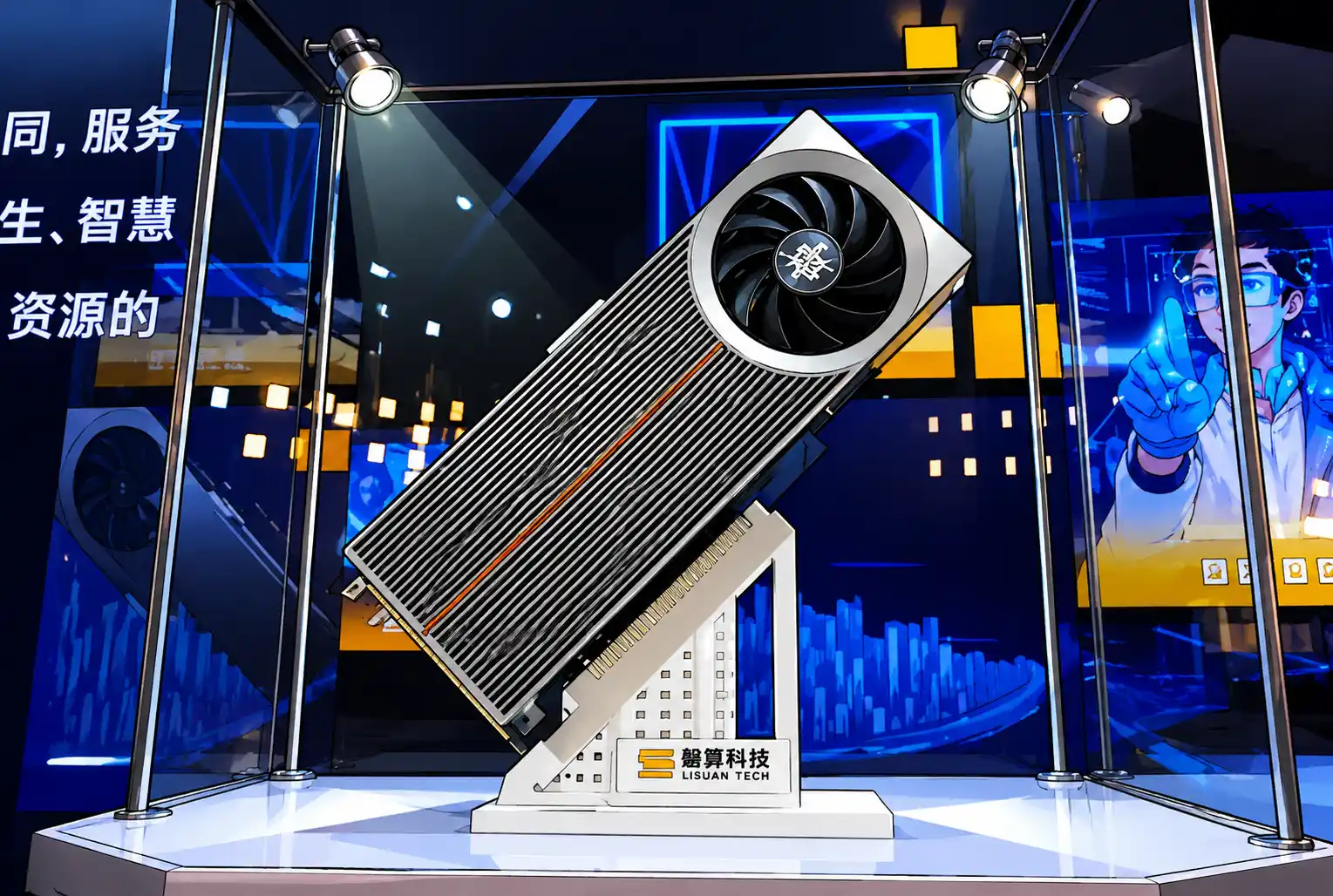
China already has several companies attempting to build domestic graphics processors, but one of the most interesting newcomers is Lisuan Technology. Founded in 2021, the Shanghai-based company has developed its own GPU architecture and launched the LX 7G100, a graphics card designed to run modern PC games.
On paper, some of its specifications look surprisingly respectable. In actual games?
Things get considerably more complicated.
And Lisuan provides a perfect example of why building a competitive GPU is not simply a matter of designing a sufficiently large piece of silicon. You also need decades of software, drivers, compiler development, developer relationships, optimization, and accumulated knowledge.
Money can buy engineers. It cannot instantly buy twenty years of bug reports.
Meet Lisuan and Its TrueGPU Architecture
Lisuan Technology was founded in 2021, making it remarkably young compared with the companies it ultimately hopes to compete against.
NVIDIA was founded in 1993. ATI, which eventually became AMD’s Radeon division, traces its history back to 1985. Intel has been making graphics hardware in various forms for decades.
Lisuan therefore arrived at the party approximately three decades late and immediately decided it would like to compete with everyone. Ambitious.
Its answer is an architecture called TrueGPU, also known as TianTu, which Lisuan describes as an independently developed graphics architecture rather than one based on licensed foreign GPU IP.
Its first major generation powers the G100 family, including the consumer-oriented LX 7G100.
Lisuan says the GPU supports modern graphics technologies including DirectX 12, Vulkan and OpenGL, alongside popular engines such as Unity and Unreal Engine. The company has also been working on compatibility with more than 100 games.
That last part might sound like an oddly specific achievement.
After all, a graphics card runs games. That’s literally the job description. But getting from “we manufactured a GPU” to “Cyberpunk 2077 actually renders the buildings” is much harder than it sounds.
Because a modern GPU is not really one product. It is an ecosystem pretending to be a graphics card.
Making the Chip Is Only the Beginning
At its simplest, a GPU contains thousands of processing units designed to perform enormous numbers of calculations simultaneously. That parallel architecture makes GPUs excellent at rendering graphics and, increasingly, workloads such as artificial intelligence.
But the silicon cannot simply receive a copy of Black Myth: Wukong and figure things out. Between the game and the GPU sits an enormous software stack. There are graphics APIs such as DirectX and Vulkan. There are shader compilers translating programs into instructions the GPU understands.
There are drivers controlling memory allocation, scheduling, synchronization, power management, display output and approximately seventeen thousand other things that nobody thinks about until one of them stops working.
Then there are game engines. Different versions of those engines. Different Windows versions. Different CPUs. Different motherboards. Different monitors. Different graphics settings.
And, because apparently this was not complicated enough, decades of old PC games expecting hardware to behave in very particular ways.
A competitive gaming GPU therefore needs much more than powerful silicon. It needs an enormous compatibility layer between hardware and software. That is where decades of experience become difficult to replicate.
Might be related: CXMT Explained: Can China Break the Global Memory Monopoly?
Why Can’t China Just Spend More Money?
This is where Lisuan becomes particularly interesting. China certainly isn’t lacking capital.
Building an advanced semiconductor industry has been a strategic priority for the country, supported through government investment, regional funding, subsidies and enormous domestic demand.
That funding matters.
Developing a GPU architecture requires thousands of engineers and years of research. Manufacturing advanced silicon requires expensive fabrication technology. Building drivers and development tools requires even more engineers who somehow enjoy staring at compiler errors for a living.
Money can accelerate all of those things. But money cannot completely skip the learning process.
Imagine deciding that you want to create a Formula 1 team. With enough money, you can build a factory, hire aerodynamicists, purchase equipment and recruit experienced engineers. You can probably build a functioning race car surprisingly quickly.
What you cannot purchase immediately is decades of institutional knowledge about every strange situation that occurs during an actual race.
GPUs have the same problem.
Except instead of tire degradation, you’re investigating why a game from 2013 turns the entire screen purple whenever someone opens the inventory.
Lisuan’s Strange Benchmark Journey
The development of Lisuan’s first GPU demonstrates this perfectly. Early engineering samples produced benchmark results that looked, to put it politely, not especially threatening to NVIDIA.
One early Geekbench OpenCL result was around 15,500 points, leading to comparisons with graphics cards such as the GTX 660 Ti from more than a decade earlier. That would be slightly concerning for a modern 6nm GPU.
But there was an important problem with those comparisons: the hardware was nowhere near finished. The engineering sample reportedly operated at extremely low clock speeds, making the result largely useless for predicting final performance.
Later results changed dramatically. More mature G100 hardware reportedly produced OpenCL performance above the RTX 4060 and Intel Arc A770 in Geekbench, while approaching the RTX 5060.
Suddenly the narrative went from: China’s new GPU performs like something from 2012. to: China’s new GPU is almost an RTX 5060!
Neither conclusion was particularly useful. Welcome to pre-release semiconductor benchmarking.
TFLOPS Are Not FPS
Lisuan has advertised approximately 24 TFLOPS of FP32 compute performance for its architecture. That sounds impressive.
An RTX 4060, for comparison, has theoretical FP32 performance in roughly the same general territory. So does that mean Lisuan has built an RTX 4060 competitor?
Not necessarily.
TFLOPS measure theoretical floating-point throughput. They tell us how much mathematical work a GPU can potentially perform under ideal conditions. Games are not ideal conditions.
Actual gaming performance depends on much more:
- Shader efficiency
- Memory bandwidth
- Cache design
- Scheduling
- Geometry performance
- Compiler optimization
- Driver overhead
- CPU interaction
- Game-engine behavior
- How effectively the hardware can actually utilize its processing units
Two GPUs can therefore have similar theoretical compute performance and deliver completely different frame rates.
Think of TFLOPS as the theoretical maximum capacity of a restaurant.
If every table is full, every chef works perfectly, nobody makes mistakes, ingredients teleport directly into the kitchen, and every customer orders the same thing, the restaurant could theoretically serve 500 meals per hour. Then Saturday night happens.
That’s gaming performance.
Actual Games Tell a Different Story
Once retail Lisuan cards reached independent testers, performance became easier to understand. The LX 7G100 could genuinely run modern games.
Tests have shown games including Black Myth: Wukong, Elden Ring, The Witcher 3, Grand Theft Auto V, and Dota 2 running at playable frame rates at 1080p. That’s important.
For a first-generation domestic gaming GPU architecture, simply running a broad collection of modern PC games properly is an accomplishment. But performance generally remains well behind what its theoretical compute figures might suggest.
And that gap tells us something important. Lisuan’s problem isn’t necessarily that the hardware cannot perform calculations quickly enough.
The challenge is making games use that hardware efficiently. Which brings us to the real nightmare.
Might not be related: PC vs Smartphone: The Business of Obsolescence
The Real Boss Fight: Drivers
PC gamers generally notice graphics drivers only under two circumstances:
- A new version gives them 8% more FPS.
- Everything suddenly catches fire.
But drivers are one of the most important technologies NVIDIA and AMD possess.
When a game sends instructions through DirectX or Vulkan, the graphics driver translates and optimizes those instructions for the GPU. That process has to happen quickly and correctly.
A driver may need specific optimizations for individual games. It must handle unusual shader behavior. It must manage memory efficiently. It needs to compile code for the architecture without leaving large portions of the GPU sitting idle.
And then someone releases a new game. Congratulations. Here are several million new ways for something to go wrong. NVIDIA and AMD have accumulated decades of fixes, optimizations and developer relationships.
Lisuan has been building this ecosystem for only a few years. That’s not an insult to Lisuan. It’s simply mathematics.
WHQL Is More Important Than It Sounds
One of Lisuan’s more meaningful recent milestones wasn’t a benchmark record. It was receiving Microsoft WHQL certification for its graphics drivers. WHQL, or Windows Hardware Quality Labs certification, means the hardware and drivers have passed Microsoft’s compatibility testing requirements.
That does not mean Lisuan’s drivers are suddenly as mature as NVIDIA’s. A driver’s license does not mean you are Max Verstappen. But it does establish an important baseline.
Lisuan is no longer merely demonstrating prototypes in controlled environments. It is building a GPU platform intended to behave like normal Windows graphics hardware.
The company has also continued releasing updated drivers, including WHQL-certified versions. And for a new GPU manufacturer, every driver release potentially matters more than another hundred theoretical GFLOPS.
Hardware performance is largely fixed once silicon leaves the factory. Software can continue improving for years. Intel Arc demonstrated exactly that.
Intel Already Proved How Hard This Is
If anyone should have been able to brute-force its way into the discrete GPU market, it was Intel.
Intel already had decades of graphics experience. It had thousands of engineers. It had compiler expertise. It had enormous OEM relationships. It understood PCs about as intimately as any company on Earth.
It also had money. Quite a lot of money.
Then Intel launched Arc. Early Arc GPUs showed impressive hardware potential but suffered from inconsistent gaming performance, especially in older DirectX 9 and DirectX 11 titles.
Intel spent years improving drivers, rewriting software components and optimizing individual games. Performance improved dramatically. But the lesson was clear.
Even Intel couldn’t simply walk into the GPU market and announce: “Hello, we understand transistors.”
GPU software takes time.
For Lisuan, the challenge is even larger because it is building much more of the ecosystem from scratch.
And Then There Is NVIDIA’s Real Weapon
Suppose Lisuan eventually creates a GPU that matches NVIDIA hardware in traditional gaming performance. Excellent.
Now we have to talk about CUDA. NVIDIA stopped being merely a graphics company a long time ago. Its ecosystem includes technologies such as CUDA, cuDNN, TensorRT, OptiX, NVENC, DLSS and Reflex, alongside extensive support across professional applications and AI frameworks.
CUDA is particularly important. Developers have spent almost two decades building software around NVIDIA’s compute platform. Researchers use it. AI frameworks support it. Universities teach it. Companies build infrastructure around it.
This creates a powerful network effect. Developers support CUDA because NVIDIA hardware is widely used. Customers buy NVIDIA hardware because software supports CUDA. And NVIDIA presumably sits somewhere in the middle looking extremely pleased with how this arrangement worked out.
Matching NVIDIA’s silicon is therefore only one challenge. Matching its ecosystem is another.
China Isn’t Starting With Lisuan
Lisuan is also not China’s only attempt at building domestic GPU technology.
Moore Threads is probably the most recognizable example. Founded by former NVIDIA China executive Zhang Jianzhong, the company has developed its own MUSA architecture and released consumer GPUs such as the MTT S80.
Other companies including Biren Technology and MetaX have focused more heavily on datacenter computing and AI accelerators. This matters because semiconductor ecosystems don’t necessarily emerge from one company succeeding.
They emerge from many companies trying. Some fail. Some get acquired. Some develop useful technology that eventually appears elsewhere. Some become specialized suppliers. And occasionally one survives long enough to become genuinely competitive.
Silicon Valley itself is basically a graveyard where several extremely successful companies happen to still be alive. China is attempting to accelerate that evolutionary process with capital, policy and a gigantic domestic market.
Lisuan is one experiment within that much larger project.
What Money Can Actually Buy
Saying “money can’t buy a competitive GPU” would therefore be misleading. Money absolutely helps. A lot.
China can use capital to:
- Hire experienced engineers
- Fund multiple GPU startups simultaneously
- Support semiconductor research
- Subsidize domestic hardware
- Build manufacturing capacity
- Encourage software developers to support Chinese GPUs
- Create domestic customers
- Allow companies to survive years without profitability
Perhaps most importantly, money buys time. A startup that would normally collapse after three unsuccessful product generations might survive long enough to produce a fourth.
And GPUs reward iteration.
NVIDIA’s first products weren’t RTX 5090s. AMD did not wake up one morning with RDNA. Intel Arc became considerably better through years of software development.
If Lisuan receives enough resources to produce TrueGPU 2, TrueGPU 3, and TrueGPU 4, each generation gives its engineers something extremely valuable: Experience.
And unlike manufacturing equipment, experience cannot be imported in a shipping container.
Lisuan Doesn’t Need to Beat Nvidia Yet
It is tempting to evaluate every new Chinese GPU by asking: Can it beat NVIDIA?
Right now, the answer is straightforward. No.
Lisuan isn’t about to overthrow GeForce. Its first gaming products do not consistently match similarly positioned NVIDIA hardware, its drivers are much younger, and its software ecosystem is tiny by comparison.
But that may be the wrong benchmark for success.
A few years ago, China did not have a competitive domestic gaming GPU ecosystem at all. Now Lisuan has produced hardware that boots Windows, supports modern graphics APIs, runs contemporary games, receives certified drivers, and is actually being sold to consumers.
None of those achievements individually sounds revolutionary. Together, they matter. Because building a GPU is not one enormous technological breakthrough. It is thousands of smaller problems that have to be solved simultaneously.
China can finance those problems. It can hire people to solve them. It can create customers willing to buy the results. But it cannot simply write a sufficiently large cheque and download thirty years of NVIDIA’s accumulated engineering experience.
That knowledge has to be built one architecture, one driver update, one game optimization, and probably one inexplicably purple inventory screen at a time.
The most important question for Lisuan therefore isn’t whether its first GPU can beat NVIDIA. It’s whether the company gets enough generations to learn how.
