
I recently talked to several friends who work for major desktop PC component companies. Different companies. Different jobs. Different parts of the industry. Yet they all described the current situation with roughly the same technical terminology: Chaos.
Memory prices are rising. Supply is uncertain. Product planning is getting harder. AI companies are absorbing enormous amounts of semiconductor capacity. Everyone is trying to figure out what components will cost six months from now.
Of course, most people blamed AI. But that’s also a very human thing to do. We have a tendency to stop thinking once we’ve found a cause or one convenient culprit. Reality is rarely that cooperative. Sometimes, there are a few more variables hiding underneath.
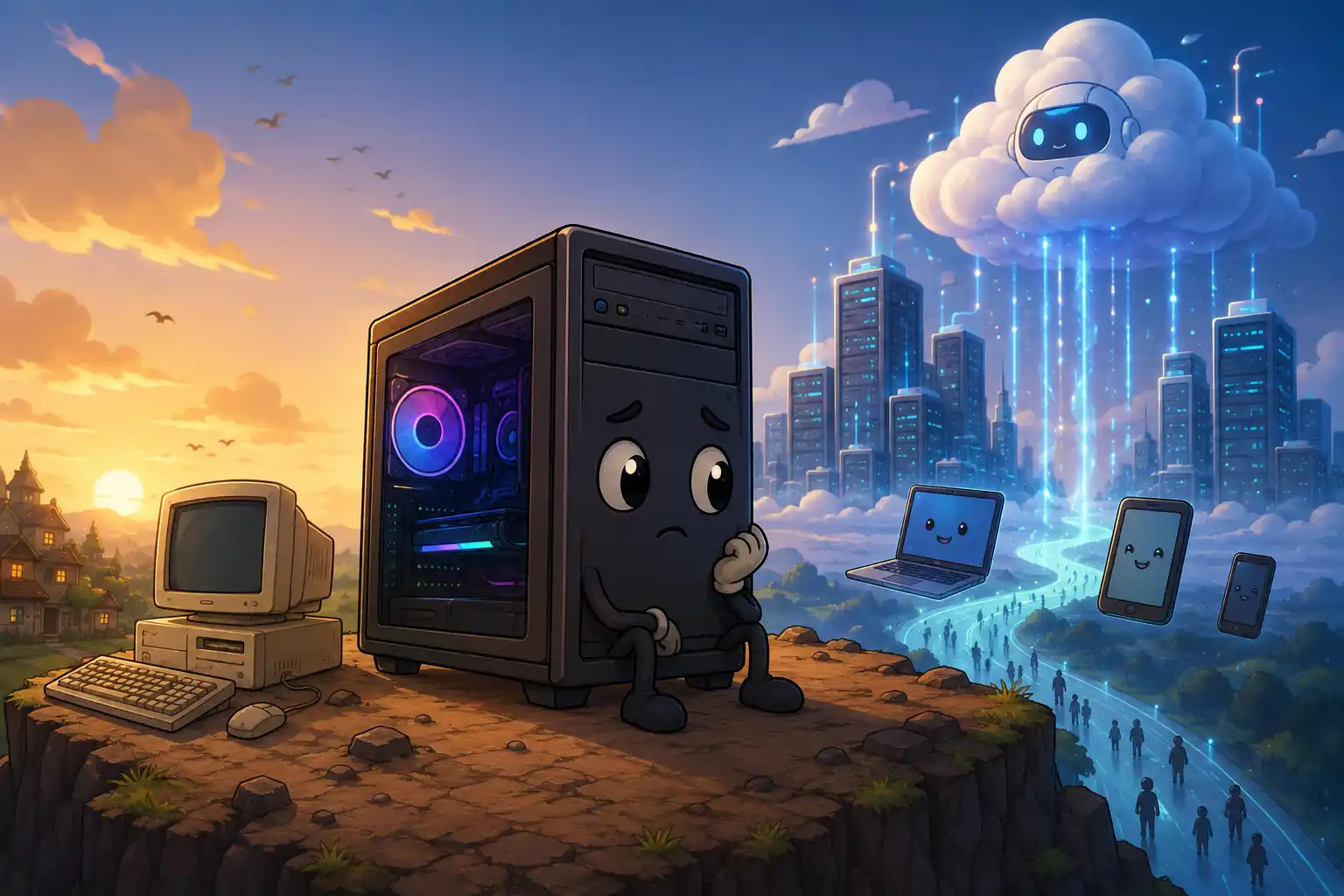
AI may be creating another crisis for the PC hardware industry, but the desktop PC was already fighting a much older battle.
Laptops replaced desktops for many ordinary users years ago. Smartphones then swallowed enormous chunks of everyday computing. Meanwhile, the desktop increasingly retreated into gaming, workstations, enterprise systems, enthusiasts, and people who believe owning six RGB fans is a personality trait.3
Which brings us to the bigger question: Is the desktop PC slowly disappearing anyway?
The Desktop Used to Be the PC
There was a time when buying a computer usually meant buying a desktop. Not because humanity had collectively decided that enormous beige boxes were beautiful, but because portable computers involved serious compromises.
Laptops were expensive. They were slower. Screens were smaller. Batteries were terrible. Upgradeability was limited. If you wanted a proper computer, you bought a desktop.
That began changing dramatically during the 2000s. One particularly important moment arrived in the third quarter of 2008.
According to iSuppli data reported at the time, worldwide notebook shipments reached 38.6 million units, narrowly surpassing desktop shipments of 38.5 million units for the first time.
The difference was only 100,000 computers. Statistically, almost a tie. Historically, enormous.
For the first time, the portable PC had overtaken the machine that had defined personal computing for decades. And it never really looked back.
Fast-forward to 2025 and the difference is no longer 100,000 units. It is approximately 160 million.
Omdia estimates that 219.7 million notebooks and mobile workstations shipped worldwide in 2025, compared with only 59.1 million desktops and desktop workstations. That means desktops represented only about 21% of worldwide PC shipments.
Put another way: Roughly four out of every five PCs shipped in 2025 were portable.
And the pattern continued into 2026. In Q2 2026, Omdia recorded 51.7 million notebook shipments versus 13.9 million desktops. The desktop PC hasn’t disappeared. But it clearly isn’t the PC anymore.
Then Smartphones Ate the Computer
Laptops were only the first problem. The smartphone attacked the PC from an entirely different direction. For decades, owning a computer was practically synonymous with participating in digital life.
You needed one to browse the internet. Send email. Chat with people. Shop online. Waste four hours arguing with strangers. The last one remains an essential pillar of modern civilization, but unfortunately you no longer need a desktop for it.
You don’t even need a laptop. Your phone handles almost everything. And the shipment numbers show just how enormous that transition became.
Omdia estimates worldwide smartphone shipments reached 1.25 billion units in 2025.
Compare that with:
- 278.7 million PCs
- 219.7 million notebooks
- 59.1 million desktops
That works out to roughly 4.5 smartphones for every PC shipped.
More dramatically, about: 21 smartphones for every desktop PC.
Twenty-one to one.
Of course, smartphones and desktops are not direct substitutes in every situation. Nobody sensible is rendering a Blender animation or compiling a giant software project on an iPhone. But that’s precisely the point. The desktop used to serve both ordinary and demanding computing. Today, ordinary computing has largely escaped the desk.
The Desktop Has Retreated to Its Strongholds
If all you need is Chrome, Microsoft Office, Zoom, Spotify and enough computing power to open 37 browser tabs before wondering why everything feels slow, a modern laptop is perfectly adequate. More importantly, you can close the lid and take it somewhere else.
The desktop therefore needs another justification. And fortunately for the desktop industry, there are plenty. Gaming remains an obvious one. So do engineering, rendering, scientific workloads, professional content creation, enterprise deployments and specialized workstations.
Then there are enthusiasts. These are people who don’t merely want a computer. They want their computer.
They care which CPU is inside it. They know the CAS latency of their RAM. They have opinions about positive versus negative case pressure. Some have spent more time optimizing fan curves than most governments spend planning public transportation.
For these users, the desktop’s apparent disadvantages become advantages. It’s large because that allows better cooling. It’s stationary because portability doesn’t matter. It’s modular because components can be replaced. It consumes enormous amounts of electricity because apparently 600 watts is acceptable if the shadows in Cyberpunk 2077 become slightly more realistic.
The desktop stopped winning on convenience. It started winning on performance, customization and specialization. That distinction matters, because it suggests the desktop isn’t necessarily dying. It may simply be turning into something else.
The Desktop PC Is Becoming the Mechanical Watch of Computing
Consider the mechanical watch. Almost nobody needs one. If you want to know the time, your phone can tell you. So can your laptop. Your microwave. Probably your refrigerator, because apparently refrigerators needed operating systems.
Yet mechanical watches still exist. Some cost thousands or even hundreds of thousands.
Their functional necessity disappeared, but the product survived by becoming something people buy because they specifically appreciate the product itself. The same thing happened to dedicated cameras. Most people no longer carry one because smartphone cameras became good enough. But professional and enthusiast cameras did not disappear.
Instead, the category became increasingly concentrated around people who actually care about photography.
Desktop PCs may be undergoing a similar transformation. People once bought desktops because they needed a computer. Increasingly, people buy desktops because they want a desktop.
That’s a subtle difference with enormous economic consequences. It means the industry can become smaller while simultaneously becoming more premium. And if you’ve looked at enthusiast PC hardware lately, you may have noticed that manufacturers have enthusiastically discovered this concept.
There are $500+ motherboards. Elaborate liquid coolers. OLED gaming monitors. High-end power supplies capable of powering a modest village. Fans with LCD screens. RAM with RGB. Cables with RGB. GPU support brackets with RGB. At some point someone will release an RGB CMOS battery and civilization will finally be complete.
This is not necessarily what a dying industry looks like. It might be what a specializing industry looks like. But then AI arrived.
AI Did Not Start the Fire
This distinction is important. It would be tempting to look at today’s hardware problems and declare: AI IS KILLING THE PC.
Excellent thumbnail. Terrible analysis.
The desktop’s structural decline began long before ChatGPT, generative AI or the current data-center construction boom. Laptops had already overtaken desktops in 2008. Smartphones had already transformed consumer computing during the following decade. AI didn’t start that transition.
What AI may be doing is making life considerably more difficult for the market that survived it.
And the current memory situation provides a remarkably clear example. IDC described the memory shortage emerging in late 2025 as being driven partly by manufacturing capacity shifting away from consumer electronics and toward higher-margin products supporting AI infrastructure, including HBM and high-capacity DDR5.
That matters because AI servers require enormous quantities of memory. More importantly, manufacturers have economic reasons to prioritize them.
If one customer wants memory for a $1,000 consumer PC while another wants enormous quantities for AI infrastructure costing millions of dollars, it doesn’t require an MBA from Harvard to guess which customer suddenly looks attractive.
IDC went as far as describing the situation as potentially more than another cyclical shortage, arguing that it could represent a strategic reallocation of silicon capacity as Samsung, SK hynix and Micron direct cleanroom space and capital toward higher-margin enterprise and AI products.
That is a much bigger problem than simply: “RAM got expensive this year.”
It suggests the underlying priority of the semiconductor industry may be changing.
For decades, consumer electronics helped dictate where enormous semiconductor investments went. Now the industry has discovered another customer. And that customer has a corporate expense account.
We’ve Seen This Before. Except We Haven’t.
PC gamers may experience a strange sense of déjà vu here. Because this isn’t the first time another technology boom has arrived and made computer hardware miserable.
Remember crypto mining? Of course you do. Your therapist probably does too.
During the cryptocurrency boom, miners discovered that consumer GPUs were extremely good at performing the calculations needed to mine currencies such as Ethereum. Suddenly gamers weren’t merely competing against other gamers for graphics cards.
They were competing against people buying GPUs by the shelf. The relationship between cryptocurrency mining and GPU demand became significant enough that NVIDIA discussed cryptocurrency mining demand in its financial disclosures.
Then the cycle changed.
Most importantly, Ethereum completed The Merge on September 15, 2022, moving from proof-of-work to proof-of-stake and eliminating the GPU-intensive mining mechanism that had supported a huge amount of mining demand. The crypto hardware crisis was painful.
But conceptually, it was relatively straightforward.
Miners wanted GPUs. They competed with gamers for hardware. When mining economics deteriorated and Ethereum abandoned proof-of-work, much of that extraordinary demand disappeared.
AI is different. An AI hyperscaler isn’t necessarily standing next to you at a computer store trying to grab the RTX 6090 before you do. Instead, AI demand operates much further upstream.
It influences investment in HBM, advanced semiconductor manufacturing, data-center storage, power infrastructure, and the capital expenditure decisions of companies throughout the semiconductor supply chain.
So while both crypto and AI can make PC hardware more painful, the mechanisms are fundamentally different.
The Numbers Are Already Getting Ugly
The effects are no longer theoretical.
Omdia says mainstream PC memory and storage costs increased roughly 40% to 70% between Q1 and Q4 2025. Despite worldwide PC shipments actually growing a healthy 9.1% during 2025, rising component costs and tightening supply were already damaging expectations for 2026.
By Q2 2026, worldwide PC shipments had fallen 3.6% year-over-year. Desktop shipments declined 1.3%, while notebooks fell 4.2%. Omdia specifically pointed toward rising memory and storage prices as an important contributor to higher PC pricing.
IDC’s outlook is considerably uglier.
As of June 2026, IDC forecasts worldwide PC shipments will decline 11.3% for the full year, with the year-over-year decline potentially reaching 20% in Q4. At the same time, it expects average PC selling prices to rise 18.3%.
Read those numbers again because they’re wonderfully horrible.
Units: down 11.3%.
Prices: up 18.3%.
The PC industry’s current sales strategy appears to be:
Would you like fewer computers for more money?
IDC doesn’t expect meaningful memory-shortage relief before the end of 2027 and believes the market may not stabilize until 2028. For PC component companies, that creates exactly the kind of chaos my friends were describing.
How do you plan next year’s products when major input costs are moving dramatically? How aggressively do you price a motherboard when you don’t know what the rest of the PC will cost? How many SKUs should you produce? How much inventory should distributors hold?
These aren’t abstract semiconductor questions anymore.
DIY PC Builders Could Be Particularly Vulnerable
There is another uncomfortable wrinkle for desktop enthusiasts. Large PC manufacturers buy enormous quantities of components. You do not.
This gives companies such as Lenovo, Dell and HP substantially more leverage when supply becomes constrained.
IDC expects larger vendors to be better positioned during the current shortage because of their purchasing volume, inventory and supplier relationships. It specifically warns that white-box and lower-tier vendors could bear more of the burden—and explicitly includes DIY systems frequently built by gamers.
That’s fascinating because it could temporarily reverse one of the traditional arguments for building your own PC. Historically, DIY enthusiasts could often say: “Why would I buy that prebuilt? I can build something better for the same money.”
But if large OEMs can secure components more efficiently than smaller assemblers and retail channels, prebuilt systems could become comparatively more attractive.
But 2025 Also Gives Us a Warning Against Doom
There is an important piece of evidence preventing us from declaring the desktop dead. Desktop shipments actually grew in 2025. Omdia estimates 59.1 million desktops and desktop workstations shipped during the year, up 14.5% from 2024.
That’s hardly extinction.
The broader PC market also benefited from the Windows 10 end-of-life replacement cycle, which encouraged businesses and consumers to upgrade older machines. This is important because technology markets rarely decline in a beautiful straight line suitable for PowerPoint. Replacement cycles happen. Pandemics happen. New games arrive. Businesses refresh hardware. Operating systems reach end of support.
A sufficiently attractive GPU can apparently cause grown adults to reconsider whether they really need savings. Desktop shipments can therefore grow strongly in individual years even while the desktop’s long-term role in computing shrinks.
Those aren’t contradictory statements. A category can be healthy while becoming more specialized.
AI Could Also Give PCs a Reason to Exist
There’s another complication.
AI may simultaneously hurt PC hardware economics and create demand for more powerful PCs.
Gartner estimated AI-capable PCs would represent 31% of worldwide PC shipments by the end of 2025 and forecast that share to reach roughly 55% in 2026. Interestingly, Gartner expected AI capability to penetrate laptops faster than desktops, but still projected AI desktops to rise from 16.4% of desktop shipments in 2025 to 42.1% in 2026.
If more AI workloads move onto local devices, PCs may need more RAM, faster processors and dedicated AI acceleration. For privacy-sensitive workloads, professional applications and enormous local models, powerful personal workstations could become more valuable rather than less.
So AI creates a bizarre contradiction. On one side, AI infrastructure is making some of the components needed for PCs scarcer and more expensive. Yet on the other, AI software may create reasons to buy more powerful PCs.
The technology threatening the economics of personal computing may simultaneously create its next upgrade cycle. Computing apparently wasn’t complicated enough already.
The Cheap PC May Be in More Danger Than the Desktop PC
This leads to an important distinction. Perhaps the biggest casualty isn’t the desktop itself. Perhaps it’s the affordable general-purpose PC.
IDC expects the industry to move toward premiumization as higher component costs push manufacturers toward products with healthier margins. That makes economic sense.
Suppose memory suddenly adds another $80 to the cost of two computers. Computer A sells for $400. Computer B sells for $2,000. The same $80 increase is devastating to the economics of Computer A and irritating but manageable for Computer B.
Manufacturers therefore have a powerful incentive to concentrate scarce components in higher-margin products. And this fits surprisingly well with the direction desktop hardware was already traveling: Gaming PCs, workstations, creator machines, premium motherboards, high-end GPUs, or even an AIO cooler with a 4K OLED screen.
The desktop may survive not by remaining cheap and universal, but by becoming increasingly expensive and specialized. Which sounds depressing until you remember that entire industries operate exactly like this.
Extinction Is Probably the Wrong Word
So, is the desktop PC on the brink of extinction? Probably not.
Nearly 60 million desktops shipped in 2025. That’s an enormous market by almost any reasonable standard.
Gaming alone gives desktops a powerful reason to exist. Workstations give them another. Enterprise environments provide another. Enthusiasts will continue building them because laptops remain frustratingly resistant to having three kilograms of cooling equipment attached to their CPUs.
But something has disappeared. The mass-market desktop as the default computer. That machine is already mostly gone.
In 2008, notebooks and desktops were shipping in almost identical numbers. In 2025, notebooks outsold desktops by nearly four to one. Meanwhile, smartphones shipped at roughly twenty-one times desktop volume. The desktop did not vanish.
It retreated.
What remained were the things desktops are exceptionally good at: performance, expandability, customization and sustained workloads.
Now AI has arrived to introduce a new problem. For perhaps the first time, consumer computing is no longer obviously the most attractive destination for some of the semiconductor industry’s enormous investments.
Data centers are willing to pay more. AI accelerators need enormous quantities of memory. HBM is enormously valuable. Hyperscalers are spending sums of money that make the entire enthusiast PC community look like people collecting loose change from underneath the sofa.
That doesn’t mean the desktop dies. It means its evolution may accelerate.
