
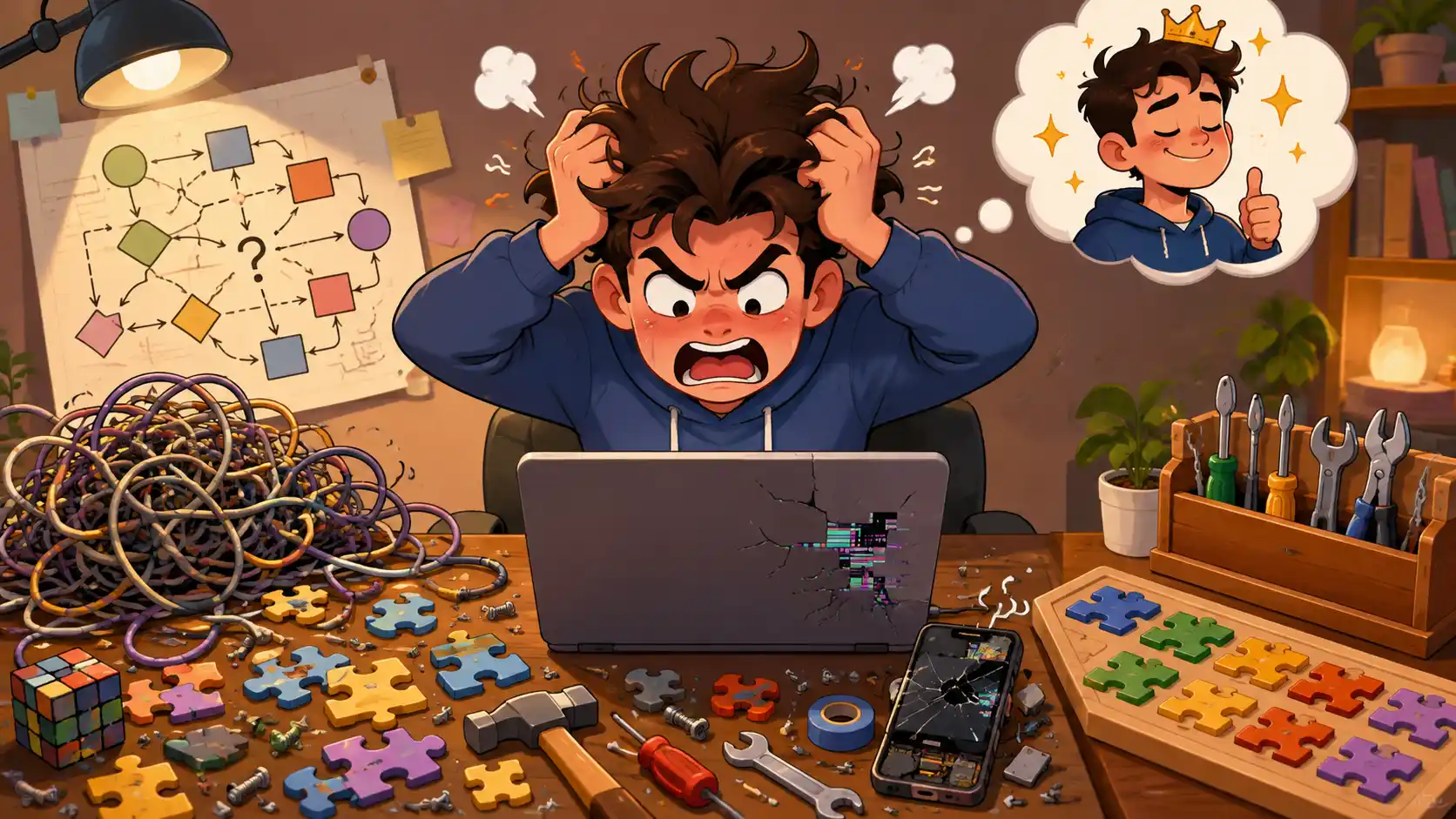
In a previous article about why some people are so much easier to anger than others, I briefly floated a slightly dangerous idea.
One of the most obvious sources of anger is frustration, and frustration often begins when something blocks us from achieving a goal. My completely peer-unreviewed thought was that perhaps some of those blocked goals would be less frustrating if we simply knew how to solve them. An experienced mechanic who finds a car that refuses to start probably sees a list of possible causes. I see a machine that has betrayed me personally.
From there, I made the considerably more irresponsible suggestion that if you are constantly furious because everything around you seems impossibly difficult, perhaps you are not quite as smart as you think you are. At the time, I treated it mostly as a joke. Unfortunately, I then looked at the research.
There is no strong evidence that simply being less intelligent makes someone angrier. That would be a wonderfully simple conclusion, and therefore almost certainly too convenient for psychology. But there is research connecting anger with frustration tolerance, executive function, cognitive control, self-assessed intelligence, and the ability to accurately evaluate our own competence.
So perhaps the interesting question is not whether stupid people are angrier. It is whether our ability to solve problems—and our beliefs about that ability—change how frustrating the world feels.
First, What Do We Even Mean by “Intelligent”?
Before accusing angry people of being stupid, which admittedly seems like an excellent way to create some original experimental data, we need to define the word.
Psychologists have studied intelligence for well over a century, and one major concept is general intelligence, usually abbreviated as g. The basic idea is that people who perform well on one type of cognitive task tend, on average, to perform relatively well on others too. That common factor is what researchers mean by general cognitive ability. But everyday life involves much more than g.
Someone can have exceptional general intelligence and know absolutely nothing about repairing an air conditioner. Someone with perfectly ordinary cognitive ability but twenty years of HVAC experience may identify the problem before the first person has finished Googling what a compressor does.
Likewise, intelligence is not the same as expertise, and neither is identical to executive function.
A major review by cognitive neuroscientist Adele Diamond describes the core executive functions as inhibitory control, working memory, and cognitive flexibility. These abilities help us resist impulses, hold information in mind, plan, and—particularly relevant here—change strategies when the current approach stops working.
Then there is metacognition: our ability to evaluate our own thinking and knowledge. Knowing something is useful. Knowing that you do not know something can be even more useful. And finally, there is emotional regulation. A person might be extraordinarily intelligent, realize exactly why the computer has crashed, and still throw the mouse across the room.
These are related abilities, but they are not interchangeable. That distinction matters because our question is not really: Are people with lower IQ more easily angered? It is closer to asking whether people become more frustrated when they have fewer ways to understand, adapt to, or overcome whatever is blocking them.
Definitely related: Carlo Cipolla and the Strange Economics of Human Stupidity
Frustration Is Closely Connected to Anger
The first part of the theory is relatively straightforward.
Blocked goals create frustration, and frustration is one of the major pathways into anger. More importantly, people differ substantially in how well they tolerate frustration.
Research based on Rational-Emotive Behavior Therapy has found an association between low frustration tolerance and higher trait anger. In one study of college students, people who scored higher in low frustration tolerance and irrational beliefs also reported significantly greater anger. Similar findings have appeared in research examining reactions to actual provocation and in adolescent populations.
That does not mean frustration automatically produces anger. One person can encounter a problem and think, “Okay, this is inconvenient.” Another experiences the same obstacle as evidence that reality itself has violated the terms and conditions.
The difference may partly involve beliefs such as:
- This shouldn’t be difficult.
- This should work.
- I should be able to solve this.
That last one is especially interesting. Because now the problem is no longer merely blocking your goal. It is also contradicting your expectations about yourself.
Competence Gives You More Ways Around a Wall
Consider the difference between a beginner and an expert confronting the same failure.
A novice tries solution A. It fails. They may genuinely have no idea what comes next. An expert tries solution A, sees the result, rules out one explanation, moves to solution B, checks another variable, and continues narrowing the problem.
Both people encounter obstacles, but only one of them experiences the obstacle as a dead end. This is where expertise and cognitive flexibility could plausibly influence frustration.
Someone with greater domain knowledge generally possesses more possible explanations, more strategies, and more experience recognizing patterns. When one route fails, they can try another. The problem remains annoying, but it is not necessarily incomprehensible.
To be clear, I could not find strong evidence establishing a neat causal chain of: expertise → fewer blocked goals → less frustration → less anger. So this part remains an interpretation rather than established psychological law.
But research on executive function gives us something nearby. A recent pair of meta-analyses found that poorer executive functioning is associated with greater aggression, particularly reactive aggression. Reactive aggression is especially relevant because it describes impulsive responses to perceived provocation rather than carefully planned aggression.
Earlier work on trait anger also points toward the importance of cognitive control. One influential review proposed that persistent anger differences involve several interacting processes, including hostile interpretations, rumination, and effortful cognitive control.
In other words, solving the problem is only part of the equation. You also need the cognitive flexibility to change approaches and the inhibitory control to avoid declaring war on the printer after solution number three fails.
Impossible Problems Reveal Something Important
There is an experiment that fits our question almost suspiciously well.
Researchers gave people anagrams containing both solvable and unsolvable problems, deliberately creating frustration. Participants higher in trait aggression did not perform significantly worse on the solvable tasks. In other words, they were not simply worse at solving the problems.
What differed was their emotional response. The more aggression-prone participants experienced greater anger and negative affect when confronted with the frustrating task. This gives us an important distinction. Problem-solving ability and frustration response are separate variables.
Two people can be equally incapable of solving something while reacting completely differently to that failure. One says, “Apparently this problem cannot be solved.” The other concludes that the problem, the person who designed it, the table it is sitting on, and possibly modern education itself are all complete garbage.
So competence alone cannot explain anger. But what if the person’s perception of their competence enters the equation? That is where things become considerably more entertaining.
Angry People May Overestimate Their Intelligence
In 2018, researchers published a paper with the wonderfully convenient title Why do angry people overestimate their intelligence?.
Across two studies, they examined trait anger, objectively measured cognitive ability, and subjectively assessed intelligence—essentially how intelligent participants believed themselves to be.
The results require some nuance. Trait anger did not simply produce a huge straightforward correlation with believing oneself to be brilliant. However, after controlling for factors including neuroticism and actual intelligence, anger was associated with higher self-assessed intelligence. Narcissism also appeared to explain part of the relationship in one sample.
That is nowhere near enough evidence to declare: Angry people think they’re geniuses. But it gives us a fascinating piece of the puzzle. Anger may sometimes coexist with overconfidence about one’s own cognitive ability. And that makes my original irresponsible theory slightly harder to dismiss.
Psychologically, the gap between perceived competence and actual competence may matter because repeated failure becomes more than inconvenient. It becomes an ego threat.
This Sounds Like Dunning–Kruger. Unfortunately, Dunning–Kruger Is Complicated
At this point, someone is almost certainly thinking about the Dunning–Kruger effect. The popular version goes something like:
Stupid people are too stupid to realize they’re stupid.
It is memorable, vicious, extremely useful in online arguments, and significantly more complicated than that.
The original Dunning–Kruger hypothesis proposed that poor performers can suffer a kind of double burden: they lack the skills needed to perform well and may also lack some of the knowledge required to accurately recognize their poor performance. But later researchers have challenged how much of the famous pattern reflects a special metacognitive deficit.
A 2020 analysis using intelligence data argued that much of the classic Dunning–Kruger pattern could be produced by statistical artifacts such as regression to the mean. A later Registered Report published in 2022 similarly found that poorer performers were generally less confident than high performers, even though they still overestimated their performance relative to reality.
Other work has found a small residual Dunning–Kruger-type effect even after attempting to account for those statistical problems. So the safest conclusion is not that incompetent people are universally overflowing with confidence. It is simply that people can be badly calibrated about their own abilities, and poorer performers can sometimes overestimate themselves.
For our anger question, calibration may matter more than raw intelligence anyway.
Maybe the Important Variable Is the Gap
This brings us to what I think is the most interesting hypothesis. Frustration may become especially intense when three things collide: what you believe you should be able to do, what you can actually do, and what reality is currently allowing you to do.
If all three are reasonably aligned, failure is easier to interpret. A beginner expects difficulty. An expert has strategies. Someone who correctly recognizes an impossible situation can eventually stop trying. But imagine being convinced that something should be easy while repeatedly failing to accomplish it.
Now every failure demands an explanation. Sometimes the explanation becomes external. Sure, sometimes the program really is garbage, the game really is cheating, and your coworkers may be conducting an ambitious group experiment on the limits of human patience. But if the same pattern appears everywhere, the possibility of miscalibrated self-assessment becomes harder to ignore.
Smart People Can Still Be Furious Idiots
None of this means intelligence protects anyone from anger.
A brilliant person can have poor emotional regulation. An expert can interpret criticism as disrespect. Someone with excellent executive function in professional settings can spend forty-five minutes arguing with a stranger online about a graphics card.
Anger research repeatedly points toward mechanisms that have little to do with IQ: hostile attribution bias, rumination, shame sensitivity, frustration tolerance, stress, sleep, and emotional regulation. And as we discussed in the broader article on why some people are easier to anger, people high in trait anger may actually interpret ambiguous situations as more hostile in the first place.
So intelligence does not provide immunity. It merely gives us one possible component of a much larger system. Being intelligent may help you solve a problem. Being experienced may help you recognize alternatives. Being cognitively flexible may help you change strategies. Being self-aware may help you admit that you have no idea what you’re doing. And emotional regulation may help you avoid punching the monitor when all four fail simultaneously.
