
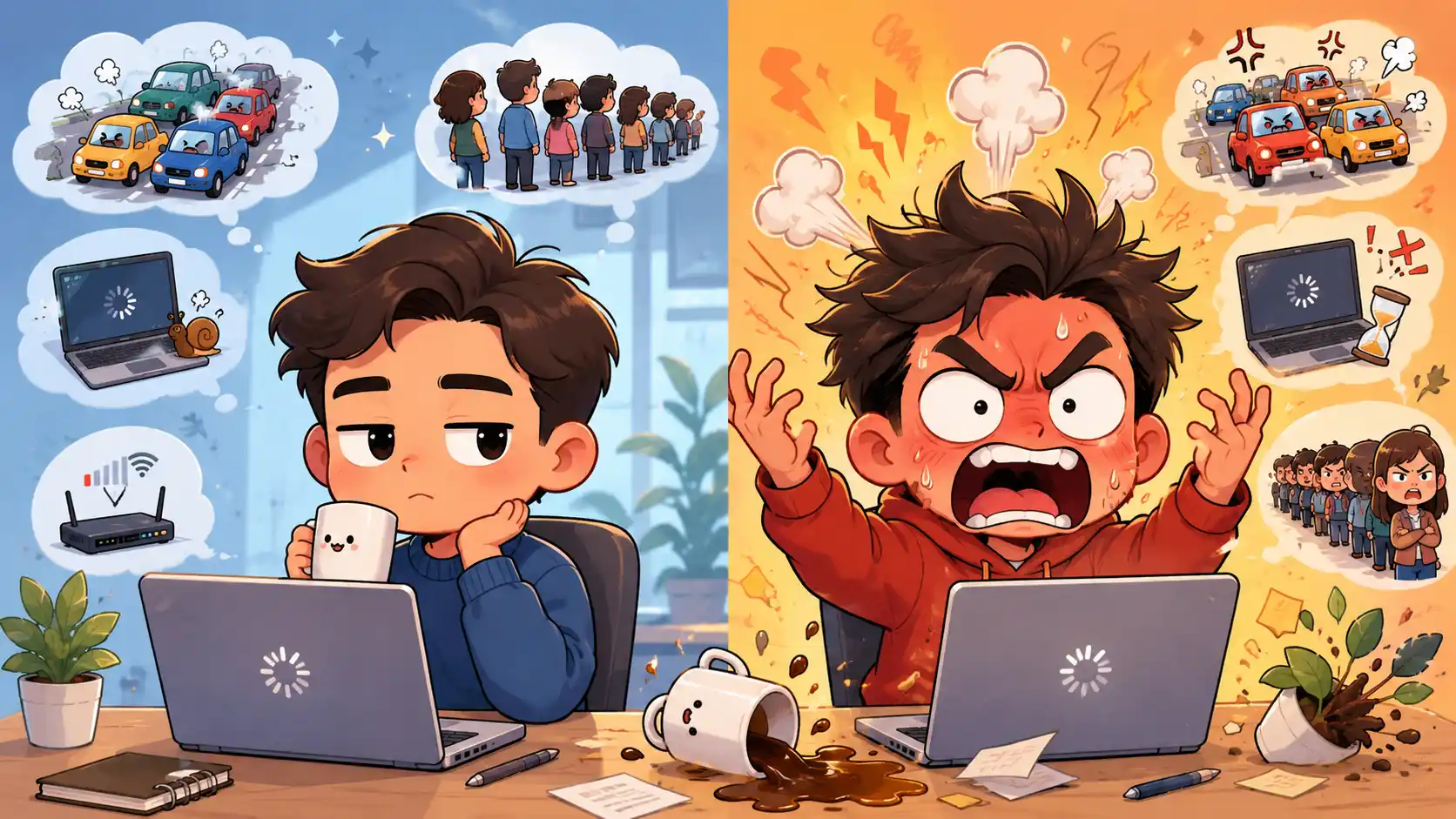
Someone cuts you off in traffic. You think: Idiot. Then you keep driving. Someone else experiences the exact same event and immediately begins auditioning for Mad Max: Fury Road.
Same road. Same traffic. Same offense. Completely different emotional outcome. We usually explain this with vague labels.
- “He has a short temper.”
- “She gets angry easily.”
- “He’s just one of those explosive people.”
But what does that actually mean?
Why can one person absorb ten small frustrations before becoming visibly annoyed, while another seems to go from perfectly normal to DEFCON 1 because the Wi-Fi took four seconds longer than expected?
Psychological research suggests that there is no single anger switch. Instead, anger proneness seems to emerge from several processes working together:
what we notice → what we think it means → how strongly we react → how long we keep thinking about it → how well we regulate the reaction.
People can differ at every one of those stages. So perhaps some people do have a shorter fuse. But they may also live in a world containing far more things that look like matches.
Could be related: Why Stupidity Can Be More Dangerous Than Evil, According to Dietrich Bonhoeffer
Some People Really Are More Prone to Anger
Psychologists commonly distinguish between state anger and trait anger. State anger is straightforward: I am angry right now. Trait anger describes a more persistent tendency to experience anger frequently, intensely, or in response to relatively mild provocations.
That does not mean humanity can be permanently divided into Normal People and Angry Goblins. Context matters enormously.
The same person might be perfectly pleasant on vacation and almost unrecognizable after three deadlines, four hours of sleep, and a printer that refuses to print black because the cyan cartridge is empty.
But meaningful individual differences in anger proneness do exist. And one of the most interesting differences may occur before somebody even becomes angry.
Some People See Hostility Where Others See Ambiguity
Imagine a coworker walks past you without saying hello. There are plenty of explanations. Maybe they did not notice you. Maybe they were distracted. Maybe they were late for a meeting. Maybe they were attempting to remember whether they turned the stove off.
Or: They ignored me on purpose.
That last interpretation changes everything. Psychologists call this tendency hostile attribution bias: the tendency to interpret ambiguous behavior as having hostile intent.
And the relationship with anger is not merely theoretical. A 2026 systematic review and meta-analysis of 35 studies involving 10,451 people found a moderate association between trait anger and hostile attribution bias, with a correlation of about r = 0.32. (PubMed)
That does not mean anger-prone people walk around hallucinating enemies. It means they may be somewhat more likely to interpret uncertain situations as deliberate provocations.
And once that happens, everyday life suddenly contains a lot more things to get angry about.
A driver does not merely change lanes badly. They cut you off. A coworker does not merely forget to answer your message. They are ignoring you. Someone does not simply disagree with your proposal. They are trying to undermine you.
The external event can be identical. The internal event is not. And that leads to one of the most useful ideas in understanding chronically angry people: They may genuinely experience the social world as more hostile than everyone else does.
Frustration Is Basically Anger’s Favorite Fuel
One of the most obvious triggers for anger is blocked goals. You want something to happen. Something prevents it. Congratulations: frustration.
Traffic prevents you from arriving somewhere. A slow computer prevents you from working. A teammate makes a mistake and prevents you from winning. A government website tells you to upload a PDF, rejects the PDF for being too large, then provides instructions for solving the problem in another PDF. Civilization had a good run.
Frustration itself does not automatically create rage. What matters partly is how people interpret being blocked.
One response is: Fine. I need another plan. Another is: This should not be happening. That small shift is important. Once an inconvenience becomes something that shouldn’t be happening, the experience can start feeling unfair. And unfairness is considerably more combustible than inconvenience.
A traffic jam is annoying. A traffic jam that feels like everyone else is incompetent and wasting my time is personal. The world is no longer merely inconvenient. The world is behaving incorrectly.
Anger and stupidity
As previously mentioned, blocked goals are one of the most obvious triggers for anger. However, I would argue that blocked goals won’t turn into anger if you know the solution. Whether it’s because you may be a genius or you have more than enough experience in the field, blocked goals won’t turn into frustration.
On the other hand, whether you’re ignorant or you simply overestimate yourself, lol, you might find that many blocked goals lead to frustration, thus anger. So, maybe, just maybe (hahaha), if you are easily angered, it could be that you’re not as smart as you think you are.
Please keep in mind that this is simply my opinion. I’m not claiming there is research, scientific evidence, or anything particularly solid behind it. Let’s just file this under “personal rambling”—possibly produced because I, too, am too stupid to solve some of my own blocked goals. Hahaha.
Sometimes Anger Is Really About Status
There is another especially powerful trigger: perceived disrespect. Humans care enormously about dignity, reputation, status, belonging, and how other people see us. That means events with trivial practical consequences can carry enormous social meaning.
Being corrected privately? Annoying. Being corrected in front of twenty coworkers? Now we potentially have humiliation.
Someone disagreeing with you? Manageable. Someone laughing while disagreeing with you? Suddenly we have entered different territory.
Classic research by June Tangney and colleagues found that shame-proneness was associated with anger, hostility, resentment, suspiciousness and a tendency to externalize blame. (PubMed)
This is where we need to avoid one of pop psychology’s favorite oversimplifications:
“Anger is always a secondary emotion.”
Not really. Anger is a meaningful emotional state in its own right. But shame, humiliation, fear, or threatened status can absolutely lead into anger.
Consider the translation chain:
“Your argument is wrong.” → “You think I’m stupid.” → “You’re humiliating me.” → “WHO THE HELL DO YOU THINK YOU ARE?”
From outside, somebody appears to have exploded because they were corrected. From inside, they may feel like they are defending their status. The reaction can still be wildly disproportionate. But it is no longer completely mysterious.
Then Comes Rumination: Anger With a Replay Button
Sometimes the biggest difference is not how quickly anger starts. It is how long it survives. Angry rumination involves repeatedly replaying an upsetting event:
- what happened,
- why it was unfair,
- what the other person should have done,
- what you should have said,
- what you will say next time,
- and the devastating comeback your brain finally invented four hours too late.
Humanity’s greatest misuse of high-performance computing. Experimental research has found that rumination after provocation can reduce self-control and increase aggressive responding. (PubMed)
And a much larger 2025 meta-analysis covering 81 studies found consistent positive relationships between anger and rumination, avoidance, and suppression, while anger was negatively related to acceptance and cognitive reappraisal. (PubMed)
The Braking System Matters Too
Feeling anger is not the same thing as acting from anger. Almost everybody occasionally experiences an impulse that civilization is fortunate they did not immediately convert into behavior.
Can you pause? Can you tolerate the rush of arousal? Can you consider another explanation? Can you postpone the conversation? Can you recognize that 11:47 PM may not be the optimal time to send the eleven-paragraph message currently waiting in Notes?
This is where cognitive reappraisal becomes useful. Reappraisal means changing how you interpret the event.
The 2025 emotion-regulation meta-analysis is particularly useful here: reappraisal and acceptance were consistently associated with lower anger, while rumination and suppression went in the opposite direction. (PubMed)
In other words, people with lower trait anger may not necessarily avoid getting angry. They may simply be better at preventing the first spark from turning into a kitchen fire.
Sometimes You Are Just Tired
Not everything requires a fourteen-session exploration of your childhood. Sometimes you slept four hours. Researchers have actually tested this.
In one experiment, 142 adults were randomly assigned either to maintain their normal sleep or restrict it for two nights. Sleep restriction intensified feelings of anger, particularly while participants were exposed to unpleasant noise. (PubMed)
The broader sleep literature points in the same general direction, although the relationship with actual aggressive behavior is more complicated. A systematic review found a robust observational association between short sleep and aggression, while experimental findings were more mixed. (PubMed)
On the other hand, besides our physical condition, I would also argue that our day-to-day psychological situation matters a lot in determining our anger threshold.
Let me use my own experience as an example. There was a time when I rarely got angry at anything. I would say that was because I had a really great boss and great colleagues at work at the time.
Now, I am easily annoyed by small things that didn’t bother me years ago. Well, maybe it’s because I am older now, and older people usually get bitter, lol. But I think it’s also because the current job I have is, let’s just say, far from ideal — in case someone from my workplace reads this article… Hahaha.
Anger Can Also Learn That Anger Works
There is another mechanism that does not require anything unusual about emotion itself. Behavior gets reinforced when it produces results.
Imagine a child becomes angry. Everyone backs down. The argument stops. They receive what they wanted. Anger worked.
Nobody needs to consciously calculate:
“Interesting. Aggressive escalation appears to have a 78% conversion rate.”
Brains learn without PowerPoint. The same thing can happen in adulthood. If shouting causes coworkers to stop challenging you, shouting has achieved something. If intimidation makes people comply, intimidation works.
If every family member carefully changes their behavior whenever you become angry, then they absorb most of the cost of your anger while you experience some of the benefits.
That can create a nasty feedback loop. The outbursts are unpleasant for everybody else. But effective for the person having them. And behaviors that reliably work have an irritating habit of continuing.
But Not Every Short Temper Is a Psychiatric Disorder
There is an actual diagnosis called Intermittent Explosive Disorder, or IED, involving recurrent impulsive aggressive outbursts that are disproportionate to the situation.
A 2025 systematic review and meta-analysis covering 29 studies and more than 182,000 participants estimated pooled lifetime prevalence at about 5.1%, although estimates varied considerably across groups and research methods. (PubMed)
But being irritable, impatient, or quick to anger does not automatically mean somebody has IED. That distinction matters.
Internet psychology has an impressive ability to transform: “My coworker gets angry easily.” into: “My coworker definitely has four psychiatric disorders, unresolved childhood trauma, narcissism, and possibly Mercury in retrograde.”
Sometimes someone simply has a shorter temper. Clinical diagnosis requires considerably more than witnessing them lose a ranked game.
One More Thing: Punching Something Probably Isn’t “Releasing” Anger
One of the most persistent ideas about anger is catharsis. You’re angry. Therefore you need to let it out. Scream. Punch a pillow. Hit a punching bag. Release the rage before the emotional pressure cooker explodes. It makes intuitive sense.
Unfortunately, intuition has once again neglected to submit its work for peer review.
A 2024 meta-analysis of 154 studies involving 10,189 participants compared activities that increase physiological arousal with activities that reduce it. (PubMed)
The result was fairly clear. Activities that lowered arousal—including relaxation, breathing, mindfulness and meditation—reduced anger and aggression. Activities that increased arousal were ineffective overall.
So punching the pillow may not empty some internal reservoir of rage. Sometimes you are simply practicing punching things while angry. The pillow, meanwhile, remains innocent.
Closing
So, why are some people so much easier to anger than others? Probably because anger is rarely just one thing. It can begin with how we interpret other people’s intentions, how much frustration we tolerate, how sensitive we are to disrespect, how tired or stressed we already are, and how long we keep replaying the offense afterward.
Sometimes the problem may even be that we simply do not have a good solution to whatever is blocking us—although, as mentioned earlier, that particular theory may just be me rambling because I am also too stupid to solve some of my own blocked goals.
Either way, the person who seems to go from zero to one hundred may not actually be starting from zero at all. By the time the explosion happens, the fuse may have been burning for much longer than anyone else could see.
