
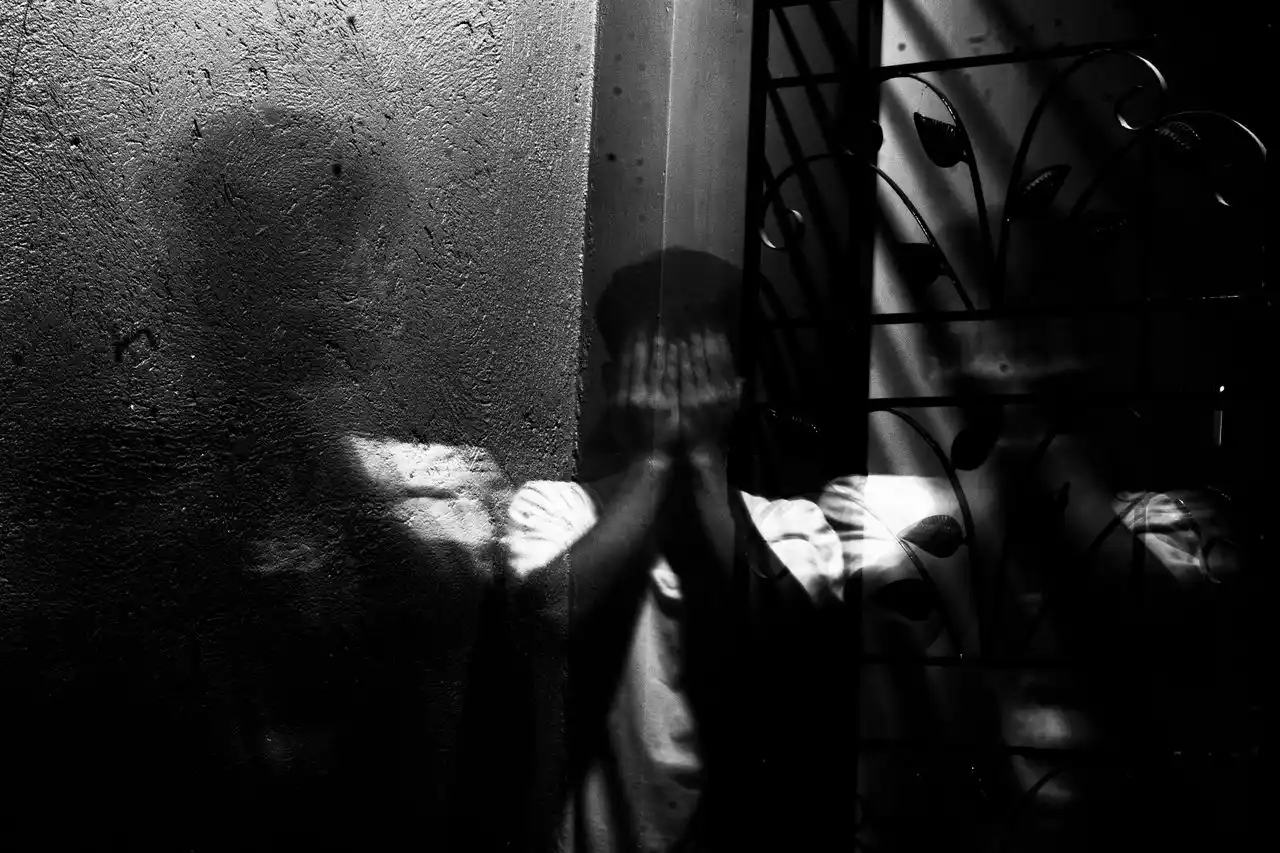
Put two people in a dark cemetery at midnight and you might get completely different reactions. One might happily walk between the graves without thinking much about it. Ghosts aren’t real, they reason, so what exactly is there to worry about? The other might refuse to leave the car.
Now put those same two people in a poorly lit street where a suspicious stranger is following them. Suddenly, their positions might reverse. The person terrified of ghosts could remain relatively calm, while their skeptical friend starts calculating how quickly they can run.
Then there is someone else who isn’t particularly afraid of either situation but absolutely refuses to get on an airplane. Fear is strange like that.
We all have roughly the same basic biological machinery for detecting danger, yet the things that activate it can be dramatically different from person to person. So why can something feel terrifying to one person and completely harmless to another?
The answer is that fear isn’t simply a measurement of how dangerous something actually is. Fear is the brain’s prediction of danger, and every brain has been trained on a slightly different dataset.
Could be related: Are Stupid People Easier to Anger?
Fear Is Supposed to Keep You Alive
Fear has an obvious evolutionary purpose.
If something might kill or injure you, being able to detect it quickly is extremely useful. You don’t want your ancestors conducting a careful statistical analysis while a predator is charging toward them.
Fear prepares the body to respond. Attention narrows toward the potential threat, while the autonomic nervous system changes the body’s state. Heart rate, breathing, muscle readiness, and other physiological processes can shift as the brain prepares for action.
But humans aren’t born with a complete catalog labeled THINGS YOU SHOULD BE AFRAID OF.
Some threats may be easier for us to notice or learn associations with than others. Researchers have long investigated the idea of biological “preparedness”: that evolution may have made humans particularly receptive to learning fears involving historically relevant threats.
Snakes are one famous example. Research has found that humans and other primates can learn associations involving snakes particularly readily, and snakes can capture human visual attention very efficiently.
However, the simple version of this theory — we fear snakes because our ancestors feared snakes — should not be taken too far. Research on fear conditioning has produced mixed results on whether certain evolutionarily relevant threats are uniquely resistant to extinction. Biology appears to influence fear, but it does not provide a complete explanation.
That is where personal experience enters the story.
Your Brain Has Its Own Danger Database
Imagine being bitten badly by a dog when you’re six. Before that experience, “dog” might have meant fluffy animal. Afterward, your brain has some new information: dogs can be dangerous.
This is one of the simplest ways fear can be learned. Through conditioning, something that was previously neutral can become associated with an unpleasant or threatening event. Encountering it again can then trigger a defensive response even when the original danger is no longer present.
But you do not actually have to experience the danger yourself. Humans can also learn fear socially. Research on observational fear learning shows that people can acquire threat responses simply by watching another person react fearfully to something. We can also learn about threats through verbal information and instruction.
From a survival perspective, this makes perfect sense. You do not need to personally eat the poisonous berry if somebody else already ate it and nearly died. Copying their avoidance is considerably cheaper. That mechanism also helps explain something much bigger than individual experience.
Sometimes We Inherit Fears Without Experiencing the Danger
Think about childhood.
Before children have enough experience to independently judge everything around them, adults provide an enormous amount of information about what is safe and what isn’t. They’re told not to touch certain things, to stay away from particular places, to be careful around strangers, or that a certain animal is dangerous.
Sometimes nobody even needs to say anything. Children can simply observe how parents and other adults react. Research into social fear learning suggests that emotional responses from caregivers can contribute to how children learn about potential threats.
And the transmission does not stop with parents. Friends, communities, religion, folklore, television, movies, social media, and news can all provide information about danger. Which brings us back to ghosts.
Why Can Someone Be Terrified of Something They Don’t Know Exists?
Fear does not require philosophical certainty. You can intellectually believe that ghosts probably aren’t real and still feel extremely uncomfortable walking through an abandoned building at midnight. That is not necessarily contradictory.
The systems involved in threat responses do not operate like a courtroom demanding conclusive evidence before taking action. They work under uncertainty.
Suppose you hear footsteps behind you in an empty building. Maybe the building is settling. Maybe it is an animal. Maybe another person is there. Maybe, if your cultural background has supplied the idea, your imagination produces something supernatural.
You do not need to consciously believe the last explanation for your brain to decide that something unexplained is happening and that unexplained things can potentially be dangerous.
This distinction helps explain why rational arguments can sometimes be surprisingly ineffective against fear. Knowing that something is probably harmless and actually feeling safe are not the same thing.
Culture Helps Decide What Lives in the Darkness
This becomes even more interesting when we compare cultures.
Humans everywhere experience fear, but cultures provide different stories, symbols, creatures, warnings, and explanations for ambiguous events. Darkness itself does not contain a specific monster. Culture helps populate it.
A child growing up surrounded by Indonesian ghost stories may learn a completely different supernatural vocabulary from a child growing up with Japanese yōkai traditions or Western horror. That does not mean everyone within the same culture develops identical fears, but culture provides the possibilities from which imagination can draw.
It tells us what could be hiding behind the door.
Because humans can acquire fear through observation and information rather than direct experience, cultural stories do not necessarily need to describe dangers we have personally encountered to influence our emotional responses. In that sense, social fear learning is extraordinarily efficient. Unfortunately, efficiency does not guarantee accuracy.
Could be related too: The Reputation Afterlife: Why Shameless Confidence Can Outlive Competence
Your Brain Is Not an Insurance Company
If fear perfectly tracked statistical danger, our fears should be relatively predictable. The thing most likely to harm you should frighten you the most. But that is clearly not how humans work.
Someone can be terrified of flying while casually driving every day. Another person might obsess over an extremely rare disease while barely thinking about far more ordinary risks.
Research on risk perception has repeatedly shown that people do not evaluate hazards purely according to numerical probability. How threatening something feels can also depend on factors such as dread, controllability, familiarity, uncertainty, and the severity of the possible consequences.
That means two risks with similar probabilities can feel completely different.
Control is particularly interesting. When you’re driving, you’re holding the steering wheel. You can brake, accelerate, change lanes, and react to what is happening around you.
On an airplane, you are sitting in seat 24A eating tiny pretzels while someone you’ve never met controls a machine traveling hundreds of kilometers per hour several kilometers above Earth. Statistically reassuring or not, your brain may still have opinions about this arrangement.
Fear therefore isn’t only asking how likely something is to hurt you. It is also responding to whether the situation feels controllable, predictable, understandable, escapable, and potentially catastrophic. Those are very different calculations from simple probability.
And Then There Is Personality
Even if two people grow up in similar cultures and experience similar events, they will not necessarily develop identical fears.
Individual differences in fear learning are substantial enough that researchers increasingly study them as meaningful phenomena rather than experimental noise. Temperament, trait anxiety, intolerance of uncertainty, stress, previous experience, age, and biological differences can all influence how people acquire, maintain, and lose fear responses.
In other words, the same experience does not necessarily produce the same lesson.
Imagine two children encountering an aggressive dog. Both escape unharmed. One may come away thinking, that dog was scary. The other may learn, dogs are dangerous.
Those conclusions sound similar, but psychologically they are very different. One describes a particular event. The other generalizes danger to an entire category.
How broadly the brain generalizes a threat can influence whether fear remains attached to one specific experience or spreads to similar situations. That is one reason asking what happened to this person? is not always enough to explain what they fear.
We also need to ask how their brain interpreted what happened.
Fear Doesn’t Have to Be Rational to Be Useful
We often describe unusual fears as “irrational.” Sometimes they certainly look that way. A tiny harmless spider poses essentially no threat, yet someone may react as though they’ve discovered a xenomorph in their bathroom.
But calling fear irrational can obscure what the system is actually designed to accomplish. Evolution did not build fear to produce perfectly calibrated statistics. It built a system that helps organisms avoid potentially catastrophic mistakes. The costs of mistakes are not always symmetrical.
Imagine hearing something moving in tall grass. If you assume it is dangerous when it is actually harmless, you waste some energy by running away. If you assume it is harmless when it is actually a predator, the consequences can be considerably worse. A threat-detection system therefore has good reason to tolerate false alarms.
A smoke detector screaming because you slightly burned your toast is annoying. A smoke detector that waits until it is 100 percent certain your house is burning would be considerably worse. Fear faces a similar problem. It often has to make decisions before complete information is available.
So Why Does One Person Fear Ghosts While Another Fears Criminals?
Because neither person is responding solely to the thing in front of them. They are responding to a model of danger assembled throughout their life.
Part of that model comes from biology. Part comes from direct experience. Part comes from watching other people. Part comes from childhood, culture, stories, temperament, and personality. It is also shaped by how the brain evaluates uncertainty, control, familiarity, and potential consequences.
Those ingredients do not combine identically in everyone. For one person, an empty cemetery might contain nothing except stone, grass, and bad lighting. For another, darkness combined with childhood stories, uncertainty, and imagination creates enough potential danger to activate the alarm.
Meanwhile, put both of them on a turbulent airplane and you may discover an entirely new hierarchy of fear. That is perhaps the most interesting thing about fear.
We don’t simply fear the world as it is. We fear the world as our brains have learned it could be.
