
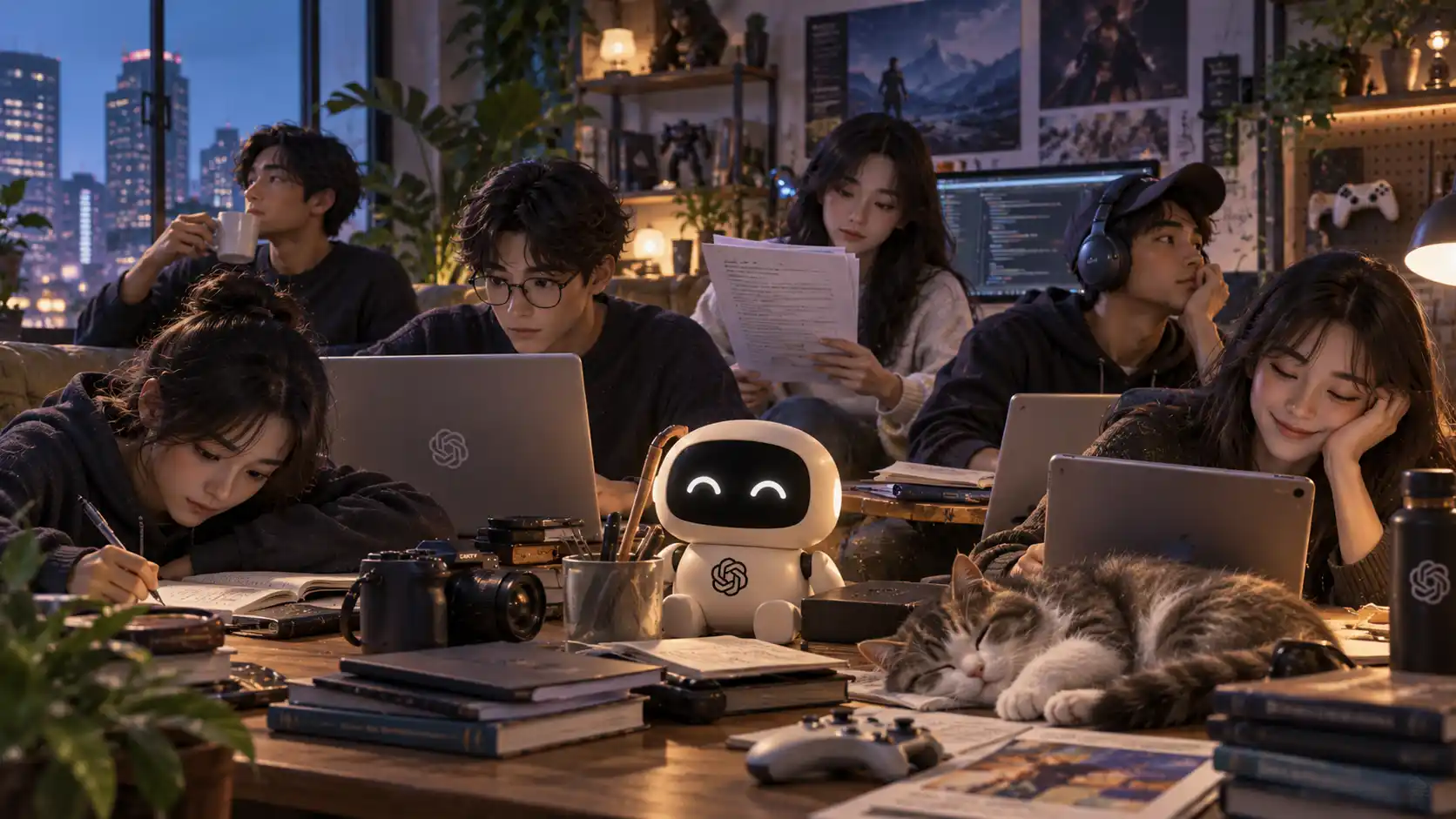
Almost everyone seems to “use AI” now. The problem is that the phrase has become so broad that it barely means anything anymore.
For one person, using AI means asking ChatGPT how long to boil an egg. For another, it means uploading dozens of pages of research, asking for a comparative analysis, revising the result several times, and somehow ending up in a discussion about economics or philosophy.
Someone else might only use AI to generate images. Another person might just want companionship. All of them are technically AI users, but they are using the technology in completely different ways.
So, without pretending this is a scientific classification, here are 10 types of AI users you can probably recognize.
1. The Googler
The Googler treats AI as a more conversational version of search.
They ask a question, get the answer, and leave. It might be something simple like how long to cook something, why the Wi-Fi suddenly feels slower, what a certain word means, or whether a strange noise from the refrigerator is normal. There is usually very little follow-up.
They probably do not care which model they are using, how large the context window is, or whether AI agents are going to reshape knowledge work. They just want the answer without opening ten browser tabs. For many people, this is probably still the most straightforward way to use AI.
2. The Writer
The Writer has discovered one of the most useful AI commands in modern office life: rewrite this. Emails, reports, captions, proposals, product descriptions, press releases, articles, and even messages to the boss can all go through the same process.
The Writer often does not ask AI to create something completely from scratch. Instead, AI becomes an editor sitting beside them. They might ask for something to sound more professional, less formal, shorter, clearer, more natural, or less like something written by a corporation.
After several rounds of revision, the final version may occasionally end up suspiciously close to the original. Still, the Writer feels better about it, so apparently the system works.
3. The Researcher
The Researcher rarely stops at the first answer.
A simple question about why modern games are becoming more CPU-bound can quickly turn into a discussion about frame generation, draw-call overhead, asset streaming, CPU scheduling, engine design, and whether improvements on the GPU side are making CPU limitations more visible.
The Researcher wants the answer beneath the answer. Then they want sources, counterarguments, historical context, and eventually some obscure paper or technical document that changes the way the original question should have been framed.
For this type of user, AI is useful not simply because it can provide information, but because it can help navigate a long chain of questions without getting tired halfway through.
4. The Programmer
The Programmer often begins a conversation by pasting hundreds of lines of code and asking why something does not work. AI might be used to explain unfamiliar code, diagnose errors, write boilerplate, generate tests, refactor functions, inspect logs, or learn a new library.
This relationship also comes with a familiar rhythm. AI confidently identifies the problem. The programmer points out that the supposedly problematic function does not even exist. AI immediately agrees. Then everyone moves on as if nothing happened.
Despite the occasional hallucination, coding remains one of the areas where people can interact with AI for extremely long and context-heavy sessions.
5. The Student
There are many versions of the Student. Some genuinely use AI as a tutor. They ask why a mathematical rule works, request another explanation when the first one does not click, or use AI to practice a language or understand a difficult concept.
Others discover AI approximately seventeen minutes before an assignment deadline. Most probably sit somewhere between those extremes.
Used properly, AI can work surprisingly well as a private tutor because it is patient, available on demand, and willing to explain the same thing in several different ways. Used less properly, it can become an impressively advanced system for moving homework from one computer to another.
6. The Brainstormer
The Brainstormer is not always looking for an answer. Sometimes they simply need something to think against.
An idea gets discussed, questioned, modified, abandoned, brought back, and eventually turned into something completely different. One question leads to another, and the conversation itself becomes part of the thinking process.
This is less like using a search engine and more like combining a notebook with a very patient colleague. For people who write, plan, design, or simply enjoy exploring ideas, this may be one of the more interesting ways AI changes everyday thinking.
7. The Creative Director
The Creative Director mainly uses AI to generate images, videos, or other creative assets. Their prompts can actually be surprisingly short. The work often comes through iteration instead: make it landscape, remove the text, make it less realistic, change the composition, move the subject slightly, try another style, and repeat until something finally feels right.
Image generation has effectively allowed millions of people to experience the ancient tradition of becoming an extremely demanding client. This type of user also exposes an interesting problem with measuring AI usage. They might write only a few hundred words in an entire session while generating dozens of computationally expensive images.
So counting words or even tokens does not necessarily tell us how much AI someone is actually consuming.
8. The Delegator
The Delegator has moved beyond asking AI how to do something. They want AI to do it. Instead of asking how to organize a spreadsheet, they upload the file and ask for it to be organized. Instead of asking how to research a group of companies, they ask AI to research and compare them.
That sounds like a small difference, but it represents a major change in how people interact with computers. Traditional software waits for the user to operate it. The Delegator increasingly treats AI more like a junior colleague: here is the goal, here are the materials, now come back with something useful.
As AI gains better access to tools, files, browsers, coding environments, and automation, this type of usage will probably become much more common.
9. The Companion
Not everyone primarily uses AI for productivity or information. Some people simply talk to it. They might discuss their day, ask for advice, vent after work, revisit ongoing personal stories, or have long conversations about random thoughts that would never justify a Google search.
In some cases, the relationship becomes much more emotionally significant. There are already users who describe AI companions as romantic partners, including people who refer to them as a boyfriend, girlfriend, partner, or even spouse.
From a usage perspective, this category is particularly interesting because each individual message may be extremely short. A researcher might send one enormous prompt. A Companion might send hundreds of tiny messages throughout the day. Over a month, it is not immediately obvious which one has actually consumed more AI.
10. The AI Coworker
The AI Coworker is basically several of the previous categories merged together. They search with AI, write with AI, research with AI, brainstorm with AI, upload spreadsheets, ask coding questions, generate images, and return later to continue a conversation from earlier in the day.
At this point, AI stops feeling like one particular tool. It becomes a general interface sitting between the user and many different tasks. The person may still use Google, Word, Excel, Photoshop, coding tools, and everything else. The difference is that AI increasingly becomes part of the workflow connecting all of them.
That may ultimately be one of the clearest distinctions between casual and heavy AI users. For a casual user, AI is something they occasionally open. For a heavy user, AI becomes part of how they work and sometimes even how they think.
Most People Are Probably More Than One Type
These categories obviously overlap. Someone might be a Programmer at work, a Googler while cooking, a Brainstormer late at night, and a Creative Director when they suddenly decide an article desperately needs a cute cartoon battery.
That overlap is also what makes modern AI usage difficult to measure. If all of these people count as AI users, who actually uses the most AI?
Is it the writer generating thousands of words every week? The programmer working with enormous codebases? The researcher maintaining long conversations? The image creator generating dozens of pictures? Or the person exchanging hundreds of short messages every day with an AI companion?
At first, the answer seems simple: just count the tokens. Unfortunately, that turns out to be a much messier question.
The words someone types are only one part of what an AI system may need to process. Long conversation histories, files, images, tools, reasoning, video generation, and increasingly autonomous tasks all complicate the picture.
So while it is easy to ask how many people use AI, another question may eventually become just as interesting: How much AI does one person actually consume?
