
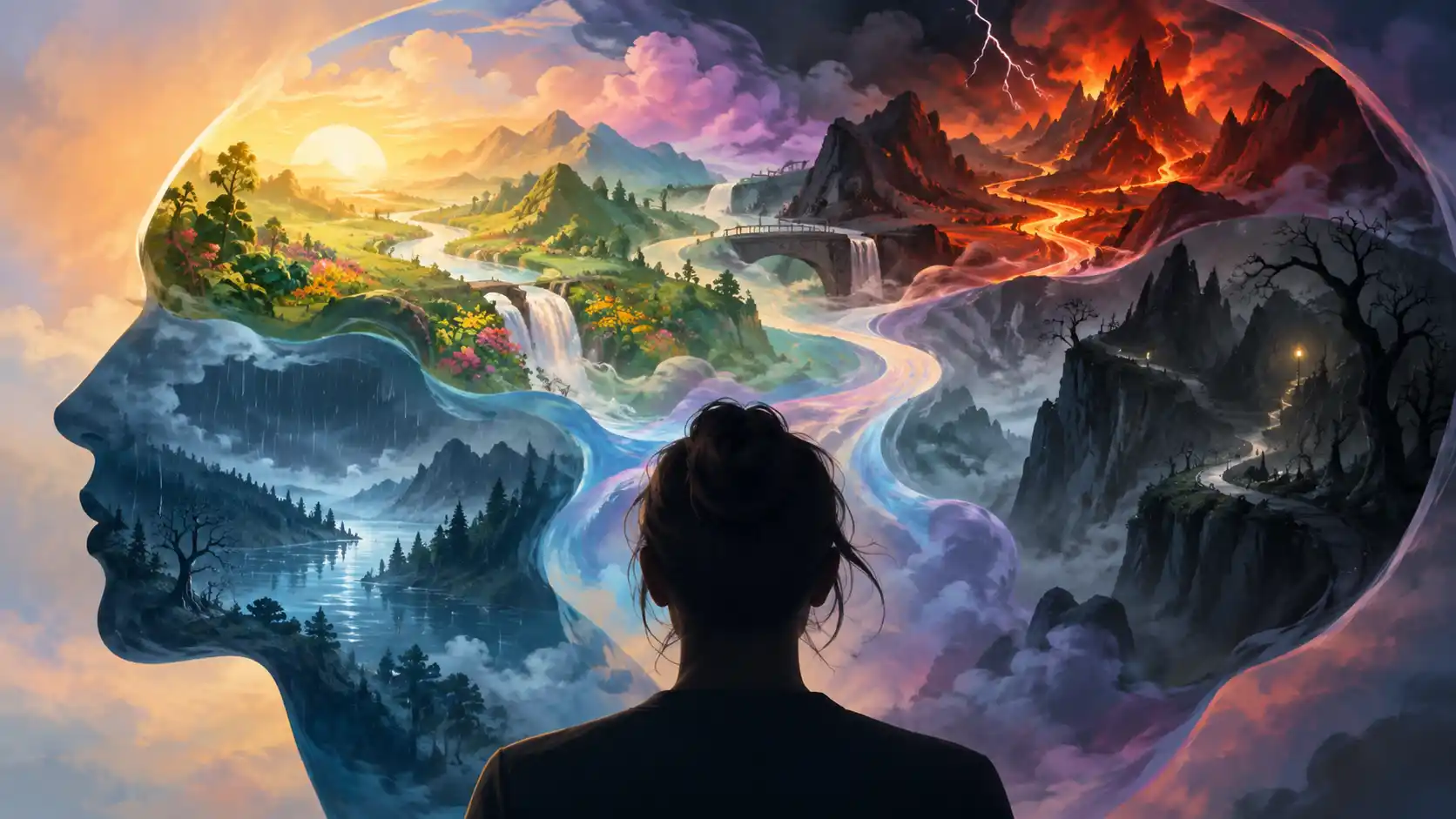
Happiness and sadness seem like obvious opposites. Anger feels very different from sadness. Fear, somehow, can feel much closer to it. That sounds intuitive enough, but once you start thinking about it, the idea gets surprisingly strange.
If emotions really have relationships with one another, then where exactly do they sit? Is happiness always opposite sadness? Is fear closer to anger or sadness? Can one emotion turn into another simply because the way we interpret a situation changes?
Psychologists have been trying to answer versions of those questions for decades. The result is that there probably is something resembling a map of human emotion. It just turns out to be much messier than a tidy wheel.
The Simplest Version of the Emotion Map
One of the most influential ways to organize emotions is the circumplex model of affect, developed by psychologist James Russell.
Instead of treating emotions as completely separate categories, the model places them along two broad dimensions. The first is valence, meaning whether an emotional state feels pleasant or unpleasant. The second is arousal, meaning how activated or energized that state feels. That already produces a useful map.
Excitement is pleasant and highly aroused. Calmness is pleasant but low in arousal. Fear and anger are unpleasant and highly aroused, while sadness tends to sit lower on the arousal side. This immediately reveals something interesting.
Fear and sadness may both feel “negative,” but physiologically and behaviorally, fear can actually resemble anger more closely. Both fear and anger can increase heart rate, narrow attention, and prepare the body to act. Sadness usually does something rather different.
So asking whether two emotions are “close” is already more complicated than it sounds. Close in what way?
Maybe you’re interested with this, too: Why Do We Fear Different Things?
Emotions Are Probably More Than Positive and Negative
The problem with a simple two-dimensional map is that emotions can feel similar in one way and completely different in another.
Researchers Klaus Scherer, Johnny Fontaine, Cristina Roesch, and Phoebe Ellsworth found evidence that emotion needs more than just pleasantness and arousal to be described properly. Their research pointed toward additional dimensions including control or power and predictability. That turns out to matter enormously.
Fear, anger, and sadness are all unpleasant emotions, but they differ strongly in how much control we think we have over a situation.
Imagine that something bad happens. You believe there is danger, you do not know what will happen next, and you feel unable to control the situation. That tends to push experience toward fear.
Now imagine the same situation, except you believe you understand what happened, know who caused it, and feel capable of confronting the problem. That can push the experience toward anger.
If instead you believe something valuable has already been lost and there is nothing you can do to restore it, the emotional state may move toward sadness.
The event itself might barely change. What changes is how the brain evaluates it.
Fear, Anger, and Sadness Are Closer Than They Look
This is where appraisal theory becomes particularly useful. Appraisal theories propose that emotions emerge partly from the meaning we assign to events, rather than from the events alone.
Psychologists Craig Smith and Phoebe Ellsworth identified several recurring appraisal dimensions that help distinguish emotional states, including certainty, responsibility, effort, pleasantness, and perceived control.
This explains why fear and anger can be weirdly close relatives. Both can involve threat. Both can be intense. Both can prepare us to react quickly. But fear tends to involve lower certainty and lower perceived control. Anger tends to involve greater certainty and a stronger feeling that something can be confronted.
Research by Jennifer Lerner and Dacher Keltner showed just how important this difference can be. Fear tends to make people perceive greater risk and become more cautious. Anger, despite also being unpleasant, can make people feel more certain and more willing to take risks.
In some decision-making contexts, angry people can even resemble happy people more than fearful people. Which is a useful reminder that calling emotions simply “positive” or “negative” can hide most of the interesting part.
Fear Can Also Be Close to Sadness
At the same time, the intuition that fear and sadness feel related is not wrong. Both can involve vulnerability and a reduced sense of control. The difference may partly involve time and possibility. Fear often concerns something that might happen. Sadness often concerns something that has already happened.
That is not a perfect rule, of course, but it captures an important pattern. And it also helps explain why emotions can transform so quickly. You might feel fear while a crisis is happening, anger once you understand who caused it, and sadness once you realize the damage cannot be undone.
One event can move through several emotional states as your interpretation changes.
Maybe Emotions Are More Like a Landscape
This becomes even clearer when we look at more recent work. In 2017, Alan Cowen and Dacher Keltner studied emotional responses to more than 2,000 video clips. They found evidence for at least 27 distinguishable varieties of emotional experience. But the most interesting part was not simply the number.
The emotional categories did not behave like isolated islands. They blended into one another along continuous gradients. Anxiety could transition toward fear. Fear could move toward horror. Horror could shade into disgust.
Different emotional states remained recognizable, but their boundaries were fuzzy. That gives us a different way to think about emotion. Instead of imagining a wheel divided into clean slices, it may be more accurate to imagine a landscape.
There are recognizable regions. Fear has a region. Sadness has a region. Anger has a region. But there are also valleys, slopes, borders, and transitional spaces between them. Some emotions may sit very close to one another along one dimension while being far apart along another.
Human emotion starts looking less like a filing cabinet and more like geography. Which is unfortunately much harder to put into a neat infographic.
So Are Happiness and Sadness Really Opposites?
This is where the obvious answer becomes less obvious. Many popular emotion models treat happiness and sadness as opposites.
Robert Plutchik’s famous wheel of emotions, for example, places joy opposite sadness, anger opposite fear, trust opposite disgust, and surprise opposite anticipation. It is elegant. Possibly suspiciously elegant. Because people can apparently experience supposedly opposite emotions at the same time.
Research on mixed emotions has shown that happiness and sadness can coexist, particularly during bittersweet moments. Graduation is an easy example. You can be genuinely happy about finishing university while simultaneously feeling sad that a major chapter of your life is ending.
The happiness does not cancel the sadness. The sadness does not prove the happiness was fake. Both can be true. The same thing happens elsewhere.
You can love someone and still be furious with them. You can feel fear and excitement before doing something risky. You can feel relief and grief after a difficult situation finally ends. If emotional opposites can coexist, then the idea of emotions behaving like switches becomes difficult to defend.
Definitely related: Are Stupid People Easier to Anger?
There Probably Is an Emotion Map, Just Not a Simple One
So does human emotion have a map? Probably, but it is unlikely to look like a perfect wheel with a handful of neatly separated categories. Research instead suggests that emotional experience is multidimensional, shaped by factors such as pleasantness, arousal, control, certainty, and predictability.
That helps explain why the relationships between emotions can seem inconsistent at first. Fear can resemble anger because both are highly arousing responses to threat, yet fear can also resemble sadness because both often involve vulnerability and reduced control. Happiness and sadness may behave like opposites in some contexts while still being experienced at the same time in others.
It also explains why two people can go through the same event and come away feeling completely different emotions. The event matters, but so does the meaning each person assigns to it: whether the situation feels controllable, whether the outcome is certain, whether someone is responsible, and whether anything can still be changed.
So the idea of an emotional map still works, as long as we stop expecting it to resemble a clean diagram. It may be better understood as a landscape with recognizable regions, overlapping borders, and gradual transitions between one state and another. That messiness is not a flaw in the map. It may simply be a more accurate reflection of how human emotion actually works.
