
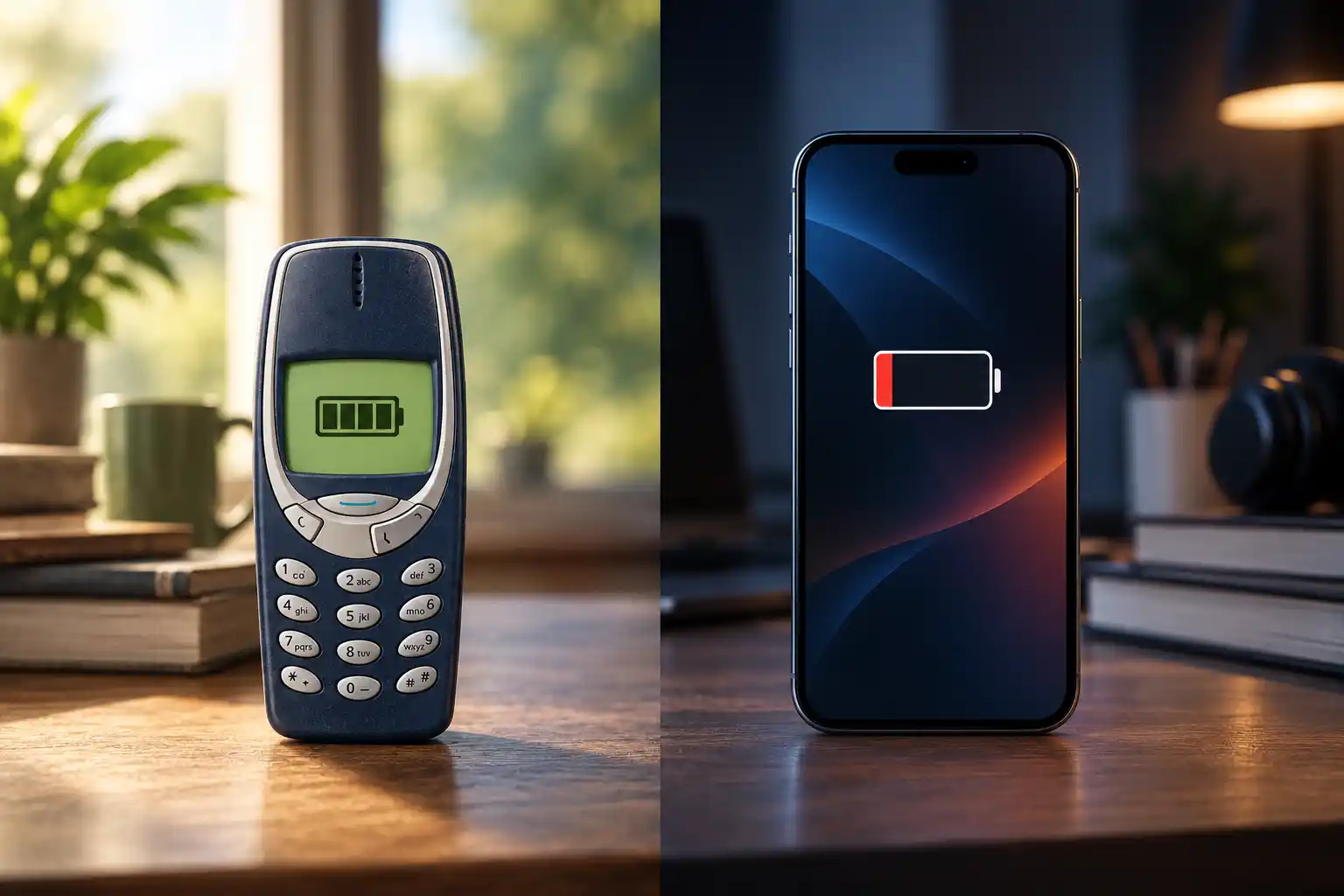
There was a time when charging your phone every night would have seemed ridiculous. An old Nokia could disappear into a bag for several days, make some calls, receive dozens of text messages, survive a few rounds of Snake, and still have enough battery to last two weekends.
Today, a smartphone with a 5,000mAh battery can make us nervous before dinner. That’s strange because almost everything inside our phones has improved. Processors are more efficient, batteries are larger, cellular networks are more advanced, and operating systems have become much better at managing power.
The easy explanation is that old phones were dumb. They had tiny screens, slow processors, limited connectivity, and very little to do. Modern smartphones are pocket computers, so naturally they consume more energy.
That’s true, but it isn’t the whole story. Between the classic dumb phone and today’s smartphone were Symbian phones and Windows Mobile PDAs. Some already had apps, multitasking, Wi-Fi, GPS, 3G, web browsers, and email, yet their battery life could differ dramatically.
The real story isn’t simply dumb phones versus smartphones. It’s about how quickly a phone spends energy and how dramatically our definition of “using a phone” has changed.
Definitely related: Si-C Batteries Explained: Why Smartphone Batteries Are Suddenly Getting Huge
Old Phones Didn’t Actually Have Huge Batteries
It is tempting to assume those legendary old phones contained enormous batteries. In reality, many were tiny by modern standards.
The Nokia 3310, for example, came with batteries around 900mAh depending on the battery type. The much more advanced Nokia E71 used a 1,500mAh battery. A modern smartphone commonly carries something around 5,000mAh.
Milliamp-hours aren’t perfect for comparing batteries with different operating voltages, so watt-hours are technically better. Even with that caveat, modern smartphones generally carry substantially more battery energy.
The E71 makes this particularly interesting. It ran Symbian S60 and supported third-party apps, multitasking, 3G, Wi-Fi, Bluetooth, GPS, push email, web browsing, and office applications. Contemporary reviews commonly reported roughly two to four days of real-world use despite its 1,500mAh battery.
Clearly, the secret wasn’t simply having a gigantic battery.
Battery Life Is About How Quickly You Spend It
A battery stores energy, while everything inside the phone consumes it. Battery life therefore depends not only on battery size, but also on average power consumption.
Imagine a modern smartphone battery containing roughly 19Wh of energy. If the entire device averaged only 0.1W, simple arithmetic gives us around 190 hours of theoretical runtime. Increase average consumption to 1W and that falls to 19 hours. At 2W, it becomes 9.5 hours, while a sustained 4W workload would empty the same energy reserve in less than five hours.
Real phones constantly move between different power states, so those aren’t predictions of actual battery life. They simply demonstrate how dramatically runtime changes with power consumption.
This was the fundamental advantage of old phones. Their batteries were small, but they spent enormous amounts of time doing almost nothing.
A feature phone could spend most of its day sitting in a pocket with the screen off while maintaining a cellular connection. Someone called or sent an SMS, the phone woke up, and afterward it returned to waiting. There was no cloud photo backup, music streaming, GPS navigation, social-media feed, or background ecosystem constantly exchanging data.
Modern smartphones are actually extremely good at sleeping too. Android even uses systems such as Doze to defer network activity and background jobs while the device isn’t being used.
The problem isn’t that modern phones forgot how to sleep. There are simply far more things trying to wake them up.
Symbian Shows That Being “Smart” Wasn’t Necessarily the Problem
The Nokia E71 proves that becoming a smartphone did not automatically destroy battery life. It could install software, multitask, browse the web, connect to Wi-Fi, use GPS, receive email, and access 3G, yet contemporary reviews still commonly achieved multiple days between charges.
What was different was also the software ecosystem. You could install plenty of applications on an S60 phone, but most behaved more like traditional programs. You opened them when needed, used them, and left them. The ecosystem wasn’t built around dozens of applications continuously competing to bring you back.
Modern apps synchronize conversations, fetch feeds, upload photos, check locations, refresh content, and send notifications. Operating systems have consequently developed sophisticated restrictions on background activity to stop applications from unnecessarily consuming power.
The calculator has somehow evolved from something that patiently waits for you to calculate a restaurant bill into something that occasionally believes it has breaking news.
A notification itself doesn’t suddenly destroy your battery. Modern push systems are designed to be efficient. The larger effect is that notifications can briefly wake the device and, more importantly, wake the least energy-efficient component in the ecosystem: you.
You unlock the phone, the display turns on, the processor becomes active, the modem transfers data, and the app loads content. What began as a tiny notification can become twenty minutes of screen-on time. Modern battery consumption is therefore partly technological and partly behavioral. We use phones more frequently, while modern software has become much better at encouraging us to do exactly that.
Might be related: PC vs Smartphone: The Business of Obsolescence
The Screen Became the Phone
The Nokia E71 had a 2.36-inch 320 × 240 display. Modern smartphones commonly have 6- to 7-inch displays with millions of pixels, high refresh rates, HDR, and enormous brightness.
Unsurprisingly, displays can be major power consumers. A 2024 UC San Diego study using Google’s on-device power measurement system on a Pixel 7a found that the display and wireless connectivity were among the major consumers across workloads including YouTube, Instagram, Google Meet, and gaming.
OLED consumption also changes with brightness and displayed content, but perhaps the biggest historical difference is simpler: modern displays stay on far longer.
Very few people spent five or six hours every day staring at a Nokia 3310. Even the most committed Snake player eventually had other responsibilities.
Faster Networks Made Us Transfer More
It is also tempting to blame the progression from GSM and GPRS through EDGE, 3G, 4G, and 5G. Surely primitive networks consumed less power? Not necessarily.
Newer cellular technologies can be more energy-efficient when transferring the same amount of data. A faster connection can finish a transfer sooner and allow the radio to return to a lower-power state.
What changed dramatically is how much data we transfer. When mobile internet meant GPRS or EDGE, loading a webpage or downloading an email already felt ambitious. Faster networks didn’t simply let us download those same tiny webpages more efficiently. They enabled music streaming, HD video, cloud backups, video calling, automatic video playback, and endless social-media feeds.
Modern networks became dramatically better at moving each bit, so we responded by moving vastly more bits.
Connectivity can still consume significant power. The UC San Diego measurements, for example, found 5G standby modem consumption around twice that of 4G in its particular test environment, although that certainly doesn’t mean switching to 4G will double total battery life. Modem hardware, network configuration, workload, and signal strength all matter.
Poor reception can also increase radio activity, which helps explain why battery life sometimes deteriorates in weak-signal areas and why airplane mode can produce surprisingly good standby endurance.
Everything Became More Efficient, and We Spent the Savings
The same pattern appears everywhere else. Processors became enormously more efficient. Memory became faster and more efficient. Storage became dramatically faster. Batteries became larger, and power management became more sophisticated.
Yet almost every efficiency gain gave us room to demand more. The Nokia E71 had 128MB of RAM. Modern phones commonly have 8GB, 12GB, or more, because they’re running enormously more complicated operating systems, applications, services, browser tabs, media, and increasingly AI workloads.
Storage went from megabytes to hundreds of gigabytes because phones now handle enormous apps, caches, high-resolution photographs, downloads, databases, and 4K video.
Even taking a photo has changed. A modern smartphone can capture multiple frames, combine exposures, perform HDR and noise reduction, run computational photography algorithms, save the result to high-speed storage, index it, and eventually upload it to the cloud. All because you photographed your lunch.
This technological escalation explains why old PDA phones are such an interesting middle ground. The O2 XDA Atom, for example, had a touchscreen, Wi-Fi, Bluetooth, web browsing, email, Microsoft Office applications, and a roughly 1,530mAh battery, almost identical in capacity to the Nokia E71’s 1,500mAh battery.
Yet contemporary reports showed highly variable endurance. Moderate use could stretch into multiple days, while intensive network activity could reduce runtime dramatically. Even twenty years ago, battery life was already less about whether something qualified as a smartphone and more about how much work it was being asked to perform.
Modernization Changed What “Using a Phone” Means
This may ultimately be the biggest difference between the Nokia era and today. Technology didn’t simply become more power-hungry. In many cases, it became considerably more efficient. What changed faster was our definition of normal usage.
Faster networks made continuous video streaming practical. Better processors enabled sophisticated games and computational photography. More memory allowed enormously more complicated software. Faster storage made recording gigabytes of high-resolution video routine.
The software business changed too. Apps increasingly became connected services rather than programs waiting to be opened. They synchronize, update, upload, download, refresh, recommend, and notify.
There is a strange rebound effect here: every time engineers make something more efficient, we tend to spend the savings on doing more.
A modern smartphone could probably achieve astonishing battery life if we gave it a tiny screen, disabled most background services, rarely transferred data, removed demanding applications, and used it primarily for calls and messages. At that point, however, we would have spent decades of semiconductor development reinventing the Nokia.
Old Phones Didn’t Have Better Batteries. They Had Less to Do
Looking back at a phone that could survive for a week can make modern battery technology seem disappointing. After decades of progress, we somehow ended up charging our phones almost every night.
But battery technology didn’t go backwards. Old feature phones carried small batteries but spent most of their lives waiting. Symbian phones became much smarter while still existing in an ecosystem where long periods of inactivity were normal. PDA phones moved closer to pocket computers, and battery life became increasingly dependent on workload. Modern smartphones completed that transformation.
Today, the device in your pocket can maintain multiple wireless connections, navigate using satellites, stream high-resolution video, run sophisticated games, process photographs, communicate with cloud services, manage dozens of applications, and drive a large high-refresh-rate display.
The old Nokia lasted forever partly because it was extraordinarily good at doing nothing. The modern smartphone is extraordinarily good at doing almost everything. Considering the difference, surviving until bedtime might actually be more impressive than it looks.
