
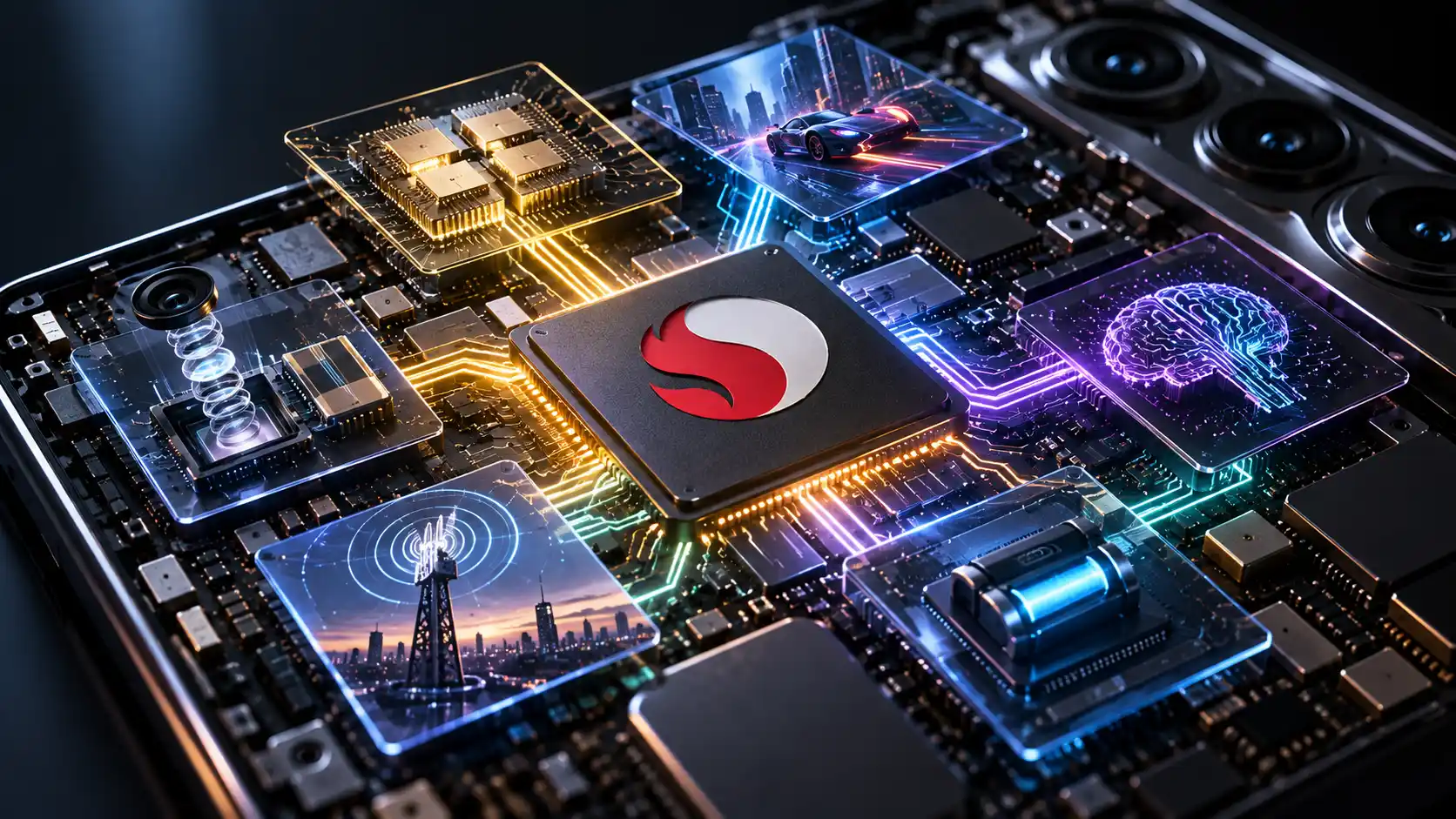
For many Android users, Snapdragon has almost become synonymous with smartphone processors. Buy an expensive Android phone and there is a decent chance you’ll find some variation of Snapdragon 8 inside. Move further down the price ladder and you’ll encounter Snapdragon 7, Snapdragon 6, and Snapdragon 4.
But Snapdragon isn’t actually a CPU.
As we discussed in our previous explanation of System on a Chip (SoC), the CPU is only one component inside a modern smartphone chip. Snapdragon combines multiple processing engines, connectivity technologies, imaging hardware, security features, and other components into one platform.
So what actually makes a Snapdragon a Snapdragon? To answer that, we have to go back to a time when smartphones barely existed.
Qualcomm Was a Wireless Company Before Snapdragon
Qualcomm’s history is deeply connected to wireless communications. Long before smartphone buyers were comparing Snapdragon benchmark scores, Qualcomm was developing cellular technologies such as CDMA. Modems and wireless communications were central to the company’s business.
That background became increasingly important as mobile phones evolved. Early phones didn’t need anything resembling today’s enormous computing capabilities, but they gradually gained web browsers, cameras, multimedia applications, increasingly sophisticated operating systems, and eventually the ability to run third-party apps.
Phones were becoming computers, and Qualcomm consequently began combining its communications expertise with increasingly capable application processors.
In 2005, the company introduced a CPU architecture called Scorpion. Instead of simply licensing a complete CPU design from Arm, Qualcomm held an Arm architecture license that allowed it to develop its own CPU microarchitecture while remaining compatible with the Arm instruction set.
That distinction becomes important later, because two years after Scorpion was announced, Qualcomm introduced something much bigger.
The First Snapdragon Arrived in 2007
Qualcomm announced its first Snapdragon chipsets, the QSD8250 and QSD8650, in November 2007. Even the original Snapdragon already demonstrated the basic philosophy that continues today.
The chips combined a 1 GHz processor with Qualcomm’s DSP technology, mobile broadband connectivity, multimedia capabilities, GPS, HD video decoding, and support for technologies such as Wi-Fi and Bluetooth.
That 1 GHz CPU was particularly noteworthy. Qualcomm promoted the original Snapdragon as the first mobile chipset solution capable of breaking the gigahertz barrier. That doesn’t sound particularly impressive when modern phones have CPU cores running several times faster, but this was 2007. The first iPhone had only launched a few months earlier, and smartphones as we know them were barely getting started.
Snapdragon therefore wasn’t originally designed as “the fast Android chip.” It was Qualcomm’s attempt to combine serious computing capabilities with the connectivity technologies it already understood extremely well.
Android simply turned out to be a very convenient place for Snapdragon to grow.
How Snapdragon Became Everywhere on Android
The first commercial Android phone, the HTC Dream — also known as the T-Mobile G1 — launched in 2008 using Qualcomm technology. Over the following years, both Android and Snapdragon evolved rapidly.
Qualcomm began sampling dual-core Snapdragon processors in 2010. Snapdragon S4 arrived in 2012 with integrated LTE capabilities, combining increasingly powerful application processing with something Qualcomm already had enormous experience building: cellular modems.
Then Qualcomm reorganized Snapdragon’s branding. In 2013, the company introduced four major tiers: Snapdragon 200, Snapdragon 400, Snapdragon 600, and Snapdragon 800. Higher numbers broadly represented increasingly premium platforms.
That basic hierarchy survives today, although the names have changed. Snapdragon 8 sits at the premium end, Snapdragon 7 targets high-tier devices, Snapdragon 6 occupies the mid-range, and Snapdragon 4 serves more affordable mainstream smartphones.
There have been many generations, suffixes, Pluses, Gens, Elites, and other branding adventures along the way, but the basic philosophy remains recognizable. Snapdragon isn’t one chip. It’s an entire family of SoCs spanning different segments of the smartphone market.
Might be related: Phone Battery Explained: Why Old Phones Seemed to Last Forever
What’s Actually Inside a Snapdragon?
Modern Snapdragon platforms contain many of the components we discussed in our SoC explainer, but Qualcomm has its own technologies and names for several of them.
The CPU in its newest premium platforms is Oryon, while Adreno handles graphics. Hexagon is Qualcomm’s architecture for AI and other specialized computing workloads, while Spectra handles much of the image-processing pipeline. Qualcomm’s Snapdragon X-series modem technology provides cellular connectivity. These aren’t simply different names Qualcomm puts on a specification sheet. They represent processing engines optimized for different jobs.
Oryon handles general-purpose computing, while Adreno specializes in graphics and highly parallel workloads. Hexagon can accelerate AI and other specialized calculations, while Spectra processes information coming from smartphone cameras. The modem, meanwhile, connects the phone to cellular networks, which remains one of Qualcomm’s historical strengths.
Increasingly, these components don’t operate as completely isolated processors either. An AI workload might involve the CPU, GPU, and NPU depending on what kind of calculation needs to be performed. Camera processing can similarly involve the ISP alongside AI acceleration and general-purpose computing.
This heterogeneous approach is increasingly central to modern SoC design. Instead of building one processor that somehow excels at everything, Qualcomm builds multiple specialized processors and tries to make them work together efficiently.
Qualcomm Designs Snapdragon, But Doesn’t Actually Make It
Here’s where semiconductor terminology gets confusing. Qualcomm makes Snapdragon, but Qualcomm doesn’t really make Snapdragon.
Helpful, isn’t it?
Qualcomm is primarily a fabless semiconductor company. It designs its chips but relies on external semiconductor foundries to physically manufacture them. Companies such as TSMC and Samsung Foundry operate the enormously expensive fabrication facilities required to turn those designs into actual silicon.
This means Qualcomm can design the CPU architecture, GPU, NPU, modem, memory systems, and overall SoC without owning the factories that manufacture the final product. Apple operates under a broadly similar fabless model with its own silicon.
Samsung is a more complicated case because different parts of Samsung are involved in semiconductor design, chip manufacturing, memory, displays, and smartphone production. We’ll get into that particular corporate octopus when we reach Exynos.
The distinction also helps explain why the manufacturing process matters. Different Snapdragon generations can use different foundries or manufacturing nodes, potentially affecting power efficiency, thermal characteristics, and achievable performance.
Designing a brilliant processor is one challenge. Manufacturing billions of microscopic transistors reliably and efficiently is another.
Snapdragon’s CPU Took a Very Strange Journey
One of the most interesting parts of Snapdragon’s history is that Qualcomm has essentially returned to where it started.
Remember Scorpion? Qualcomm originally designed custom Arm-compatible CPU cores. Scorpion was eventually followed by Krait, another Qualcomm-designed CPU architecture used across several generations of Snapdragon processors.
Qualcomm later moved away from custom CPU cores. Snapdragon increasingly adopted CPU designs developed directly by Arm, including various Cortex cores. Qualcomm continued designing the overall SoC and many of its other components, but the fundamental CPU microarchitecture was no longer entirely its own.
That approach worked for years. Then Qualcomm bought a company called NUVIA.
The $1.4 Billion Acquisition That Brought Oryon
Qualcomm announced its acquisition of NUVIA in 2021 for approximately $1.4 billion. NUVIA was founded by experienced processor designers and had been developing high-performance Arm-compatible CPUs.
Qualcomm saw an opportunity to bring custom CPU development back in-house.
The acquisition eventually produced Oryon, Qualcomm’s new custom CPU architecture. Oryon initially appeared in Snapdragon X processors aimed at Windows PCs, but in 2024 Qualcomm brought the architecture to smartphones with the Snapdragon 8 Elite.
That represented a significant change. Qualcomm was once again designing its own Arm-compatible smartphone CPU cores after years of relying primarily on Arm’s Cortex designs.
The journey from Scorpion to Krait, then Cortex and finally Oryon looks almost circular. Qualcomm had essentially returned to its original strategy, except this time it was doing so with much larger ambitions.
Why Oryon Matters
A custom CPU gives Qualcomm more control over one of the most important components inside Snapdragon. Instead of taking an existing Arm CPU core and integrating it into the SoC, Qualcomm can design its CPU architecture around its own performance, efficiency, and product goals.
This doesn’t mean Arm suddenly disappears. Oryon still operates within the Arm ecosystem and uses the Arm instruction set. The important distinction is that Qualcomm designs the underlying CPU microarchitecture itself.
That becomes particularly interesting when you consider how many other major pieces Qualcomm already controls. It develops Adreno graphics, Hexagon AI acceleration, Spectra imaging technology, and its own modem systems alongside Oryon.
Qualcomm doesn’t have Apple’s level of vertical integration because it doesn’t control Android or manufacture most of the devices using Snapdragon. But at the silicon level, modern Snapdragon is becoming increasingly Qualcomm’s own creation.
What Do Snapdragon 8, 7, 6, and 4 Mean?
Fortunately, the first part of Snapdragon’s modern naming system is relatively straightforward. Snapdragon 8 represents the premium family, Snapdragon 7 targets high-tier smartphones, Snapdragon 6 generally occupies the mid-range, and Snapdragon 4 serves more affordable mainstream devices.
After that, things become slightly more adventurous.
Qualcomm has gone through names such as Snapdragon 888, Snapdragon 8 Gen 1, 8+ Gen 1, 8 Gen 2, 8 Gen 3, 8 Elite, 8 Elite Gen 5, and now another evolution of the Elite branding. There are also variants such as the Snapdragon 8s family whose position isn’t necessarily obvious to someone looking only at the name.
The safest way to read Snapdragon branding is therefore to treat the first number as the broad product class and everything after it as the generation or particular variant.
After that, read the actual specifications.
Trying to understand an entire smartphone SoC from Qualcomm’s product name alone is an excellent way to turn buying a phone into an administrative task.
Snapdragon in 2026: The 5 GHz Era
This brings us to September 2026.
At Snapdragon Summit 2026, Qualcomm introduced a new two-tier flagship strategy built around the Snapdragon 8 Elite Gen 6 and the higher-end Snapdragon 8 Elite Extreme Gen 6. Both move Qualcomm’s premium smartphone platforms into the 2nm manufacturing era.
More symbolically, Qualcomm’s newest Oryon CPU has reached 5 GHz.
That gives Snapdragon a rather satisfying historical milestone. The original Snapdragon made headlines in 2007 for breaking 1 GHz. Almost two decades later, the family has reached 5 GHz.
That obviously doesn’t mean the modern chip is simply five times faster. Clock speed alone tells us very little when architectures, core counts, cache systems, manufacturing processes, memory, and practically everything else have changed.
Still, it demonstrates how far mobile computing has travelled. Something designed to fit inside your pocket now operates at clock speeds that would once have sounded absurd even for desktop processors.
Yet CPU frequency may not actually be the most interesting part of Qualcomm’s latest generation.
The GPU Is Starting to Think Like an AI Processor
One of Qualcomm’s more interesting developments in 2026 is happening inside Adreno.
The Snapdragon 8 Elite Extreme Gen 6 introduces matrix-processing capabilities and a technology Qualcomm calls Adreno Neural Fusion. The basic idea is to bring AI processing more directly into graphics workloads.
Instead of relying entirely on conventional rendering techniques, neural processing can assist with things such as image reconstruction, super resolution, frame generation, and other techniques broadly grouped under neural rendering.
If that sounds familiar to PC gamers, it should.
The PC graphics industry has already moved heavily toward technologies such as DLSS, where machine learning assists traditional rendering instead of relying purely on brute-force GPU performance. Smartphone graphics are beginning to move in a similar direction.
That makes particular sense on mobile devices because their power and thermal limits are far tighter than those of desktop gaming PCs. You can make a desktop GPU larger, give it a giant heatsink, and feed it hundreds of watts.
Trying the same strategy inside a smartphone mostly produces a very expensive hand warmer.
Smarter rendering is therefore particularly attractive on mobile.
AI Is Becoming Part of the Entire Snapdragon
Qualcomm’s other major theme in 2026 is what it calls agentic AI. Like most terminology surrounding AI right now, that deserves a little skepticism before we accept the marketing presentation wholesale.
The underlying hardware direction, however, is genuinely interesting.
Instead of treating AI as something performed exclusively by the NPU, Qualcomm increasingly distributes workloads across Oryon, Adreno, Hexagon, sensing hardware, the ISP, and other components depending on what needs to be processed.
The company’s vision for agentic AI involves systems that can understand context and potentially carry out more complicated tasks locally on the device. Whether every promised AI assistant eventually becomes useful is another question, and probably an article of its own.
For understanding Snapdragon, the important part is architectural.
Snapdragon is becoming even less centered around one dominant processor. Qualcomm increasingly treats it as a collection of specialized computing engines designed to cooperate.
Which is precisely why calling Snapdragon merely a CPU misses most of what Qualcomm is actually selling.
Snapdragon’s Next Battle Isn’t Just About CPU Speed
Qualcomm remains one of the biggest names in premium Android smartphones, but its position isn’t uncontested.
MediaTek’s Dimensity chips have moved aggressively into flagship territory. Samsung continues developing Exynos and has returned to using its own silicon in parts of the Galaxy S26 lineup. Google is developing Tensor around its own priorities, while Apple remains the most vertically integrated competitor, designing silicon specifically for devices and operating systems it controls.
That means Qualcomm can’t simply build a faster CPU and declare victory.
Modern smartphone competition involves CPU and GPU performance, efficiency, AI acceleration, camera processing, modem performance, wireless connectivity, software optimization, thermal behavior, and ultimately how well all of those components work together.
That is perhaps the best way to understand what Snapdragon has become.
The original Snapdragon was Qualcomm’s attempt to combine serious mobile computing with the wireless technology the company already knew extremely well. Nearly twenty years later, Qualcomm designs its own CPU architecture again alongside its GPU, AI accelerators, image-processing technology, and modem systems.
It then attempts to make all of them operate as one tightly integrated platform.
Snapdragon isn’t just the processor inside an Android phone. It’s Qualcomm’s idea of what the entire brain of a mobile device should look like.
And that idea now has some very serious competition.
