
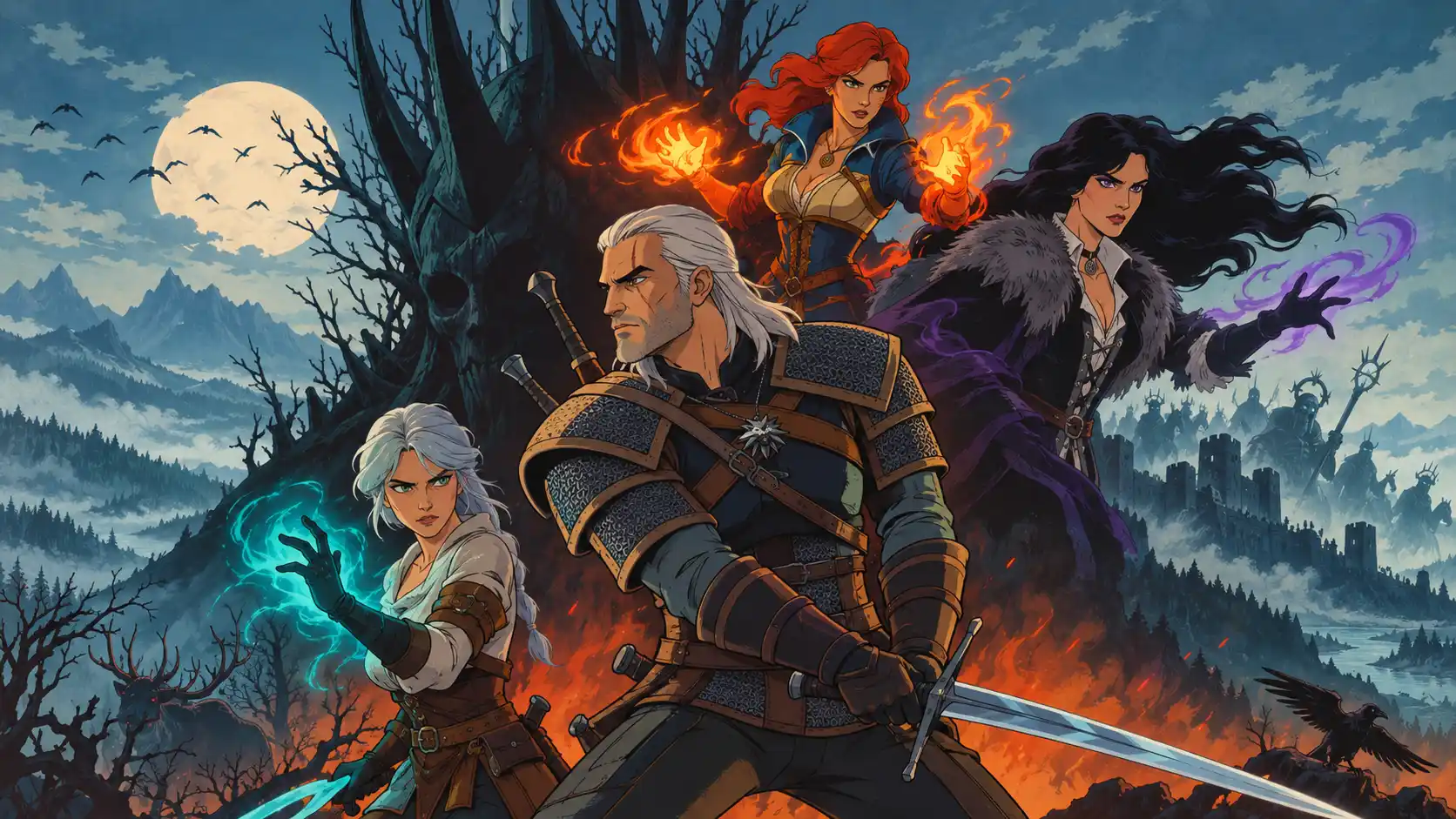
The Witcher looks fairly straightforward from a distance. A white-haired man carries two swords, drinks suspicious liquids, and kills whatever has been eating the villagers. Occasionally, he plays cards while an urgent international crisis waits politely in the quest log.
Then someone mentions Elder Blood, a dead emperor who apparently is not dead, or elves who travel between worlds. Suddenly, the monster-hunting adventure requires a family tree and a foreign-policy briefing.
With The Witcher 3: Wild Hunt — Remastered released on September 29, 2026, this is a good time to revisit the story beneath the swords and sorcery. Understanding The Witcher lore starts with a few connected ideas: a world disrupted by collisions between realities, people fighting over who belongs in it, and a girl whose existence makes her valuable to almost everyone except the people who simply love her. Remastered is available now
This explainer follows the books’ background into CD Projekt Red’s game continuity. The games continue beyond Andrzej Sapkowski’s original saga; they are not direct retellings, and the Netflix adaptation follows its own version. Major spoilers follow for the trilogy, Hearts of Stone, and Blood and Wine.
A World Where the Monsters Came From Somewhere Else
Long before Geralt’s adventures, a catastrophe called the Conjunction of the Spheres brought different realities into contact. Creatures became stranded outside their original worlds, helping create the dangerous mixture of supernatural beings found across the Continent.
That matters because many monsters are not simply ordinary animals with additional teeth. They belong to a world whose boundaries have already broken. Later, when Ciri travels between realities and the Wild Hunt arrives from another world, the story expands an idea built into the setting from the beginning.
The Continent also has a long history of settlement, conquest, and displacement. Humans dominate many kingdoms, while elves and dwarves face discrimination and violence. Some nonhumans attempt to survive within human society; others join the Scoia’tael, armed groups resisting human domination.
Their grievances are real, but their methods can be brutal. Human rulers exploit fear, while resistance fighters can endanger the people they claim to defend. Geralt’s contracts repeatedly pull him into these conflicts because monsters, politics, and ordinary suffering rarely stay in separate boxes.
Maybe you’re interested with this: The Elder Scrolls Timeline Explained: A Brief History of Tamriel
What a Witcher Actually Is
Witchers are trained monster hunters whose bodies have been altered through dangerous alchemical procedures. The best-known is the Trial of the Grasses, which many candidates do not survive. Those who do gain enhanced senses, reflexes, and tolerance for substances that would poison ordinary humans.
Geralt belongs to the School of the Wolf and was trained at Kaer Morhen. His abilities make him useful, but they also make him an outsider. Villagers may hire a witcher to save their children, then call him a freak once the immediate danger has passed. Customer loyalty is apparently harder to cultivate than a resistance to toxins.
A common belief within the setting is that witchers have no emotions. Geralt repeatedly demonstrates otherwise. He cares, grieves, falls in love, and makes decisions that complicate his supposedly professional detachment.
He also prefers to avoid political commitments, although that preference rarely survives contact with actual people. Remaining neutral becomes difficult when someone is being persecuted in front of him. His central struggle is how to act responsibly when every available choice carries consequences.
Geralt, Yennefer, and the Child of Surprise
The emotional center of The Witcher is the family Geralt forms with Yennefer and Ciri.
Yennefer is a powerful sorceress whose relationship with Geralt begins long before the games. Their history is turbulent, shaped by affection, pride, magic, and repeated separation. Their bond with Ciri gives them a shared commitment that reaches beyond their own complicated romance.
Ciri enters Geralt’s life through the Law of Surprise. This custom allows someone who saves another person to claim an unexpected reward: something the rescued person possesses but does not yet know about.
After helping Duny, the future husband of Princess Pavetta, Geralt invokes that law. Pavetta is pregnant, making their unborn daughter, Ciri, the unexpected reward. Geralt does not immediately become her guardian, but their lives cross again, and he eventually raises and trains her.
Destiny creates the connection; their choices turn it into a family. Geralt loves Ciri as his daughter, while Yennefer becomes her mother figure and magical teacher. Ciri learns witcher skills at Kaer Morhen, but during the original saga and The Witcher 3 she has not undergone the mutations that created Geralt.
Why Everyone Wants Ciri
Ciri is dangerous to powerful people because she combines royal ancestry with extraordinary magical potential.
She carries Elder Blood, an inherited lineage connected to the elven sorceress Lara Dorren. Its exceptional expression in Ciri allows her to move across space and between worlds. She is consequently far more valuable than a princess whose marriage might secure an alliance.
Her biological father is Duny, later revealed to be Emhyr var Emreis, emperor of Nilfgaard. Geralt is her adoptive father. That distinction helps explain the competing interests around her: Emhyr’s relationship with Ciri is entangled with imperial succession, while Geralt’s priority is her safety.
Other factions see her as the fulfillment of prophecy, a source of power, or a means of controlling the future. The recurring cruelty is that everyone can explain what Ciri should become, while relatively few ask what she wants.
For Geralt and Yennefer, protecting her therefore means more than preventing her death. It also means protecting her ability to choose her own life.
The First Witcher Game: A Stolen Past and a Stolen Future
The first game begins with Geralt suffering from amnesia. He returns to Kaer Morhen without the memories that would explain his relationships or disappearance.
A criminal organization called Salamandra attacks the fortress and steals the secrets used to create witchers. Geralt’s pursuit leads him to Vizima, where prejudice, political manipulation, and conflict between the Scoia’tael and the Order of the Flaming Rose complicate his investigation.
The conspiracy ultimately leads to Jacques de Aldersberg, the Order’s Grand Master. Jacques has visions of the White Frost, an apocalyptic frozen future. He intends to use the stolen knowledge to create mutated soldiers and secure humanity’s survival, treating present suffering as an acceptable price for his imagined rescue.
The disturbing twist connects Jacques to Alvin, a magically gifted boy Geralt previously protected. Alvin disappears through uncontrolled magic; the ending strongly indicates that he traveled into the past and grew into Jacques.
Geralt’s attempt to protect a vulnerable child has become entangled with the creation of a fanatic. It establishes a recurring Witcher problem: good intentions offer no guarantee that the consequences will remain good.
The Witcher 2: How Murder Becomes Foreign Policy
The second game begins with the assassination of King Foltest of Temeria. Geralt, who was protecting him, is blamed and must find the real killer.
The assassin is Letho of Gulet, another witcher. His involvement leads Geralt into a struggle involving Northern rulers, elven rebels, sorceresses, and Nilfgaardian ambitions.
Nilfgaard’s underlying objective is to destabilize the Northern Kingdoms before invasion. Removing rulers creates succession crises and distrust, weakening enemies before imperial troops march across their borders. The conspiracy makes the wars surrounding The Witcher 3 easier to understand: the political landscape has been deliberately damaged.
Geralt’s route through these events varies substantially depending on whether he allies with Vernon Roche or Iorveth. Letho’s survival is also a player choice.
Alongside the political revelations, Geralt recovers his missing memories. He learns about the Wild Hunt’s abduction of Yennefer and his own decision to surrender himself in exchange for her freedom. His personal past and the threat approaching the Continent finally converge.
The Wild Hunt: Elves Behind the Nightmare
To ordinary people, the Wild Hunt appears as spectral riders associated with death and disaster. In the games, its leaders are revealed as Aen Elle elves from another world, led by Eredin.
Their frightening appearance conceals an agenda. Their world is threatened by the White Frost, and Ciri’s power offers a means of moving between worlds on a scale their existing abilities cannot provide. The danger facing their people helps explain their pursuit. It does not make their violence harmless. Ciri is being hunted because her body and ancestry can solve someone else’s crisis.
The White Frost itself also requires a distinction between versions of the story. The books connect it with a distant climatic catastrophe and prophecy; The Witcher 3 presents it as a destructive threat moving between worlds that Ciri can confront. Blending those treatments creates confusion.
The Witcher 3: Finding Ciri Is Only Half the Story
Geralt searches for Ciri across Velen, Novigrad, and Skellige while Nilfgaard’s war and Northern persecution reshape everyday life.
Each region shows a different expression of the setting’s cruelty. Velen reveals the devastation of war and abuse. Novigrad turns religious fear into persecution. Skellige combines family loyalties with struggles over succession and leadership.
Geralt eventually reunites with Ciri and gathers allies at Kaer Morhen. The Wild Hunt attacks, and Vesemir is killed. Ciri’s uncontrolled power forces the attackers to retreat, but the loss makes clear that finding her has not ended the danger.
Geralt and his allies take the fight to Eredin. After his defeat, Ciri faces the White Frost herself. The ending depends partly on how Geralt has treated her: whether he supports her confidence and independence or repeatedly makes her feel incapable.
Within The Witcher 3, she can return and pursue life as a witcher, become empress under the appropriate political conditions, or fail to return. The darkest ending leaves Geralt believing he has lost her.
That structure gives the story its emotional weight. Geralt can defeat extraordinary enemies, but fatherhood demands something his swords cannot provide: knowing when to trust his daughter.
Hearts of Stone: The Price of Getting What You Want
Hearts of Stone narrows the story to Olgierd von Everec and his bargain with Gaunter O’Dimm.
Olgierd seeks restored fortune and a future with Iris, the woman he loves. O’Dimm grants his wishes in a form that destroys their meaning. Olgierd gains immortality but loses his capacity to feel, leaving the relationship he wanted to preserve to collapse.
Geralt becomes the intermediary required to fulfill the contract’s conditions. He can ultimately allow O’Dimm to collect Olgierd’s soul or risk his own to challenge him.
O’Dimm makes power terrifying through precision rather than spectacle. He understands desire, exploits wording, and turns apparent generosity into ownership. His contracts are effective because their victims think they understand the price.
Blood and Wine: Even Fairy Tales Have Casualties
Blood and Wine takes Geralt to Toussaint, a duchy whose vineyards and chivalric traditions initially seem distant from the misery of Velen.
A series of killings reveals a conflict involving the higher vampire Dettlaff, Duchess Anna Henrietta, and her exiled sister Syanna. Syanna manipulates Dettlaff into murdering people who abused her, exploiting his attachment to her through a fabricated kidnapping.
Her suffering explains the revenge, but the consequences spread far beyond its intended targets. Dettlaff’s response brings further violence, while Anna Henrietta’s determination to protect her sister complicates Geralt’s attempts to resolve the crisis.
Different choices lead to reconciliation or tragedy. Geralt also receives Corvo Bianco, a vineyard that offers the possibility of a settled life. Who visits him there depends on earlier decisions.
After so many stories about being used by powerful people, the possibility of a home feels unusually significant.
What Holds The Witcher’s Lore Together
The Witcher’s history is full of magical bloodlines, fallen kingdoms, and beings from other realities. Those details matter because they repeatedly place ordinary relationships under extraordinary pressure.
Jacques sacrifices people to a future he fears. Nilfgaard destabilizes kingdoms to expand its power. The Wild Hunt pursues Ciri to secure its own survival. O’Dimm turns longing into a trap. Each believes, or claims, that the outcome justifies the cost.
Geralt’s most meaningful resistance is often personal: protecting someone who has been reduced to a tool, a threat, or a category.
That is why the saga remains compelling beyond its monsters and magic. Its grandest conflict concerns whether people can retain the freedom to live their own lives when everyone around them has already decided what they are worth.
