
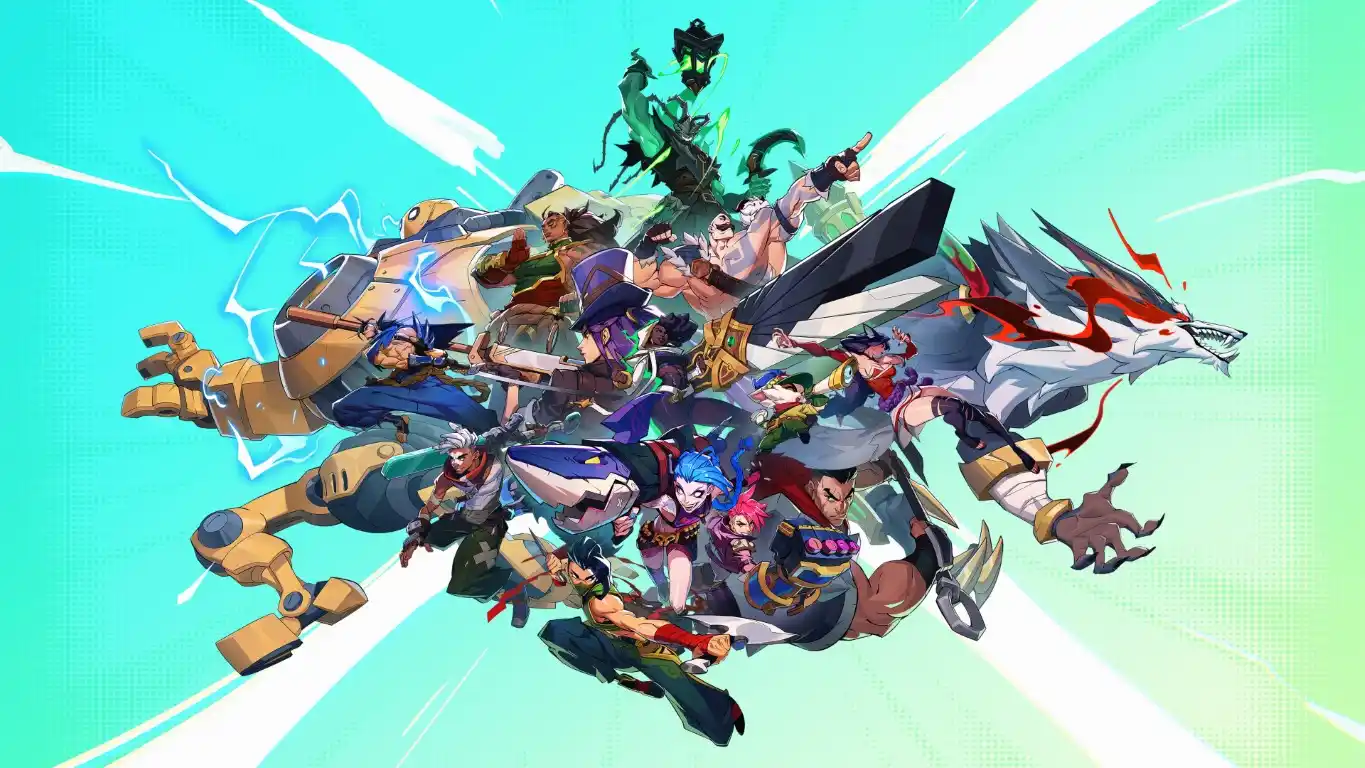
For years, fighting games seemed to have a fairly obvious problem. They were too difficult.
Combos were difficult. Motion inputs were difficult. Matchups were difficult. Online play was often terrible. Learning involved losing repeatedly to someone who knew exactly what they were doing while you desperately tried to remember whether the fireball was quarter-circle forward or quarter-circle backward.
Surely, if someone could just remove all those barriers, fighting games could finally break out of their niche. Then Riot Games tried. 2XKO had almost everything you would put into the hypothetical experiment.
It was free-to-play. It used characters from League of Legends, one of the largest games on Earth. It had simplified controls, modern online infrastructure, 2v2 gameplay designed to make fighting games more social, competitive support, and the resources of a company that had already turned League of Legends and Valorant into global phenomena.
People tried it. Then many of them left.
On August 20, 2026, Riot announced that active development of 2XKO would end at the end of the year. The servers would remain online, but major development was essentially over.
Riot’s explanation was especially revealing. The problem wasn’t simply getting people through the door. Plenty of people tried 2XKO. The problem was getting enough of them to stay.
Riot said player engagement remained relatively flat despite major updates, new champions, PvE content and competitive events. More painfully, the company said the game cost substantially more to operate than it generated and had reached only a fraction of the trajectory necessary to become sustainable.
Which creates an uncomfortable question. If Riot couldn’t make a fighting game into a massive live-service hit, can anyone? Or are fighting games simply destined to remain niche?
Maybe Fighting Games Really Do Have a Ceiling
Calling fighting games “niche” sounds slightly ridiculous when you look at how recognizable they are. Street Fighter gave gaming Ryu, Chun-Li and Hadouken.
Tekken has been throwing dysfunctional members of the Mishima family into volcanoes for three decades.
Mortal Kombat has movies, television series, merchandise, congressional hearings and an entire vocabulary built around removing people’s spines.
Those are not obscure properties. Commercially, however, something interesting happens. Street Fighter 6 surpassed 7 million copies in June 2026, an excellent result and one that Capcom continues to celebrate. The entire Mortal Kombat franchise has sold more than 100 million games.
These are successful businesses by almost any reasonable definition. But compare them with the truly gigantic games. Mario Kart 8 Deluxe has sold more than 71 million copies. Animal Crossing: New Horizons has passed 50 million. Even Super Smash Bros. Ultimate—we will return to that inconvenient example shortly—has sold more than 38 million copies.
Traditional fighting games can become very successful. They just seem to hit a ceiling much earlier than the largest mainstream games. Why? The obvious explanation has always been difficulty.
But 2XKO suggests that explanation may be incomplete.
Definitely not related: Homo Ludens: Life Is a Game with No Tutorial
The Real Problem Might Not Be Doing the Moves
Traditional fighting games are famous for their inputs. Quarter-circle forward. Dragon-punch motion. Charge back for two seconds. Half circle. Full circle.
Pretzel motion, because apparently somebody once looked at human hands and decided they had been treated too kindly.
For decades, these inputs acted as an obvious barrier between someone seeing a cool character and actually making that character do something cool. Modern fighting games have increasingly attacked the problem.
Street Fighter 6, for example, introduced Modern Controls, allowing players to perform special attacks without traditional complex inputs. Capcom explicitly positioned the system as part of making the game accessible to a wider range of players.
2XKO went even further. Its basic controls were designed around simpler inputs from the beginning. And that helps.
But simplifying inputs can only simplify execution. It cannot simplify fighting.
You can make throwing a fireball easier. But, you cannot remove spacing, timing, matchup knowledge, pressure, or the psychological ‘warfare’.
Fighting Games Have a Brutal Relationship With Failure
Think about what happens when someone is bad at a typical multiplayer game. In a shooter, they can still accidentally kill someone.
Maybe an enemy runs around the corner at precisely the wrong moment. Maybe they throw a grenade into a crowded room. Maybe their teammates carry them. Maybe they capture an objective.
Maybe the enemy team is clearly full of hackers, all five teammates are idiots, the servers are lagging and Mercury is in retrograde. There are places for failure to hide.
Fighting games provide far fewer. There are usually two people. One wins. The other person’s health bar reaches zero. The game then asks whether you would like another demonstration.
The better player doesn’t merely beat you either. A sufficiently large skill gap can stop you from meaningfully playing at all. You get knocked down. You guess wrong. You’re pressured. You panic. You press a button. That button was apparently a declaration of bankruptcy.
For an experienced player, all of this represents an incredibly rich conversation between two people. For a beginner, it can feel like someone stole the controller. That distinction matters enormously for retention. Fighting games often demand that players pass through a competence valley.
There Is Nowhere to Hide
There is another difference between fighting games and most gigantic live-service games. You can play many mainstream games without obsessing over their central competitive mechanic.
Fortnite has quests, cosmetics, custom modes, exploration and social spaces. MMOs contain professions, housing, collecting and entire populations who appear to have forgotten that monsters need killing because they’re currently fishing. Even shooters spread attention across loadouts, progression, objectives, teamwork and larger maps.
A conventional fighting game eventually leads back to one central activity: fight another person. This is magnificent if fighting another person is what you want. If it isn’t, there often isn’t much game left.
The fighting games that have reached the furthest beyond the traditional fighting-game audience seem to understand this.
Street Fighter 6 didn’t merely introduce easier controls. It built World Tour, a substantial single-player mode in which fighting mechanics are wrapped inside something closer to an RPG.
Mortal Kombat has spent years investing heavily in cinematic campaigns, unlockables, spectacle and characters being disassembled with the anatomical enthusiasm of an unusually creative medical student.
And then there is the elephant in the room. Or technically the pink puffball.
Super Smash Bros. Ruins the Entire Argument
If fighting games inherently cannot become mainstream, someone forgot to tell Nintendo. As of June 30, 2026, Super Smash Bros. Ultimate had sold 38.14 million copies.
That is not niche. That is one of Nintendo’s best-selling games ever.
The Fighting Game Community has spent decades debating whether Smash should be considered a “real” fighting game, which is a fascinating discussion if you enjoy opening portals to hell on internet forums.
For our purposes, the taxonomy doesn’t matter much. Players pick characters. They attack one another. Eventually somebody loses. Close enough. What matters is how Smash presents fighting.
Smash can be played as an extraordinarily deep competitive game. It can also be played by four children screaming while Poké Balls fall from the sky and Luigi gets hit by a train.
Stages move. Items appear. Characters come from dozens of beloved franchises. Eight people can play together.
There are single-player modes, collectibles, unlockables, challenges and enough crossover material to resemble the intellectual-property equivalent of a shopping mall.
Competitive fighting is there. But the player does not need to care about competitive fighting to enjoy the game. Maybe that is the secret.
Brawlhalla Makes Things Even More Awkward
There is another inconvenient counterexample. Brawlhalla passed 100 million lifetime players in 2023.
That number needs context. Brawlhalla is free-to-play, so registered or lifetime players cannot be compared directly with premium-game sales. Still. One hundred million people is a rather substantial niche.
Brawlhalla also did many of the things supposedly necessary for broader fighting-game appeal. It is free. It supports crossplay. It exists on practically everything, including mobile devices. It offers 1v1 competitive play but also 2v2, free-for-all and alternative modes.
Ubisoft itself credited things such as crossplay and close community development with helping the game’s growth. So 2XKO cannot prove that free-to-play fighting games don’t work.
One already did. The question becomes much more specific. Why didn’t this particular one work at the scale Riot needed?
Maybe 2XKO’s Problem Wasn’t Fighting Games
This is where the definition of failure becomes important. Riot did not say nobody played 2XKO. In fact, its announcement explicitly acknowledged that the game still had a community playing every day.
What Riot said was that there weren’t enough players sticking around to create a viable path toward sustainability. Engagement stayed relatively flat, while operating costs remained substantially higher than revenue.
Those are different statements. Imagine a fighting game with 30,000 extremely dedicated players. For an indie studio with ten employees, that audience might be fantastic. For a premium fighting game with modest post-launch support, perhaps perfectly sustainable.
For Riot? Different equation.
Large live-service games have large teams, continuous development, infrastructure, customer support, marketing, esports initiatives and an expectation that new content will continue arriving indefinitely.
The audience doesn’t merely need to exist. It has to pay for the machine. And free-to-play games make the equation harsher in another way. A premium game earns money when someone buys it. A free-to-play game earns nothing when someone installs it.
The player must stay. Then stay longer. Then ideally decide that Ahri would look significantly better wearing something that costs $17.50.
Suddenly retention isn’t merely a desirable metric. It’s the business model. In that sense, 2XKO may tell us as much about modern live-service economics as it does about fighting games.
Perhaps Riot didn’t discover that fighting games are unsustainable. Perhaps Riot discovered that fighting games are difficult to operate at Riot scale.
But Riot Was Trying to Solve Something Real
That doesn’t mean we should dismiss the genre problem. 2XKO was built around several ideas clearly intended to remove traditional fighting-game friction.
The most interesting was its 2v2 structure. Traditional fighting games are strangely antisocial multiplayer games. You play against other people constantly, yet the fundamental experience is often solitary.
Your friend cannot really help you during a Street Fighter match. They can coach you. They can give advice. They can watch. But ultimately, you have to enter the arena alone.
Team-based games have a gigantic advantage here. A veteran Valorant player can invite an inexperienced friend and play alongside them. A good League player can protect a weaker teammate. Friends can teach one another while participating in the same match.
Even losing becomes social. Traditional fighting-game onboarding often works differently.
2XKO tried to build friendship directly into the format. One player could control one champion while a friend controlled the other. It was clever. It still wasn’t enough though. Which brings us back to the uncomfortable possibility that the deepest barrier isn’t controls, pricing or even loneliness.
Maybe it is what fighting games fundamentally ask from their players.
Fighting Games Demand Responsibility
Fighting games are unusually honest videogames. Sometimes brutally so. When you lose in a team game, causality becomes conveniently complicated.
Was it you? Was it matchmaking? Was it the jungler? Probably the jungler.
In a fighting game, there is remarkably little bureaucracy between your decision and its consequences.
You jumped. They anti-aired. You pressed while disadvantaged. They punished you. You kept doing the same thing. They kept punishing you. The game is practically producing peer-reviewed evidence. That clarity is one reason fighting games are so rewarding.
Improvement feels personal because failure was personal too.
When you finally beat something that destroyed you fifty matches earlier, there is very little doubt about what changed. You did. But the same structure that makes mastery incredibly satisfying also makes casual participation difficult.
Fighting games don’t just ask players to consume content. They ask them to develop competence. And perhaps only a certain percentage of people actually want their entertainment to make that demand.
Fighting Games Are Already Mainstream—Just Not in the Way We Think
This is why saying “fighting games will always be niche” isn’t quite right. They clearly aren’t culturally niche. Millions of people know Ryu. Scorpion is one of gaming’s most recognizable characters.
Tekken has sold tens of millions of games. Mortal Kombat has surpassed 100 million franchise sales. Super Smash Bros. Ultimate alone has sold more than 38 million copies. Street Fighter 6 continues growing and has already passed seven million.
Fighting games can absolutely become mainstream products. What remains niche may be something much narrower:
the desire to play fighting games competitively, repeatedly and seriously for years.
And those two things aren’t the same. Millions of people watch boxing. Far fewer spend Wednesday evening voluntarily getting punched in the liver.
Millions may enjoy Street Fighter characters, play through World Tour, mess around with friends and occasionally enter ranked mode.
A much smaller group wants to study frame data at 1:30 AM because Cammy’s standing heavy punch did something suspicious.
Perhaps fighting games spent years trying to turn the first group into the second. Maybe that conversion rate simply has a natural limit.
2XKO Didn’t Prove Fighting Games Can’t Be Mainstream
If anything, its failure gives us a more interesting conclusion. Fighting games have spent years attacking their obvious barriers. Controls are easier. Online play is dramatically better. Tutorials are better. Matchmaking is better. Crossplay is increasingly standard.
Games are adding social spaces, single-player modes and alternate control schemes.
2XKO even removed the price. And yet the fundamental challenge remains. At some point, a fighting game needs you to fight. Not collect. Not grind. Not complete a daily mission. Fight.
Another person will make decisions specifically designed to stop you from having a pleasant evening, and your long-term enjoyment depends partly on whether repeatedly solving that problem sounds rewarding.
For some people, that is one of the greatest forms of videogame competition ever invented. For everyone else, Mario Kart is right there.
What 2XKO may have demonstrated is that mainstream attention and mainstream commitment are completely different things. Riot got people through the door. The genre still struggled to convince enough of them to make fighting games a habit.
And maybe that—not fireball motions, not pricing, not graphics, not netcode—has always been the fighting game’s real ceiling.
