
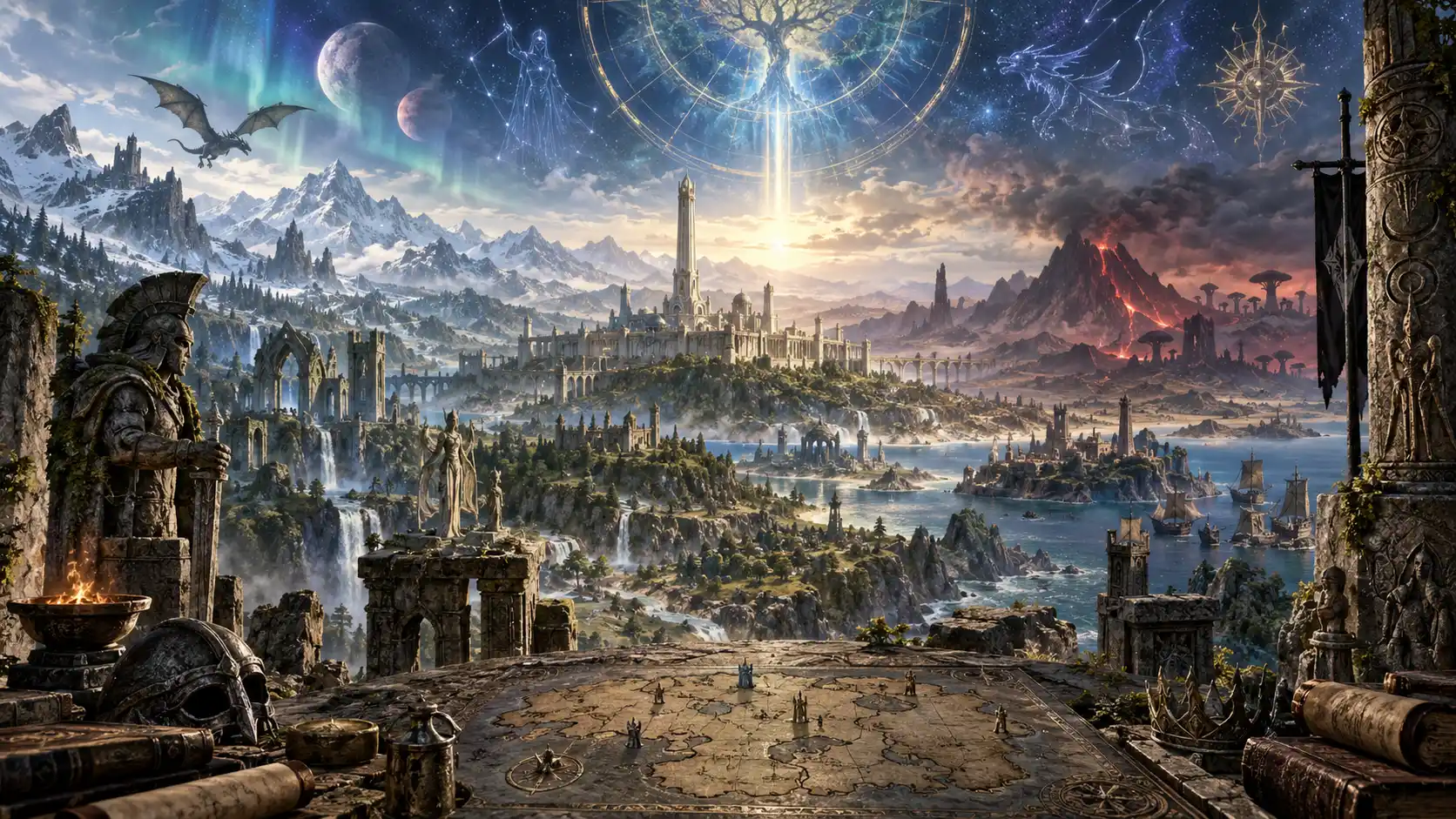
The world of The Elder Scrolls is old. Very old.
By the time the Last Dragonborn wakes up on a cart headed toward Helgen in Skyrim, civilizations have already risen and disappeared, humans and elves have fought wars lasting generations, mortals have become gods, gods have lost their power, an entire race has mysteriously vanished, and at least one giant brass robot has caused serious problems with reality.
Understanding all of that can make The Elder Scrolls lore feel intimidating. Fortunately, its history is divided into several major periods: the Dawn Era, Merethic Era, First Era, Second Era, Third Era, and Fourth Era.
The further back we go, however, the less reliable history becomes. The earliest events are closer to mythology than conventional historical records, and different cultures frequently disagree about what actually happened.
So rather than attempting to document every king, war, dynasty, and suspiciously powerful magical artifact ever mentioned in the games, this is the broader story of how Tamriel became the world we recognize today.
Definitely related: What Are the Elder Scrolls? The Mysterious Scrolls Behind the Game’s Name
Before Tamriel: The Dawn Era
The history of The Elder Scrolls begins before history itself.
According to several creation traditions, existence emerged from opposing primordial forces commonly associated with Anu, representing order and permanence, and Padomay, representing change.
From the interactions between these forces came the original spirits known as the et’Ada. Among them were beings that would eventually become associated with familiar gods such as Akatosh, Mara, and others, as well as the entities later known as the Daedric Princes.
Then came Lorkhan. Lorkhan proposed the creation of a mortal world: Mundus, the plane containing Nirn and therefore Tamriel. How exactly this happened depends heavily on who is telling the story.
Some traditions portray Lorkhan as a creator who made mortal existence possible. Others, particularly many elven traditions, regard him as a trickster who deceived other spirits into sacrificing part of their divine power to create the mortal world. The spirits who participated became associated with the Aedra, while those who did not sacrifice themselves became associated with the Daedra.
Magnus, one of the principal architects of creation, supposedly abandoned the project after realizing its cost. His departure tore a hole toward Aetherius that became the Sun, while other escaping spirits created additional holes seen as the stars.
Eventually, Lorkhan was punished. His Heart was torn from him and cast into the mortal world, where it would eventually come to rest beneath Red Mountain. That particular piece of divine anatomy will become extremely important later.
The Dawn Era is difficult to treat as ordinary history because linear time itself was not yet functioning normally. Gods, spirits, creation myths, and contradictory versions of events overlap constantly.
Only after Akatosh—or the establishment of linear time associated with him—does Tamrielic history begin to resemble something we can actually put on a timeline.
The Merethic Era: Elves, Dragons, and the Arrival of Men
The Merethic Era, literally the era associated with the Mer or elves, represents the transition between mythological creation and recorded history.
Early Aldmeri civilization developed and spread across Tamriel, eventually producing many of the elven cultures recognizable from the games.
The Altmer established themselves around Summerset. The Bosmer became associated with Valenwood. The Chimer followed the prophet Veloth eastward toward what would eventually become Morrowind. Other groups developed into cultures such as the Ayleids and Dwemer.
The Dwemer were particularly unusual. Despite commonly being called dwarves, they were actually a race of Mer. They built enormous underground cities and developed technology combining machinery, engineering, and magic at a level later civilizations struggled to reproduce.
Meanwhile, humans were also arriving and expanding across Tamriel. Nordic tradition remembers migrants from the northern continent of Atmora, most famously Ysgramor and the Five Hundred Companions, whose conflicts with the Snow Elves helped establish Nordic power in Skyrim.
The Merethic Era was also the age of dragons. Dragons led by Alduin dominated much of early Nordic society through the Dragon Cult. Human Dragon Priests ruled beneath them until rebellion broke out. According to the events later witnessed in Skyrim, ancient Nord heroes eventually used the Thu’um and an Elder Scroll against Alduin, casting him forward through time rather than truly killing him.
Nobody involved knew exactly when he would return. That problem would remain unresolved for thousands of years.
The First Era: Tamriel Begins Looking Familiar
The First Era is where Tamrielic history becomes considerably more recognizable. Kingdoms expand. Empires form. Wars become better documented. Many of the political and religious divisions seen thousands of years later begin taking shape.
One of the earliest major human powers was the Nordic Empire, which at its height controlled territory far beyond modern Skyrim. But one of the era’s most important events occurred farther south in Cyrodiil.
The region was dominated by the Ayleids, an elven civilization whose city-states relied heavily on enslaved human populations. In 1E 242, a slave rebellion led by Alessia overthrew Ayleid rule and established what became known as the First Empire of Cyrodiil.
Alessia was enormously important to Imperial culture. The religious system associated with her helped reconcile Nordic and elven traditions into the foundations of the Eight Divines worshipped throughout later Imperial history.
But while humans were building empires in Cyrodiil, something considerably stranger was happening around Red Mountain.
The Dwemer Disappear
The Chimer and Dwemer of Resdayn, the region later known as Morrowind, had spent generations alternating between conflict and cooperation.
Eventually, Dwemer tonal architect Kagrenac discovered the Heart of Lorkhan beneath Red Mountain. He created three tools—Keening, Sunder, and Wraithguard—to manipulate its divine power.
This contributed to a conflict between the Dwemer and Chimer culminating in the Battle of Red Mountain, conventionally dated around 1E 700. And then the Dwemer disappeared. Not one city. Not one army. Essentially the entire race vanished simultaneously.
The games provide several conflicting accounts of the battle, and what exactly Kagrenac did remains one of the great unresolved mysteries of the series. That is why the disappearance of the Dwemer deserves its own article rather than a paragraph pretending we have a definitive answer.
The immediate aftermath was almost as significant.
Three companions of the Chimer leader Nerevar—Vivec, Almalexia, and Sotha Sil—eventually used Kagrenac’s tools and the Heart of Lorkhan to become the living gods known as the Tribunal. The Chimer themselves became the Dunmer, or Dark Elves. The Tribunal would dominate Morrowind for thousands of years.
Empires Rise and Fall
The First Era lasted nearly three thousand years, so describing it solely through Alessia and Red Mountain leaves out an enormous amount of history.
Cyrodiil itself went through several political transformations. Alessia’s empire eventually declined, while the later Reman Empire once again brought significant portions of Tamriel under Imperial authority.
The period also saw major migrations that reshaped the continent.
The ancestors of the Redguards arrived from Yokuda and established themselves in Hammerfell. Breton culture developed in High Rock through centuries of interaction between human and elven populations. Orcish kingdoms rose and repeatedly fell around Orsinium.
By the end of the era, Tamriel already contained most of the cultures and provinces recognizable to modern players. But unified Imperial power would collapse again. That brings us into the Second Era.
The Second Era: Everybody Wants the Imperial City
The Second Era began after the end of the Reman dynasty and eventually descended into the long political instability known as the Interregnum. Imperial authority weakened dramatically. Different rulers and factions fought over Cyrodiil while regional kingdoms grew increasingly independent.
This is also the general period in which The Elder Scrolls Online takes place.
Around 2E 582, three major alliances—the Aldmeri Dominion, Daggerfall Covenant, and Ebonheart Pact—were competing for influence and control, while Tamriel simultaneously faced supernatural threats including Molag Bal’s attempt to merge Nirn with his realm of Coldharbour.
Yet none of these alliances ultimately created the empire that would define the next age. That job fell to a warlord whose identity is itself complicated. His name was Tiber Septim.
Tiber Septim Unites Tamriel
Tiber Septim rose during the final decades of the Second Era and embarked on a campaign to bring Tamriel under his authority. Some regions were conquered militarily. Others were incorporated through diplomacy and treaties.
One of his greatest advantages eventually came from Morrowind.
The Tribunal agreed to an armistice with Tiber Septim, allowing Morrowind considerable internal autonomy while formally joining the Empire. As part of that arrangement, Tiber gained access to Numidium, an enormous Dwemer construct often called the Brass God.
With Numidium, Tiber Septim was eventually able to overcome resistance from powers including the Altmer of Summerset. By 2E 896, his conquest of Tamriel was effectively complete.
The following year became 3E 0. The Third Era had begun. And Tiber Septim would eventually become even more important after his death, when Imperial religion came to worship him as the god Talos.
Exactly how a mortal emperor became a Divine is another subject deserving far more than a few sentences.
The Third Era: The Empire of the Games
For players of the older mainline games, the Third Era is particularly important.
The Septim Empire dominated much of Tamriel, although it was hardly a peaceful golden age. The dynasty experienced assassinations, internal conflicts, invasions, rebellions, and succession problems over several centuries.
The Elder Scrolls: Arena takes place during the reign of Uriel Septim VII, when Imperial Battlemage Jagar Tharn imprisons the Emperor and secretly assumes his identity.
Daggerfall takes place several years later around the Iliac Bay, eventually leading to the bizarre event known as the Warp in the West, where several mutually incompatible outcomes apparently become true simultaneously.
Again, Elder Scrolls history occasionally decides that causality is more of a recommendation. Then came Morrowind.
Morrowind and the End of the Tribunal
In 3E 427, an Imperial prisoner arrives on the island of Vvardenfell. That prisoner eventually becomes identified with the Nerevarine, the prophesied reincarnation of the ancient hero Indoril Nerevar.
At the same time, Dagoth Ur has returned beneath Red Mountain and gained power through the Heart of Lorkhan.
The Nerevarine eventually confronts Dagoth Ur and destroys the enchantments allowing the Heart to be exploited. This ends Dagoth Ur’s immediate threat but also removes the source of the Tribunal’s divine power.
Thousands of years of Dunmer religious and political history begin unraveling remarkably quickly. And things are about to get considerably worse for the Empire as well.
The Oblivion Crisis Ends the Third Era
In 3E 433, Emperor Uriel Septim VII and his heirs are assassinated by the Mythic Dawn, a cult devoted to the Daedric Prince Mehrunes Dagon. With the Imperial succession broken, gates to Oblivion begin opening across Tamriel. This is the setting of The Elder Scrolls IV: Oblivion.
The player eventually discovers Martin Septim, the Emperor’s illegitimate son and last surviving heir.
At the climax of the crisis, Mehrunes Dagon physically enters the Imperial City. Martin sacrifices himself by shattering the Amulet of Kings and transforming into an avatar of Akatosh, defeating Dagon and permanently changing the barrier between Mundus and Oblivion.
Martin dies. The Septim bloodline ends. And with it ends the Third Era.
The Fourth Era: An Empire in Decline
The Fourth Era begins with Tamriel significantly less stable than before.
Morrowind suffers enormous disasters. The Ministry of Truth crashes into Vivec City, Red Mountain erupts during the Red Year, and large parts of the province are devastated. Argonian forces later invade southern Morrowind.
The Empire, meanwhile, eventually comes under the Mede dynasty but never fully regains the dominance enjoyed under the Septims. A new power rises in the south: the Aldmeri Dominion, led by the Thalmor.
In 4E 171, the Dominion launches the Great War against the Empire. After years of devastating fighting, Emperor Titus Mede II accepts the White-Gold Concordat. Among its most controversial conditions is the prohibition of Talos worship.
That decision becomes particularly explosive in Skyrim. Many Nords worship Talos not merely as another Divine but as a human—and specifically culturally Nordic—figure who rose to godhood. To them, banning his worship is not some obscure theological regulation. It is humiliation.
Skyrim and the Return of Alduin
By 4E 201, Skyrim is divided by civil war. The Stormcloaks, led by Ulfric Stormcloak, seek Skyrim’s independence from an Empire they consider too weak and too willing to obey the Dominion. Imperial loyalists argue that division only makes both Skyrim and the Empire more vulnerable to the Thalmor.
And while everyone is occupied debating politics, something much older returns. Alduin. The same dragon thrown forward through time during the Merethic Era finally reappears.
Dragons begin returning across Skyrim, and another prisoner scheduled for execution discovers that they are Dragonborn: a mortal possessing the soul and abilities of a dragon.
The Last Dragonborn eventually learns Dragonrend, travels to Sovngarde, and defeats Alduin. And that is roughly where the mainline Elder Scrolls timeline currently leaves us.
Thousands of Years, One Very Unstable World
Looking at the entire timeline reveals something interesting about The Elder Scrolls. Its history rarely moves cleanly from one civilization to another. Everything leaves something behind.
Lorkhan’s Heart influences the Dwemer thousands of years after creation. The disappearance of the Dwemer leaves Numidium behind. Numidium helps Tiber Septim create an empire. Tiber becomes Talos. Talos worship contributes to conflict with the Aldmeri Dominion. That conflict helps produce the civil war we encounter in Skyrim.
Ancient mythology continuously leaks into modern politics. That may be the most useful way to understand Elder Scrolls lore.
The Dawn Era isn’t simply irrelevant mythology that happened before the “real” story began. Decisions supposedly made during creation continue shaping religion, racial identity, political conflicts, and even wars thousands of years later.
And we have skipped an enormous amount.
The Daedric Princes. The Great Houses of Morrowind. The Psijic Order. The Blades. Dragon Breaks. The Tribunal. The Thalmor. The disappearance of the Dwemer. The strange story of Tiber Septim.
Those are where the timeline stops being the article and starts becoming the map. Because now that we know roughly when everything happened, we can start asking the much more interesting question: What actually happened?
