
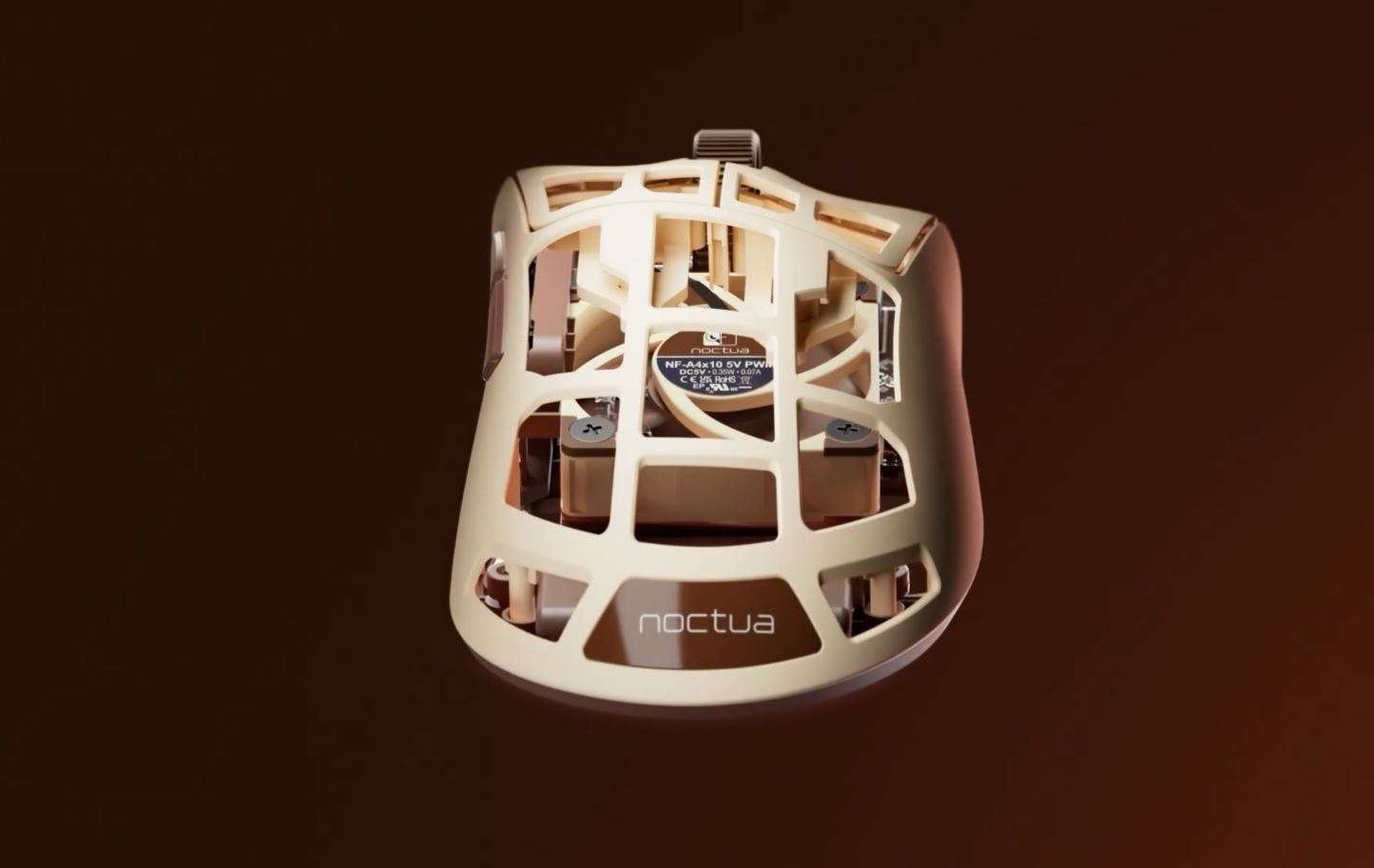
Gaming mice have spent years competing over familiar numbers: lower weight, higher DPI, faster polling rates, and increasingly elaborate shells full of holes. Pulsar’s latest collaboration with Noctua takes a rather different approach.
The Feinmann F01 Noctua Edition contains an actual 40mm cooling fan designed to push air toward the player’s palm. It sounds like the kind of idea someone would sketch during an especially sweaty ranked session, but Pulsar is turning it into a real commercial product.
The mouse is scheduled to launch on July 21, 2026, at 4:00 p.m. KST, according to Pulsar’s official announcement.
Yes, There Is Really a Noctua Fan Inside It
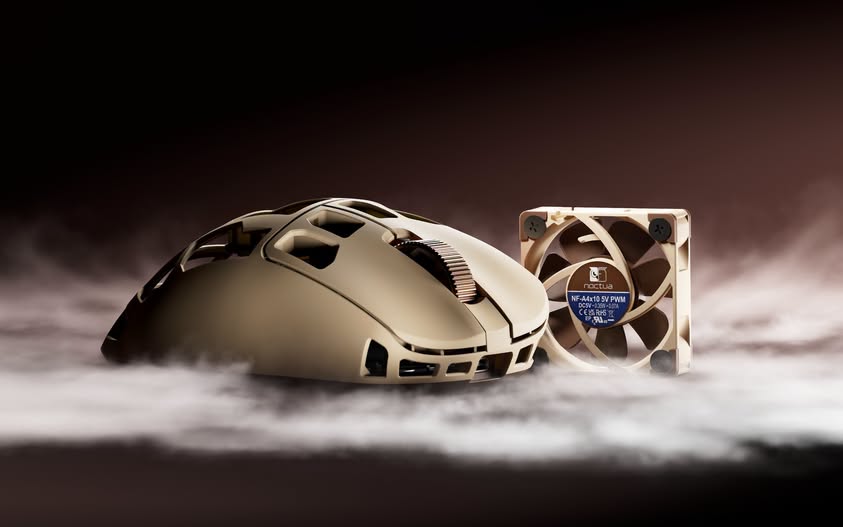
The centerpiece is a genuine Noctua NF-A4x10 5V PWM fan integrated into the mouse’s carbon-composite shell. Large openings across the upper body allow the fan to direct airflow toward the user’s hand, with the aim of reducing sweat and maintaining grip during long gaming sessions.
Pulsar is not simply running the fan at one fixed speed, either. The cooling system offers five levels of fan control, giving players some choice between stronger airflow and quieter operation.
That control is important. A tiny desk fan permanently spinning at maximum speed beneath your palm could become irritating rather quickly, no matter how prestigious the owl logo on the side happens to be.
Flagship Gaming Specifications Remain Intact
Pulsar has not treated the Noctua Edition as a novelty mouse with mediocre internals. It still carries specifications expected from a modern high-end competitive model.
Key features include:
- Pulsar’s XS-2 sensor
- Sensitivity of up to 42,000 DPI
- An 8,000Hz polling rate
- Pulsar optical switches
- Five-speed PWM fan control
- Dimensions of 121.7 × 66.5 × 43.3mm
- An approximate weight of 73 grams
An 8,000Hz polling rate allows the mouse to report its position to the PC as many as 8,000 times per second. The practical benefit will depend on the game, system performance, display refresh rate, and the player’s sensitivity to latency, but it keeps the F01 Noctua Edition firmly in flagship territory.
The 42,000 DPI ceiling is similarly excessive for ordinary play—unless someone has finally developed a competitive mode that requires crossing three monitors with a wrist twitch—but it demonstrates that Pulsar has not compromised the sensor hardware to make room for the fan.
Surprisingly Light, Considering the Extra Hardware
The standard Feinmann F01 weighs around 46 grams, meaning the Noctua Edition gains a substantial amount of weight. Even so, 73 grams remains relatively light for a gaming mouse, particularly one containing a motor, fan blades, extra wiring, and airflow channels.
That may be the most technically interesting part of the design. Installing active cooling is easy if weight and dimensions do not matter. Doing it while keeping the mouse below the weight of many conventional wireless models requires much more careful engineering.
The Noctua Edition is also larger than the original F01, although its 121.7mm length keeps it reasonably compact. Its shape will likely be better suited to small and medium-sized hands than to players looking for a large ergonomic shell.
From Computex Curiosity to Shipping Product
The concept did not appear overnight. Noctua previously displayed a fan-equipped Feinmann mouse at Computex 2025, where the companies described airflow toward the palm, software-adjustable fan speed, a magnesium-alloy structure, and an earlier XS-1 sensor configuration. At that stage, the estimated release window was November 2025.
The production version has clearly evolved since that showing. Pulsar now lists a carbon-composite shell, the newer XS-2 sensor, five-speed control, and a firm July 2026 launch date.
That lengthy development period suggests the challenge was not merely squeezing a fan into a mouse. Pulsar also had to manage weight distribution, vibration, noise, power consumption, structural rigidity, and the small matter of keeping dust and debris away from moving parts.
A Gimmick With a Legitimate Use Case
Active cooling will not suddenly become mandatory across every gaming mouse. Plenty of players do not experience serious hand sweating, while others may prefer simpler hardware with fewer mechanical components.
Still, the feature addresses a genuine problem. Moisture can reduce grip consistency, make perforated shells uncomfortable, and encourage players to keep towels or desk fans nearby. Competitive gamers already use grip tape, sleeves, chalk-like products, and external cooling accessories, so integrating airflow directly into the mouse is not quite as absurd as it initially sounds.
It also gives Pulsar something increasingly rare in the peripheral market: a feature that is immediately understandable and genuinely different. Another sensor upgrade or two-gram weight reduction is difficult to communicate outside enthusiast circles. “This mouse has a Noctua fan in it” requires considerably less explanation.
What It Could Mean for Gaming Peripherals
The broader significance is not that every mouse will soon contain miniature cooling systems. Instead, the F01 Noctua Edition shows manufacturers experimenting beyond the usual specification race.
Gaming peripherals have entered a phase where conventional performance improvements offer diminishing returns. Polling rates are already extremely high, modern sensors are highly accurate, and ultra-light shells are widely available. Companies therefore need new ways to distinguish premium products.
That could lead to more peripherals designed around comfort and environmental control rather than raw input performance: improved ventilation, temperature-responsive materials, adjustable airflow, or more advanced moisture-resistant surfaces.
Naturally, it could also lead to RGB-equipped mouse exhaust systems. The industry rarely encounters a sensible idea without eventually adding lighting to it.
Final Thoughts
The Pulsar Feinmann F01 Noctua Edition is unusual, slightly ridiculous, and far more technically credible than the phrase “fan-cooled gaming mouse” might suggest.
At 73 grams, it remains reasonably lightweight. Its XS-2 sensor and 8,000Hz polling rate give it legitimate flagship credentials, while the adjustable Noctua fan offers a practical benefit for players who struggle with sweaty hands.
Its success will ultimately depend on pricing, battery or power impact, fan noise, durability, and how the airflow feels during actual use. But as gaming-mouse innovations go, this is at least more memorable than adding another few thousand DPI that almost nobody will use.
