
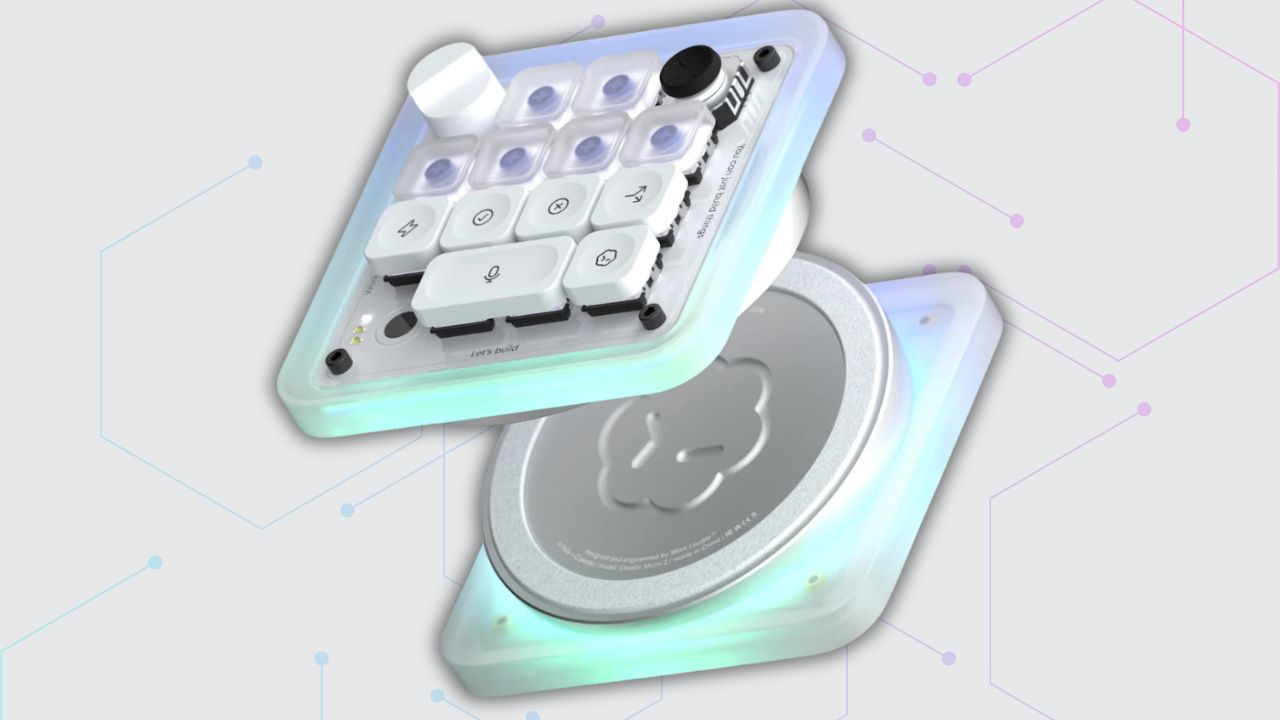
OpenAI’s first step into branded hardware is not a robot, a wearable, or the mysterious screenless AI companion everyone keeps imagining. It is a tiny mechanical keyboard with RGB lighting.
The Codex Micro, officially labeled the considerably less memorable kbd-1.0-codex-micro, is a $230 desktop controller built in collaboration with boutique keyboard manufacturer Work Louder. Its purpose is to give developers physical controls for monitoring and directing OpenAI’s Codex coding agents.
In other words, AI software has finally evolved far enough to require its own expensive collection of buttons.
A Physical Control Panel for Codex
The Codex Micro is based on Work Louder’s existing Creator Micro 2 platform, but it arrives with dedicated Codex integration, a translucent white finish, and a set of interchangeable command keycaps.
Its control layout includes:
- 13 low-profile mechanical keys
- One rotary encoder
- One clickable joystick
- A capacitive touch strip
- Per-key and perimeter RGB lighting
- Bluetooth and USB-C connectivity
- Six programmable control layers
- A CNC-machined aluminum body with polycarbonate elements
OpenAI sells the device for $230, including a separate Codex icon set containing 32 additional keycaps. Buyers can choose between clicky and silent switches.
This is not intended to replace a keyboard. It is closer to a compact command console that sits beside one, offering shortcuts for commonly used agent actions and a glanceable view of what Codex is doing.
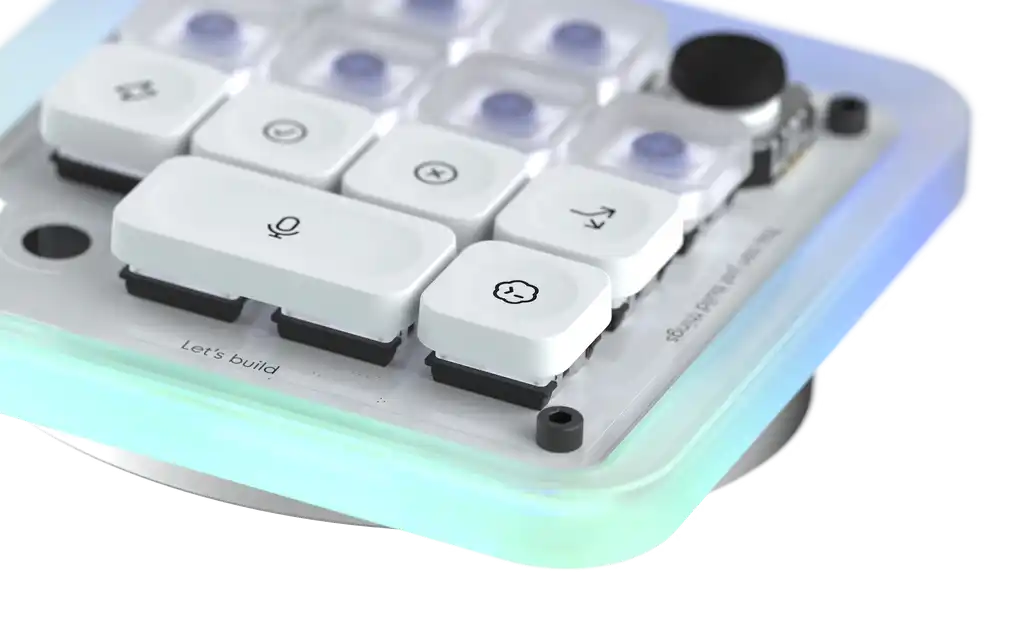
RGB, but This Time It Allegedly Means Something
Most RGB lighting exists to make a desk look as though it is preparing to enter hyperspace. The Codex Micro at least gives the colors a functional role.
Six translucent keys near the top can represent active Codex threads, while lighting around the edge of the device reflects agent status. The system is designed to help users see whether an agent is idle, processing a task, awaiting input, or encountering a problem without constantly reopening the Codex app.
The reported color scheme includes:
- White for idle
- Green for unread activity
- Blue while an agent is thinking
- Peach when Codex has a question
- Red when something has gone wrong
Work Louder describes the device as directly integrated with Codex, allowing users to remap commands and adjust its layout without relying exclusively on separate controller software. Custom shortcuts can also be assigned across six programmable layers.
That makes the lighting more than decoration, although it remains amusing that the future of autonomous software development apparently looks a little like a gaming PC during an error state.
Also read: AI-Generated Video Sounds Efficient. Reality Is More Expensive
The Joystick Opens an AI Action Wheel
The small joystick in the upper-right corner acts as both a directional controller and a clickable button.
It can open a radial menu containing frequently used Codex workflows, potentially including actions such as:
- Reviewing a pull request
- Debugging an error
- Refactoring code
- Switching between agent tasks
- Launching custom shortcuts
Work Louder’s underlying Micro platform supports a seven-position radial menu, giving users a compact way to group commands without dedicating a separate key to every action.
Yes, it is essentially an emote wheel for software engineering. Instead of selecting a dance, however, you ask an AI agent to untangle the authentication module someone promised was “temporary” three years ago.

A Dial for Adjusting How Hard the AI Thinks
The rotary encoder provides another unusual layer of control. OpenAI and Work Louder position it as a way to adjust settings such as an agent’s reasoning level while working.
That is an interesting idea because AI coding tools increasingly involve trade-offs between speed, computational effort, and task complexity. A simple fix may not need the same reasoning depth as an architectural change affecting half a repository.
A physical dial could make that trade-off feel more immediate: turn one way for quicker responses, turn the other when the agent needs to contemplate the existential consequences of modifying a legacy database schema.
The dial can also be remapped to conventional functions such as volume control, scrolling, zooming, or application-specific shortcuts. This flexibility matters because not everyone will need to adjust AI reasoning often enough to dedicate permanent desk space to it.
The Hardware Is Familiar—The Integration Is the Product
The Codex Micro is not an entirely new hardware design. It is derived from Work Louder’s Creator Micro 2, which already offers 13 keys, a dial, a radial joystick menu, wireless operation, programmable layers, and RGB lighting.
That makes the Codex edition less of a ground-up OpenAI device and more of a specialized, co-branded version of an established controller.
The price reflects that positioning. Work Louder lists the standard Creator Micro 2 from $144, while the Codex version costs $230 and includes the extra icon keycap set, custom enclosure treatment, and native Codex-oriented functionality.
Whether those additions justify the premium will depend almost entirely on how deeply someone uses Codex. A developer managing several AI agents throughout the day may appreciate immediate status indicators and tactile workflow controls. Someone who occasionally asks an agent to fix a CSS bug probably does not need a dedicated AI flight deck.
Why OpenAI Is Experimenting With Physical Controls
The Codex Micro makes more sense when viewed alongside OpenAI’s broader direction for Codex.
The company increasingly describes Codex as a command center for managing multiple agents running separate, parallel tasks. Its desktop application organizes agents into threads and projects, allowing developers to supervise longer-running workflows rather than simply request individual code completions.
That creates a new interface problem.
Traditional keyboards and mice are designed for direct interaction with software. Agentic tools require something closer to supervision: checking status, switching between workers, answering questions, approving changes, and intervening when an agent encounters an error.
A physical controller is one possible answer. Instead of repeatedly cycling through windows, users can receive ambient status signals and trigger common actions from dedicated controls.
The Codex Micro therefore feels less like an attempt to revolutionize keyboards and more like an experiment in how people might manage fleets of AI workers.
Useful Tool or Very Expensive Desk Toy?
For most people, $230 is difficult to justify for a macropad, particularly when similar shortcuts can be configured on cheaper programmable keyboards, Stream Deck-style controllers, or the standard Creator Micro 2.
The strongest selling point is not the aluminum construction or the RGB lighting. It is the promised direct Codex integration.
That could make the device genuinely valuable for developers who:
- Run multiple Codex agents simultaneously
- Frequently review pull requests and diffs
- Want visible agent-status notifications
- Prefer tactile shortcuts over navigating software menus
- Already invest heavily in premium mechanical keyboards
For everyone else, it risks becoming an attractive little status lamp that occasionally reminds them an AI agent has broken the build.
A Small Product With a Bigger Implication
The Codex Micro is unlikely to become a mass-market hit. It is expensive, specialized, and aimed squarely at developers already committed to agent-assisted programming.
But it points toward a potentially important shift in hardware design.
As AI agents become more autonomous, computer interfaces may need to represent not only applications and notifications but also the state of multiple digital workers. Users may want dedicated ways to assign tasks, monitor progress, approve decisions, and interrupt actions.
The first generation of those interfaces may look slightly ridiculous. Early products often do. The Codex Micro is essentially a premium macropad covered in lights—but it is also an early attempt to give AI agents a physical presence on the desk.
For $230, that presence had better at least refactor responsibly.
