
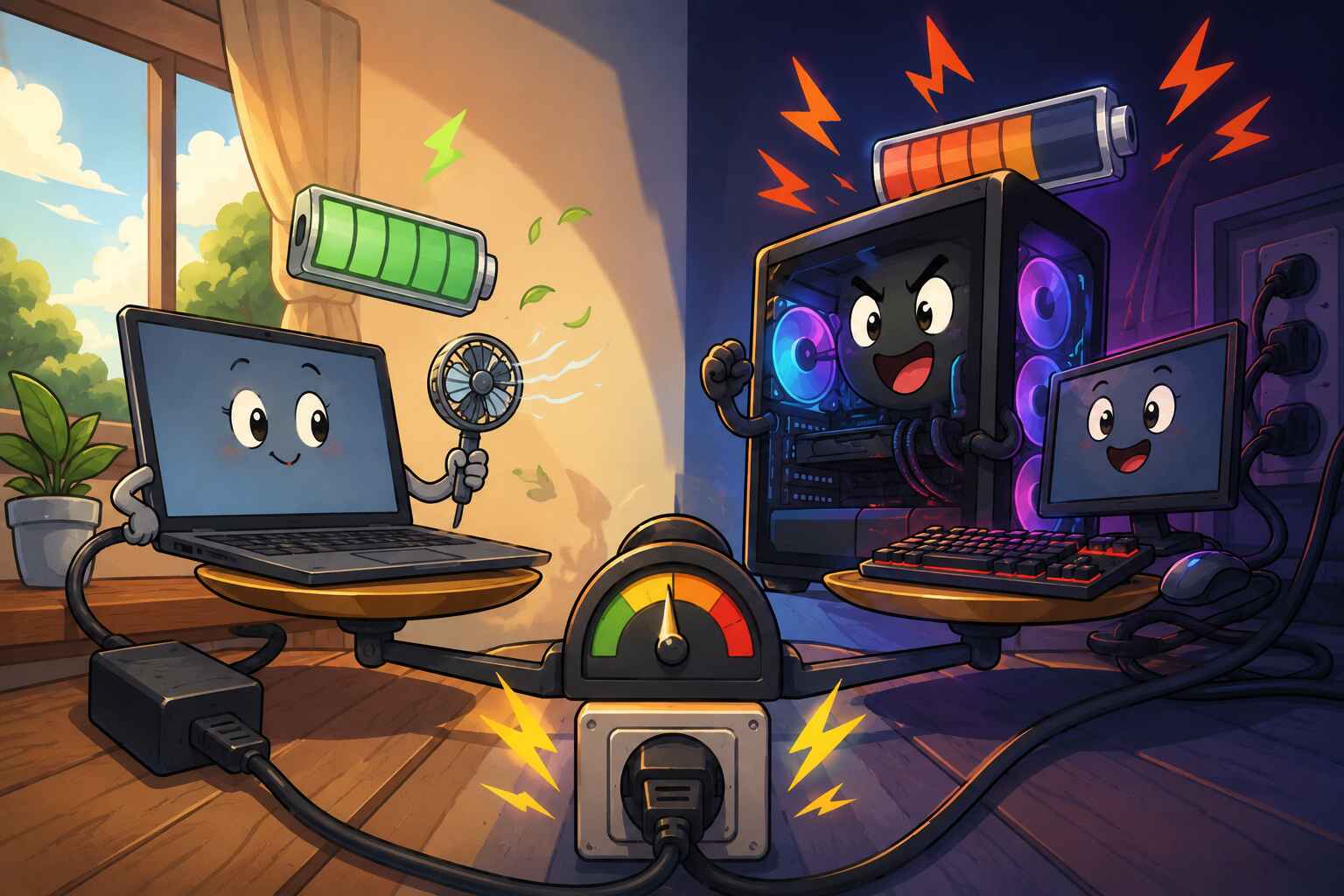
“Your desktop has a 750W power supply? Wow, your electricity bill must be terrifying.” If you’ve ever owned a desktop PC, you’ve probably heard some version of that sentence.
The logic seems obvious. A gaming laptop usually comes with a 180W or 230W charger. Meanwhile, desktop enthusiasts casually recommend 750W or even 1000W power supplies like they’re handing out candy.
Case closed, right? Desktop PCs must consume three or four times more electricity.
Well… not exactly.
It turns out one of the biggest misconceptions in PC hardware comes from confusing how much power a computer can use with how much power it actually uses. And once you understand the difference, you’ll never look at PSU wattage the same way again.
The 750W Myth
Let’s start with the most common misunderstanding.
Imagine someone tells you: “My PC has a 750W power supply.”
Many people subconsciously translate that into: “His PC uses 750 watts.”
But that’s not what a PSU rating means. A 750W power supply simply means: The maximum amount of power it is capable of delivering safely.
Think of it like a car. Owning a car capable of reaching 250 km/h doesn’t mean you’re driving at 250 km/h to buy groceries.
Likewise, a 750W PSU isn’t constantly pumping 750 watts into your PC. It’s simply saying: “If the components ask for up to 750 watts, I’ve got it covered.”
Also read: Tech Explained: Heat — Understanding Thermal Throttling and Why Cooling Matters
Your Components Decide the Bill
Here’s the important part. The power supply doesn’t decide how much electricity your computer uses. Your CPU, GPU, storage drives, fans, and every other component request power.
The PSU simply supplies it.
Imagine you’re eating at a restaurant. The waiter doesn’t decide how much food you’ll consume. He simply brings whatever you order. Your PSU is the waiter.
Your components are the hungry customers.
Why Desktop Power Consumption Changes Constantly
This is why your desktop can have a 750W PSU while using nowhere near that amount most of the time.
For example:
Browsing the web
- CPU barely working
- GPU mostly idle
- Total system power might only be around 40–70W
Watching YouTube
- Slightly higher
- Maybe 60–90W
Gaming
- GPU wakes up and chooses violence
- Power draw might jump to 250–450W, depending on your hardware.
Rendering video or stress testing
- CPU and GPU both working flat out
- Now the system might finally approach 500–700W
Notice something? The PSU rating never changed. Only the workload did.
So… Are Laptops Always More Efficient?
Now things get interesting. Most people answer: “Of course.”
But the answer depends on what you mean by efficient.
Let’s compare.
Laptop:
- Draws 120W while rendering a video.
Desktop:
- Draws 300W doing the same job.
Looks like an easy win for the laptop. Until you ask one more question.
How long did each machine take?
Imagine this:
| Laptop | Desktop | |
| Power Needed | 120W | 300W |
| Duration Needed | 25 minutes | 10 minutes |
| Calculations | 120W × 25/60 hour = 50 Wh | 300W × 10/60 hour = 50 Wh |
Surprise. The desktop consumed almost exactly the same amount of energy. It simply used it much faster.
Think of it like this. One person walks to work. Another rides a motorcycle. The motorcycle burns fuel much faster, but it also arrives much sooner. Sometimes they end up using roughly the same total amount of energy to complete the journey.
Another Tech Explained: Tech Explained: USB — The Universal Standard That Isn’t
Power Isn’t the Same as Energy
This is where many discussions go off the rails. People use power and energy interchangeably. They’re not.
Power (watts) tells you: How fast electricity is being used right now.
Energy (watt-hours) tells you: How much electricity was used over time.
A desktop often uses more power. But because it can finish demanding tasks much faster, the total energy consumed isn’t always dramatically higher.
Sometimes it can even be surprisingly close.
Then Why Do Laptops Have Better Battery Life?
Simple. They’re designed for an entirely different goal.
Desktop CPUs and GPUs prioritize maximum performance. Laptop chips prioritize performance per watt. That means they’re engineered to deliver as much speed as possible while sipping electricity instead of chugging it.
To achieve this, laptops use:
- Lower operating voltages
- Lower power limits
- Smaller cooling systems
- More aggressive power-saving features
The result? Excellent efficiency. But also lower sustained performance.
It’s not because desktop engineers forgot how to save electricity. It’s because desktops aren’t trying to survive six hours away from a wall outlet.
Does a Bigger PSU Waste More Electricity?
Here’s another myth worth retiring.
Suppose you replace your perfectly good 650W PSU with a shiny new 1000W model. Will your electricity bill suddenly skyrocket? No. If your components only need 300W. Both power supplies will still deliver roughly 300W.
The difference lies in efficiency, not capacity. Every PSU wastes a little electricity as heat. Higher-quality power supplies often waste less. That means the electricity drawn from your wall might actually be slightly lower, even if the PSU itself has a higher maximum wattage.
Ironically, buying a larger PSU doesn’t automatically make your PC more wasteful. Buying a better PSU can sometimes make it slightly more efficient.
So Why Do Desktop PCs Feel More Expensive to Run?
Because during heavy workloads, they usually are.
A desktop with a powerful graphics card can easily draw two or three times as much instantaneous power as a gaming laptop. If both systems spend hours gaming every day, the desktop will almost certainly consume more electricity.
But that’s very different from saying: “A desktop with a 750W PSU always uses 750W.”
That’s like saying a truck always carries its maximum cargo load. It can. It usually doesn’t.
The Real Difference
Laptops and desktops aren’t competing to see who uses the least electricity. They’re optimized for different missions.
A laptop asks: “How much performance can I deliver using as little power as possible?”
A desktop asks: “How much performance can I deliver, period?”
One values endurance. The other values horsepower. Neither approach is inherently better. They’re simply solving different problems.
Final Thoughts
The next time someone says, “Your desktop has a 750W power supply? That must be expensive to run.”
You’ll know the answer.
A PSU rating is a capacity, not a promise. Your computer only consumes the power its components demand at that moment. Sometimes that’s 50 watts. Sometimes it’s 500. And sometimes your desktop finishes a task so much faster that it ends up using surprisingly similar total energy to a laptop.
In the end, watts tell you how fast you’re spending electricity. Time tells you how much you’ve actually spent. They’re not the same thing.
Just like owning a Ferrari doesn’t mean you’re permanently driving at 300 km/h… even if your electricity bill occasionally feels like you are.
