
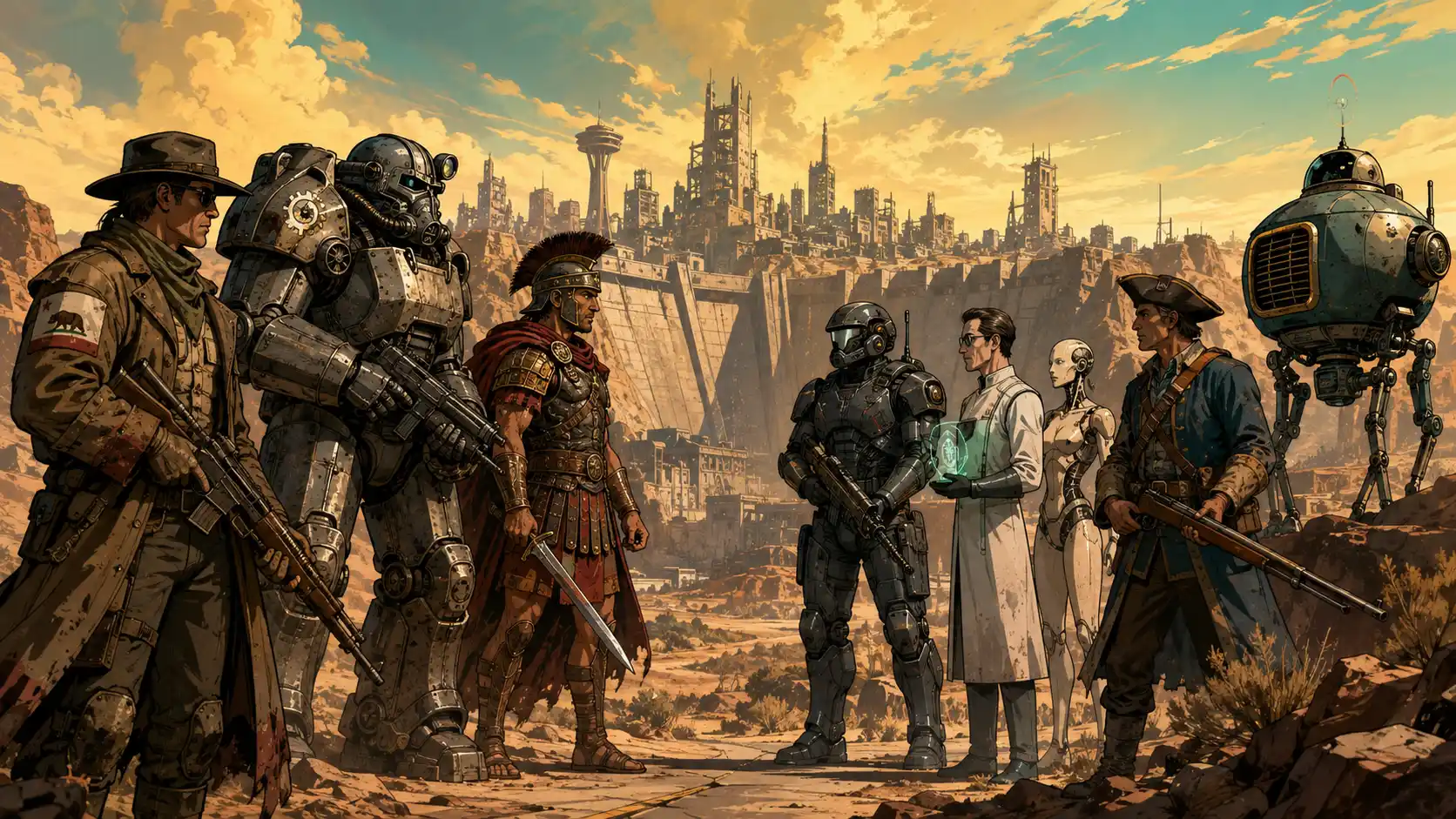
Destroying civilisation is surprisingly easy in Fallout. Rebuilding it is where everyone starts arguing.
More than two centuries after the Great War, humanity has produced republics, military orders, dictatorships, scientific technocracies, liberation movements, local militias, and one extremely determined businessman who looked at Las Vegas and decided democracy was unnecessary because he already owned the building.
That is what makes Fallout’s factions interesting. They are not simply different armies wearing different uniforms. Most represent competing answers to one question:
What should humanity become after the old world failed?
Unfortunately, several answers involve slavery, genocide, or giant robots. So, here are the major factions fighting over Fallout’s future.
Definitely related: The Most Horrifying Vault Experiments in Fallout
New California Republic: Rebuild the Old World
The New California Republic, or NCR, is probably the closest Fallout gets to rebuilding a conventional nation.
Founded in 2189 from the settlement of Shady Sands, the NCR developed into a federal republic with elected representatives, courts, presidents, taxation, laws, trade routes, infrastructure, and a professional military.
In other words, humanity survived nuclear annihilation and eventually rediscovered bureaucracy.
The NCR officially supports democracy, individual freedom, the rule of law, and opposition to slavery. Under President Tandi, it expanded roads, trade, manufacturing, and political institutions across California.
But success created problems.
As the NCR expanded, wealthy landowners gained political influence, corruption increased, resources became strained, and the Republic grew increasingly willing to impose its version of civilisation on communities that had not necessarily requested the service.
By the time it reached the Mojave, NCR expansion had begun looking suspiciously like imperialism with paperwork.
Its philosophy: Rebuild democratic civilisation.
Its biggest problem: It also rebuilds many of the old civilisation’s problems.
Also related: Vault-Tec Explained: Fallout’s Most Evil Company Was Worse Than You Remember
Brotherhood of Steel: Humanity Cannot Be Trusted With Technology
The Brotherhood of Steel began shortly after the Great War under Captain Roger Maxson.
Before the bombs fell, Maxson discovered that scientists at Mariposa Military Base were conducting human experiments with the Forced Evolutionary Virus. He rebelled against the US government, survived the war, and eventually established a new organisation dedicated to preserving technology and human knowledge.
The Brotherhood’s core belief is simple: Advanced technology helped destroy the world, so humanity should not be allowed to casually find a plasma cannon in a basement and begin experimenting.
Reasonable.
The complication is that the Brotherhood increasingly decided it should determine who deserves access.
Different chapters interpret the mission differently. Roger Maxson originally envisioned cooperation with outsiders. Later West Coast chapters became much more isolationist. Elder Lyons’ East Coast Brotherhood focused heavily on protecting civilians, while Arthur Maxson later blended humanitarian activity with the Brotherhood’s traditional obsession with acquiring technology.
This produces one of Fallout’s recurring contradictions. The Brotherhood wants to protect humanity from dangerous technology. It does this by accumulating enormous quantities of dangerous technology.
Its philosophy: Preserve knowledge and prevent technological catastrophe.
Its biggest problem: “We should control the dangerous weapons” eventually becomes “give us your laser rifle.”
The Enclave: America Never Ended—Unfortunately
The Enclave believes it is the legitimate continuation of the United States government. Technically, it has a point.
Before the Great War, the Enclave already existed as a secret network of presidents, senior military officers, politicians, scientists, and powerful business leaders. Its members prepared protected facilities such as an offshore oil rig so that they could survive a nuclear conflict.
The country died. The people secretly running parts of it did not.
After the war, the Enclave gradually developed an even more extreme ideology. It came to regard wastelanders exposed to generations of radiation as genetically contaminated mutants, while Enclave members represented supposedly “pure” humanity.
Its solution was not coexistence. It was extermination.
President Richardson planned to use a modified strain of FEV to eliminate nearly everyone outside the Enclave. Later, President John Henry Eden wrapped similar ideas in cheerful patriotic broadcasts about restoring America.
Essentially: “Good morning, citizens. Baseball, apple pie, family values, and comprehensive genocide.”
Its philosophy: Restore America under the descendants of its pre-war elite.
Its biggest problem: Almost everyone alive fails its citizenship requirements by being alive.
Caesar’s Legion: Order at Any Cost
Caesar’s Legion takes the opposite approach. Where the NCR attempts to rebuild the old democratic world, Caesar believes that world deserved to die.
The Legion was created by Edward Sallow, an educated former member of the Followers of the Apocalypse who became fascinated by Roman history. After helping the Blackfoot tribe defeat its enemies, he transformed himself into Caesar and began absorbing tribes across Arizona and New Mexico.
Absorbing is perhaps too polite. The Legion destroys tribal identities, enslaves populations, indoctrinates children, brutally subordinates women, and demands absolute loyalty to Caesar.
Yet the Legion does achieve something important: security. Territories under Legion control can be safer from raiders because the Legion simply exterminates or enslaves them.
This creates Fallout’s unpleasant question: How much freedom would people surrender for order? Caesar’s answer is apparently “all of it, please.”
His ultimate ambition was to conquer the NCR and combine its civilian infrastructure with the Legion’s military discipline.
Its philosophy: Peace comes through absolute unity and authority.
Its biggest problem: The entire system depends heavily on one man pretending he personally invented Rome.
Mr. House: Let the CEO Handle Everything
Robert House offers another alternative. Not democracy. Not nationalism. Not military collectivism. Management.
House survived the Great War through life-support technology inside the Lucky 38 and successfully protected much of Las Vegas from nuclear destruction.
When he eventually re-emerged, he used an army of Securitron robots and three local tribes to rebuild the Strip as the Free Economic Zone of New Vegas.
House declared himself its president, CEO, and sole proprietor. There was no election. This is less a government than an extremely aggressive homeowners association.
House believes technological development, economic growth, and rational long-term planning can restore civilisation. He sees democratic politics as inefficient and tribal warfare as primitive.
His solution is enlightened autocracy, assuming you accept House’s definition of “enlightened,” which conveniently includes House controlling everything.
Its philosophy: Progress through technology, capitalism, and competent central management.
Its biggest problem: The entire political system has one shareholder.
The Institute: Science Without the Annoying Ethics Part
Hidden beneath the Commonwealth, the Institute represents perhaps the most technologically advanced society in post-war America.
Its scientists developed teleportation and increasingly sophisticated synthetic humans known as synths.
Generation 3 synths are virtually indistinguishable from humans and appear capable of independent thought.
The Institute responds to this remarkable scientific achievement by using them as servants, infiltrators, replacements, and property. Naturally.
The Institute believes the surface world is chaotic, primitive, and largely beyond saving. Its researchers therefore isolate themselves underground while pursuing technological advancement according to their own priorities.
Their scientific accomplishments are extraordinary.
Their relationship with everyone above ground is somewhat less impressive, involving kidnapping, replacement, secret experimentation, and occasional murder.
Its philosophy: Humanity’s future depends on scientific advancement.
Its biggest problem: It has tremendous intelligence but apparently misplaced the ethics department during construction.
The Railroad: If Synths Can Think, Synths Should Be Free
The Railroad exists largely as a reaction to the Institute. Its members believe self-aware synths are people and deserve freedom.
Operating through secret safe houses, informants, runners, and field agents, the Railroad helps escaped synths evade Institute retrieval teams and establish new lives.
Its organisational structure reflects the danger involved. Members use code names, information is tightly compartmentalised, and most agents know only what they need for their particular mission.
The Railroad’s strength is moral clarity. If a being can think, fear, choose, and desire freedom, treating it as equipment becomes difficult to justify simply because somebody manufactured it.
Its weakness is scale.
Unlike the NCR or Brotherhood, the Railroad has little interest in governing territory or rebuilding entire societies. It exists primarily to solve one specific injustice.
Its philosophy: Conscious beings deserve autonomy regardless of how they were created.
Its biggest problem: Freeing synths does not automatically answer who fixes the roads afterward.
The Minutemen: Maybe Just Help Your Neighbours
And then there are the Minutemen. Compared with the Brotherhood, Institute, and Enclave, their philosophy is almost suspiciously straightforward.
Settlements should help one another.
The Minutemen emerged as a volunteer militia defending Commonwealth communities from raiders, mutants, and other threats. They became famous after helping defend Diamond City and later attempted to create a provisional Commonwealth government.
That effort failed, and the organisation gradually collapsed through military defeats, leadership disputes, and internal fragmentation.
By 2287, its reputation had nearly disappeared. Yet the basic idea remained remarkably durable. No grand ideology. No genetically pure master race. No secret robot replacement programme. No guy wearing football equipment claiming to be the son of Mars.
Just people responding when another settlement needs help. Apparently Fallout’s most radical political philosophy is mutual assistance.
Its philosophy: Communities survive by protecting one another.
Its biggest problem: Volunteer organisations become considerably less effective when nobody volunteers.
So, Who Should Actually Rule the Wasteland?
That is the question Fallout deliberately refuses to answer cleanly.
The NCR offers democracy but brings corruption and expansionism. The Brotherhood understands the danger of technology but becomes obsessed with controlling it.
The Enclave offers continuity with the old world while demonstrating exactly why the old world needed replacing. Caesar creates order by eliminating freedom.
House offers competence without accountability. The Institute advances science without sufficient concern for the people affected by it. The Railroad defends individual freedom but lacks a broader plan for civilisation.
And the Minutemen offer community-led cooperation while constantly struggling to remain organised.
None provides a perfect solution. That is probably the point.
Fallout takes familiar political ideals—democracy, security, technological progress, individual liberty, strong leadership—and pushes each toward its uncomfortable extreme.
Everyone believes they know how to save humanity. And several are so committed to saving humanity that they become remarkably comfortable killing humans who disagree.
Maybe war never changes because humanity keeps rebuilding the same argument with better armour.
