
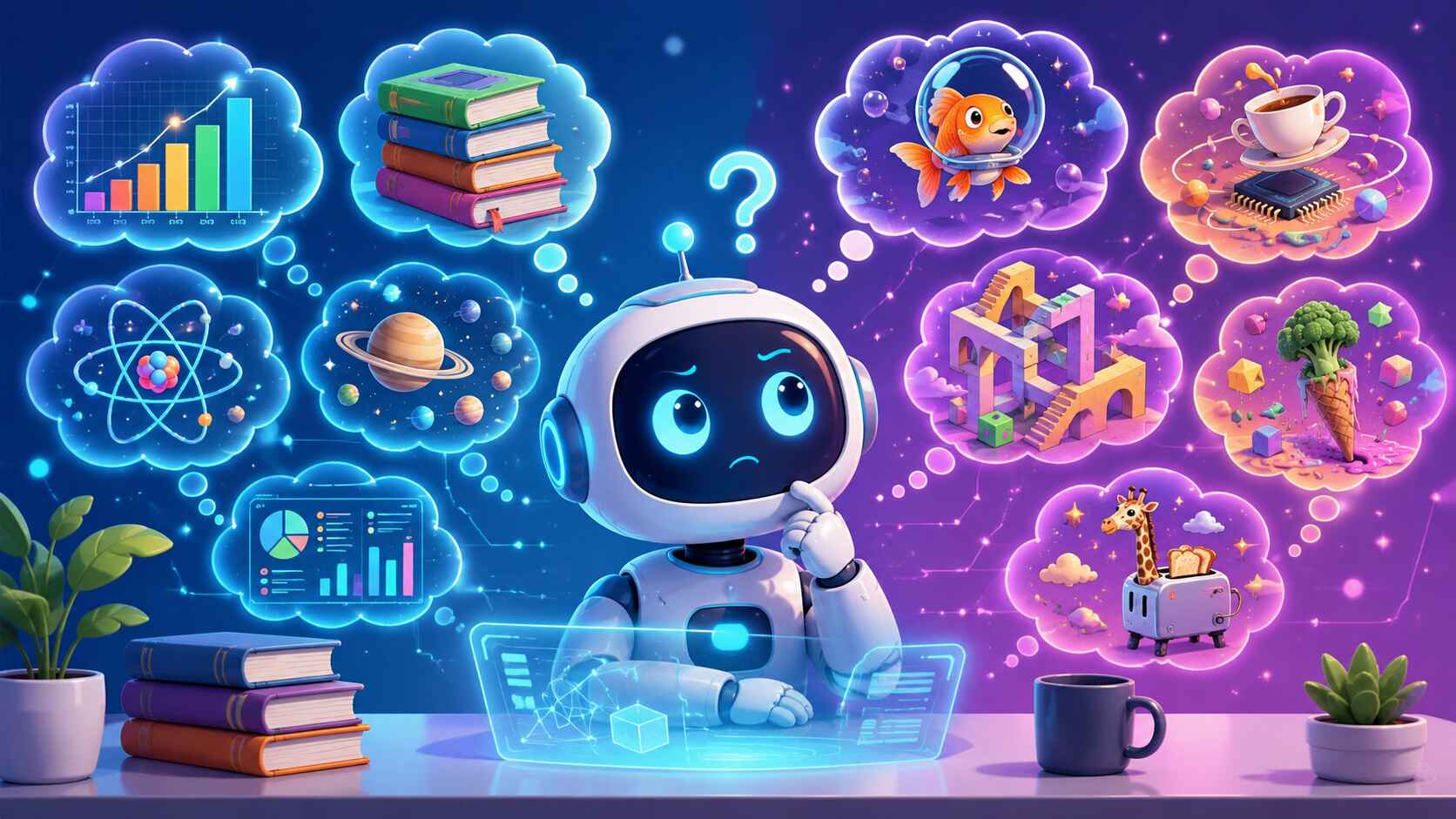
Ask an AI to explain photosynthesis, and it may produce a perfectly respectable answer about sunlight, carbon dioxide, and plants doing complicated things while pretending to be decorative.
Ask it about an obscure academic paper, however, and things can become more adventurous.
The AI may confidently give you the title, author, publication date, journal, page number, and perhaps the researcher’s favorite breakfast. Unfortunately, the paper does not exist. Neither does the journal. The researcher might not exist either.
This is called an AI hallucination: information that sounds plausible but is false, unsupported, or completely invented. Researchers have described hallucinations as “plausible yet nonfactual content.” Google DeepMind puts it even more simply: “text that seems correct but is made up.”
The strange part is not merely that AI makes mistakes. Humans make mistakes constantly. We built an entire civilization around making mistakes and then scheduling meetings to discuss them.
The strange part is how convincing AI can sound while being wrong. So why does it happen?
The basic answer is uncomfortable: AI hallucinates because producing a convincing answer and producing a truthful answer are not necessarily the same task.
AI Is a Language Machine, Not a Truth Machine
Large language models are trained by processing enormous amounts of text and learning to predict what should come next.
Given the sentence:
The capital of France is…
the model predicts that “Paris” is the most likely continuation.
Given:
The mysterious professor published his theory in…
it may predict a year, publication, and institution that fit the pattern—even when it has no reliable information about this supposedly mysterious professor.
The model is not opening a tiny encyclopedia inside its head. It is generating a sequence of words based on patterns learned during training.
This does not mean AI is “just autocomplete” in the same sense as your phone suggesting that every message should end with “thanks.” Large models develop complex internal representations and can summarize, translate, write code, compare ideas, and solve many unfamiliar problems.
But all those abilities emerge from a system fundamentally trained to predict language.
That distinction matters.
Truth is about whether a claim matches reality. Language prediction is about whether a word fits the surrounding words. Those goals frequently overlap, but not always.
A true sentence usually sounds plausible. Unfortunately, a false sentence can sound plausible too.
It Has a Compressed Impression of Knowledge
An AI model does not normally store every fact as a clean database entry.
There is no internal spreadsheet containing:
| Claim | Status |
|---|---|
| Earth orbits the Sun | Confirmed |
| Napoleon invented Wi-Fi | Probably not |
| Citation I just generated | Uh-oh |
Instead, knowledge is distributed across a vast network of numerical parameters. Names, dates, concepts, writing styles, and relationships become encoded as patterns.
Frequently repeated facts may be represented strongly. Rare or conflicting information may be represented weakly. Similar people, places, and events can become tangled together.
That is why an AI may correctly remember that a person was a physicist but attach the wrong university, award, or publication to them. It has not necessarily retrieved one complete false record. It may have assembled the answer from several related patterns.
Think of it less like a library and more like someone who read half the internet, slept badly, and is now trying to remember where every sentence came from.
AI Is Often Rewarded for Guessing
One of the most interesting explanations comes from OpenAI researchers, who argue that conventional training and evaluation systems can encourage models to guess rather than admit uncertainty.
As they put it:
“Training and evaluation procedures reward guessing over acknowledging uncertainty.”
Imagine an exam where a correct answer earns one point, a wrong answer earns zero, and “I don’t know” also earns zero.
Under those rules, guessing is rational. Silence offers no chance of success, while a confident attempt might accidentally be correct.
Language models face a similar incentive in many evaluations. They are often judged by whether they produce the expected answer—not necessarily whether they correctly recognize the limits of their knowledge. Humans also tend to prefer systems that answer quickly and confidently. A chatbot that responds to everything feels more capable than one that repeatedly says, “I’m not sure.”
So we reward helpfulness. We reward completeness. We reward confidence. Just look at our governments, representatives, and political figures. Many of us prefer people who can answer confidently, even when what they say is not necessarily true, scientific, or even sensible.
Then we act surprised when the machine behaves like a student desperately trying to fill every blank before the teacher collects the paper. We did not explicitly tell AI to fabricate facts. But we often taught it that producing something is better than producing nothing.
Fluent Writing Hides Uncertainty
When humans are unsure, they often reveal it.
They hesitate. They qualify their statements. They say things like:
- “I think…”
- “As far as I remember…”
- “Don’t quote me on this…”
- “My cousin posted it on Facebook, so naturally I have conducted no further research.”
AI does not always provide these social signals reliably.
A well-supported answer and a completely invented answer can arrive in the same polished tone. Both may include headings, bullet points, confident transitions, and a tasteful conclusion explaining the broader implications for society.
This creates a dangerous mismatch between linguistic confidence and factual confidence.
The answer sounds certain because the language is smooth. But smoothness only tells us that the model is good at constructing sentences. It does not prove that those sentences are true.
We are particularly vulnerable to this because humans already associate articulate speech with intelligence and authority. Add precise dates, technical vocabulary, and a few impressive-looking citations, and our internal skepticism may quietly leave the room.
AI did not invent our habit of confusing confidence with competence. It merely automated it at extraordinary speed.
The Machine Is Designed to Continue
Traditional software can stop.
A search engine may return no results. A database can report that a record does not exist. Your printer can refuse to work because Mercury is apparently in retrograde.
A generative model, however, is built to generate.
When information is missing, it does not naturally encounter an empty box labelled FACT NOT FOUND. It still has a job: predict the next token, then the next, and then another.
If the answer is well represented in its training or supplied sources, this process may produce something accurate. If the evidence is incomplete, the model may bridge the gaps using patterns that merely look appropriate.
This is extremely useful for creative work. Writers ask AI to imagine scenes, invent characters, and explore possibilities precisely because it can construct things that did not previously exist.
The same ability becomes a problem when the task requires an exact quotation, court case, scientific paper, medical fact, or historical date.
The machine is still improvising. Only now, the audience thinks it is doing accounting.
One Mistake Can Build an Entire Fictional Universe
AI generates responses sequentially. Every new word becomes part of the context used to generate what follows.
Suppose it invents an incorrect publication date near the beginning of an answer. Later, it may use that date to infer which technologies existed, which political events influenced the author, and who might have responded to the publication.
The first error becomes a foundation for several additional errors. Soon, the answer may be internally consistent. Every paragraph supports the others. The chronology fits. The explanation flows beautifully.
The only minor inconvenience is that none of it happened.
Longer answers can therefore become more persuasive without becoming more accurate. Given enough room, the model can build an elegant mansion on top of a sinkhole.
Sometimes the Question Encourages the Hallucination
Users can also unintentionally pressure AI into inventing things.
Consider this prompt:
Give me five scientific studies proving that playing video games increases intelligence.
The request assumes that five suitable studies exist and that they all support the same conclusion. A model optimized to follow instructions may try to satisfy the format rather than challenge the premise.
The danger increases when we demand:
- an exact number of examples,
- quotations without providing sources,
- obscure facts,
- recent information,
- certainty about a disputed issue,
- evidence supporting only one predetermined conclusion.
A better prompt would ask whether reliable studies exist, what they actually found, and where the evidence remains uncertain.
In other words, do not interrogate AI like a manager who has already decided what the quarterly report should say.
Can Hallucinations Be Eliminated?
They can be reduced.
Connecting AI to search engines, databases, calculators, or supplied documents helps ground its answers in external evidence. Training models to express uncertainty can also make them less likely to guess.
Researchers continue developing benchmarks and methods for detecting unsupported claims. Google DeepMind, for example, has created evaluations specifically designed to test whether models remain faithful to provided source material.
But grounding is not magic.
A model can retrieve the wrong source, misunderstand a passage, combine incompatible claims, or cite a document that does not actually support its conclusion. Research surveys note that retrieval-augmented systems still face limitations when trying to prevent hallucinations.
Giving AI access to a library helps. It does not guarantee that the AI reads the correct book.
Hallucination Is Not the Same as Lying
Calling AI a liar is tempting, especially after it invents three researchers, two journals, and a conference held in a city that sank beneath the ocean in 1842.
But lying usually involves knowing the truth and deliberately stating something else.
Ordinary AI hallucination is different. The model is not necessarily hiding a fact it knows to be correct. It is generating a response that statistically fits the request, without reliably determining whether every claim corresponds to reality.
A better word might be confabulation: filling gaps with a coherent but unsupported explanation.
Still, “AI hallucination” has won the terminology battle, partly because it is memorable and partly because “probabilistic machine confabulation” sounds like an experimental jazz album.
The Real Problem May Be Us
AI hallucination is a technical problem, but our reaction to it reveals a human one. We often judge information by how it is presented. Confidence feels like knowledge. Detail feels like evidence. Good writing feels like intelligence.
AI can manufacture all three.
That does not make language models useless. They remain extraordinarily powerful tools for explanation, brainstorming, drafting, coding, research assistance, and analysis.
But they work best when we understand what they are doing.
An AI answer is not automatically a retrieved fact. It is a generated response that may contain facts. The more accuracy matters, the more important it becomes to verify its sources, inspect its reasoning, and allow it to admit uncertainty.
AI hallucinates not simply because it is broken. It hallucinates because it was trained to speak, encouraged to help, and rewarded for having an answer.
Sometimes, the most intelligent thing it could say is:
“I don’t know.”
We are still teaching it that this counts as an answer too.
