
For most of the AI era, the loudest questions have been about intelligence.
How smart will AI become? Will it surpass humans?
Will it replace programmers, doctors, writers, lawyers, accountants, and that one coworker whose primary contribution appears to be scheduling meetings about other meetings?
But Mark Zuckerberg’s August 2026 manifesto, The Future Is for Everyone, makes a different argument. The defining question of the AI age, he argues, is not simply how intelligent artificial intelligence becomes.
It is who gets to control that intelligence.
Zuckerberg proposes three principles for the age of superintelligence: individual empowerment, invention rather than automation, and a balance of power that favors ordinary people rather than governments, corporations, or a small number of AI laboratories.
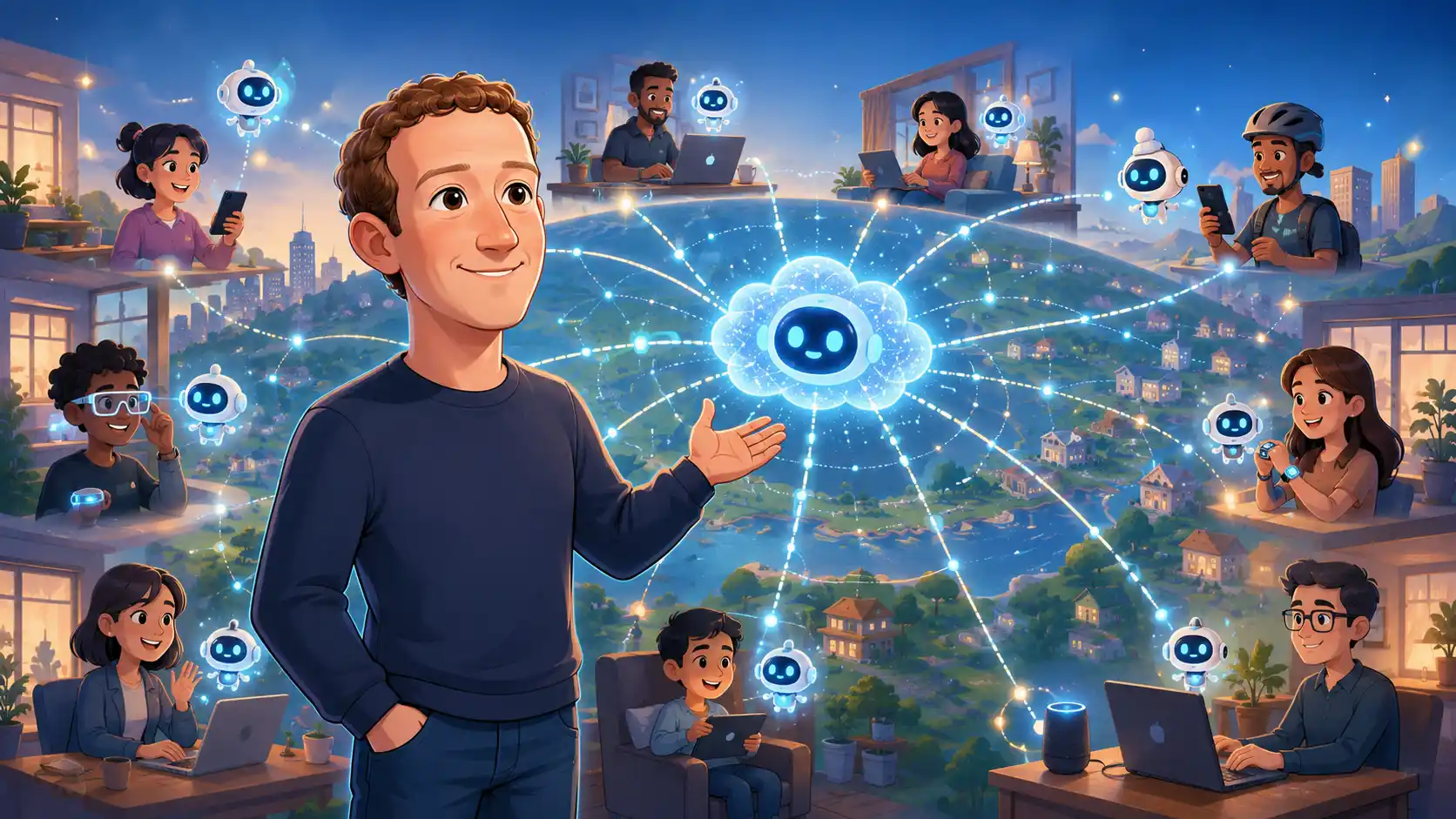
His proposed future is not one enormous benevolent AI carefully deciding what is best for humanity. It is billions of personal AIs working for billions of different people.
Whether Meta is the company we should entrust with delivering this decentralized utopia is a separate question with enough historical baggage to require its own checked luggage.
But beneath the corporate positioning is an interesting idea:
Perhaps the biggest AI safety problem is not intelligence at all. Perhaps it is concentrated power.
The Problem With Building a Perfect AI
A common version of the AI alignment problem sounds deceptively simple. We build increasingly powerful AI systems, so we need to ensure those systems behave according to human values.
Unfortunately, humanity has spent several thousand years attempting to determine what “human values” actually are and has mostly produced philosophy departments, constitutional crises, religious wars, and Twitter.
There is no universally agreed definition of the good life.
People disagree about politics, morality, religion, freedom, equality, privacy, responsibility, fairness, sexuality, education, punishment, property, and whether pineapple belongs on pizza.
Zuckerberg therefore rejects the idea that a single superintelligence could somehow be perfectly aligned with humanity.
His argument is that humanity is not a monoculture. A single system would inevitably have to prioritize some values over others. Instead of trying to create one universally benevolent AI, he proposes something closer to the political idea of checks and balances: many powerful AI systems serving different people and institutions, preventing any single actor from becoming overwhelmingly dominant.
This is an unusual way to frame AI alignment because it turns what looks like a computer science problem into something resembling political philosophy.
The question changes from: How do we build a perfectly good ruler?
to: How do we make sure nobody becomes an all-powerful ruler in the first place?
Human civilization has encountered this problem before. We generally do not protect democracy by finding an exceptionally trustworthy dictator. We build institutions in which different branches of government, political parties, courts, businesses, journalists, civil society, voters, and other institutions constrain each other.
The Superintelligent Lawyer Problem
One of the clearest examples in the manifesto is a thought experiment involving lawyers. Imagine only one person has access to a superintelligent lawyer. That person could gain an enormous advantage in court regardless of whether their case actually deserves it.
Now imagine everyone has access to one.
According to Zuckerberg, the imbalance largely disappears. The technology could instead make the legal system more efficient and accessible. He applies the same logic to cybersecurity and business: concentrated AI capability creates domination; broadly distributed AI capability creates competition.
There is something appealing about this. Technology has repeatedly allowed capabilities once reserved for institutions to move into individuals’ hands.
Computers were once room-sized machines operated by governments and universities. Publishing once required printing presses and distribution networks.
Today someone with a laptop can publish software, books, music, movies, games, and regrettable opinions about Star Wars from their bedroom.
Generative AI could push that trend much further. A person might eventually have access to something resembling a researcher, programmer, designer, tutor, analyst, lawyer, translator, and business consultant simultaneously.
Zuckerberg describes this as personal superintelligence: an agent that understands your goals and works continuously on your behalf. And there is already evidence that AI can expand individual capability rather than merely replace it.
A study by Erik Brynjolfsson, Danielle Li, and Lindsey Raymond examining more than 5,000 customer-support agents found that access to a generative AI assistant increased productivity by about 15% on average. More importantly, the largest improvements occurred among less experienced and lower-skilled workers, while highly experienced workers gained relatively little.
That looks surprisingly similar to Zuckerberg’s empowerment thesis. AI does not necessarily replace the worker. Sometimes it gives the worker abilities that previously required much more experience.
Automation Is Not the Only Possible AI Future
This leads to another important distinction in Zuckerberg’s manifesto. He argues that the greatest contribution of superintelligence should be invention, not automation. Those sound similar, but economically they can lead in very different directions.
Economists Daron Acemoglu and Pascual Restrepo have spent years studying this distinction. Their task-based framework argues that automation can displace workers by transferring tasks from labor to machines, while new technologies can also create entirely new tasks in which human labor becomes productive again.
Their research on American wage inequality is a useful warning against assuming technological progress automatically benefits everyone. They estimate that the relative wage declines of workers concentrated in routine tasks exposed to automation account for a substantial portion of changes in the U.S. wage structure over recent decades.
Imagine a company with 1,000 workers. One version of AI allows the company to produce the same amount with 100 workers. Another version allows each employee to produce entirely new products and services that previously required teams of specialists.
Both increase productivity. Only one necessarily begins with “so unfortunately, we’re restructuring.”
Recent economic research increasingly recognizes this second possibility. A 2026 NBER paper by Ajay Agrawal, John McHale, and Alexander Oettl models AI specifically as a technology that enhances worker productivity without automating their tasks, and finds that outcomes depend heavily on how widely relevant expertise and complementary skills are distributed.
The direction of AI development therefore matters. AI is not a meteor. We are not standing beneath it debating whether impact will occur.
Companies choose what systems to build. Organizations choose how to deploy them. Governments choose which incentives to create. Workers choose how to use them. The economic consequences are partly technological, but they are also institutional.
Equal Access Is Not Equal Power
And this is where Zuckerberg’s argument starts becoming more complicated. Suppose everyone really does receive access to advanced AI. Wonderful.
But everyone already technically has access to many powerful technologies. Almost anyone can create a website. Amazon has one too. These have not produced exactly equivalent economic outcomes.
Access to a tool does not eliminate differences in capital, infrastructure, education, networks, proprietary data, organizational capacity, or bargaining power. The same could happen with AI.
One person might have a personal agent running on a monthly subscription. A major corporation might operate millions of agents using proprietary datasets across enormous computing infrastructure.
Even Zuckerberg’s manifesto acknowledges that compute remains finite and therefore must be allocated somehow. Meta proposes free or affordable basic access alongside mechanisms that allow people to purchase additional compute.
This creates a potential new hierarchy. Intelligence may become abundant. Compute may not.
And if increasingly capable intelligence depends on increasingly large quantities of computation, electricity, chips, data centers, and capital, then economic power could simply migrate upward through the technology stack.
Research on AI’s economic effects already suggests that distribution is not straightforward. Models of automation find that technological improvement can sometimes reduce inequality and sometimes increase it depending on worker skills, task structure, and how technology is deployed.
AI may democratize capability without democratizing resources. Those are not the same thing.
The Bigger Question Is Who Captures the Productivity
There is another inconvenient issue.
Suppose AI makes you twice as productive. Congratulations.
Who receives the extra value? Perhaps everyone receives some portion.
Perhaps your employer simply notices that you now complete eight hours of work in four hours and responds with the traditional reward for efficiency: more work.
A 2025 NBER study examining AI exposure and working hours found something rather less utopian than the automated leisure society people have imagined since roughly the invention of the washing machine. Greater AI exposure was associated with longer working hours and less leisure in contexts where AI complemented human labor, with productivity gains often captured elsewhere when workers had limited bargaining power.
Again, technology determines what becomes possible. Institutions determine who benefits. That distinction may eventually matter more than benchmark scores.
Intelligence May Not Be the Thing We Should Fear Most
Perhaps superintelligent AI eventually presents risks completely unlike anything in previous human history.
Zuckerberg himself acknowledges that possibility, including the problem of recursively self-improving systems accumulating enough effective intelligence to overpower everyone else.
But long before we discover whether AI develops ambitions of its own, humans will use it to pursue ambitions we already have.
Companies want competitive advantage. Governments want influence and security. Workers want better lives. Entrepreneurs want opportunities. Criminals want vulnerabilities. Researchers want discoveries. And everyone would prefer their particular collection of values to remain surprisingly well represented in whatever future eventually arrives.
Human history offers plenty of evidence that powerful technologies change civilization. It offers considerably less evidence that humans distribute newly acquired power peacefully, equally, and without somebody eventually inventing a subscription tier.
The AI revolution may ultimately be about intelligence. But the fight over its consequences will almost certainly be about power.
References
Acemoglu, D., & Restrepo, P. (2018). Artificial Intelligence, Automation and Work. NBER Working Paper No. 24196.
Acemoglu, D., & Restrepo, P. (2020). The Wrong Kind of AI? Artificial Intelligence and the Future of Labour Demand. Cambridge Journal of Regions, Economy and Society, 13(1), 25–35.
Acemoglu, D., & Restrepo, P. (2022). Tasks, Automation, and the Rise in U.S. Wage Inequality. Econometrica, 90(5), 1973–2016.
Agrawal, A. K., McHale, J., & Oettl, A. (2026). Enhancing Worker Productivity Without Automating Tasks: A Different Approach to AI and the Task-Based Model. NBER Working Paper No. 34781.
Benzell, S. G., & Myers, K. R. (2026). Automation Experiments and Inequality. NBER Working Paper No. 34668.
Brynjolfsson, E., Li, D., & Raymond, L. R. (2025). Generative AI at Work. Quarterly Journal of Economics, 140(2), 889–942.
Jiang, W., Park, J., Xiao, R., & Zhang, S. (2025). AI and the Extended Workday: Productivity, Contracting Efficiency, and Distribution of Rents. NBER Working Paper No. 33536.
Zuckerberg, M. (2026). The Future Is for Everyone: The Path to a Positive AI Future.
