
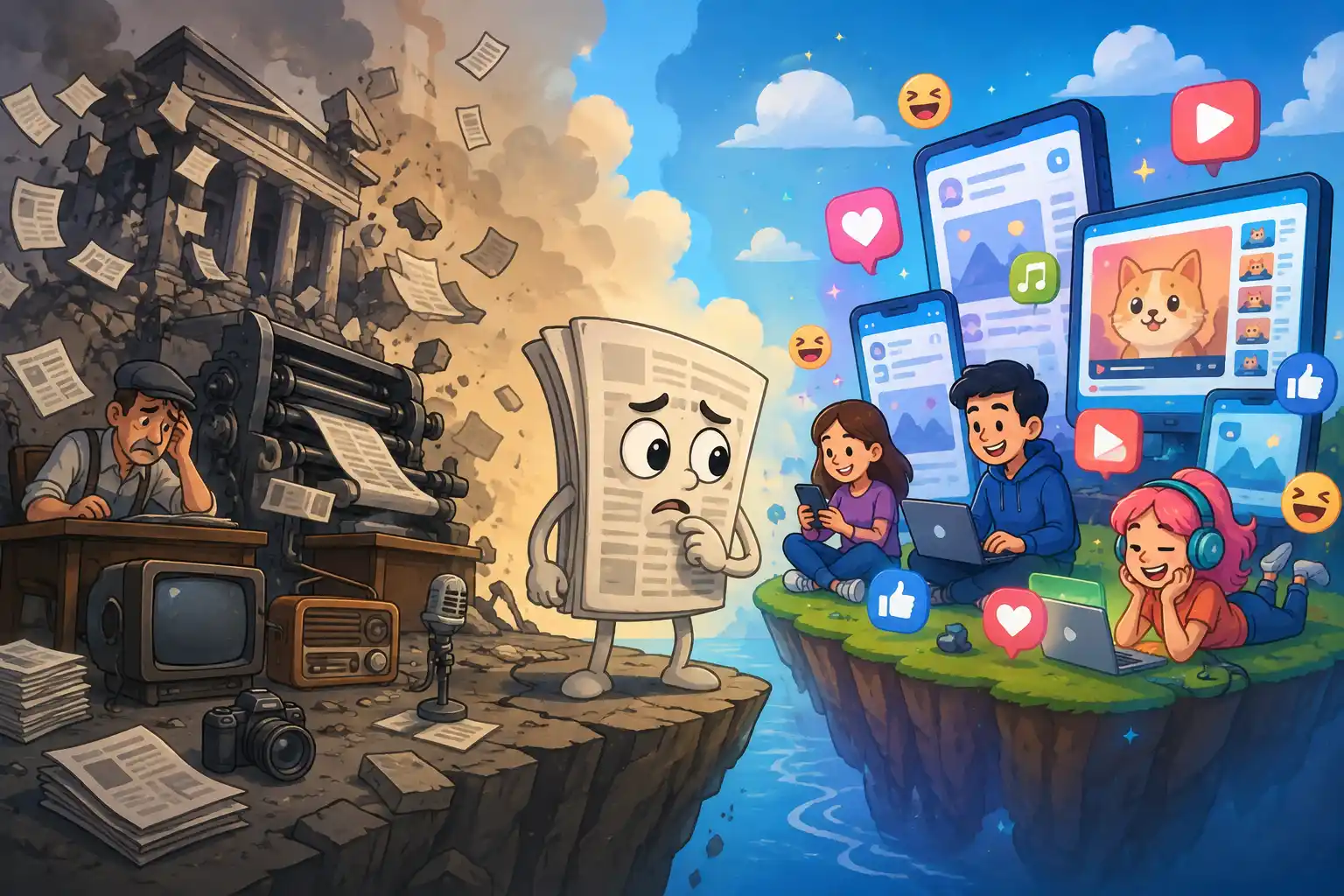
There has never been a better time to be a person who wants information.
Within seconds, you can learn what happened in Washington, check the latest semiconductor shortage in Taiwan, discover why your GPU suddenly costs as much as a used motorcycle, watch someone explain quantum mechanics with animated cats, and then spend 45 minutes reading strangers argue about whether an air fryer is technically an oven.
Information is everywhere. And somehow, the companies whose entire business is producing information are struggling to make money.
Newspapers are shrinking. Magazines have disappeared. Digital publications regularly announce layoffs. Local journalism has been devastated. Even relatively successful online publications seem to alternate between “record audience growth” and “we regret to announce a restructuring.”
Something clearly went wrong. The usual explanation is that people stopped reading. That’s convenient. It’s also not particularly convincing.
People haven’t stopped consuming information. If anything, we’re consuming absurd amounts of it. We read Reddit threads while watching YouTube videos while receiving WhatsApp messages about another TikTok someone thinks we absolutely need to see.
The problem isn’t that people stopped wanting information. The problem is that information became abundant while human attention remained scarce. And underneath that transformation sits an even bigger economic problem. The internet didn’t simply disrupt journalism. It dismantled the business model that used to pay for it.
Definitely related: AI Didn’t Kill Journalism—Humans Did
Newspapers Were Never Just Selling News
Imagine running a newspaper in the 1980s. From the outside, your product appears straightforward.
Journalists investigate stories. Editors assemble them. Giant industrial machines turn dead trees into rectangles containing information. Someone throws those rectangles at people’s houses every morning. But the newspaper wasn’t merely selling journalism. It was selling access to an audience.
- Want to sell your Toyota? Put a classified ad in the newspaper.
- Looking for an accountant? Check the jobs section.
- Buying a house? Real estate listings.
- Opening a restaurant? Buy an advertisement.
- Someone died? Obituaries.
The bundle was incredibly powerful because newspapers occupied a privileged position in the information economy. If thousands or millions of people in a particular city regularly opened the same publication, businesses had a strong incentive to pay for access to those eyeballs.
Journalism helped attract the audience. But journalism wasn’t necessarily the only thing paying the bills. Then the internet arrived and proceeded to separate almost every one of them.
Classifieds moved to Craigslist and dedicated marketplaces. Jobs moved to LinkedIn, Indeed, and countless recruitment platforms. Coupons became apps. Dating ads became dating platforms. And advertising itself increasingly moved somewhere even more dangerous. Google and social media.
The newspaper still had journalists. It still had editors. It still had printing presses, offices, photographers, correspondents, lawyers, and expensive reporting operations.
What disappeared were many of the highly profitable businesses surrounding journalism that had helped subsidize those costs. The internet didn’t just create a better newspaper. It unbundled the newspaper. And journalism was left holding the expensive part.
Then Google and Facebook Took the Advertising
For a while, digital advertising looked like the obvious replacement. Fine. Readers were moving online, so publishers would move online too.
More readers meant more pageviews. More pageviews meant more advertisements. More advertisements meant more money. Problem solved. Except the internet produced something advertisers liked much more than journalism: data.
A newspaper could tell an advertiser:
“We have 500,000 readers.”
A digital advertising platform could effectively say:
“We can show your advertisement specifically to 31-year-old men interested in gaming PCs who recently searched for mechanical keyboards and appear suspiciously willing to spend $200 on something that makes the letter W slightly more responsive.”
That’s a difficult sales pitch to compete with. Google knew what people were searching for. Facebook knew what people liked, followed, clicked, and shared. Amazon knew what people were actually buying.
Suddenly advertisers didn’t necessarily need to buy access to a publication’s audience. They could buy access to specific people across the internet.
Media companies were no longer the gatekeepers between advertisers and consumers. And once that gatekeeping power disappeared, a huge portion of their economic advantage disappeared with it.
Media Isn’t Competing With Media Anymore
There was another problem. Competition exploded.
A newspaper once primarily competed against other newspapers. A television network competed against other television networks. A magazine competed against other magazines.
Today? The New York Times isn’t merely competing against The Washington Post. It’s competing against YouTube. And Netflix. And TikTok. And Instagram. And Reddit. And podcasts. And Spotify. And video games. And that WhatsApp group where someone has apparently decided everyone needs to see 17 pictures from their vacation.
This matters because the real commodity being fought over isn’t information. It’s attention. There are still 24 hours in a day.
Technology has dramatically increased the amount of content available during those 24 hours, but unfortunately nobody has released Human 2.0 with 38-hour days and four additional eyeballs.
Every article competes against essentially every other form of entertainment. And many of those competitors have advantages journalism doesn’t. A TikTok video takes 20 seconds. A meme takes three. A YouTube creator can explain a story while you’re eating dinner.
A game provides interaction. Netflix provides entertainment. Meanwhile journalism sometimes asks you to read 2,500 words about monetary policy.
The Internet Made Publishing Almost Free
There’s another cruel irony. The internet dramatically reduced the cost of publishing. That’s fantastic for society. It’s complicated for publishers.
Before the internet, becoming a major publisher required serious infrastructure. Printing presses. Distribution networks. Broadcast licenses. Physical stores. Production equipment.
Capital.
Today you need a domain name, WordPress, and enough optimism to believe Google will eventually notice you exist. The barriers collapsed. Suddenly traditional media wasn’t just competing with traditional media.
It was competing with bloggers. Then YouTubers. Then podcasters. Then newsletters. Then independent journalists. Then influencers. Then Reddit communities. Then TikTok creators. Then companies producing their own content. And now AI can generate more words before breakfast than a newsroom could publish in a week.
Most of this isn’t journalism in the traditional sense. But economically, that distinction doesn’t always matter. If someone spends 20 minutes watching a YouTuber explain Nvidia’s latest GPU, that’s 20 minutes they aren’t spending reading a technology publication.
Attention doesn’t care about professional classifications.
And Then Media Became Dependent on Platforms
Publishers eventually found another solution. If audiences weren’t going directly to news websites anymore, media companies would simply meet readers wherever they were.
Google. Facebook. Twitter. Instagram. News aggregators. Perfectly reasonable.
Until publishers discovered the slight problem with building your house on someone else’s land. You don’t control the land.
For years, media companies optimized aggressively for Facebook because Facebook could send enormous amounts of traffic. Entire publications built strategies around social distribution. Then Facebook changed its priorities. Traffic collapsed.
Publishers optimized heavily for Google. SEO departments expanded. Headlines became search-friendly. Articles became structured around keywords. If you’ve ever wondered why approximately 84% of the internet appears to have been written by the same extremely enthusiastic SEO manager, that’s part of the reason.
Google became enormously important to publishers. Which means Google also became enormously powerful over them. And now search itself is changing. Search engines increasingly answer questions directly through snippets, knowledge panels, summaries, and AI-generated answers.
From the user’s perspective, that’s convenient. From the publisher’s perspective, the relationship gets awkward.
You produce the information. A platform indexes the information. The platform summarizes the information. The reader gets the answer. But nobody remembers that the website producing the original information also needs money.
The SEO Machine Created Another Problem
Platform dependency also influenced what journalism produced. If traffic determines revenue, and Google determines traffic, publications naturally start producing what Google rewards.
This doesn’t require some sinister conspiracy. It’s incentives.
Suppose an investigative story takes three journalists six weeks to produce. It requires interviews, travel, documents, editing, legal review, and possibly several uncomfortable phone calls.
Now suppose: “How to Fix Windows Update Error 0x800SomethingSomething” takes one writer two hours and generates reliable search traffic for five years.
Which one does the spreadsheet prefer? Journalism is expensive. Search content can be cheap. Eventually many publications discovered that the economics of the internet rewarded quantity, searchability, and speed.
Hence the modern content factory.
- Publish.
- Publish again.
- Update.
- Optimize.
- Refresh.
- Add affiliate links.
- Change the headline.
- Publish another article explaining something you’ve already explained because apparently Google prefers this URL now.
The industry adapted to the internet. The uncomfortable question is whether some parts adapted themselves into something readers no longer particularly valued.
Subscriptions Were Supposed to Save Everything
Eventually publishers realized advertising alone wasn’t enough. So the pendulum swung back toward readers. Subscriptions! And subscriptions absolutely can work.
The New York Times is probably the most famous example of successfully building a huge digital subscription business. Other publications have built strong paid audiences too. But there’s a problem with treating subscriptions as the universal solution.
People have limited money. More importantly, they have limited willingness to manage subscriptions.
Strong publications can convince readers that their journalism is worth paying for. But the internet trained people for decades to expect information for free. Reversing that expectation isn’t easy.
And the publications most desperately needing subscription revenue are often those with the smallest potential subscriber bases. A global financial publication can sell specialized information to professionals worldwide.
A newspaper investigating corruption in a town of 80,000 people has a slightly smaller total addressable market. Unfortunately, democracy didn’t design itself around SaaS economics.
The Internet Also Destroyed Scarcity
This may be the biggest change of all. Media used to operate in an environment of information scarcity. There were limited newspaper pages. Limited television channels. Limited radio frequencies. Limited distribution.
That scarcity made attention easier to concentrate. The internet reversed the equation. Content became effectively infinite. Billions of articles. Millions of videos. Podcasts about every conceivable subject.
The supply of content exploded.
But demand couldn’t explode alongside it because demand is ultimately constrained by human time. Economically, that’s brutal. When supply becomes enormous while attention remains finite, each individual piece of content has to fight harder for visibility.
Which produces another predictable outcome.
Welcome to the Headline Arms Race
If attention is scarce, you need to capture it. So headlines become more aggressive. Eventually everyone is shouting. Which means shouting stops working. So everyone shouts louder.
This creates one of the stranger problems facing modern media. The industry desperately needs trust. But the economic system often rewards behaviors that erode trust.
Sensational headlines generate clicks. Outrage generates engagement. Speed generates traffic. Quantity creates more chances to rank.
Nuance? Nuance is lovely. Unfortunately, “The Situation Is Complicated and Several Interpretations Are Reasonable” performs terribly as a thumbnail.
Then AI Walked Into the Room
And now we arrive at everyone’s favorite new scapegoat. Artificial intelligence. AI absolutely creates new problems for publishers.
Generative AI can produce enormous amounts of cheap content. AI search can answer questions without sending users to publishers. Companies can generate basic marketing content internally.
Readers can ask an AI assistant to summarize topics instead of visiting several websites. The potential disruption is real. But blaming AI for the media industry’s problems is like blaming the final mosquito for sinking the Titanic.
There were already some structural issues. Advertising had moved elsewhere. Classifieds had disappeared. Distribution was controlled by platforms. Subscription fatigue was growing. Social traffic had become unreliable. SEO competition was enormous. Attention had fragmented.
Newsrooms had been shrinking for years. AI didn’t create most of these problems. It arrived in an industry that had already spent two decades trying to figure out how to make digital journalism economically sustainable.
AI may accelerate the crisis. It isn’t where the crisis began.
The Strange Economics of Journalism
There is another problem hiding underneath all of this: the most valuable journalism is often the most expensive content to produce.
A breaking news rewrite can be published in an hour. An SEO article might take an afternoon. But original reporting can require weeks or months of research, interviews, travel, data analysis, editing, and legal review.
And after spending all that money?
The finished investigation might still generate fewer pageviews than “10 Things You Didn’t Know About the iPhone.” That’s the uncomfortable economics of modern media.
The internet has made information incredibly cheap to distribute, but creating genuinely new information is still expensive.
Someone has to attend the court hearing. Someone has to interview the source. Someone has to examine hundreds of documents. Someone has to spend three months figuring out whether a company actually did the suspicious thing everyone on Twitter already decided it definitely did.
Once that reporting is published, however, everyone else can discuss it, summarize it, aggregate it, react to it, make a YouTube video about it, or turn it into seventeen LinkedIn posts.
The expensive part happens once. The cheap part can happen infinitely. And unfortunately for media companies, the internet is extremely good at rewarding the cheap part.
So Why Are Media Companies Struggling?
Because there isn’t one reason. That’s precisely the point. The media industry didn’t encounter a single technological disruption.
It experienced several economic transformations stacked on top of each other. The internet unbundled newspapers. Digital platforms captured advertising. Publishing barriers collapsed. Content supply exploded. Audience attention fragmented. Google became a major distributor. Social networks became another.
Publishers optimized themselves around those platforms, instead of real readers. Subscriptions worked brilliantly for some organizations but couldn’t support everyone. And now AI is potentially weakening search traffic while making basic information even cheaper to produce.
All while journalism itself remains expensive. The cost of producing genuinely original information remains relatively high.
Yet on the other side, the cost of copying, summarizing, discussing, aggregating, reacting to, and generating content around that information keeps approaching zero.
That’s not a comfortable equation.
Information Is Abundant. Attention Isn’t.
Maybe that’s the simplest way to understand what’s happening.
For most of modern history, information was scarce. Media companies controlled expensive infrastructure capable of producing and distributing it.
That scarcity created economic power. The internet destroyed the scarcity. And that’s mostly a wonderful thing. More people can publish. More voices can participate.
Experts can communicate directly with audiences. Independent journalists can build businesses. Someone with a laptop can potentially reach millions of people without asking a television network or newspaper editor for permission.
But abundance has consequences.
When everyone can publish, publishing itself becomes less valuable. When information is everywhere, information alone isn’t enough.
Trust matters. Expertise matters. Community matters. Personality matters. Analysis matters. And above everything else: attention matters.
That’s why saying “people don’t read anymore” misses the point. People haven’t stopped consuming information. They consume it constantly.
They consume so much information that we invented the phrase doomscrolling because apparently humanity needed a word for voluntarily consuming information until we feel terrible.
The media industry’s problem isn’t disappearing demand. It’s that the relationship between information, distribution, attention, and money has fundamentally changed.
