
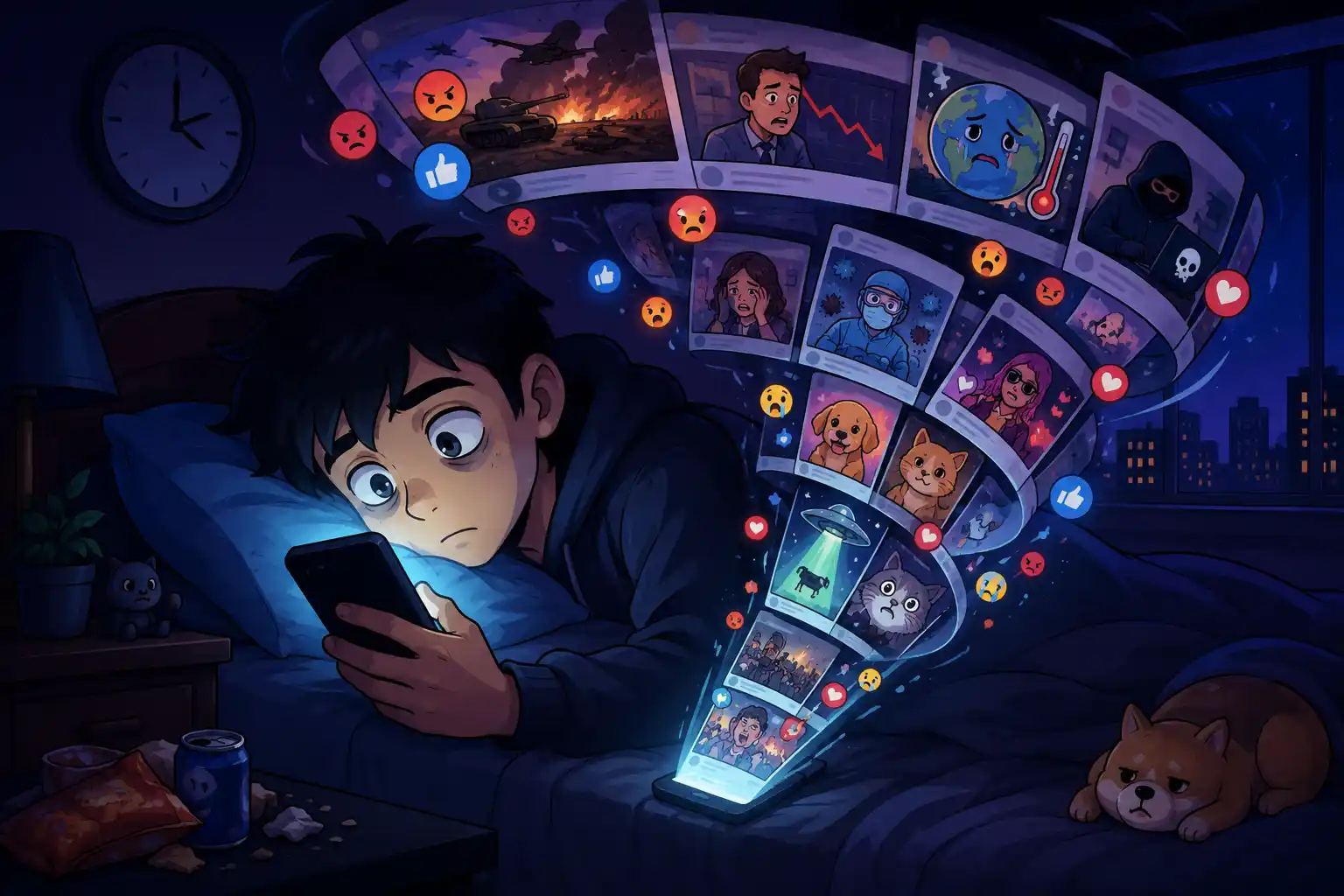
“I’ll just check my phone for a minute.”
Thirty minutes later, you’ve somehow learned about a volcanic eruption, a celebrity breakup, a new AI that might replace your job, a possible asteroid that almost certainly won’t hit Earth, and an octopus escaping an aquarium.
Somehow, you still haven’t replied to the message you originally unlocked your phone for.
Congratulations. You’ve just experienced doomscrolling. Most people think doomscrolling happens because we’re addicted to bad news. That’s only part of the story. The real reason is both older and stranger. Your brain isn’t searching for negativity. It’s searching for uncertainty. And the internet has become the greatest uncertainty machine humanity has ever built.
Check this out: Homo Ludens: Life Is a Game with No Tutorial
Your Brain Was Never Designed for Infinite News
Imagine you’re living 30,000 years ago. You hear rustling behind a bush. You have two options.
Option one: “Probably just the wind.”
Option two: “That could be a tiger.”
Evolution strongly favored people who occasionally overreacted. Missing a beautiful sunset rarely killed anyone. Ignoring a predator often did.
Psychologists call this the negativity bias. In a landmark review, Roy Baumeister and colleagues argued that “bad is stronger than good.” Across many aspects of life, negative events generally attract more attention, have a stronger emotional impact, and are remembered longer than equally positive ones.
In other words, your ancestors survived because their brains treated potential danger as urgent. Thousands of years later, your brain still works remarkably well. Unfortunately, it now thinks Twitter is a forest.
Your Brain Hates Unfinished Stories
Suppose you read this headline: Scientists discover something beneath Antarctica…
That’s it. No explanation. No details. No conclusion. Annoying, isn’t it?
This tendency was first described nearly a century ago by psychologist Bluma Zeigarnik. She found that people remember unfinished tasks better than completed ones, a phenomenon now known as the Zeigarnik Effect.
Our brains crave closure. Modern headlines know this.
- “Doctors are shocked…”
- “Experts warn…”
- “You won’t believe…”
- “The ending changes everything…”
Every incomplete headline creates a tiny question mark in your mind. One click removes it. Another headline creates another one. Repeat until your battery reaches 3%.
Social Media Is Basically Infinite Gacha for Information
Yesterday, we talked about gacha games. You keep pulling because the next reward might be incredible. Social media works almost exactly the same way.
Swipe. Nothing interesting. Swipe. Advertisement.
Swipe. Someone’s lunch. Swipe. A genuinely hilarious meme.
Swipe. Breaking scientific discovery.
Notice something? Every swipe is a mystery box. You never know what’s coming next.
Behavioral psychologists have spent decades studying something called a variable-ratio reinforcement schedule. Instead of rewarding every action, rewards arrive unpredictably.
It’s the same principle behind slot machines. It’s the same principle behind loot boxes. It’s also surprisingly close to how infinite scrolling feels. You don’t keep scrolling because every post is good. You keep scrolling because the next one might be.
Your Brain Doesn’t Remember Every Scroll
Here’s something fascinating. Imagine you scroll through one hundred posts. Ninety-nine are completely forgettable. One makes you laugh so hard you nearly spill your coffee. Guess which one your brain remembers?
Not because it has erased the other ninety-nine. Because it gives the unexpected reward much more weight. Neuroscientists call this a reward prediction error.
When something turns out better than expected, dopamine neurons respond strongly. Research by Wolfram Schultz and colleagues showed that unexpected rewards produce a stronger learning signal than expected ones. More recently, researchers have found that surprising positive outcomes are encoded into memory more effectively than predictable ones.
In other words, your brain isn’t keeping score. It’s keeping highlights. That’s why the next time you’re bored, your memory quietly whispers: “Remember that hilarious video you found yesterday?”
It doesn’t mention the other ninety-nine posts that were about as exciting as reading printer instructions.
Algorithms Know This Better Than We Do
Many people blame algorithms for doomscrolling. That’s understandable. But algorithms didn’t invent our psychology. They simply learned it.
Social media platforms are designed to maximize engagement. If people spend more time reading emotionally charged stories than ordinary updates, the algorithm doesn’t ask whether those stories are good or bad.
It simply notices what keeps us looking. The result is a feedback loop. Your brain prefers uncertainty. The algorithm notices. It serves more uncertainty. Your brain keeps responding.
Nobody sat in a secret meeting deciding to make humanity anxious. The mathematics simply discovered that uncertainty keeps people scrolling.
Why Doomscrolling Rarely Makes Us Feel Better
Here’s the strange part. Most people start doomscrolling because they want information. They finish feeling exhausted. Why?
Because information isn’t the same thing as certainty. Reading fifty headlines rarely resolves uncertainty. It often creates new questions. Every answer leads to another article. Another opinion. Another prediction. Another debate.
The scroll never ends because uncertainty never completely disappears. The internet promises closure. It delivers updates.
Your Brain Isn’t Broken
It’s tempting to think that doomscrolling means we’ve become weak or addicted. The science paints a more compassionate picture. Your brain evolved in a world where paying attention to uncertainty helped you survive.
Today’s digital platforms simply provide uncertainty faster than evolution ever anticipated. Thousands of years ago, uncertainty sounded like rustling leaves behind a bush. Today, it arrives as an endless stream of notifications, headlines, videos, and recommendations. Different delivery system. Same ancient software.
Perhaps that’s why doomscrolling feels so difficult to resist. We’re not just scrolling through information. We’re chasing the comforting illusion that the next swipe will finally answer every question.
Ironically, it’s usually the swipe after that.
Or the one after that. Or maybe…
Just one more.
Scientific References
- Baumeister, R. F., Bratslavsky, E., Finkenauer, C., & Vohs, K. D. (2001). Bad Is Stronger Than Good. Review of General Psychology.
- Zeigarnik, B. (1927). On Finished and Unfinished Tasks.
- Schultz, W., Dayan, P., & Montague, P. R. (1997). A Neural Substrate of Prediction and Reward. Science.
- Rouhani, N., Norman, K. A., & Niv, Y. (2018). Research on reward prediction errors and memory formation.
- Alter, A. (2017). Irresistible: The Rise of Addictive Technology and the Business of Keeping Us Hooked.
- Tversky, A., & Kahneman, D. (1973). Availability: A Heuristic for Judging Frequency and Probability.
- Montag, C., Sindermann, C., et al. (2025). Research on reinforcement learning mechanisms in social media use.
