
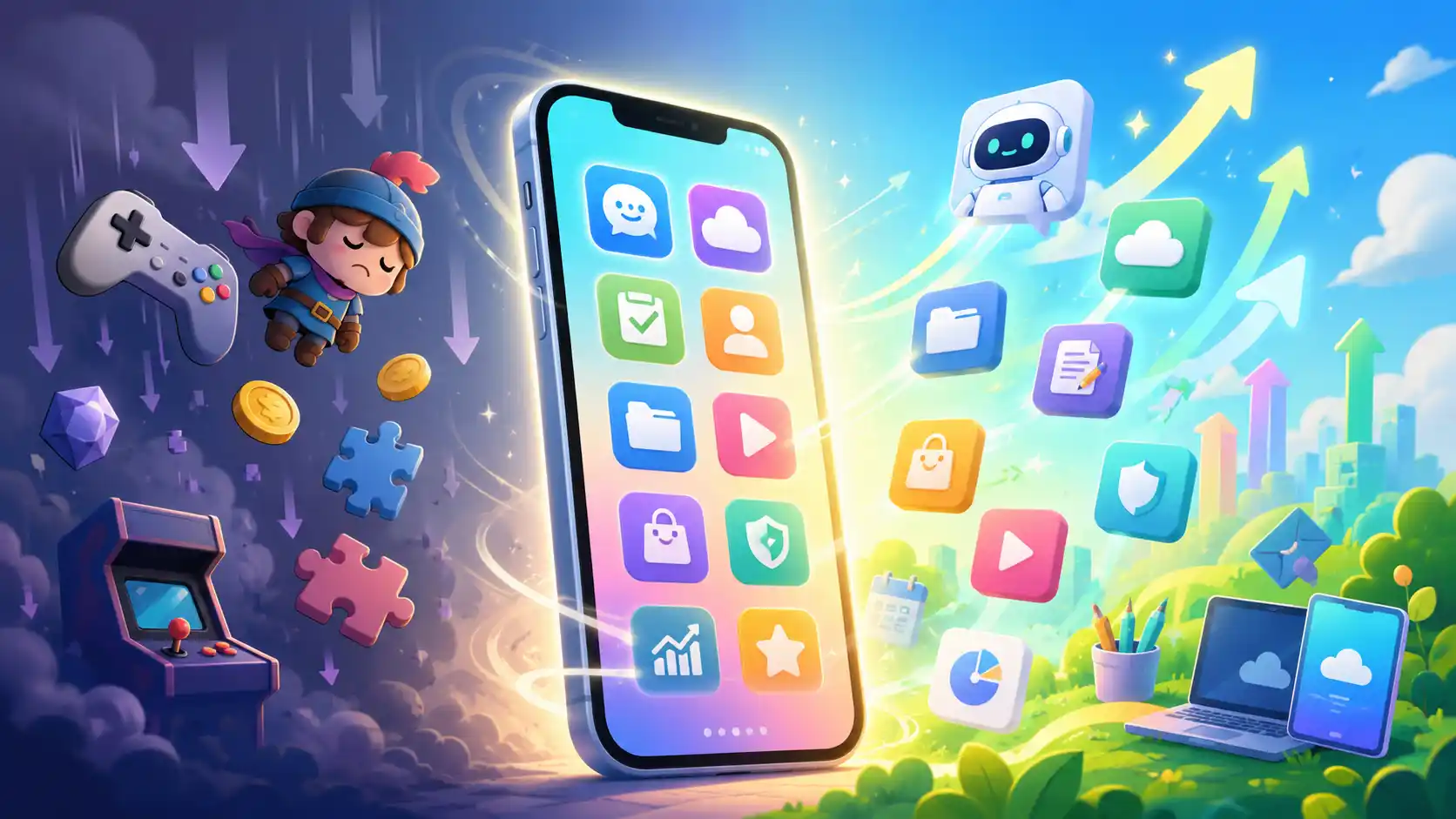
For a long time, the economics of smartphone apps were fairly easy to understand.
There were apps. And then there were games, which were extremely good at convincing people to spend money on things that technically did not exist.
Extra lives. Battle passes. Character skins. Energy. Summoning currencies. Premium currencies used to buy other premium currencies because apparently one imaginary economy was not complicated enough.
Mobile gaming became one of the economic engines of the app-store ecosystem. But something interesting is happening.
According to Sensor Tower’s Q2 2026 Digital Market Index, worldwide in-app purchase revenue across iOS and Google Play reached $43.6 billion, increasing 5.3% compared with the same quarter a year earlier.
The app economy, in other words, is still growing. Mobile gaming isn’t.
Gaming revenue fell 4.5% year-over-year to $19.2 billion, while non-gaming apps generated a record $24.4 billion, up 14.6%. Gaming revenue also slipped below $20 billion after spending nine consecutive quarters above that level.
The divide becomes even more obvious when we look at downloads. Global app downloads were almost completely flat at 36.8 billion in Q2 2026. But non-gaming downloads grew 6% to 25.5 billion while mobile-game downloads dropped 12% year-over-year.
People haven’t suddenly stopped using smartphones. They aren’t abandoning apps. They appear to be changing what they install and what they are willing to pay for. And that may be much more important than one bad quarter for mobile games.
The App Economy Looks Healthy Until You Open the Box
At first glance, $43.6 billion in quarterly consumer spending sounds perfectly healthy. It is even higher than Q2 2025’s $41.4 billion. Sensor Tower’s estimates put global IAP revenue at roughly $43 billion or above for four consecutive quarters.
The problem is that the growth is increasingly coming from somewhere else. Non-gaming apps now generated about $5.2 billion more quarterly IAP revenue than games in Q2 2026.
That distinction matters because mobile gaming is declining on two different measurements simultaneously:
- Game revenue: down 4.5% YoY.
- Game downloads: down 12% YoY.
And the decline isn’t confined to one storefront. On Google Play, game downloads dropped 13% year-over-year. On iOS, they fell 8%. Non-gaming downloads increased on both platforms.
Mobile-game monetization weakened on both stores too. Sensor Tower estimates iOS gaming revenue fell 5.4% to around $12 billion, while Google Play gaming revenue slipped 3% to roughly $7 billion.
Meanwhile, total Google Play IAP revenue grew almost 10%, more than three times the growth rate of Apple’s App Store. The reason wasn’t games. It was primarily non-gaming monetization.
So mobile gaming isn’t dragging down a struggling app economy. It is weakening inside an app economy that continues to make more money. That’s the interesting part.
Everyone Else Learned How to Monetize Like a Game
Mobile games became extremely sophisticated at monetization because they had to. Selling a game once for $5.99 was never going to create the economics behind today’s giant live-service mobile titles.
So developers experimented. Free-to-play. Microtransactions. Monthly passes. Cosmetics. Limited-time offers. Recurring events. Premium progression tracks. Eventually, games stopped merely selling products and started building systems designed to turn continuing engagement into continuing revenue.
The rest of the app industry appears to have learned the same lesson. Except instead of buying a legendary sword with +12% critical damage, you are subscribing to cloud storage.
Sensor Tower specifically points toward increasing demand for subscription-based services, particularly AI and utility apps, as one of the forces driving non-gaming revenue growth.
Utilities provide an especially revealing example. Their downloads actually fell 7% year-over-year. Their IAP revenue increased 33%.
Sensor Tower describes this as a shift away from maximizing downloads and toward retention, subscriptions, and premium features. That’s an important change in how we should think about app-store growth.
A developer doesn’t necessarily need ten million new users. It may be more valuable to convince one million existing users that the useful feature they already depend on is worth $4.99 every month. Congratulations. Your calculator now has recurring revenue.
Definitely related: When Mobile Games Stopped Feeling Like Games: How Fun Became Retention
And Then AI Arrived
If there is one category showing how quickly the economics of the app stores can change, it is generative AI.
ChatGPT maintained roughly 60% of generative-AI app revenue in Q2 2026 while growing revenue 82% year-over-year. But competitors expanded even faster: Claude, Grok, and Gemini each increased revenue by at least seven times compared with Q2 2025.
ChatGPT reportedly generated $1.4 billion in IAP revenue during the quarter, putting it close to TikTok among the world’s highest-grossing non-game apps.
Claude’s quarterly revenue grew fourfold from Q1 and pushed the app all the way into the global top ten by IAP revenue. That is remarkable for a category that barely existed as a mainstream consumer software market a few years ago.
And AI fits beautifully into the new app economy because its business model is naturally recurring. Users aren’t purchasing ChatGPT once. They are paying for access. The same is true for Claude, Gemini, cloud storage, dating apps, streaming services, productivity software, video editing tools, and increasingly many utilities.
The app store is gradually becoming less like a digital shop and more like a shopping mall where every store would very much appreciate your credit card details and permission to charge you again next month.
Mobile Gaming Has Another Problem: The Market Is Mature
There is another number in Sensor Tower’s report that might be even more important than the revenue figures.
Worldwide app downloads have been sitting between roughly 36 billion and 38 billion per quarter for the past three years. Sensor Tower describes this as a mature market where overall acquisition volume has settled into a relatively stable baseline.
That changes the economics considerably.
During the explosive growth phase of smartphones, game publishers benefited from something enormously useful: More smartphone users kept appearing. New consumers bought their first smartphones. App stores expanded internationally. Mobile internet became more accessible.
Every year brought another enormous population of potential players. In a mature market, that free tailwind becomes weaker.
Publishers increasingly have to compete for people who already own smartphones, already have favorite games, already maintain several subscriptions, and already receive approximately seventeen notifications asking them to return to something.
Mobile gaming also faces an awkward problem here. Games demand time.
You might subscribe to several productivity apps simultaneously, but you probably aren’t actively playing twelve live-service games every evening unless your occupation happens to be “person who has somehow escaped the concept of sleep.”
Every successful live-service game doesn’t merely compete for money. It competes for hours. And hours stubbornly remain limited to 24 per day despite decades of venture-capital enthusiasm.
The Sensor Tower report does not prove that attention competition is causing the current decline. But in a mature market where total downloads have plateaued, growth increasingly has to come from taking users, spending, or time from somewhere else rather than simply waiting for millions of new smartphone owners to arrive.
This Doesn’t Mean Mobile Games Are Dying
Before we prepare the funeral procession, there is an important caveat. Mobile gaming remains enormous. $19.2 billion in three months is not exactly the financial profile of an industry preparing to live beneath a bridge.
There are also categories bucking the broader decline.
Puzzle games were the only major gaming category highlighted by Sensor Tower as growing downloads year-over-year, rising 1% despite the 12% contraction across mobile gaming overall. Arrow-style puzzle games were particularly successful.
In fact, Puzzle games occupied all five of Sensor Tower’s biggest breakout positions by quarterly download growth, led by titles including Arrows GO! and Arrows Puzzle Escape.
Major events can create huge spikes too. Sensor Tower found eFootball became a major revenue breakout title in football-heavy markets during the 2026 World Cup period.
So the conclusion isn’t that nobody wants mobile games anymore. It is subtler.
Might be related: PC vs Smartphone: The Business of Obsolescence
Mobile Gaming Is Losing Its Privileged Position
For much of the smartphone era, mobile gaming benefited from two enormous advantages. First, smartphones themselves were growing rapidly. Second, games were much better than most apps at monetizing engaged users.
Both advantages are becoming weaker. The smartphone app market has matured. And non-gaming developers have become dramatically better at turning software into recurring revenue.
AI apps charge subscriptions. Utilities charge subscriptions. Streaming apps charge subscriptions. Productivity software charges subscriptions. Storage charges subscriptions. Dating apps charge subscriptions. At this point, it may be quicker to make a list of software that doesn’t want you to subscribe.
That doesn’t make gaming irrelevant. It means gaming increasingly has to compete as one category among many inside an ecosystem that it once economically dominated.
The most interesting number in Sensor Tower’s Q2 2026 report therefore may not be mobile gaming’s 4.5% revenue decline. It may be the 14.6% growth of everything else.
Because smartphones are still generating more money. The money is simply finding new places to go.
Sensor Tower’s mobile-market figures are estimates covering the iOS App Store and Google Play. Its Android figures exclude third-party Android stores, while IAP revenue includes paid downloads, in-app purchases, and subscriptions but excludes advertising and third-party payment revenue. Revenue figures are gross of app-store fees.
